
Frank ICSE Solutions for Class 9 Biology Chapter 5-Vegetative Propagation
PAGE NO : 49
Solution 1: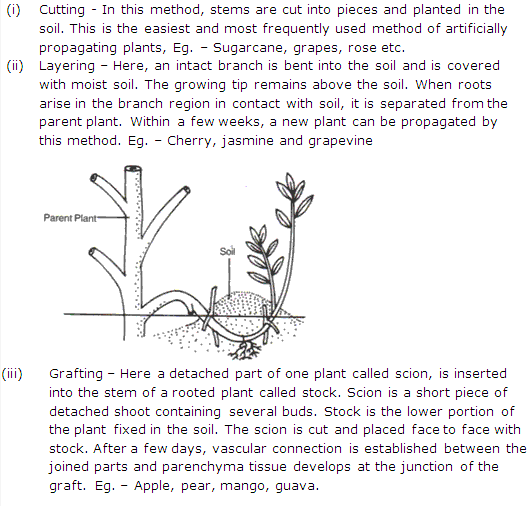
Solution 2:
Advantages of vegetative propagation are:
- Vegetative propagation is the only method to obtain new plants in those plants where seed formation does not occur.
- This method is cheaper, convenient and rapid method of plant multiplication.
- It is the only method of reproduction in plants like grapes, roses, pineapple etc. which do not form viable seeds.
- Plants raised through vegetative propagation from a single plant form a genetically uniform population called a clone.
Solution 3: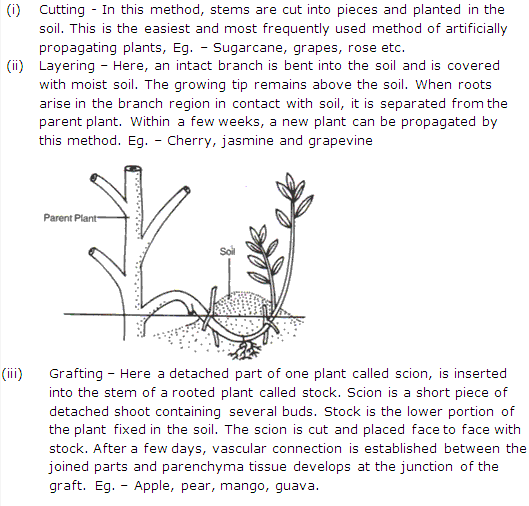
Solution 4:
Orchids, Rose
Solution 5:
Plants propagated through root cuttings are:
- Roses
- Raspberries
- Blackberries
- Crabapple
- Fig
- Lilac
Plants propagated through stem cuttings are:
- Blackberries
- Cannabis
- Grapes
- Pineapple
- Sugarcane
(Write any four of each)
Solution 6:
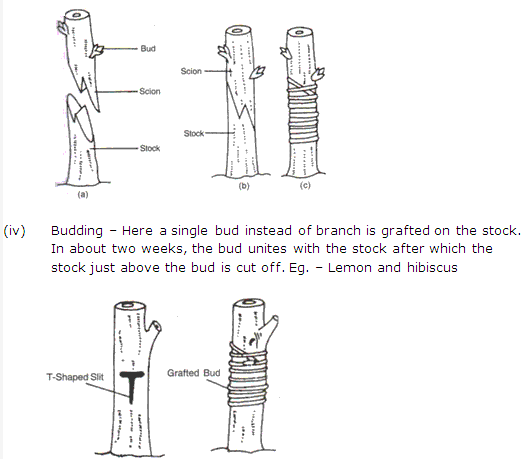
(a) Budding – Here a single bud instead of a branch is grafted on the stock. In about two weeks, the bud unites with the stock after which the stock just above the bud is cut off. Budding is usually done in rainy season. Budding is carried out in plants like lemon and hibiscus.
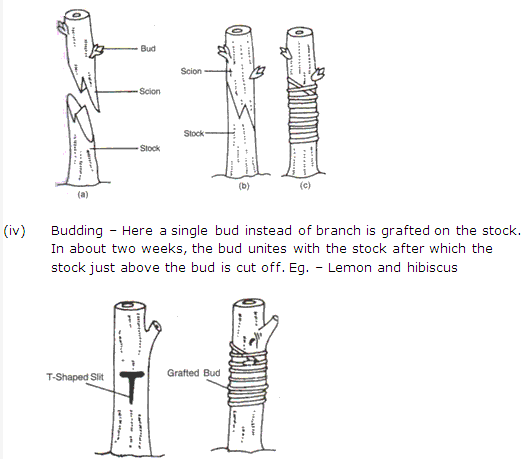
(b) Grafting – Here a detached part of one plant called scion, is inserted into the stem of a rooted plant called stock. Scion is a short piece of detached shoot containing several buds. After a few days, vascular connection is established between the joined parts and parenchyma tissue develops at the junction of the graft. Examples of plants in which grafting is carried out are apple, pear, mango and guava.
(c) Layering – In layering, an intact branch is bent into the soil and is covered with moist soil. The growing tip remains above the soil. When roots arise in the branch region in contact with soil, it is separated from the parent plant. Within a few weeks, a new plant can be propagated by this method. Examples of plants in which layering is carried out are cherry, jasmine and grapevine.
Solution 7:
(a) Tubers
(b) Stem cutting
(c) Bulb
(d) Corm
(e) Stem cutting
Solution 8:
(a) Sugarcane
(b) Agave/ Oxalis
(c) Bryophyllum
(d) Potato
(e) Apple
Solution 9:
Hybridisation is the crossing of two plants differing in one or more genetic characters to obtain a new individual or variety.
Solution 10:
Plant hybridisation is a time consuming process and is carried out between two plants of different species or between two varieties of the same species.
Two parent plants are selected of which one parent has the desired characters. On the female plant, emasculation is carried out i.e. stamens are removed to prevent undesirable fertilization. Then pollen of the male plant is collected and artificially brushed on stigma of emasculated flower. The emasculated flower is kept bagged before and after fertilization to prevent any unwanted cross pollination. After pollination, fertilization takes place and seeds of desired variety are produced.
Solution 11:
Vegetative propagation is economically important in the following ways:
- Vegetative propagation is helpful in the improvement of food crops, cash crops and ornamentals.
- Plants raised through vegetative propagation are totally identical to the parent plants (clones) and are genetically similar.
- Vegetative propagation is the only method to multiply those plants where seed formation does not occur.
- This is a cheaper, convenient and rapid method of plant multiplication.
- It is the only method of reproduction in plants like grapes, roses, Chrysanthemums, pineapples etc. which do not form viable seeds i.e. seeds do not germinate.
Solution 12:
The objectives of plant hybridisation are:
- Development of hybrid vigour
- Accumulation of desired traits of two or more plants in a single hybrid.
Plant hybridization is beneficial to us in the following ways:
- It is useful in obtaining clones and genetic experimental plants.
- It is a quick and convenient method.
- Hybrid plants are stronger than either parent plant in general and have a higher yield.
- Crop plants giving a much higher yield can be developed using this technique.
- Plants resistant to diseases, pests and climatic factors can be produced by hybridization with desired plants or wild species.
- The hybrid plants (especially ornamentals) have more colourful or fragrant flowers that enhance their commercial value.
Solution 13:
Micropropagation is a technique of propagating plants by culturing cells, tissues or organs. This technique uses a very small amount of the stock plant.
Solution 14:
In micropropagation, a piece of tissue such as bud or shoot tip is removed from a plant, sterilized and placed onto a culture medium. The tissue multiplies into an undifferentiated mass of cells called callus. Later it is transferred to a nutrient medium where this tissue differentiates and produces a number of plantlets. The plantlets are then transplanted into pots kept in green houses and then placed in fields to see their performance.
Solution 15:
- (b) layering
- (c) lack cambium
- (a) agamospermy
- (b) both genetically and morphologically similar to parent-plants