
[mathjax]
Question 1
उस रेखा की ढाल निकाले जिसका झुकाव है :
[Find the slope of the line whose inclination is]
(i) 0°
Sol :
θ=0°
रेखा का ढ़ाल ,m=tan0°=0
(ii) 60°
Sol :
(iii) 150°
Sol :
रेखा का ढ़ाल=tan150°
=tan(180°-30°)
=-tan30°
$=-\frac{1}{\sqrt{3}}$
(iv) 45°
Sol :
Question 2
निम्नलिखित बिन्दुओ से जाती हुई रेखा की ढ़ाल निकाले ।
[Find the slope of the line through the points]
(i) (6,3) तथा (9,3)
Sol :
माना A(6,3) ,B(9,3) से गुजरने वाली रेखा AB है।
रेखा AB का ढ़ाल$=\frac{3-3}{9-6}=\frac{0}{3}$
=0
(ii) (1,2) तथा (4,2)
Sol :
(iii) (0,9) तथा (-3,0)
Sol :
(iv) (0,-4) तथा (-6,2)
Sol :
(v) (3,-2) तथा (3,4)
Sol :
(vi) (3,-2) तथा (-1,4)
Sol :
$=\frac{2-(-4)}{-6-0}=\frac{6}{-6}$
=-1
(vii) (3,-2) तथा (7,-2)
Sol :
Question 3
दिखाएँ कि बिन्दुओ (5,6) तथा (2,3) से जाती हुई रेखा (9,-2) तथा (6,-5) से जाती हुई रेखा के समान्तर है ।
[Show that the line joining (5,6) and (2,3) is parallel to the line through (9,-2) and (6,-5)]
Sol :
माना A(5,6),B(2,3) से जाती हुई रेखा AB है ।
और C(9,-2) , D(6,-5) से जाती हुई रेखा CD है ।
रेखा AB का ढाल $=\frac{3-6}{2-5}=\frac{-3}{-3}$
=1
रेखा CD का ढाल $=\frac{-5-(-2)}{6-9}=\frac{-3}{-3}$
=1
रेखा CD का ढ़ाल $=\frac{-5-(-2)}{6-9}=\frac{-3}{-3}$
=1
रेखा AB का ढ़ाल =रेखा CD का ढ़ाल
AB||CD
Question 4
दिखाएँ कि (2,-5) तथा (-2,5) से जाती हुई रेखा (6,3) तथा (1,1) से जाती हुई रेखा पर लम्ब है ।
[Show that the line through (2,-5) and (-2,5) is perpendicular to the line through (6,3) and (1,1) ]
Sol :
माना A(2,-5) , (-2,5) से जाती हुई रेखा AB है ।
और C(6,3) ,D(1,1) से जाती हुई रेखा CD है ।
रेखा AB का ढ़ाल$=\frac{5-(-5)}{-2-(2)}=\frac{10}{-4}$
$=\frac{-5}{2}$
रेखा CD का ढ़ाल $=\frac{1-3}{1-6}=\frac{-2}{-5}=\frac{2}{5}$
रेखा AB का ढ़ाल×रेखा CD का ढ़ाल
$=\frac{-5}{2} \times \frac{2}{5}$
=-1
m(AB)×m(CD)
$=\frac{-5}{2} \times \frac{2}{5}$
=-1
∴AB⟂CD
Question 5
जाँच करे कि निम्नलिखित मे से प्रत्येक मे दो रेखाएँ , परस्पर लम्ब या न समान्तर और न लम्ब है ।
[Examine whether the two lines in each of the following are parallel perpendicular or neither parallel nor perpendicular]
(i) (-2,6) तथा (4,8) से गुजरती हुई
[through (-2,6) and(4,8)]
(8,12) तथा (4,24) से गुजरती हुई
(ii) (9,5) तथा (-1,1) से गुजरती हुई
[through (9,5) and (-1,1)]
(8,-3) तथा (3,-5) से गुजरती हुई
[through (8,-3) and(3,-5)]
Sol :
Question 6
A(5,-3) , B(8,2) , C(0,0) किसी त्रिभुज के शीर्ष है । दिखाएँ कि A से गुजरती हुई मध्यिका भुजा BC पर लम्ब है ।
[A(5,-3) , B(8,2) , C(0,0) are the vertices of a triangles. Show that the median from A is perpendicular to the side BC.]
Sol :

माना A(5,-3) , B(8,2) , C(0,0)
किसी ΔABC के शीर्ष है ।
AD, ΔABC की मध्यिका है ।
∴D,BC का मध्य बिंदु है ।
D का निर्देश$=\left(\frac{8+0}{2}+\frac{2+0}{2}\right)$
$=\left(\frac{8}{2},\frac{2}{2}\right)$
=(4,1)
$m(BC)=\frac{0-2}{0-8}=\frac{-2}{-8}=\frac{1}{4}$
$m(AD)=\frac{1-(-3)}{4-5}=\frac{4}{-1}$
=-4
m(AD)×m(BC)$=-4 \times \frac{1}{4}$
=-1
∴AD⟂BC
Question 7
(i) y का मान निकाले ताकि (3,y) तथा (2,7) से जाती हुई रेखा (-1,4) तथा (0,6) से जाती हुई रेखा के समान्तर है ?
[Determine y so that the line through (3,y) and (2,7) is parallel to the line through (-1,4) and (0,6) ?]
Sol :
माना A(3,y) तथा B(2,7) से जाती हुई रेखा AB, बिन्दुओ C(-1,4) तथा D(0,6) से जाती हुई रेखा CD के समांतर है ।
m(AB)=m(CD)
$\frac{7-y}{2-3}=\frac{6-4}{0-(-1)}$
$\frac{7-y}{-1}=\frac{2}{1}$
7-y=-2
7+2=y
y=9
(iii) x का मान निकाले जिसके लिए बिन्दु (x,-1) ,(2,1) तथा (4,5) संरेख है ।
[Find the value of x fro which the points (x,1),(2,1) and (4,5) arc collinear]
Sol :
माना A,B तथा C तीन संरेखी बिंदु है ।
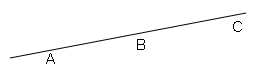
रेखा AB का ढ़ाल=रेखा BC का ढ़ाल
=रेखा AC का ढाल
माना A(x,-1) , B(2,1) तथा C(4,5) तीन संरेखी बिंदु है।
m(AB)=n(BC)
$\frac{1-(-1)}{2-x}=\frac{5-1}{4-2}$
$\frac{2}{2-x}=\frac{4}{2}$
4-2x=2
-2x=2-4
-2x=-2
$x=\frac{-2}{-2}=1$
Question 8
उस रेखा की ढ़ाल निकाले जो y-अक्षं की धनात्मक दिशा से घड़ी की सुई की विपरित दिशा मे 30° का कोण बनाती है ।
[Find the slope of the line , which makes an angle 30° will the positive direction of y-axis measured anti-clockwise]
Sol :
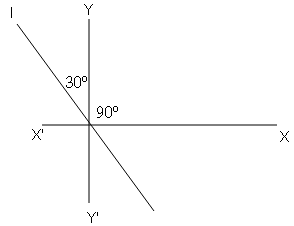
रेखा l द्वारा x-अक्ष पर,
झूकाव=90°+36
=120°
m(l)=tan120°
=tan(90°+30°)
=-cot30°
=-√3
Question 9
उस रेखा की ढ़ाल निकाले जो मूल बिन्दु A(0,-4) और B(8,0) के मध्य बिंदु से गुजरती है ?
[Find the slope of a line , which passes through the origin and the mid-point of the line segment joinning the points A(0,-4) and B(8,0)]
Sol :
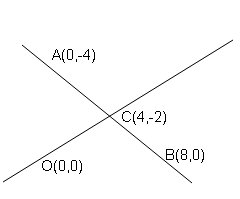
माना मूल बिंदु O(0,0) है ।
C,AB का मद्धय बिंदु है ।
C का निर्देशांक $=\left(\frac{0+8}{2},\frac{-4+0}{2}\right)$
$=\left(\frac{8}{2},\frac{-4}{2}\right)$
=(4,-2)
रेखा OC का ढ़ाल $=\frac{-2-0}{4-0}=\frac{-2}{4}$
$=-\frac{1}{2}$
Question 10
x-अक्ष तथा बिन्दुओ (3,-1) तथा (4,-2) को मिलाने वाली रेखा के बीच का कोण निकाले ।
[Find the angle between the x-axis and the line joining the joining the points (3,-1) and (4,-2)]
Sol :
माना x-अक्ष तथा बिन्दुओ (3,-1) तथा (4,-2) को मिलाने वाली रेखा θ कोण बनती है ।
रेखा AB का ढ़ाल $=\frac{-2-(-1)}{4-3}$
tanθ$=\frac{-2+1}{1}$
tanθ=-1
tanθ=-tan45°
tanθ=tan(90°+45°)
tanθ=tan135°
θ=135°
Question 11
एक रेखा (x1,y1) तथा (h,k) से गुजराती है । यदि रेखा की ढाल m है तो दिखाएँ कि
[A Line passes through (x1,y1) and (h,k). If slope of the line is m , show that]
k-y1=m(h-x1)
Sol :
माना बिंदु A(x1,y1) तथा B(h,k) से गुजरने वाली रेखा AB का ढाल m है ।
$m=\frac{k-y_1}{h-x_1}$
m(h-x1)=k-y1
Question 12
ढाल का प्रयोग करते हुई दिखाएँ कि (1,1),(2,3) तथा (3,5) संरेख है ।
[Using slopes , show that the points (1,1),(2,3) and (3,5) are collinear]
Sol :
माना A(1,1),B(2,3) तथा C(3,5) तीन बिंदुएँ है ।
m(AB)$=\frac{3-1}{2-1}=\frac{2}{1}$
=2
m(BC)$=\frac{5-3}{3-2}=\frac{2}{1}$
=2
m(AC)$=\frac{5-1}{3-1}=\frac{4}{2}$
=2
m(AB)=m(BC)=m(AC)
∴A(1,1),B(2,3),C(3,5) संरेख है ।
Question 13
A(3,4), B(-3,0) तथा C(7,-4) किसी त्रिभुज के शीर्ष है । दिखाएँ कि AB तथा AC के मध्य बिन्दुओ को मिलाने वाली रेखा BC के समान्तर तथा आधी है ।
[A(3,4) ,B(-3,0) and C(7,-4) are the vertices of a triangle . Show that the line joining the mid-points of AB and AC is parallel to BC and is half of it]
Sol :

माना ΔABC मे , AB तथा AC का मध्य बिंदु क्रमश D तथा E है ।
तो सिद्ध करना है ः
∵D तथा E क्रमशः AB तथा AC का मध्य बिंदु है ।
D का निर्देशांक$=\left(\frac{-3+3}{2},\frac{0+4}{2}\right)$
$=\left(\frac{0}{2},\frac{4}{2}\right)$
=(0,2)
D का निर्देशांक$=\left(\frac{7+3}{2},\frac{-4+4}{2}\right)$
$=\left(\frac{10}{2},\frac{0}{2}\right)$
=(5,0)
m(DE)$=\frac{0-2}{5-0}=-\frac{2}{5}$
m(BC)$=\frac{-4-0}{7-(-3)}=\frac{-4}{10}$
$=-\frac{2}{5}$
m(DE)=m(BC)
DE||BC
DE$=\sqrt{(5-0)^2+(0-2)^2}$
$=\sqrt{25+4}=\sqrt{25}$
BC$=\sqrt{(-4-0)^2+(7-(-3))^2}$
$=\sqrt{16+100}=\sqrt{116}$
$=\sqrt{2\times 2\times 29}=2\sqrt{29}$
$DE=\frac{1}{2}BC$
Question 14
तीन बिन्दु A(x1,y1) ,B(x2,y2) तथा C(x,y) संरेख है तो साबित करे कि
[Three points A(x1,y1) ,B(x2,y2) and C(x,y) are collinear. Prove that (x-x1)(y2-y1)=(x2-x1)(y-y1)
Sol :
दिया है(Given)
A(x1,y1) ,B(x2,y2) तथा C(x,y) संरेख है

m(AC)=m(AB)
$\frac{y-y_1}{x-x_1}=\frac{y_2-y_!}{x_2-x_1}$
(x-x1)(y2-y1)=(x2-x1)(y-y1)
Question 15
ढाल की अवधारणा का प्रयोग करते हुए दिखाएँ कि (-2,-1),(4,0),(3,3) तथा (-3,2) एक समान्तर चतुर्भुज के शीर्ष है ।
[By using the concept of slope, show that (-2,-1),(4,0),(3,3) and (-3,2) are the vertices of a parallelogram]
Sol :
माना A(-2,-1) ,B(4,0),C(3,3) तथा D(-3,2) चार बिंदु है ।
m(AB)$=\frac{0-(-1)}{4-(-2)}=\frac{1}{6}$
m(BC)$=\frac{3-0}{3-4}=\frac{3}{-1}$
=-3
m(CD)$=\frac{2-3}{-3-3}=\frac{-1}{-6}=\frac{1}{6}$
m(AD)$=\frac{2-(1)}{-3-(-2)}=\frac{3}{-1}$
=-3
$\begin{array}{l|l}m(AB)=m(CD)&m(BC)=m(AD)\\AB||CD&BC||AD\end{array}$
∴ABCD एक समांतर चतुर्भुज है ।
A(-2,-1),B(4,0),C(3,3) तथा D(-3,2) समांतर चतुर्भुज के शीर्ष है ।
Question 16
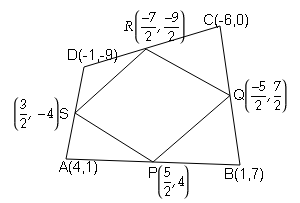
एक चतुर्भुज के शीर्ष (4,1),(1,7),(-6,0) तथा (-1,-9) है । दिखाएँ कि इस चतुर्भुज के मध्य बिन्दु एक समान्तर चतुर्भुज बनाते है ।
[A quadrilateral has vertices (4,1),(1,7),(-6,0) and (-1,-9). Show that the mid-points of the sides of sides of this quadrilateral form a parallelogram]
Sol :

माना A(4,1),B(1,7),C(-6,0) and D(-1,-9) चतुर्भुज ABCD के शीर्ष है ।
माना P,Q,R तथा S क्मशः चतुर्भुज ABCD के भुजाओ AB,BC,CD तथा AD के मध्य बिंदु है ।
तो साबित करना है ः PQRS एक समांतर चतुर्भुज है ।
प्रमाण
P,Q,R and S क्रमशः AB,BC,CD तथा AD के मध्य बिंदु है ।
P का निर्देशांक $=\left(\frac{4+1}{2},\frac{1+7}{2}\right)$
$=\left(\frac{5}{2},\frac{8}{2}\right)$
$=\left(\frac{5}{2},2\right)$
Q का निर्देशांक $=\left(\frac{1-6}{2},\frac{7+0}{2}\right)$
$=\left(-\frac{5}{2},\frac{7}{2}\right)$
R का निर्देशांक $=\left(-\frac{-1+(-6)}{2},\frac{-9+0}{2}\right)$
$=\left(\frac{-3}{2},\frac{-9}{2}\right)$
S का निर्देशांक $=\left(-\frac{-1+4}{2},\frac{-9+1}{2}\right)$
$=\left(\frac{3}{2},\frac{-8}{2}\right)$
$=\left(\frac{3}{2},-4\right)$
m(PQ)$=\dfrac{\frac{7}{2}-4}{-\frac{5}{2}-\frac{5}{2}}$
$=\dfrac{\frac{7-8}{2}}{\frac{-5-5}{2}}$
$=\frac{-1}{-10}=\frac{1}{10}$
m(QR)$=\dfrac{\frac{-9}{2}-\frac{7}{2}}{-\frac{7}{2}-\left(-\frac{5}{2}\right)}$
$=\dfrac{\frac{-16}{2}}{\frac{-2}{2}}$
=8
m(RS)$=\dfrac{\frac{-9}{2}-4}{-\frac{7}{2}-\frac{3}{2}}$
$=\dfrac{\frac{-9+8}{2}}{\frac{-7-3}{2}}$
$=\frac{-1}{-10}=\frac{1}{10}$
m(PS)$=\dfrac{4-(-4)}{-\frac{5}{2}-\frac{3}{2}}$
$=\dfrac{8}{\frac{2}{2}}$
=8
$\begin{array}{l|l}m(PQ)=m(RS)&m(QR)=m(PS)\\PQ||RS&QR||PS\end{array}$
∴PQRS एक समांतर चतुर्भुज है ।
Question 17
साबित करे कि समबाहु त्रिभुज की माध्यिका संगत भुजा पर लम्ब होती है ।
[Prove that a median of an equilateral triangle is perpendicular to the corresponding side of the triangle]
Sol :

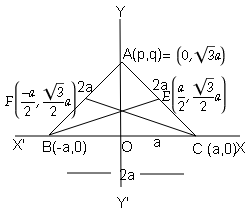
माना ABC एक समबाहु त्रिभुज है ।
जहाँ AB=BC=AC=2a
जिसकी भुजा BC x-अक्ष पर है ।
माना O,BC का मध्य बिंदु है । जो निर्देशांक अक्षो के मूल बिंदु है ।
AB=AC=2a
माना A का निर्देशांक=(p.q)
AB=AC
AB2=AC2
(p+a)2+(q.0)2=(p-a)2+(q-0)2
p2+a2+2pa=p2+a2-2pa
4pa=0
p=0
अतः A y-अक्ष पर स्थित है ।
OA=$\sqrt{AC^2-OC^2}$
$=\sqrt{(2a)^2}-a^2$
$q=\sqrt{3}a$
माना BE तथा CF क्रमश
B तथा C शिर्ष से खिची जाने वाली माध्मिक है ।
∴E तथा F क्रमशः AC तथा AC मध्य बिंदु है ।
E का निर्देशांक$=\left(\frac{a+0}{2},\frac{\sqrt{3}a+0}{2}\right)$
$=\left(\frac{a}{2},\frac{\sqrt{3}a}{2}\right)$
F का निर्देशांक$=\left(\frac{-a+0}{2},\frac{0+\sqrt{3}a}{2}\right)$
$=\left(\frac{-a}{2},\frac{\sqrt{3}a}{2}\right)$
m(BE)$=\left(\dfrac{\frac{\sqrt{3}a}{2}-0}{\frac{a}{2}-(-a)}\right)$
$=\dfrac{\frac{\sqrt{3}a}{2}}{\frac{a+2a}{2}}$
$=\frac{\sqrt{3}a}{3a}=\frac{\sqrt{3}}{3}$
m(AC)$=\frac{\sqrt{3}a-0}{0-a}=\frac{\sqrt{3}a}{-a}$
=-√3
m(BE)×m(AC)$=\frac{\sqrt{3}}{3}\times (-\sqrt{3})$
$=\frac{-3}{3}=-1$
∴BE⟂AC
अतः माध्यिका BE ΔABC की भुजा AC पर लंब है ।
Question 18
साबित करे कि किसी विषमकोण समचतुर्भुज के विकर्ण परस्पर लम्ब है ।
[Prove that the diagonals of a rhombus are at right angels]
Sol :
माना OABC एक विषमकोण समचतुर्भुज है , जिसकी प्रत्येक भुजा a है ।
O मूल बिंदु है तथा OA x-अक्ष पर है । समचतुर्भुज की ऊँचाई b है ।
माना CE तथा BF लंब है x-अक्ष पर ,
माना OE=C
ΔCOE⩭ΔBAF (R.H.S)
OE=AF=C
O का निर्देशांकृ(0,0) ,
A का निर्देशांकृ=(a,0)
B का निर्देशांक=(a+c,b)
C का निर्देशांक=(c,b)
ΔCOE मे ,
OC2=OE2+CE2
a2=c2+b2
m(OB)$=\frac{b-0}{a+c-0}$
$=\frac{b}{a+c}$
m(AC)$=\frac{b-0}{c-a}$
$=\frac{b}{c-a}$
m(OB)×m(AC)$=\frac{b}{c+a}\times \frac{b}{c-a}$
$=\frac{b^2}{c^2-a^2}=\frac{b^2}{-b^2}$
∴विषमकोण समचतुर्भुज के विकर्ण परस्पर लंब होते है ।