
[mathjax]
Question 1
If Z+ is the set of all non-negative integers , determine whether or not each of the operation * given below gives a binary operation. In case * is not a binary operation, given justification for this.
(i) On Z+, operation * defined by a * b=a-b+5
Sol :
a∈Z+ , b∈Z+
a*b=a-b+5∉Z+
i.e.
1∈Z+, 9∈Z+
1*9=1-9+5=-3∉Z+
∴ operation * is not a binary operation
(ii) On Z+, operation * defined by a * b=a-b
Sol :
a∈Z+ , b∈Z+
a*b=a-b∉Z+
i.e.
1∈Z+, 5∈Z+
1*5=1-5=-4∉Z+
∴ operation * is not a binary operation
(iii) On Z+, operation * defined by a * b=ab
Sol :
a∈Z+ , b∈Z+
i.e.
1∈Z+, 11∈Z+
1*11=1*11=11∈Z+
∴ operation * is a binary operation
(iv) On R , operation * defined by a*b=ab2
Sol :
a∈R ,b∈R
a*b=ab2∈R
i.e.
$\dfrac{2}{3}\in \text{R ,} \sqrt{3}\in \text{R}$
$\dfrac{2}{3}*\sqrt{3}=\dfrac{2}{3}\times (\sqrt{3})^2$ $=\dfrac{2}{3}\times 3$
=2∈R
∴ operation * is a binary operation
(v) Z+ पर ,$a * b=\frac{a+b}{2}$ द्वारा परिभाषित संक्रिया *
Sol :
a∈Z+,b∈Z+
$a * b=\frac{a+b}{2} \notin Z^{+}$
i.e.
2∈Z+,3∈Z+
2*3$=\frac{2+3}{2}=\frac{5}{2} \notin Z^{+}$
∴operation * is not a binary operation
(vi) Z+ पर ,a * b=|a-b| द्वारा परिभाषित संक्रिया *
On Z+ ,operation * defined by a*b=|a-b|
Sol :
a∈Z+,b∈Z+
a*b=|a-b|∈Z+
i.e.
2∈Z+,5∈Z+
2*5=|2-5|=|-3|=3∈Z+
∴operation * is a binary operation
(viii) Z+ पर ,a * b=2b द्वारा परिभाषित संक्रिया *
On Z+ ,operation * defined by a*b=2b
Sol :
a∈Z+,b∈Z+
a*b=2b∈Z+
i.e.
1∈Z+,2∈Z+
1*2=2×2=4∈Z+
∴operation * is a binary operation
Question 2
For each operation * defined below determine whether or not * is a binary operation on the given set. Justify your answer if * is not a binary operation
(i) Q पर $a * b=\frac{a+b}{3}$ द्वारा परिभाषित
On Q, defined by $a * b=\frac{a+b}{3}$
Sol :
a∈Q ,b∈Q
$a * b=\frac{a+b}{3}\in Q$
∵operation * is a binary operator
i.e.
$\frac{2}{3} \in Q, \frac{4}{3} \in Q$
$\frac{2}{3} * \frac{4}{3}=\frac{\frac{2}{3}+\frac{4}{3}}{3}$
$=\frac{\frac{6}{3}}{3}=\frac{2}{3} \in Q$
(ii) R-{-1} पर , a * b=\frac{a}{b+1} द्वारा परिभाषित
On R-{-1}, defined by $a * b=\frac{a}{b+1}$
Sol :
a∈R-{-1},b∈R-{-1}
$a * b=\frac{a}{b+1}$∈R-{-1}
i.e.
$\frac{2}{3} \in R-\{-1\}$ , $\frac{7}{3} \in R-\{-1\}$
$\frac{2}{3} * \frac{7}{3}=\frac{\frac{2}{3}}{\frac{7}{3}+1}$
$=\frac{\frac{2}{3}}{\frac{7+3}{3}}=\dfrac{2}{10}$
$=\frac{1}{5} \in R-\{-1\}$
∴operator * is a binary operation
(iii) N पर a*b=a2b द्वारा परिभाषित
On N, defined by a*b=a2b
Sol :
a∈N ,b∈N
a*b=a2b∈N
i.e.
2∈N ,5∈N
2*5=22×5=4×5=20∈N
∴operation * is a binary operation
i.e.
$\frac{2}{3} \in R^{+}, \frac{1}{9} \in R^{+}$
$=\frac{\left(\frac{2}{3}\right)^{2}}{\frac{1}{9}}=\frac{\frac{4}{2}}{\frac{1}{8}}$
=4∈R2
∴operation * is a binary operation
(v) समुच्चय A={1,2,3,4,5} पर ,a*b=a और b का LCM, द्वारा परिभाषित
On set A={1,2,3,4,5} , defined by a*b=LCM of a and b
Sol :
a∈A,b∈A
a*b=LCM(a,b)∉A
i.e.
2∈A,5∈A
2*5=10∉A
∴operation * is not a binary operation
Question 3
(i) Show that *: R×R→R given by (a, b)→a+4b2 is a binary operation
दिखाएँ कि (a,b)→a+4b2 द्वारा प्रदत्त है संक्रिया * :R×R→R एक द्विआधारी सक्रिया है
Sol :
a∈R,b∈R
a*b=a+4b2∈R
i.e.
$\frac{2}{3} \in R, \frac{5}{2} \in R$
$\frac{2}{3} * \frac{5}{2}=\frac{2}{3}+4\left(\frac{5}{2}\right)^{2}$
$=\frac{2}{3}+4 \times \frac{25}{4}$
$=\frac{2+75}{3}=\frac{77}{3} \in R$
∴operation * is a binary operation
(ii) Show that v:R×R→R given by (a,b)→max{a,b} and ∧:R×R→R given by (a,b)→min {a,b} are binary operations on R
दिखाएँ कि v:R×R→R जो (a,b)→महत्तम{a,b}तथा ∧:R×R→R जो (a,b)→न्यूनतम(a,b) द्वारा प्रदत्त है , R पर द्विआधारी संक्रियाएँ है ।
Sol :
V:(V,e)
a∈R,b∈R
avb=max{a,b}∈R
i.e.
1∈R,2∈R
1v2=2∈R
∴ operation 'v' is a binary operation
∧: (wedge)
a∈R,b∈R
a∧b=min{a,b}∈R
i.e.
1∈R,Z∈R
1∧2=1∈R
∴ operation '∧' is a binary operation
(iii) माना कि P दिये गये समुच्चय X के सभी उपसमुच्चयो का समुच्चय है ।
दिखाएँ कि ⋃:P×P→P जो(A,B)→A⋃B द्वारा प्रदत्त है तथा
∩:P×P→P जो(A,B)→A∩B द्वारा प्रदत्त है
समुच्चय P पर द्विआधारी संक्रियाएँ है ।
Let P be the set of all subsets of a given set X. Show that
⋃:P×P→P जो(A,B)→A⋃B and
∩:P×P→P जो(A,B)→A∩B
are binary operations on the set P
Sol :
A⊆X,B⊆X
P={A,B..}
A∈P,B∈P
A∪B∈P
∴'∪' is a binary operation
Question 4
निचे परिभाषित प्रत्येक द्विआधारी संक्रिया * के लिए निर्धारित करे कि क्या * क्रमविनिमेय है तथा क्या * साहचर्य है ।
For each binary operation * defined below , determine whether * is commutative and whether * is associative
(i) Z पर ,a*b=a-b द्वारा परिभाषित
On Z, defined by a*b=a-b
Sol :
For commutative
a*b=b*a,∀a,b∈Z
a*b=a-b
b*a=b-a
a*b≠b*a,∀a,b∈Z
∴operation * is not commutative
For associative
a*(b*c)=(a*b)*c,∀a,b∈Z
L.H.S
a*(b*c)=a*(b-c)
=a-(b-c)
=a-b+c
=a-b+c
R.H.S
(a*b)*c=(a-b)*c
=(a-b)-c
=a-b-c
a*(b*c)≠(a*b),∀a,b,c∈Z
∴operation * is not associative
(ii) Q पर,a*b=ab+1 द्वारा परिभाषित
On Q, defined by a*b=ab+1
Sol :
For commutative
a*b=b*a,∀a,b∈Q
L.H.S
a*b=ab+1
R.H.S
b*a=ba+1=ab+1
a*b=b*a∀a,b∈Q
∴operation '∀' is commutative
For associative
a*(b*c)=(a*b)*c,∀a,b,c∈Q
L.H.S
a*(b*c)=(a*b)*c
=a(bc+1)+1
=abc+a+1
R.H.S
(a*b)*c=(ab+1)*c
=(ab+1)c+1
=abc+c+1
a*(b*c)≠(a*b)*c,∀a,b,c∈Q
∴operation '*' is not associative
(iii) N पर ,a*b=a3+b3 द्वारा परिभाषित
On N defined by a*b=a3+b3
Sol :
For commutative
a*b=b*a,∀a,b∈N
L.H.S
a*b=a3+b3
R.H.S
b*a=b3+a3
(∵a3+b3=b3+a3)
=a3+b3
a*b=b*a,∀a,b∈N
∴operation is commutative
For associative
a*(b*c)=(a*b)*c,∀a,b,c∈N
L.H.S
a*(b*c)=a*(b3+a3)
=a3+(b3+a3)
R.H.S
(a*b)*c=(a3+b3)*c
=(a3+b3)*c
a*(b*c)≠(a*b)*c
∴operation '*' is not associative
(iv) Q पर,$a * b=\frac{a b}{3}$ द्वारा परिभाषित
On Q,defined by $a * b=\frac{a b}{3}$
Sol :
For commutative
a*b=b*a,∀a,b∈Q
L.H.S
$a*b=\frac{a b}{3}$
R.H.S
(∵ab=ba)
$b*a=\frac{ba}{3}=\frac{ab}{3}$
a*b=b*a,∀a,b∈Q
∴operator '*' is commutative
For associative
a*(b*c)=(a*b)*c, ∀a,b∈Q
L.H.S
a*(b*c)$=a+\frac{b c}{3}=\frac{a b c}{3 \times 3}$ $=\frac{abc}{9}$
R.H.S
a*(b*c)$=\frac{a b}{3} * c=\frac{a b c}{3 \times 3}$ $=\frac{a b c}{9}$
∴a*(b*c)=(a*b)*c,∀a,b,c∈Q
∴operation * is associative
(v) Z+ पर , a*b=2ab द्वारा परिभाषित
On Z+, defined by a*b=2ab
Sol :
For commutative
a*b=b*a,∀a,b∈Z+
L.H.S
a*b=2ab
R.H.S
b*a=2ba=2ab(∵ab=ba)
a*b=b*a,∀a,b∈Z+
∴operation is commutative
For associative
a*(b*c)=(a*b)*c,∀a,b,c∈Z+
L.H.S
a*(b*c)=a*2bc$=2^{a^{2^{b c}} }$
R.H.S
(a*b)*c=2ab*c$=2^{c \cdot 2^{a b}}$
∴a*(b*c)≠(a*b)*c,∀a,b,c∈Z+
∴operation '*' is not associative
(vi) R-{-1} पर,$a * b=\frac{a}{b+1}$ द्वारा परिभाषित
On R-{-1} defined by $a * b=\frac{a}{b+1}$
Sol :
For commutative
a*b=b*a,∀a,b∈R-{-1}
L.H.S
$a * b=\frac{a}{b+1}$
R.H.S
$5+a=\frac{b}{a+1}$
∴a*b=b*a,∀a,b,∈R-{-1}
∴operation '*' is not commutative
For associative
a*(b*c)=(a*b)*c,∀a,b,c∈R-{-1}
L.H.S
a*(b*c)$=a+\frac{b}{c+1}$
$=\frac{a}{\frac{b}{c+1}+1}=\frac{a}{\frac{b+c+1}{c+1}}$
$=\frac{a(c+1)}{b+c+1}$
$=\frac{a c+a}{b+c+1}$
R.H.S
(a*b)*c$=\frac{a}{b+1} * c$
$=\frac{\frac{a}{b+1}}{\frac{c+1}{1}}$
$=\frac{a}{(b+1)(c+1)}$
$=\frac{a}{b c+b+c+1}$
a*(b*c)≠(a*b)*c,∀a,b,c∈R-{-1}
∴operation * is not associative
Question 5
माना कि * परिमेय संख्याओ के समुच्चय Q पर निम्न प्रकार परिभाषित एक द्विआधारी सांक्रिया है । ज्ञात करे कि इनमे कौन-कौन सी द्विआधारी सांक्रिया क्रमविनिमेय है ।
Let * be a binary operation on the set Q of rational numbers defined as given below. Find which of the binary operations are commutative.
(i) a*b=ab2
Sol :
For commutative
a*b=b*a,∀a,b∈Q
L.H.S
a*b=ab2
R.H.S
b*a=ba2=a2b
(∵a2b=ba2)
a*b≠b*a,∀a,b∈Q
∴operation * is not commutative
(ii) a*b=न्यूनतम[min]{a,b}
Sol :
For commutative
a*b=b*a,∀a,b∈Q
Let a≥b
L.H.S
a*b=b
R.H.S
b*a=b
Let a≤b
L.H.S a*b=a
R.H.S
b*a=a
a*b=b*a ,∀a,b∈Q
∴operation * is commutative binary operator
(vii) a*b=|a-b|
Sol :
For commutative
a*b=b*a,∀a,b∈Q
L.H.S
a*b=|a-b|
R.H.S
b*a=|b-a|
=|-a+b|
=|a-b|
a*b=b*a,∀a,b∈Q
∴operation '*' is commutative binary operation
Question 7
माना कि * समुच्चय Z पर a*b=a+b-4 सभी a,b∈Z द्वारा परिभाषित द्विआधारी संक्रिया है ।
(i) दिखाएँ कि * क्रमविनिमेय तथा साहचर्य दोनो है ।
Sol :
For commutative
a*b=b*a,∀a,b∈Z
L.H.S
a*b=a+b-4
R.H.S
b*a=b+a-4
=a+b-4
(∵a+b=b+a)
a*b=b*a,∀a,b∈Z
∴operation '*' is commutative
For associative
a*(b*c)=(a*b)*c,∀a,b∈Z
L.H.S
a*(b*c)=a*(b+c-4)
=a+b+c-4-4
=a+b+c-8
R.H.S
(a*b)*c=(a+b-4)*c
=a+b-4+c-4
=a+b+c-8
a*(b*c)=(a*b)*c,∀a,b,c∈Z
∴operation '*' is associative
(ii) Z मे तत्समक अवयव निकाले ।
Sol :
माना a∈Z का तत्समक अवयव e है , जहाँ e∈Z
a*e=a*e*a
a*e=a
a+e-4=a
e=4
(iii) Z में व्युत्क्रमणीय अवयवो को निकाले ।
Sol :
माना a∈Z का व्युत्क्रमणीय अवयव b है , जहाँ b∈Z
a*b=b*a=4
a*b=4
a+b-4⇒b=8-a
a-1=b=8-a
Question 8
माना कि * N पर परिभाषित एक द्विआधारी संक्रिया है ताकि
a*b=a2+b2+2 सभी a,b∈N के लिए
Let * be a binary operation defined on N such that
a*b=a2+b2+2 for all a,b∈N:
(a)(i) Find 2*5 निकाले
Sol :
2*5=22+52+2
=4+25+2
=31
(ii) दिखाएँ कि '*' क्रम विनिमेय है ।
Sol :
1*2=12+22+2
=1+4+2
=7
2*1=22+12+2
=4+1+2
1*2=2*1
(b) दिखाएँ कि '*' क्रम विनिमेय है ।
Show that '*' is commutative
Sol :
For commutative
a*b=b*a,∀a,b∈N
L.H.S
a*b=a2+b2+2
R.H.S
b*a=b2+a2+2=a2+b2+2
(∵a2+b2=b2+a2)
a*b=b*a,∀a,b∈N
∴operation '*' is commutative
Question 9
यदि *Q पर a*b=4a2+6b2 द्वारा परिभाषित एक द्विआधारी संक्रिया है तो सत्यापित करे कि * क्रमविनिमये नहीं है ।
If a*b=4a2+6b2 be a binary operation on Q , then verify that * is not commutative
Sol :
Question 10
माना कि A=N×N तथा * पर (a,b)*(c,d)=(ac,bd) द्वारा परिभाषित एक द्विआधारी संक्रिया है । दिखाए कि(i) * साहचर्य है (ii) * क्रम विनिमेय है । A मे तत्समक अवयव निकाले यदि कोई हो तो
Let A=N×N and let '*' be a binary operation on A defined by (a,b)*(c,d)=(ac,bd), show that
(i) * is associative
(ii) * is commutative
Find the identity element if any in A
Sol :
(i) For associative
(a,b)*{(c,d)*(e,f)}
={(a,b)*(c,d)}*(e,f),∀(a,b),(c,d),(e,f)∈N×N
L.H.S
(a,b)*{(c,d)*(e,f)}
=(a,b)*(ce,df)
=(ace,bdf)
R.H.S
{(a,b)*(c,d)}*(e,f)
=(ac,bd)*(ef)
=(ace,bdf)
∴(a,b)*{(c,d)*(e,f)}
={(a,b)*(c,d)}*(e,f)∀(a,b),(c,d),(e,f)∈N×N
∴operation '*' is associative
(ii) For commutative
(a,b)*(c,d)=(c,d)*(a,b),∀(a,b),(c,d)∈A
L.H.S
(a,b)*(c,d)=(ac,bd)
R.H.S
(c,d*(a,b)=(ca,db)
=(ac,bd)
{∵ac=ca
bd=db}
∴(a,b)*(c,d)=(c,d)*(a,b),∀(a,b),(c,d)∈A
∴operation '*' is commutative
(iii) माना (a,b)∈A का तत्समक अवयव(x,y) है
(a,b)*(x,y)=(a,b)
(ax,by)=(a,b)
ax=a,by=b
x=,y=
∴तत्समक अवयव=(1,1)
Question 11
यदि * समुचय A पर क्रमविनिमेय द्विआधारी संक्रिया है , तो दिखाएँ कि
a*(b*c)=(c*b)*a for all a,b,c∈A
Sol :
* समुच्चय A पर एक commutative binary operative है
a*b=b*a or b*c=c*b,∀a,b,c∈A
L.H.S
a*(b*c)=a*(c*b)
=(c*b)*a
Question 12
माना कि R सभी वास्तविक संख्याओ का समुच्चय है तथा माना कि o,R पर सभी a,b∈R के लिए aob=2a+3b द्वारा परिभाषित एक द्विआधारी संक्रिया है । दिखाएँ कि o साहचर्य नही है ।
Let R be the set of all real numbers and let o be a binary operator on R defined by aob=2a+3b, for a,b∈R
Show that o is not associative
Sol :
For associative
ao(boc)=(aob)oc,∀a,b,c∈R
L.H.S
ao(boc)=ao(2b+3c)
=2a+3(2b+3c)
=2a+6b+9c
R.H.S
(aob)oc=(2a+3b)oc
=2(2a+3b)+3c
=4a+6b+3c
ao(boc)≠(aob)oc,≠a,b,c∈R
∴operation '*' is not associative
Question 13
माना कि o:Z×Z→Z, जहाँ Z सभी पूर्णाको का समुच्चय है ,
(a,b),o(c,d)=(ad+bc,bd) द्वारा परिभाषित है । दिखाएँ कि o साहचर्य है ।
Let o:Z×Z→Z, be defined by (a,b)o(c,d)=(ad+bc,bd) where Z is the set of all integers .Show that o is associative
Sol :
For associative
(a,b)o{(c,d)o(e,f)}={(a,b)o(c,d)}o(e,f)∀(a,b),(c,d),(e,f)∈Z×Z
L.H.S
(a,b)o{(c,d)o(e,f)}
=(a,b)o(cf+de,df)
={adf+bcf+bde,bdf}
R.H.S
{(a,b)o(c,d)}o(e,f)
=(ad+bc,bd)o(e,f)
=(adf+bcf+bde,bdf)
(a,b)o{(c,d)o(e,f)}={(a,b)o(c,d)}o(e,f)
∴operation '*' is associative binary operation
Question 14
माना कि N पर o,aob=c, जहाँ c,a+b से कम-से-कम 5 अधिक है , द्वारा परिभाषित एक संक्रिया है । क्या o,N पर द्विआधारी संक्रिया है ?
Let o be an operation defined on N as aob=c, where c is at least more than a+b. Is o, a binary operation on N ?
Sol :
a∈N ,b∈N⇒aob∈R
$2 * 3=\frac{40}{3} \in R$
$2*3=\frac{100}{3} \in R$
∴o,N पर एक binary operation नही है ।
Question 15
माना कि ⊕ तथा ⊕, N पर a⊕b=2a तथा a⊕b=2ab द्वारा परिभाषित है । निर्धारित करें कि ये द्विआधारी संक्रियाएँ है या नहीं
Let ⊕and⊕ be defined on N as a⊕b=2a and a⊕b=2ab . Determine whether these operations are binary or not
Sol :
a∈N,b∈N:a⊕b=2a∈N
∴operation ⊕ is a binary operation
a∈N,b∈N:a⊕b=2a∈N
∴operation ⊕ is a binary operation
Question 16
समुच्चय{1,2} पर द्विआधारी संक्रियाओ की संख्या निकाले ।
Find the number of binary operation on set {1,2}
Sol :
Number of binary operation$=2^{2^{2}}=2^{4}$=16
Question 17
बताइए कि क्या निम्नलिखित कथन सत्य है या असत्य है । औचित्य भी बताइए
State whether the following statements are true or false>justify
(i) समुच्चय N मे किसी भी स्वेच्छ द्विआधारी संक्रिया * के लिए a*a=a,∀a∈N
For an arbitrary binary operation * on a set N, a*a=a,,∀a∈N
Sol :
असत्य(False)
(ii) यदि N मे * ऐक क्रमविनिमेय द्विआधारी है, तो a*(b*c)=(c*b*a)
If * is a commutative binary operation on N
Then a*(b*c)=(c*b)*a
Sol :
L.H.S
a*(b*c)=a*(c*b)=(c*b)*a
सत्य(True)
Question 18
समुच्चय{1,2,3,4,5} मे a∧b=निम्नतम{a,b} द्वरा परिभाषित द्विआधारी संक्रिया पर विचार कीजिए । संक्रिया ∧ के लिए संक्रिया सारणी लिखिए।
Consider the binary operation ∧ on the set{1,2,3,4,5} defined by a∧b=min{a,b}. Write the operation table for the operation ∧
Sol :
माना A={1,2,3,4,5}
a∈A,b∈A
a∧b=निम्नतम{a,b}∈A
∴operation '∧' is a binary operation

Question 19
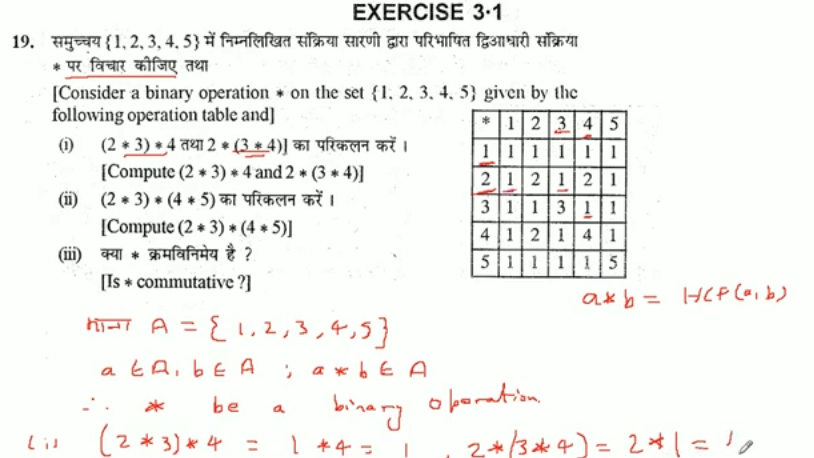
समुच्चय{1,2,3,4,5} मे निम्नलिखित संक्रिया सारणी द्वारा परिभाषित द्विआधारी संक्रिया * पर विचार कीजिए तथा
Consider a binary operation * on set{1,2,3,4,5}given by the following operation table and
(i) (2*3)*4 तथा 2*(3*4) का परितलन करे ।
Compute (2*3)*4 and 2*(3*4)
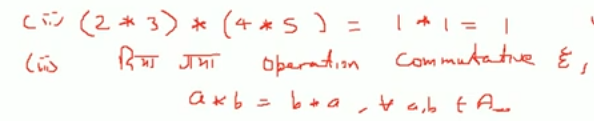
(ii) (2*3)*(4*5) का परिकलन करे ।
Compute (2*3)*(4*5)
(iii)
Question 20
Question 21
(v) माना a∈N का प्रतिलोम x∈N है


a*x=1
LCM(a,x)=1
a=1,x=1
Question 23
माना कि A=N×N है तथा A में (a,b)*(c,d)=(a+c,b+d) द्वारा परिभाषित एख द्विआधारी संक्रिया * है । सिद्द कीजिए कि * क्रमविनिमेय तथा साहचर्य है । A मे * का तत्समक अवयव यदि कोई है,तो ज्ञात कीजिए ।
Let A=N×N * be the binary operation on A defined by
(a,b)*(c,d)=(a+c,b+d)
Show that * is commutative and associative. Find the identity element for * on A, if any
Sol :
For commutative
(a,b)*(c,d)=(c,d)*(a,b),∀(a,b)(c,d)∈A
L.H.S
(a,b)*(c,d)=(a+c,b+d)
R.H.S
(c,d)*(a,b)=(c+a,d+b)
=(a+c,b+d) (∵a+c=c+a
b+d=d+b)
(a,b)*(c,d)=(c,d)*(a,b),∀(a,b),(c,d)∈A
∴operation '*' is commutative
For associative
(a,b)*[(c,d)*(e,f)]=[(a,b)*(c,d)]*(e,f)∀(a,b),(c,d),(e,f)∈A
L.H.S
(a,b)*[(c,d)*(e,f)]=(a,b)*(c+e,d+f)
(a+c+e,b+d+f)
R.H.S
[(a,b)*(c,d)*(e,f)=(a+c,b+d)*(e,f)
=(a+c+e,b+d+f)
(a,b)*[(c,d)*(e,f)]=[(a,b)*(c,d)]*(e,f)
∴operation * is associative
(ii) माना (a,b)∈A का तत्समक अवयव (x,y)∈A हो
(a,b)*(x,y)=(a,b)
(a+x,b+y)=(a,b)
a+x=a,b+y=b⇒x=0,y=0
(a+x,b+y)=(a,b)
a+x=a,b+y=b⇒x=0,y=0
तत्समक अवयव=(0,0)