State Board Primary (1-5) Private Session 2025-26
Free Open Access
KC Sinha: Exercise 4.1 - Mathematics Solution Class 10 Chapter 4 Real numbers
[mathjax] Question 1 From the given figure, find the value of the following: (i) sin C (ii) sin A (iii) cos C (iv) cos A (v) tan C (vi) tan A Sol : (i) Sin C We know that, $\sin \theta=\frac{\text {...
Verified chapter-wise solutions, answers, and study notes
Curriculum & Exam Preparation Note:Regular practice of NCERT textbook exercises and chapter-end questions establishes strong conceptual clarity for primary and secondary examinations.
[mathjax]
Question 1
From the given figure, find the value of the following:
(i) sin C (ii) sin A (iii) cos C (iv) cos A (v) tan C (vi) tan A Sol : (i) Sin C We know that, $\sin \theta=\frac{\text { side opposite to angle } \theta}{\text { hypotenuse }}$ So, here θ = C Side opposite to ∠C = AB = 3 Hypotenuse = AC = 5 So, $\sin C=\frac{A B}{A C}=\frac{3}{5}$
(ii) Sin A So, here θ = A The side opposite to ∠A = BC = 4 Hypotenuse = AC = 5 So, $\sin A=\frac{B C}{A C}=\frac{4}{5}$
(iii) Cos C We know that, $\cos \theta=\frac{\text { side adjacent to angle } \theta}{\text { hypotenuse }}$ So, here θ = C Side adjacent to ∠C = BC = 4 Hypotenuse = AC = 5 So, $\cos C=\frac{B C}{A C}=\frac{4}{5}$
(iv) Cos A Here, θ = A Side adjacent to ∠A = AB = 3 Hypotenuse = AC = 5 So, $\cos A=\frac{A B}{A C}=\frac{3}{5}$
(v) tan C We know that, $\tan \theta=\frac{\text { side opposite to angle } \theta}{\text { side adjacent to angle } \theta}$ So, here θ = C Side opposite to ∠C = AB = 3 Side adjacent to ∠C = BC = 4 So, $\tan C=\frac{A B}{B C}=\frac{3}{4}$
(vi) tan A here θ = A Side opposite to ∠A = BC = 4 Side adjacent to ∠A = AB = 3 So, $\tan A=\frac{A B}{B C}=\frac{4}{3}$
Question 2
From the given figure, find the value of :
(i) tan θ (ii) cos θ
Sol : (i) tan θ We know that, $\tan \theta=\frac{\text { side opposite to angle } \theta}{\text { side adjacent to angle } \theta}$ Side opposite to θ = AB = 4 Side adjacent to θ = BC = 3 So, $\tan \theta=\frac{\mathrm{AB}}{\mathrm{BC}}=\frac{4}{3}$
(ii) cos θ We know that, $\cos \theta=\frac{\text { side adjacent to angle } \theta}{\text { hypotenuse }}$ Side adjacent to θ = BC = 3 Hypotenuse = AC = 5 So, $\cos \theta=\frac{B C}{A C}=\frac{3}{5}$
Question 3
From the given figure, find the value of
(i) sin θ (ii) tan θ (iii) tan A – cot C
Sol : (i) sin θ We know that, $\sin \theta=\frac{\text { side opposite to angle } \theta}{\text { hypotenuse }}$ Side opposite to θ = BC = ? Hypotenuse = AC = 13 Firstly we have to find the value of BC. So, we can find the value of BC with the help of Pythagoras theorem. According to Pythagoras theorem, (Hypotenuse)2 = (Base)2 + (Perpendicular)2 ⇒ (AB)2 + (BC)2 = (AC)2 ⇒ (12)2 + (BC)2 = (13)2 ⇒ 144 + (BC)2 = 169 ⇒ (BC)2 = 169–144 ⇒ (BC)2 = 25 ⇒ BC =√25 ⇒ BC =±5 But side BC can’t be negative. So, BC = 5 Now, BC = 5 and AC = 13 So, $\sin \theta=\frac{B C}{A C}=\frac{5}{13}$
(ii) tan θ We know that, $\tan \theta=\frac{\text { side opposite to angle } \theta}{\text { side adjacent to angle } \theta}$ Side opposite to θ = BC = 5 Side adjacent to θ = AB = 12 So, $\tan \theta=\frac{\mathrm{BC}}{\mathrm{AB}}=\frac{5}{12}$
(iii) tan A – cot C We know that, $\tan \theta=\frac{\text { side opposite to angle } \theta}{\text { side adjacent to angle } \theta}$ and $\cot \theta=\frac{\text { side adjacent to angle } \theta}{\text { side opposite to angle } \theta}$ tan A Here, θ = A Side opposite to ∠A = BC = 5 Side adjacent to ∠A = AB = 12 So, $\tan \mathrm{A}=\frac{\mathrm{BC}}{\mathrm{AB}}=\frac{5}{12}$ Cot C Here, θ = C Side adjacent to ∠C = BC = 5 Side opposite to ∠C = AB = 12 So, $\cot C=\frac{B C}{A B}=\frac{5}{12}$ So, $\tan A-\cot C=\frac{5}{12}-\frac{5}{12}=0$
Question 4 A
In ∆ABC, right angled at B, AB = 24 cm, BC = 7 cm. Determine
a. sin A, cos A b. sin C, cos C Sol :
(i) (a) sin A We know that, $\sin \theta=\frac{\text { side opposite to angle } \theta}{\text { hypotenuse }}$ So, here θ = A Side opposite to ∠A = BC = 7 Hypotenuse = AC = ? Firstly we have to find the value of AC. So, we can find the value of AC with the help of Pythagoras theorem.
According to Pythagoras theorem, (Hypotenuse)2 = (Base)2 + (Perpendicular)2 ⇒ (AB)2 + (BC)2 = (AC)2 ⇒ (24)2 + (7)2 = (AC)2 ⇒ 576 + 49 = (AC)2 ⇒ (AC)2 = 625 ⇒ AC =√625 ⇒ AC =±25 But side AC can’t be negative. So, AC = 25cm Now, BC = 7 and AC = 25 So, $\sin A=\frac{B C}{A C}=\frac{7}{25}$ Cos A We know that, $\cos \theta=\frac{\text { side adjacent to angle } \theta}{\text { hypotenuse }}$ So, here θ = A Side adjacent to ∠A = AB = 24 Hypotenuse = AC = 25 So,$\cos A=\frac{A B}{A C}=\frac{24}{25}$ (b) sin C
We know that, $\sin \theta=\frac{\text { side opposite to angle } \theta}{\text { hypotenuse }}$ So, here θ = C The side opposite to ∠C = AB = 24 Hypotenuse = AC = 25 So, $\sin C=\frac{A B}{A C}=\frac{24}{25}$ Cos C We know that, $\cos \theta=\frac{\text { side adjacent to angle } \theta}{\text { hypotenuse }}$ So, here θ = C Side adjacent to ∠C = BC = 7 Hypotenuse = AC = 25 So, $\cos C=\frac{B C}{A C}=\frac{7}{25}$
Question 4 B
Consider ∆ACB, right angled at C, in which AB = 29 units, BC = 21 units and ∠ABC=θ. Determine the values ofa. cos2 θ+ sin2 θ b. cos2 θ – sin2 θ Sol :(a) Cos2θ +sin2 θ Firstly we have to find the value of AC. So, we can find the value of AC with the help of Pythagoras theorem. According to Pythagoras theorem, (Hypotenuse)2 = (Base)2 + (Perpendicular)2 ⇒ (AC)2 + (BC)2 = (AB)2 ⇒ (AC)2 + (21)2 = (29)2 ⇒ (AC)2 = (29)2 – (21)2 Using the identity a2 –b2 = (a+b) (a – b) ⇒ (AC)2 = (29–21)(29+21) ⇒ (AC)2 = (8)(50) ⇒ (AC)2 = 400 ⇒ AC =√400 ⇒ AC =±20 But side AC can’t be negative. So, AC = 20units Now, we will find the sin θ and cos θ $\sin \theta=\frac{\text { side opposite to angle } \theta}{\text { hypotenuse }}$ In ∆ACB, Side opposite to angle θ = AC = 20 and Hypotenuse = AB = 29 So, $\sin \theta=\frac{A C}{A B}=\frac{20}{29}$ Now, We know that $\cos \theta=\frac{\text { side adjacent to angle } \theta}{\text { hypotenuse }}$
In ∆ACB, Side adjacent to angle θ = BC = 21 and Hypotenuse = AB = 29 So, $\cos \theta=\frac{B C}{A B}=\frac{21}{29}$ So$\cos ^{2} \theta+\sin ^{2} \theta=\left(\frac{21}{29}\right)^{2}+\left(\frac{20}{29}\right)^{2}$ $=\frac{441+400}{29 \times 29}$ $=\frac{841}{841}$ =1 Cos2θ +sin2 θ = 1 (b) Cos2θ – sin2 θ Putting values, we get $\cos ^{2} \theta-\sin ^{2} \theta=\left(\frac{21}{29}\right)^{2}-\left(\frac{20}{29}\right)^{2}$ $=\frac{441-400}{29 \times 29}$ $=\frac{41}{841}$
Question 4 C
In ∆ABC, ∠A is a right angle, then find the values of sin B, cos C and tan B in each of the following :a. AB = 12, AC = 5, BC = 13 b. AB = 20, AC = 21, BC = 29 c. BC = √2, AB = AC = 1 Sol : Given that ∠A is a right angle.(a) AB = 12, AC = 5, BC = 13 To Find : sin B, cos C and tan B We know that, $\sin \theta=\frac{\text { side opposite to angle } \theta}{\text { hypotenuse }}$ Here, θ = B Side opposite to angle B = AC = 5 Hypotenuse = BC =13 So, $\sin \mathrm{B}=\frac{\mathrm{AC}}{\mathrm{BC}}=\frac{5}{13}$ Now, Cos C We know that, $\cos \theta=\frac{\text { side adjacent to angle } \theta}{\text { hypotenuse }}$ Here, θ = C Side adjacent to angle C = AC = 5 Hypotenuse = BC =13 So, $\cos C=\frac{A C}{B C}=\frac{5}{13}$ Now, tan B We know that, $\tan \theta=\frac{\text { side opposite to angle } \theta}{\text { side adjacent to angle } \theta}$ Here, θ = B The side opposite to angle B = AC = 5 The side adjacent to angle B = AB = 12 So, $\tan \mathrm{B}=\frac{\mathrm{AC}}{\mathrm{AB}}=\frac{5}{12}$ (b) AB = 20, AC = 21, BC = 29 To Find: sin B, cos C and tan B We know that, $\sin \theta=\frac{\text { side opposite to angle } \theta}{\text { hypotenuse }}$ Here, θ = B The side opposite to angle B = AC =21 Hypotenuse = BC =29 So, $\sin B=\frac{A C}{B C}=\frac{21}{29}$ Now, Cos C We know that, $\cos \theta=\frac{\text { side adjacent to angle } \theta}{\text { hypotenuse }}$ Here, θ = C Side adjacent to angle C = AC = 21 Hypotenuse = BC = 29 So,$\cos C=\frac{A C}{B C}=\frac{21}{29}$
Now, tan B We know that, $\tan \theta=\frac{\text { side opposite to angle } \theta}{\text { side adjacent to angle } \theta}$ Here, θ = B The side opposite to angle B = AC = 21 The side adjacent to angle B = AB = 20 So, $\tan \mathrm{B}=\frac{\mathrm{AC}}{\mathrm{AB}}=\frac{21}{20}$
(c) BC =√2, AB = AC = 1 To Find: sin B, cos C and tan B We know that, $\sin \theta=\frac{\text { side opposite to angle } \theta}{\text { hypotenuse }}$ Here, θ = B The side opposite to angle B = AC =1 Hypotenuse = BC =√2 So$\sin \mathrm{B}=\frac{\mathrm{AC}}{\mathrm{BC}}=\frac{1}{\sqrt{2}}$ Now, Cos C We know that, $\cos \theta=\frac{\text { side adjacent to angle } \theta}{\text { hypotenuse }}$ Here, θ = C Side adjacent to angle C = AC = 1 Hypotenuse = BC = √2 So, $\cos C=\frac{A C}{B C}=\frac{1}{\sqrt{2}}$ Now, tan B We know that, $\tan \theta=\frac{\text { side opposite to angle } \theta}{\text { side adjacent to angle } \theta}$ Here, θ = B The side opposite to angle B = AC = 1 The side adjacent to angle B = AB = 1 So,$\tan B=\frac{A C}{A B}=\frac{1}{1}=1$
Question 5 A
Find the value of the following : (a) sin θ (b) cos θ (c) tan θ from the figures given below :
Sol : Firstly, we give the name to the midpoint of BC i.e. M BC = BM + MC = 2BM or 2MC ⇒ BM = 5 and MC = 5 Now, we have to find the value of AM, and we can find out with the help of Pythagoras theorem. So, In ∆AMB ⇒ (AM)2 + (BM)2 = (AB)2 ⇒ (AM)2 + (5)2 = (13)2 ⇒ (AM)2 = (13)2 – (5)2 Using the identity a2 –b2 = (a+b) (a – b) ⇒ (AM)2 = (13–5)(13+5) ⇒ (AM)2 = (8)(18) ⇒ (AM)2 = 144 ⇒ AM =√144 ⇒ AM =±12 But side AM can’t be negative. So, AM = 12 a. sin θ We know that, $\sin \theta=\frac{\text { side opposite to angle } \theta}{\text { hypotenuse }}$ In ∆AMB Side opposite to θ = AM = 12 Hypotenuse = AB=13 So, $\sin \theta=\frac{A M}{A B}=\frac{12}{13}$ So, $\sin \theta=\frac{12}{13}$ b. cos θ We know that, $\cos \theta=\frac{\text { side adjacent to angle } \theta}{\text { hypotenuse }}$ In ∆AMB The side adjacent to θ = BM = 5 Hypotenuse = AB = 13 So, $\cos \theta=\frac{B M}{A B}=\frac{5}{13}$ So, $\cos \theta=\frac{5}{13}$ c. tan θ We know that, $\tan \theta=\frac{\text { side opposite to angle } \theta}{\text { side adjacent to angle } \theta}$ In ∆AMB Side opposite to θ = AM = 12 The side adjacent to θ = BM = 5 So, $\tan \theta=\frac{\mathrm{AM}}{\mathrm{BM}}=\frac{12}{5}$ So, $\tan \theta=\frac{12}{5}$
Question 5 B
Find the value of the following : (a) sin θ (b) cos θ (c) tan θ from the figures given below : Sol : Firstly, we have to find the value of XM and we can find out with the help of Pythagoras theorem So, In ∆XMZ ⇒ (XM)2 + (MZ)2 = (XZ)2 ⇒ (XM)2 + (16)2 = (20)2 ⇒ (XM)2 = (20)2 – (16)2 Using the identity a2 –b2 = (a+b) (a – b) ⇒ (XM)2 = (20–16)(20+16) ⇒ (XM)2 = (4)(36) ⇒ (XM)2 = 144 ⇒ XM =√144 ⇒ XM =±12 But side XM can’t be negative. So, XM = 12 Now, In ∆XMY we have the value of XM and MY but we don’t have the value of XY. So, again we apply the Pythagoras theorem in ∆XMY ⇒ (XM)2 + (MY)2 = (XY)2 ⇒ (12)2 + (5)2 = (XY)2 ⇒ 144 + 25 = (XY)2 ⇒ (XY)2 = 169 ⇒ XY =√169 ⇒ XY =±13 But side XY can’t be negative. So, XY = 13 a. sin θ We know that, $\sin \theta=\frac{\text { side opposite to angle } \theta}{\text { hypotenuse }}$ In ∆XMY Side opposite to θ = MY = 5 Hypotenuse = XY = 13 So, $\sin \theta=\frac{\mathrm{MY}}{\mathrm{XY}}=\frac{5}{13}$ b. cos θ We know that, $\cos \theta=\frac{\text { side adjacent to angle } \theta}{\text { hypotenuse }}$ In ∆XMY Side adjacent to θ = XM = 12 Hypotenuse = XY = 13 So,$\cos \theta=\frac{\mathrm{XM}}{\mathrm{XY}}=\frac{12}{13}$ c. tan θ We know that, $\tan \theta=\frac{\text { side opposite to angle } \theta}{\text { side adjacent to angle } \theta}$ In ∆XMY The side opposite to θ = MY = 5 Side adjacent to θ = XM = 12 So, $\tan \theta=\frac{\mathrm{MY}}{\mathrm{XM}}=\frac{5}{12}$
Question 6
In ∆PQR, ∠Q is a right angle PQ = 3, QR = 4. If ∠P=α and ∠R=β, then find the values of(i) sin α (ii) cos α (iii) tan α (iv) sin β (v) cos β (vi) tan β Sol : Given : PQ = 3, QR = 4 ⇒ (PQ)2 + (QR)2 = (PR)2 ⇒ (3)2 + (4)2 = (PR)2 ⇒ 9 + 16 = (PR)2 ⇒ (PR)2 = 25 ⇒ PR =√25 ⇒ PR =±5 But side PR can’t be negative. So, PR = 5 (i) sin α We know that, $\sin \theta=\frac{\text { side opposite to angle } \theta}{\text { hypotenuse }}$ Here, θ = α The side opposite to angle α = QR =4 Hypotenuse = PR =5 So, $\sin \alpha=\frac{4}{5}$ (ii) cos α We know that, $\cos \theta=\frac{\text { side adjacent to angle } \theta}{\text { hypotenuse }}$ Here, θ = α The side adjacent to angle α = PQ =3 Hypotenuse = PR =5 So, $\cos \alpha=\frac{3}{5}$ (iii) tan α We know that, $\tan \theta=\frac{\text { side opposite to angle } \theta}{\text { side adjacent to angle } \theta}$ Here, θ = α Side opposite to angle α = QR =4 Side adjacent to angle α = PQ =3 So,$\tan \alpha=\frac{4}{3}$ (iv) sin β We know that, $\sin \theta=\frac{\text { side opposite to angle } \theta}{\text { hypotenuse }}$ Here, θ = β The side opposite to angle β = PQ =3 Hypotenuse = PR =5 So, $\sin \beta=\frac{3}{5}$ (v) cos β We know that, $\cos \theta=\frac{\text { side adjacent to angle } \theta}{\text { hypotenuse }}$ Here, θ = β Side adjacent to angle β = QR =4 Hypotenuse = PR =5 So, $\cos \beta=\frac{4}{5}$ (vi) tan β We know that, $\tan \theta=\frac{\text { side opposite to angle } \theta}{\text { side adjacent to angle } \theta}$ Here, θ = β Side opposite to angle β = PQ =3 Side adjacent to angle β = QR =4 So, $\tan \beta=\frac{3}{4}$
Question 7 A
If $\sin \theta=\frac{4}{5}$ ,then find the values of cos θ and tan θ.Sol : Given: $\sin \theta=\frac{4}{5}$ We know that, $\sin \theta=\frac{\text { side opposite to angle } \theta}{\text { hypotenuse }}$ Or $\sin \theta=\frac{\text { Perpendicular }}{\text { Hypotenuse }}$ $\sin \theta=\frac{4}{5} \Rightarrow \frac{\mathrm{P}}{\mathrm{H}}=\frac{4}{5} \Rightarrow \frac{\mathrm{AB}}{\mathrm{AC}}=\frac{4}{5}$ Let, Perpendicular =AB =4k and Hypotenuse =AC =5k where, k is any positive integer So, by Pythagoras theorem, we can find the third side of a triangle In right angled ∆ ABC, we have ⇒ (AB)2 + (BC)2 = (AC)2 ⇒ (4k)2 + (BC)2 = (5k)2 ⇒ 16k2 + (BC)2 = 25k2 ⇒ (BC)2 = 25 k2 –16 k2 ⇒ (BC)2 = 9 k2 ⇒ BC =√9 k2 ⇒ BC =±3k But side BC can’t be negative. So, BC = 3k Now, we have to find the value of cos θ and tan θ We know that, $\cos \theta=\frac{\text { base }}{\text { hypotenuse }}$ The side adjacent to angle θ or base = BC =3k Hypotenuse = AC =5k So, $\cos \theta=\frac{3 \mathrm{k}}{5 \mathrm{k}}=\frac{3}{5}$ Now, We know that,$\tan \theta=\frac{\text { perpendicular }}{\text { base }}$ Perpendicular = AB =4k Base = BC =3k So, $\tan \theta=\frac{4 k}{3 k}=\frac{4}{3}$
Question 7 B
If $\sin \mathrm{A}=\frac{3}{4}$ ,calculate cos A and tan A.Sol : Given: Sin A $=\frac{3}{4}$ We know that, $\sin \theta=\frac{\text { side opposite to angle } \theta}{\text { hypotenuse }}$ Or $\sin \theta=\frac{\text { Perpendicular }}{\text { Hypotenuse }}$ $\sin \theta=\frac{3}{4} \Rightarrow \frac{\mathrm{P}}{\mathrm{H}}=\frac{3}{4} \Rightarrow \frac{\mathrm{BC}}{\mathrm{AC}}=\frac{3}{4}$ Let, Side opposite to angle θ = BC =3k and Hypotenuse = AC =4k where, k is any positive integer So, by Pythagoras theorem, we can find the third side of a triangle ⇒ (AB)2 + (BC)2 = (AC)2 ⇒ (AB)2 + (3k)2 = (4k)2 ⇒ (AB)2 + 9k2 = 16k2 ⇒ (AB)2 = 16 k2 – 9 k2 ⇒ (AB)2 = 7 k2 ⇒ AB =k√7 So, AB = k√7 Now, we have to find the value of cos A and tan A We know that, $\cos \theta=\frac{\text { Side adjacent to angle } \theta}{\text { hypotenuse }}$ Here, θ = A The side adjacent to angle A = AB =k√7 Hypotenuse = AC =4k So,$\cos A=\frac{k \sqrt{7}}{4 k}=\frac{\sqrt{7}}{4}$ Now, We know that, $\tan \theta=\frac{\text { side opposite to angle } \theta}{\text { side adjacent to angle } \theta}$ The side opposite to angle A = BC =3k The side adjacent to angle A = AB =k√7 So,$\tan \mathrm{A}=\frac{3 \mathrm{k}}{\mathrm{k} \sqrt{7}}=\frac{3}{\sqrt{7}}$
Question 8
If $\sin \theta=\frac{3}{5}$ , then find the values cos θ and tan θ.Sol : Given:$\sin \theta=\frac{3}{5}$ We know that, $\sin \theta=\frac{\text { side opposite to angle } \theta}{\text { hypotenuse }}$ Or $\sin \theta=\frac{\text { Perpendicular }}{\text { Hypotenuse }}$ $\sin \theta=\frac{3}{5} \Rightarrow \frac{\mathrm{P}}{\mathrm{H}}=\frac{3}{5} \Rightarrow \frac{\mathrm{AB}}{\mathrm{AC}}=\frac{3}{5}$ Let, Perpendicular =AB =3k and Hypotenuse =AC =5k where, k is any positive integer So, by Pythagoras theorem, we can find the third side of a triangle ⇒ (AB)2 + (BC)2 = (AC)2 ⇒ (3k)2 + (BC)2 = (5k)2 ⇒ 9k2 + (BC)2 = 25k2 ⇒ (BC)2 = 25 k2 – 9 k2 ⇒ (BC)2 = 16 k2 ⇒ BC =√16 k2 ⇒ BC =±4k But side BC can’t be negative. So, BC = 4k Now, we have to find the value of cos θ and tan θ We know that, $\cos \theta=\frac{\text { side adjacent to angle } \theta}{\text { hypotenuse }}$ The side adjacent to angle θ = BC =4k Hypotenuse = AC =5k So, $\cos \theta=\frac{4 \mathrm{k}}{5 \mathrm{k}}=\frac{4}{5}$ Now, tan θ We know that, $\tan \theta=\frac{\text { perpendicular }}{\text { base }}$ Perpendicular = AB =3k Base = BC =4k So, $\tan \theta=\frac{3 \mathrm{k}}{4 \mathrm{k}}=\frac{3}{4}$
Question 9
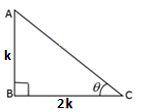
If $\cos \theta=\frac{4}{5}$ , then find the value of tan θ.Sol : We know that, $\cos \theta=\frac{\text { side adjacent to angle } \theta}{\text { hypotenuse }}$ Or $\cos \theta=\frac{\text { base }}{\text { Hypotenuse }}$ $\cos \theta=\frac{4}{5} \Rightarrow \frac{B}{H}=\frac{4}{5} \Rightarrow \frac{B C}{A C}=\frac{4}{5}$ Let, Base =BC = 4k Hypotenuse =AC = 5k Where, k ia any positive integer So, by Pythagoras theorem, we can find the third side of a triangle ⇒ (AB)2 + (BC)2 = (AC)2 ⇒ (AB)2 + (4k)2 = (5k)2 ⇒ (AB)2 + 16k2 = 25k2 ⇒ (AB)2 = 25 k2 –16 k2 ⇒ (AB)2 = 9 k2 ⇒ AB =√9 k2 ⇒ AB =±3k But side AB can’t be negative. So, AB = 3k Now, we have to find tan θ We know that, $\tan \theta=\frac{\text { side opposite to angle } \theta}{\text { side adjacent to angle } \theta}$ Side opposite to angle θ = BC =4k Side adjacent to angle θ = AB =3k So,$\tan \theta=\frac{4 k}{3 k}=\frac{4}{3}$
Question 10 A
If $\tan \theta=\frac{3}{4}$ then find the values of cos θ and sin θ.Sol :We know that, $\tan \theta=\frac{\text { side opposite to angle } \theta}{\text { side adjacent to angle } \theta}$ Or $\tan \theta=\frac{\text { perpendicular }}{\text { base }}$ $\tan \theta=\frac{3}{4}$$\Rightarrow \frac{P}{B}=\frac{3}{4}$$\Rightarrow \frac{\mathrm{AB}}{\mathrm{BC}}=\frac{3}{4}$ Let, The side opposite to angle θ =AB = 3k The side adjacent to angle θ =BC = 4k where k is any positive integer Firstly we have to find the value of AC. So, we can find the value of AC with the help of Pythagoras theorem ⇒ (AB)2 + (BC)2 = (AC)2 ⇒ (3k)2 + (4k)2 = (AC)2 ⇒ (AC)2 = 9 k2+16 k2 ⇒ (AC)2 = 25 k2 ⇒ AC =√25 k2 ⇒ AC =±5k But side AC can’t be negative. So, AC = 5k Now, we will find the sin θ and cos θ $\sin \theta=\frac{\text { side opposite to angle } \theta}{\text { hypotenuse }}$ Side opposite to angle θ = AB = 3k and Hypotenuse = AC = 5k So, $\sin \theta=\frac{A B}{A C}=\frac{3 k}{5 k}=\frac{3}{5}$ Now, We know that $\cos \theta=\frac{\text { side adjacent to angle } \theta}{\text { hypotenuse }}$ Side adjacent to angle θ = BC = 4k and Hypotenuse = AC = 5k So,$\cos \theta=\frac{B C}{A C}=\frac{4 k}{5 k}=\frac{4}{5}$
Question 10 B
If tan A= 4/3. Find the other trigonometric ratios of the angle A.Sol :
We know that,
$\tan \theta=\frac{\text { side opposite to angle } \theta}{\text { side adjacent to angle } \theta}$ Or $\tan \theta=\frac{\text { perpendicular }}{\text { base }}$ Here, θ = A$\tan \mathrm{A}=\frac{4}{3}$$\Rightarrow \frac{P}{B}=\frac{4}{3}$$\Rightarrow \frac{\mathrm{BC}}{\mathrm{AB}}=\frac{4}{3}$Let, The side opposite to angle A =BC = 4k The side adjacent to angle A =AB = 3k where k is any positive integer Firstly we have to find the value of AC. So, we can find the value of AC with the help of Pythagoras theorem ⇒ (AB)2 + (BC)2 = (AC)2 ⇒ (3k)2 + (4k)2 = (AC)2 ⇒ (AC)2 = 9 k2 +16 k2 ⇒ (AC)2 = 25 k2 ⇒ AC =√25 k2 ⇒ AC =±5k But side AC can’t be negative. So, AC = 5k Now, we will find the sin A and cos A $\sin \theta=\frac{\text { side opposite to angle } \theta}{\text { hypotenuse }}$ Side opposite to angle A = BC = 4k and Hypotenuse = AC = 5k So, $\sin A=\frac{B C}{A C}=\frac{4 k}{5 k}=\frac{4}{5}$
Now, We know that $\cos \theta=\frac{\text { side adjacent to angle } \theta}{\text { hypotenuse }}$ Side adjacent to angle A = AB = 3k and Hypotenuse = AC = 5k
So, $\cos A=\frac{A B}{A C}=\frac{3 k}{5 k}=\frac{3}{5}$ Now, we find other trigonometric ratios $\operatorname{cosec} \mathrm{A}=\frac{1}{\sin \mathrm{A}}$ $=\frac{1}{\frac{4}{5}}$ $=\frac{5}{4}$$\sec \mathrm{A}=\frac{1}{\cos \mathrm{A}}$ $=\frac{1}{\frac{3}{5}}$ $=\frac{5}{3}$$\cot A=\frac{1}{\tan A}$ $=\frac{1}{\frac{4}{3}}$ $=\frac{3}{4}$
Question 11
If cot $\theta=\frac{12}{5}$, then find the value of sin θ.Sol : We know that, $\cot \theta=\frac{\text { side adjacent to angle } \theta}{\text { side opposite to angle } \theta}$ Or $\cot \theta=\frac{\text { base }}{\text { perpendicular }}$ $\cot \theta=\frac{12}{5} \Rightarrow \frac{\mathrm{B}}{\mathrm{P}}=\frac{12}{5} \Rightarrow \frac{\mathrm{AB}}{\mathrm{BC}}=\frac{12}{5}$ Let, Side adjacent to angle θ =AB = 12k The side opposite to angle θ =BC = 5k where k is any positive integer Firstly we have to find the value of AC. So, we can find the value of AC with the help of Pythagoras theorem ⇒ (AB)2 + (BC)2 = (AC)2 ⇒ (12k)2 + (5k)2 = (AC)2 ⇒ (AC)2 = 144 k2 +25 k2 ⇒ (AC)2 = 169 k2 ⇒ AC =√169 k2 ⇒ AC =±13k But side AC can’t be negative. So, AC = 13k Now, we will find the sin θ $\sin \theta=\frac{\text { side opposite to angle } \theta}{\text { hypotenuse }}$ Side opposite to angle θ = BC = 5k and Hypotenuse = AC = 13k So, $\sin \theta=\frac{B C}{A C}=\frac{5 k}{13 k}=\frac{5}{13}$
Question 12
If tan $\theta=\frac{5}{12}$, then find the value of cos θ.Sol : We know that, $\tan \theta=\frac{\text { side opposite to angle } \theta}{\text { side adjacent to angle } \theta}$ Or $\tan \theta=\frac{\text { perpendicular }}{\text { base }}$ $\tan \theta=\frac{5}{12} \Rightarrow \frac{\mathrm{P}}{\mathrm{B}}=\frac{5}{12} \Rightarrow \frac{\mathrm{BC}}{\mathrm{AB}}=\frac{5}{12}$ Let, The side opposite to angle θ =BC = 5k The side adjacent to angle θ =AB = 12k where k is any positive integer Firstly we have to find the value of AC. So, we can find the value of AC with the help of Pythagoras theorem ⇒ (AB)2 + (BC)2 = (AC)2 ⇒ (12k)2 + (5k)2 = (AC)2 ⇒ (AC)2 = 144 k2 +25 k2 ⇒ (AC)2 = 169 k2 ⇒ AC =√169 k2 ⇒ AC =±13k But side AC can’t be negative. So, AC = 13k Now, We know that $\cos \theta=\frac{\text { side adjacent to angle } \theta}{\text { hypotenuse }}$ Side adjacent to angle θ = AB = 12k and Hypotenuse = AC = 13k So, $\cos \theta=\frac{A B}{A C}=\frac{12 k}{13 k}=\frac{12}{13}$
Question 13
If sin $\theta=\frac{12}{13}$, then find the value of cos θ and tan θ.Sol : Given: $\sin \theta=\frac{12}{13}$ We know that, $\sin \theta=\frac{\text { side opposite to angle } \theta}{\text { hypotenuse }}$ Or $\sin \theta=\frac{\text { Perpendicular }}{\text { Hypotenuse }}$ $\sin \theta=\frac{12}{13} \Rightarrow \frac{\mathrm{P}}{\mathrm{H}}=\frac{12}{13} \Rightarrow \frac{\mathrm{AB}}{\mathrm{AC}}=\frac{12}{13}$ Let, Side opposite to angle θ = 12k and Hypotenuse = 13k where, k is any positive integer So, by Pythagoras theorem, we can find the third side of a triangle ⇒ (AB)2 + (BC)2 = (AC)2 ⇒ (12k)2 + (BCk)2 = (13)2 ⇒ 144 k2 + (BC)2 = 169 k2 ⇒ (BC)2 = 169 k2 –144 k2 ⇒ (BC)2 = 25 k2 ⇒ BC =√25 k2 ⇒ BC =±5k But side BC can’t be negative. So, BC = 5k Now, we have to find the value of cos θ and tan θ We know that, $\cos \theta=\frac{\text { side adjacent to angle } \theta}{\text { hypotenuse }}$ Side adjacent to angle θ = BC =5k Hypotenuse = AC =13k So, $\cos \theta=\frac{5 \mathrm{k}}{13 \mathrm{k}}=\frac{5}{13}$ Now, tan θ We know that, $\tan \theta=\frac{\text { side opposite to angle } \theta}{\text { side adjacent to angle } \theta}$ side opposite to angle θ = AB =12k Side adjacent to angle θ = BC =5k So, $\tan \theta=\frac{12 \mathrm{k}}{5 \mathrm{k}}=\frac{12}{5}$
Question 14
If tan θ =0.75, then find the value of sin θ.Sol :We know that, $\tan \theta=\frac{\text { side opposite to angle } \theta}{\text { side adjacent to angle } \theta}$ Or $\tan \theta=\frac{\text { perpendicular }}{\text { base }}$Given: tan θ =0.75 $\Rightarrow \tan \theta=\frac{75}{100}=\frac{3}{4}$ $\tan \theta=\frac{3}{4} \Rightarrow \frac{\mathrm{P}}{\mathrm{B}}=\frac{3}{4} \Rightarrow \frac{\mathrm{BC}}{\mathrm{AB}}=\frac{3}{4}$ Let, The side opposite to angle θ =BC = 3k The side adjacent to angle θ =AB = 4k Firstly we have to find the value of AC. So, we can find the value of AC with the help of Pythagoras theorem ⇒ (AB)2 + (BC)2 = (AC)2 ⇒ (4k)2 + (3k)2 = (AC)2 ⇒ (AC)2 = 16 k2 +9 k2 ⇒ (AC)2 = 25 k2 ⇒ AC =√25 k2 ⇒ AC =±5k But side AC can’t be negative. So, AC = 5k Now, we will find the sin θ $\sin \theta=\frac{\text { side opposite to angle } \theta}{\text { hypotenuse }}$ Side opposite to angle θ = BC = 3k and Hypotenuse = AC = 5k So, $\sin \theta=\frac{B C}{A C}=\frac{3 k}{5 k}=\frac{3}{5}$
Question 15
If tan B= √3, then find the values of sin B and cos B.Sol :We know that, $\tan \theta=\frac{\text { side opposite to angle } \theta}{\text { side adjacent to angle } \theta}$ Or $\tan \theta=\frac{\text { perpendicular }}{\text { base }}$ Given: tan B = √3 $\Rightarrow \tan \mathrm{B}=\frac{\sqrt{3}}{1}$ $\tan \mathrm{B}=\frac{\sqrt{3}}{1} \Rightarrow \frac{\mathrm{P}}{\mathrm{B}}=\frac{\sqrt{3}}{1} \Rightarrow \frac{\mathrm{AC}}{\mathrm{AB}}=\frac{\sqrt{3}}{1}$ Let, Side opposite to angle B =AC = √3k The side adjacent to angle B =AB = 1k where k is any positive integer Firstly we have to find the value of BC. So, we can find the value of AC with the help of Pythagoras theorem ⇒ (AB)2 + (AC)2 = (BC)2 ⇒ (1k)2 + (√3k)2 = (BC)2 ⇒ (BC)2 = 1 k2 +3 k2 ⇒ (BC)2 = 4 k2 ⇒ BC =√2 k2 ⇒ BC =±2k But side BC can’t be negative. So, BC = 2k Now, we will find the sin B and cos B $\sin \theta=\frac{\text { side opposite to angle } \theta}{\text { hypotenuse }}$ Side opposite to angle B = AC = k√3 and Hypotenuse = BC = 2k So, $\sin \mathrm{B}=\frac{\mathrm{AC}}{\mathrm{BC}}=\frac{\mathrm{k} \sqrt{3}}{2 \mathrm{k}}=\frac{\sqrt{3}}{2}$ Now, we know that, $\cos \theta=\frac{\text { side adjacent to angle } \theta}{\text { hypotenuse }}$ The side adjacent to angle B = AB =1k Hypotenuse = BC =2k So, $\cos \mathrm{B}=\frac{\mathrm{AB}}{\mathrm{BC}}=\frac{1 \mathrm{k}}{2 \mathrm{k}}=\frac{1}{2}$
Question 16
If $\tan \theta=\frac{\mathrm{m}}{\mathrm{n}}$, then find the values of cos θ and sin θ.Sol :We know that, $\tan \theta=\frac{\text { side opposite to angle } \theta}{\text { side adjacent to angle } \theta}$ Or $\tan \theta=\frac{\text { perpendicular }}{\text { base }}$ Here, $\tan \theta=\frac{\mathrm{m}}{\mathrm{n}}$ So, Side opposite to angle θ =AC = m The side adjacent to angle θ =AB = n Firstly we have to find the value of BC. So, we can find the value of AC with the help of Pythagoras theorem ⇒ (AB)2 + (AC)2 = (BC)2 ⇒ (n)2 + (m)2 = (BC)2 ⇒ (BC)2 = m2 + n2 ⇒ BC =√ m2 + n2 So, BC =√(m2 + n2) Now, we will find the sin B and cos B $\sin \theta=\frac{\text { side opposite to angle } \theta}{\text { hypotenuse }}$ Side opposite to angle θ = AC = m and Hypotenuse = BC =√(m2 + n2) So, $\sin \theta=\frac{A C}{B C}=\frac{m}{\sqrt{m^{2}+n^{2}}}$
Now, we know that, $\cos \theta=\frac{\text { side adjacent to angle } \theta}{\text { hypotenuse }}$ Side adjacent to angle θ = AB =n Hypotenuse = BC =√(m2 + n2) So, $\cos \theta=\frac{A B}{B C}=\frac{n}{\sqrt{m^{2}+n^{2}}}$
Question 17
If sin θ = √3 cos θ, then find the values of cos θ and sin θ.Sol : Given : sin θ =√3cos θ $\Rightarrow \frac{\sin \theta}{\cos \theta}=\sqrt{3}$ ⇒ tan θ =√3 We know that, $\tan \theta=\frac{\text { side opposite to angle } \theta}{\text { side adjacent to angle } \theta}$ Or $\tan \theta=\frac{\text { perpendicular }}{\text { base }}$ and tan θ = √3 $\Rightarrow \tan \theta=\frac{\sqrt{3}}{1}$ $\tan \theta=\frac{\sqrt{3}}{1} \Rightarrow \frac{\mathrm{P}}{\mathrm{B}}=\frac{\sqrt{3}}{1} \Rightarrow \frac{\mathrm{AC}}{\mathrm{AB}}=\frac{\sqrt{3}}{1}$ Let, The side opposite to angle θ =AC = k√3 The side adjacent to angle θ =AB = 1k where k is any positive integer Firstly we have to find the value of BC. So, we can find the value of AC with the help of Pythagoras theorem ⇒ (AB)2 + (AC)2 = (BC)2 ⇒ (1k)2 + (k√3)2 = (BC)2 ⇒ (BC)2 = 1 k2 +3 k2 ⇒ (BC)2 = 4 k2 ⇒ BC =√2 k2 ⇒ BC =±2k But side BC can’t be negative. So, BC = 2k Now, we will find the sin θ and cos θ $\sin \theta=\frac{\text { side opposite to angle } \theta}{\text { hypotenuse }}$ Side opposite to angle θ = AC = k√3 and Hypotenuse = BC = 2k So,$\sin \theta=\frac{\mathrm{AC}}{\mathrm{BC}}=\frac{\mathrm{k} \sqrt{3}}{2 \mathrm{k}}=\frac{\sqrt{3}}{2}$ Now, we know that, $\cos \theta=\frac{\text { side adjacent to angle } \theta}{\text { hypotenuse }}$ The side adjacent to angle θ = AB =1k Hypotenuse = BC =2k So, $\cos \theta=\frac{A B}{B C}=\frac{1 k}{2 k}=\frac{1}{2}$
Question 18 A
If $\cot \theta=\frac{21}{20}$, then find the values of cos θ and sin θ.Sol : We know that, $\cot \theta=\frac{\text { side adjacent to angle } \theta}{\text { side opposite to angle } \theta}$ Or $\cot \theta=\frac{\text { base }}{\text { perpendicular }}$ $\cot \theta=\frac{21}{20} \Rightarrow \frac{\mathrm{B}}{\mathrm{P}}=\frac{21}{20} \Rightarrow \frac{\mathrm{AB}}{\mathrm{BC}}=\frac{21}{20}$ Let, Side adjacent to angle θ =AB = 21k The side opposite to angle θ =BC = 20k where k is any positive integer Firstly we have to find the value of AC. So, we can find the value of AC with the help of Pythagoras theorem ⇒ (AB)2 + (BC)2 = (AC)2 ⇒ (21k)2 + (20k)2 = (AC)2 ⇒ (AC)2 = 441 k2 +400 k2 ⇒ (AC)2 = 841 k2 ⇒ AC =√841 k2 ⇒ AC =±29k But side AC can’t be negative. So, AC = 29k Now, we will find the sin θ $\sin \theta=\frac{\text { side opposite to angle } \theta}{\text { hypotenuse }}$ Side opposite to angle θ = BC = 20k and Hypotenuse = AC = 29k So, $\sin \theta=\frac{B C}{A C}=\frac{20 k}{29 k}=\frac{20}{29}$ Now, we know that, $\cos \theta=\frac{\text { side adjacent to angle } \theta}{\text { hypotenuse }}$ Side adjacent to angle θ = AB =21k Hypotenuse = AC =29k So, $\cos \theta=\frac{\mathrm{AB}}{\mathrm{AC}}=\frac{21 \mathrm{k}}{29 \mathrm{k}}=\frac{21}{29}$
Question 18 B
If 15 cot A=18, find sin A and sec A.Sol : Given: 15 cot A = 8 $\Rightarrow \cot A=\frac{8}{15}$ And we know that, $\cot \theta=\frac{\text { side adjacent to angle } \theta}{\text { side opposite to angle } \theta}$ Or $\cot \theta=\frac{\text { base }}{\text { perpendicular }}$ $\cot \mathrm{A}=\frac{8}{15} \Rightarrow \frac{\mathrm{B}}{\mathrm{P}}=\frac{8}{15} \Rightarrow \frac{\mathrm{BC}}{\mathrm{AC}}=\frac{8}{15}$ Let, Side adjacent to angle A =AB = 8k The side opposite to angle A =BC = 15k where k is any positive integer Firstly we have to find the value of AC. So, we can find the value of AC with the help of Pythagoras theorem ⇒ (AB)2 + (BC)2 = (AC)2 ⇒ (8k)2 + (15k)2 = (AC)2 ⇒ (AC)2 = 64 k2 +225 k2 ⇒ (AC)2 = 289 k2 ⇒ AC =√289 k2 ⇒ AC =±17k But side AC can’t be negative. So, AC = 17k Now, we will find the sin θ $\sin \theta=\frac{\text { side opposite to angle } \theta}{\text { hypotenuse }}$ Side opposite to angle θ = BC = 15k and Hypotenuse = AC = 17k So, $\sin \theta=\frac{B C}{A C}=\frac{15 k}{17 k}=\frac{15}{17}$ Now, we know that, $\cos \theta=\frac{\text { side adjacent to angle } \theta}{\text { hypotenuse }}$ The side adjacent to angle θ = AB =8 Hypotenuse = AC =17 So, $\cos \theta=\frac{A B}{A C}=\frac{8 k}{17 k}=\frac{8}{17}$ $\therefore \sec \theta=\frac{1}{\cos \theta}$$=\frac{1}{\frac{8}{17}}$$=\frac{17}{8}$
Question 19
If sin θ = cos θ and 0° < θ <90°, then find the values of sin θ and cos θ.Sol : Given: sinθ = cosθ $\Rightarrow \frac{\sin \theta}{\cos \theta}=1$ ⇒ tan θ = 1$\tan \theta=\frac{1}{1} \Rightarrow \frac{P}{B}=\frac{1}{1} \Rightarrow \frac{A B}{B C}=\frac{1}{1}$ Let, Side opposite to angle θ = AB =1k The side adjacent to angle θ = BC =1k where k is any positive integer Firstly we have to find the value of AC. So, we can find the value of AC with the help of Pythagoras theorem ⇒ (AB)2 + (BC)2 = (AC)2 ⇒ (1k)2 + (1k)2 = (AC)2 ⇒ (AC)2 = 1k2 +1k2 ⇒ (AC)2 = 2k2 ⇒ AC =√2k2 ⇒ AC =k√2 So, AC = k√2 Now, we will find the sin θ $\sin \theta=\frac{\text { side opposite to angle } \theta}{\text { hypotenuse }}$ Side opposite to angle θ = AB= 1k and Hypotenuse = AC = k√2 So, $\sin \theta=\frac{A B}{A C}=\frac{1 k}{k \sqrt{2}}=\frac{1}{\sqrt{2}}$
Now, we know that, $\cos \theta=\frac{\text { side adjacent to angle } \theta}{\text { hypotenuse }}$ The side adjacent to angle θ = BC =1k Hypotenuse = AC =k√2 So, $\cos \theta=\frac{B C}{A C}=\frac{1 k}{k \sqrt{2}}=\frac{1}{\sqrt{2}}$
Question 20
If $\sin \theta=\frac{x^{2}-y^{2}}{x^{2}+y^{2}}$, then find the values of cos θ and $\frac{1}{\tan \theta}$.Sol : $\sin \theta=\frac{x^{2}-y^{2}}{x^{2}+v^{2}}$ We know that, $\sin \theta=\frac{\text { side opposite to angle } \theta}{\text { hypotenuse }}$ Or, $\sin \theta=\frac{\text { Perpendicular }}{\text { hypotenuse }}$$\sin \theta=\frac{x^{2}-y^{2}}{x^{2}+y^{2}}$ $\Rightarrow \frac{\mathrm{P}}{\mathrm{H}}=\frac{\mathrm{x}^{2}-\mathrm{y}^{2}}{\mathrm{x}^{2}+\mathrm{y}^{2}}$ $ \Rightarrow \frac{\mathrm{AB}}{\mathrm{AC}}=\frac{\mathrm{x}^{2}-\mathrm{y}^{2}}{\mathrm{x}^{2}+\mathrm{y}^{2}}$Let, Side opposite to angle θ = AB = x2 – y2 and Hypotenuse = AC = x2 + y2 In right angled ∆ABC, we have (AB)2 + (BC)2 = (AC)2 [by using Pythagoras theorem] ⇒ (x2 – y2 )2 + (BC)2 = (x2 + y2 )2 ⇒ (BC)2 = (x2 + y2 )2 – (x2 – y2 )2 Using the identity, a2 – b2 = (a+b)(a – b) ⇒ (BC)2 = [(x2 + y2 + x2 – y2 )][ x2 + y2 –( x2 – y2)] ⇒ (BC)2 = (2x2)(2y2) ⇒ (BC)2 = (4x2y2) ⇒ BC =√4x2y2 ⇒ BC = ±2xy ⇒ BC = 2xy [taking positive square root since, side cannot be negative] $\therefore \cos \theta=\frac{\text { Base }}{\text { Hypotenuse }}=\frac{\text { BC }}{\text { AC }}=\frac{2 x y}{x^{2}+y^{2}}$ and $\tan \theta=\frac{\text { Perpendicular }}{\text { Base }}=\frac{\mathrm{AB}}{\mathrm{BC}}=\frac{\mathrm{x}^{2}-\mathrm{y}^{2}}{2 \mathrm{xy}}$ So, $\frac{1}{\tan \theta}=\frac{1}{\frac{x^{2}-y^{2}}{2 x y}}=\frac{2 x y}{x^{2}-y^{2}}$
Question 21
Iftan $\theta=\frac{\sqrt{\mathrm{m}^{2}-\mathrm{n}^{2}}}{\mathrm{n}}$, then find the values of sin θ and cos θ.Sol : Given: $\tan \theta=\frac{\sqrt{\mathrm{m}^{2}-\mathrm{n}^{2}}}{\mathrm{n}}$ We know that, $\tan \theta=\frac{\sqrt{\mathrm{m}^{2}-\mathrm{n}^{2}}}{\mathrm{n}} \Rightarrow \frac{\mathrm{P}}{\mathrm{B}}=\frac{\sqrt{\mathrm{m}^{2}-\mathrm{n}^{2}}}{\mathrm{n}} \Rightarrow \frac{\mathrm{AB}}{\mathrm{BC}}=\frac{\sqrt{\mathrm{m}^{2}-\mathrm{n}^{2}}}{\mathrm{n}}$ Let, AB = √(m2 – n2) and BC = n In right angled ∆ABC, we have (AB)2 + (BC)2 = (AC)2 [by using Pythagoras theorem] ⇒ (√(m2 – n2))2 + (n)2 = (AC )2 ⇒ m2 – n2 + n2 = (AC )2 ⇒ (AC)2 = (m2) ⇒ AC =√ m2 ⇒ AC = ±m ⇒ AC = m [taking positive square root since, side cannot be negative] Now, we have to find the value of cos θ and sin θ We, know that $\cos \theta=\frac{\text { Base }}{\text { Hypotenuse }}$ $=\frac{\mathrm{BC}}{\mathrm{AC}}=\frac{\mathrm{n}}{\mathrm{m}}$ and $\sin \theta=\frac{\text { Perpendicular }}{\text { Hypotenuse }}$ $=\frac{A B}{A C}=\frac{\sqrt{m^{2}-n^{2}}}{m}$
Question 22 A
If sec θ = 2, then find the values of other t–ratios of angle θ.Sol : Given: sec θ = 2We know that, $\sec \theta=\frac{\text { hypotenuse }}{\text { base }}$ $\operatorname{Sec} \theta=\frac{2}{1} \Rightarrow \frac{\mathrm{H}}{\mathrm{B}}=\frac{2}{1} \Rightarrow \frac{\mathrm{AC}}{\mathrm{BC}}=\frac{2}{1}$ Let, BC = 1k and AC = 2k where, k is any positive integer. In right angled ∆ABC, we have (AB)2 + (BC)2 = (AC)2 [by using Pythagoras theorem] ⇒ (AB)2 + (1k)2 = (2k )2 ⇒ (AB)2 + k2 = 4k2 ⇒ (AB)2 = 4k2 – k2 ⇒ (AB)2 = 3k2 ⇒ AB = k√3 Now, we have to find the value of other trigonometric ratios. We, know that $\sin \theta=\frac{\text { Perpendicular }}{\text { Hypotenuse }}$ $=\frac{A B}{A C}=\frac{k \sqrt{3}}{2 k}=\frac{\sqrt{3}}{2}$ $\cos \theta=\frac{\text { Base }}{\text { Hypotenuse }}$ $=\frac{\mathrm{BC}}{\mathrm{AC}}=\frac{1 \mathrm{k}}{2 \mathrm{k}}=\frac{1}{2}$$\tan \theta=\frac{\text { Perpendicular }}{\text { Base }}$ $=\frac{\mathrm{AB}}{\mathrm{BC}}=\frac{\mathrm{k} \sqrt{3}}{1 \mathrm{k}}=\frac{\sqrt{3}}{1}=\sqrt{3}$ $\operatorname{cosec} \theta=\frac{1}{\sin \theta}=\frac{1}{\frac{\sqrt{3}}{2}}=\frac{2}{\sqrt{3}}$ $\cot \theta=\frac{1}{\tan \theta}=\frac{1}{\sqrt{3}}$
Question 22 B
Given $\sec \theta=\frac{13}{12}$ calculate all other trigonometric ratios.Sol :
Given: $\sec \theta=\frac{13}{12}$
We know that, $\sec \theta=\frac{\text { hypotenuse }}{\text { base }}$ $\sec \theta=\frac{13}{12} \Rightarrow \frac{\mathrm{H}}{\mathrm{B}}=\frac{13}{12} \Rightarrow \frac{\mathrm{AC}}{\mathrm{BC}}=\frac{13}{12}$ Let, BC = 12k and AC = 13k where, k is any positive integer. In right angled ∆ABC, we have (AB)2 + (BC)2 = (AC)2 [by using Pythagoras theorem] ⇒ (AB)2 + (12k)2 = (13k )2 ⇒ (AB)2 + 144k2 = 169k2 ⇒ (AB)2 = 169k2 – 144k2 ⇒ (AB)2 = 25k2 ⇒ AB = √25k2 ⇒ AB =±5k [taking positive square root since, side cannot be negative] Now, we have to find the value of other trigonometric ratios. We, know that $\sin \theta=\frac{\text { Perpendicular }}{\text { Hypotenuse }}$ $=\frac{A B}{A C}=\frac{5 k}{13 k}=\frac{5}{13}$ $\cos \theta=\frac{\text { Base }}{\text { Hypotenuse }}$ $=\frac{B C}{A C}=\frac{12 k}{13 k}=\frac{12}{13}$$\tan \theta=\frac{\text { Perpendicular }}{\text { Base }}$ $=\frac{A B}{B C}=\frac{5 k}{12 k}=\frac{5}{12}$$\operatorname{cosec} \theta=\frac{1}{\sin \theta}=\frac{1}{\frac{5}{13}}=\frac{13}{5}$$\cot \theta=\frac{1}{\tan \theta}=\frac{1}{\frac{5}{12}}=\frac{12}{5}$
Question 23
If $\operatorname{cosec} \theta=\sqrt{10}$, then find the values of other t–ratios of angle θ.Sol : We know that, $\operatorname{cosec} \theta=\frac{\text { hypotenuse }}{\text { perpendicular }}$ $\operatorname{cosec} \theta=\frac{\sqrt{10}}{1} \Rightarrow \frac{\mathrm{H}}{\mathrm{P}}=\frac{\sqrt{10}}{1} \Rightarrow \frac{\mathrm{AC}}{\mathrm{AB}}=\frac{\sqrt{10}}{1}$ Let, AB = 1k and AC = k√10 where, k is any positive integer. In right angled ∆ABC, we have (AB)2 + (BC)2 = (AC)2 [by using Pythagoras theorem] ⇒ (1k )2+ (BC)2 = (k√10)2 ⇒ (BC)2 = 10k2 – k2 ⇒ (BC)2 = 9k2 ⇒ BC = √9k2 ⇒ BC =±3k [taking positive square root since, side cannot be negative] Now, we have to find the value of other trigonometric ratios. We, know that $\sin \theta=\frac{\text { Perpendicular }}{\text { Hypotenuse }}$ $=\frac{\mathrm{AB}}{\mathrm{AC}}=\frac{1 \mathrm{k}}{\mathrm{k} \sqrt{10}}=\frac{1}{\sqrt{10}}$$\cos \theta=\frac{\text { Base }}{\text { Hypotenuse }}$ $=\frac{B C}{A C}=\frac{3 k}{k \sqrt{10}}=\frac{3}{\sqrt{10}}$$\tan \theta=\frac{\text { Perpendicular }}{\text { Base }}$ $=\frac{\mathrm{AB}}{\mathrm{BC}}=\frac{1 \mathrm{k}}{3 \mathrm{k}}=\frac{1}{3}$$\sec \theta=\frac{1}{\cos \theta}=\frac{1}{\frac{3}{\sqrt{10}}}=\frac{\sqrt{10}}{3}$$\cot \theta=\frac{1}{\tan \theta}=\frac{1}{\frac{1}{3}}=3$
Question 24 A
If $\tan \mathrm{A}=\frac{\sqrt{3}}{2}$ then find the values of sin A + cos A.Sol :We know that, $\tan \theta=\frac{\text { side opposite to angle } \theta}{\text { side adjacent to angle } \theta}$ Or $\tan \theta=\frac{\text { perpendicular }}{\text { base }}$ Given: $\tan \mathrm{A}=\frac{\sqrt{3}}{2}$ $\Rightarrow \tan \mathrm{A}=\frac{\sqrt{3}}{2}$ $\tan \mathrm{A}=\frac{\sqrt{3}}{2} \Rightarrow \frac{\mathrm{P}}{\mathrm{B}}=\frac{\sqrt{3}}{2} \Rightarrow \frac{\mathrm{BC}}{\mathrm{AB}}=\frac{\sqrt{3}}{2}$ Let, Side opposite to angle A =BC = k√3 Side adjacent to angle A =AB = 2k where, k is any positive integer Firstly we have to find the value of BC. So, we can find the value of AC with the help of Pythagoras theorem ⇒ (AB)2 + (BC)2 = (AC)2 ⇒ (2k)2 + (√3k)2 = (AC)2 ⇒ (AC)2 = 4 k2 +3 k2 ⇒ (AC)2 = 7 k2 ⇒ AC =√7 k2 ⇒ AC =k√7 So, AC = k√7
Now, we will find the sin A and cos A $\sin \theta=\frac{\text { side opposite to angle } \theta}{\text { hypotenuse }}$ Side opposite to angle A = BC = k√3 and Hypotenuse = AC = k√7 So, $\sin \mathrm{A}=\frac{\mathrm{BC}}{\mathrm{AC}}=\frac{\mathrm{k} \sqrt{3}}{\mathrm{k} \sqrt{7}}=\frac{\sqrt{3}}{\sqrt{7}}$
Now, we know that, $\cos \theta=\frac{\text { side adjacent to angle } \theta}{\text { hypotenuse }}$ Side adjacent to angle A = AB =2k Hypotenuse = AC = k√7 So, $\cos \mathrm{A}=\frac{\mathrm{AB}}{\mathrm{AC}}=\frac{2 \mathrm{k}}{\mathrm{k} \sqrt{7}}=\frac{2}{\sqrt{7}}$ Now, we have to find sin A +cos A
Putting values of sin A and cos A, we get $\sin \mathrm{A}+\cos \mathrm{A}=\frac{\sqrt{3}}{\sqrt{7}}+\frac{2}{\sqrt{7}}=\frac{\sqrt{3}+2}{\sqrt{7}}$
Question 24 B
If $\sin \theta=\sqrt{3} \cos \theta$ find the value of cos θ – sin θ.Sol : Given: sin θ =√3cos θ $\Rightarrow \frac{\sin \theta}{\cos \theta}=\sqrt{3}$ ⇒ tan θ = √3We know that, $\tan \theta=\frac{\text { side opposite to angle } \theta}{\text { side adjacent to angle } \theta}$ Or $\tan \theta=\frac{\text { perpendicular }}{\text { base }}$ Given: tan θ = √3 $\Rightarrow \tan \theta=\frac{\sqrt{3}}{1}$ $\tan \theta=\frac{\sqrt{3}}{1} \Rightarrow \frac{\mathrm{P}}{\mathrm{B}}=\frac{\sqrt{3}}{1} \Rightarrow \frac{\mathrm{AC}}{\mathrm{AB}}=\frac{\sqrt{3}}{1}$ Let, Side opposite to angle θ =AC = √3k Side adjacent to angle θ =AB = 1k where k is any positive integer Firstly we have to find the value of BC. So, we can find the value of AC with the help of Pythagoras theorem ⇒ (AB)2 + (AC)2 = (BC)2 ⇒ (1k)2 + (√3k)2 = (BC)2 ⇒ (BC)2 = 1 k2 +3 k2 ⇒ (BC)2 = 4 k2 ⇒ BC =√2 k2 ⇒ BC =±2k But side BC can’t be negative. So, BC = 2k
Now, we will find the sin B and cos B $\sin \theta=\frac{\text { side opposite to angle } \theta}{\text { hypotenuse }}$ Side opposite to angle θ = AC = k√3 and Hypotenuse = BC = 2k So, $\sin \theta=\frac{\mathrm{AC}}{\mathrm{BC}}=\frac{\mathrm{k} \sqrt{3}}{2 \mathrm{k}}=\frac{\sqrt{3}}{2}$
Now, we know that, $\cos \theta=\frac{\text { side adjacent to angle } \theta}{\text { hypotenuse }}$ The side adjacent to angle θ = AB =1k Hypotenuse = BC =2k So, $\cos \theta=\frac{A B}{B C}=\frac{1 k}{2 k}=\frac{1}{2}$ Now, we have to find the value of cos θ – sin θ Putting the values of sin θ and cos θ, we get $\cos \theta-\sin \theta=\frac{1}{2}-\frac{\sqrt{3}}{2}=\frac{1-\sqrt{3}}{2}$
Question 24 C
If $\tan \theta=\frac{8}{15}$, find the value of 1+ cos2 θ.Sol :We know that, $\tan \theta=\frac{\text { side opposite to angle } \theta}{\text { side adjacent to angle } \theta}$ Or $\tan \theta=\frac{\text { perpendicular }}{\text { base }}$ $\tan \theta=\frac{8}{15} \Rightarrow \frac{\mathrm{P}}{\mathrm{B}}=\frac{8}{15} \Rightarrow \frac{\mathrm{AB}}{\mathrm{BC}}=\frac{8}{15}$ Let, Side opposite to angle θ =AB = 8k Side adjacent to angle θ =BC = 15k where, k is any positive integer Firstly we have to find the value of AC. So, we can find the value of AC with the help of Pythagoras theorem ⇒ (AB)2 + (BC)2 = (AC)2 ⇒ (8k)2 + (15k)2 = (AC)2 ⇒ (AC)2 = 64k2+225k2 ⇒ (AC)2 = 289 k2 ⇒ AC =√289 k2 ⇒ AC =±17k But side AC can’t be negative. So, AC = 17k Now, we will find the cos θ
We know that $\cos \theta=\frac{\text { side adjacent to angle } \theta}{\text { hypotenuse }}$ Side adjacent to angle θ = BC = 15k and Hypotenuse = AC = 17k So, $\cos \theta=\frac{B C}{A C}=\frac{15 k}{17 k}=\frac{15}{17}$ Now, we have to find the value of 1+ cos2 θ
Putting the value of cos θ, we get $1+\cos ^{2} \theta=1+\left(\frac{15}{17}\right)^{2}$$=1+\frac{225}{289}$$=\frac{289+225}{289}$$=\frac{514}{289}$
Question 25
If $\cot \theta=\frac{7}{8}$, evaluate(i) $\frac{(1+\sin \theta)(1-\sin \theta)}{(1+\cos \theta)(1-\cos \theta)}$ (ii) $\cot ^{2} \theta$Sol :Given: $\cot \theta=\frac{7}{8}$ We know that, $\cot \theta=\frac{\text { side adjacent to angle } \theta}{\text { side opposite to angle } \theta}$ Or $\cot \theta=\frac{\text { base }}{\text { perpendicular }}$ $\cot \theta=\frac{7}{8} \Rightarrow \frac{\mathrm{B}}{\mathrm{P}}=\frac{7}{8} \Rightarrow \frac{\mathrm{AB}}{\mathrm{BC}}=\frac{7}{8}$ Let, Side adjacent to angle θ =AB = 7k Side opposite to angle θ =BC = 8k where, k is any positive integer Firstly we have to find the value of AC. So, we can find the value of AC with the help of Pythagoras theorem ⇒ (AB)2 + (BC)2 = (AC)2 ⇒ (7k)2 + (8k)2 = (AC)2 ⇒ (AC)2 = 49 k2 +69 k2 ⇒ (AC)2 = 113 k2 ⇒ AC =√113 k2 ⇒ AC =k√113 $\therefore \sin \theta=\frac{\mathrm{P}}{\mathrm{H}}=\frac{\mathrm{BC}}{\mathrm{AC}}=\frac{8 \mathrm{k}}{\mathrm{k} \sqrt{113}}=\frac{8}{\sqrt{113}}$and $\cos \theta=\frac{B}{H}=\frac{A B}{A C}=\frac{7 k}{k \sqrt{113}}=\frac{7}{\sqrt{113}}$(i) $\frac{(1+\sin \theta)(1-\sin \theta)}{(1+\cos \theta)(1-\cos \theta)}$ We know that, (a+b)(a – b) = (a2 – b2) So, using this identity, we get $=\frac{(1)^{2}-(\sin \theta)^{2}}{(1)^{2}-(\cos \theta)^{2}}$$=\frac{1-\sin ^{2} \theta}{1-\cos ^{2} \theta}$$=\frac{1-\left(\frac{8}{\sqrt{113}}\right)^{2}}{1-\left(\frac{7}{\sqrt{113}}\right)^{2}}$$=\frac{1-\frac{64}{113}}{1-\frac{49}{113}}$$=\frac{\frac{113-64}{113}}{\frac{113-49}{113}}$$=\frac{49}{64}$(ii) cot2 θ Given $\cot \theta=\frac{7}{8}$$=\left(\frac{7}{8}\right)^{2}$$=\frac{49}{64}$
Question 26 A
If 3 cot A = 4, check whether $\frac{1-\tan ^{2} A}{1+\tan ^{2} A}$=cos2A–sin2 A or not.Sol : Given: 3cot A = 4 $\Rightarrow \cot A=\frac{4}{3}$We know that, $\cot \theta=\frac{\text { side adjacent to angle } \theta}{\text { side opposite to angle } \theta}$ Or $\cot \theta=\frac{\text { base }}{\text { perpendicular }}$ $\cot A=\frac{4}{3} \Rightarrow \frac{B}{P}=\frac{4}{3} \Rightarrow \frac{A B}{B C}=\frac{4}{3}$ Let, Side adjacent to angle A =AB = 4k The side opposite to angle A =BC = 3k where k is any positive integer Firstly we have to find the value of AC. So, we can find the value of AC with the help of Pythagoras theorem ⇒ (AB)2 + (BC)2 = (AC)2 ⇒ (4k)2 + (3k)2 = (AC)2 ⇒ (AC)2 = 16 k2 + 9 k2 ⇒ (AC)2 = 25 k2 ⇒ AC =√25k2 ⇒ AC = ±5k [taking positive square root since, side cannot be negative] $\therefore \tan \mathrm{A}=\frac{1}{\cot \mathrm{A}}=\frac{1}{\frac{4}{3}}=\frac{3}{4}$ $\sin \mathrm{A}=\frac{\mathrm{P}}{\mathrm{H}}=\frac{\mathrm{BC}}{\mathrm{AC}}=\frac{3 \mathrm{k}}{5 \mathrm{k}}=\frac{3}{5}$ and $\cos A=\frac{B}{H}=\frac{A B}{A C}=\frac{4 k}{5 k}=\frac{4}{5}$
And RHS = cos2 A – sin2 A $=\left(\frac{4}{5}\right)^{2}-\left(\frac{3}{5}\right)^{2}$$=\frac{16}{25}-\frac{9}{25}$$=\frac{7}{25}$ …(ii)
From Eqs. (i) and (ii) LHS =RHS Hence Proved
Question 26 B
In a right triangle ABC, right angled at B, if tan A = 1, then verify that 2 sin A cos A = 1.Sol : tan A = 1 As we know $\tan \theta=\frac{\text { perpedicular }}{\text { base }}$ Now construct a right angle triangle right angled at B such that ∠ BAC = θ Hence perpendicular = BC = 1 and base = AB = 1By Pythagoras theorem, AC2 = AB2 + BC2 ⇒ AC2 = (1)2 + (1)2 ⇒ AC2 = 2 ⇒ AC = As,$\sin \theta=\frac{\text { perpendicular }}{\text { hypotenuse }}$ and $\cos \theta=\frac{\text { base }}{\text { hypotenuse }}$ ⇒ $\sin \theta=\frac{1}{\sqrt{2}}$ and $\cos \theta=\frac{1}{\sqrt{2}}$ Hence, 2 sin A cos A=$2 \times \frac{1}{\sqrt{2}} \times \frac{1}{\sqrt{2}}$ ⇒ 2 sin A cos A=$2 \times \frac{1}{2}$ ⇒ 2 sin A cos A=1 = R.H.S Hence proved.
Question 27
If 4sin2 θ =3 and 0o < θ <90o, find the value of 1 + cos θ.Sol : 4sin2 θ =3 $\Rightarrow \sin ^{2} \theta=\frac{3}{4}$ $\Rightarrow \sin \theta=\pm \frac{\sqrt{3}}{2}$
But it is given 0o< θ <90o So, $\sin \theta=\frac{\sqrt{3}}{2}$ $\sin \theta=\frac{\sqrt{3}}{2} \Rightarrow \frac{\mathrm{P}}{\mathrm{H}}=\frac{\sqrt{3}}{2}$
Let, P =k√3 and H =2k In right angled ∆ABC, we have B2 + P2 = H2 ⇒ B2 + (k√3)2 = (2k)2 ⇒ B2 + 3k2 = 4k2 ⇒ B2 = 4k2 – 3k2 ⇒ B2 = k2 ⇒ B = ±k ⇒ B = k [taking positive square root since, side cannot be negative] $\therefore \cos \theta=\frac{B}{H}=\frac{k}{2 k}=\frac{1}{2}$ So, $1+\cos \theta=1+\frac{1}{2}=\frac{2+1}{2}=\frac{3}{2}$
Question 28
If $\tan \theta=\frac{p}{q}$find the value of $\frac{p \sin \theta-q \cos \theta}{p \sin \theta+q \cos \theta}$.Sol : Given:$\tan \theta=\frac{p}{q}$
If 13 cos θ = 5, $\frac{\sin \theta+\cos \theta}{\sin \theta-\cos \theta}$.Sol : Given: 13 cosθ = 5 $\Rightarrow \cos \theta=\frac{5}{13}$We know that, $\cos \theta=\frac{\text { Base }}{\text { hypotenuse }}$ $\cos \theta=\frac{5}{13} \Rightarrow \frac{B}{H}=\frac{5}{13}$Let AB =5k and BC = 13k In right angled ∆ABC, we have B2 + P2 = H2 ⇒ (5k)2 + P2 = (13k)2 ⇒ P2 + 25k2 = 169k2 ⇒ P2 = 169k2 – 25k2 ⇒ P2 = 144k2 ⇒ P =√144k2 ⇒ P = ±12k ⇒ P = 12k [taking positive square root since, side cannot be negative] $\therefore \sin \theta=\frac{P}{H}=\frac{12}{13}$Now, $\frac{\sin \theta+\cos \theta}{\sin \theta-\cos \theta}$ $=\frac{\frac{12}{13}+\frac{5}{13}}{\frac{12}{13}-\frac{5}{13}}$ $=\frac{17}{7}$
Question 30
If $\sec \theta=\frac{13}{5}$, show that $\frac{2 \sin \theta-3 \cos \theta}{4 \sin \theta-9 \cos \theta}=3$.Sol : Given: $\sec \theta=\frac{13}{5}$We know that, $\sec \theta=\frac{\text { hypotenuse }}{\text { base }}$ $\operatorname{Sec} \theta=\frac{13}{5} \Rightarrow \frac{\mathrm{H}}{\mathrm{B}}=\frac{13}{5} \Rightarrow \frac{\mathrm{AC}}{\mathrm{BC}}=\frac{13}{5}$ Let, BC = 5k and AC = 13k where, k is any positive integer. In right angled ∆ABC, we have (AB)2 + (BC)2 = (AC)2 [by using Pythagoras theorem] ⇒ (AB)2 + (5k)2 = (13k )2 ⇒ (AB)2 + 25k2 = 169k2 ⇒ (AB)2 = 169k2 – 25k2 ⇒ (AB)2 = 144k2 ⇒ AB = √144k2 ⇒ AB =±12k [taking positive square root since, side cannot be negative] Now, we have to find the value of other trigonometric ratios. We, know that $\sin \theta=\frac{\text { Perpendicular }}{\text { Hypotenuse }}$ $=\frac{A B}{A C}=\frac{12 k}{13 k}=\frac{12}{13}$$\cos \theta=\frac{\text { Base }}{\text { Hypotenuse }}$ $=\frac{B C}{A C}=\frac{5 k}{13 k}=\frac{5}{13}$
If 2 tan θ = 1, find the value of $\frac{3 \cos \theta+\sin \theta}{2 \cos \theta-\sin \theta}$.Sol : Given: 2 tan θ = 1 $\Rightarrow \tan \theta=\frac{1}{2}$We know that, $\tan \theta=\frac{\text { side opposite to angle } \theta}{\text { side adjacent to angle } \theta}$ Or $\tan \theta=\frac{\text { perpendicular }}{\text { base }}$ $\tan \theta=\frac{1}{2} \Rightarrow \frac{\mathrm{P}}{\mathrm{B}}=\frac{1}{2} \Rightarrow \frac{\mathrm{AB}}{\mathrm{BC}}=\frac{1}{2}$ Let, Side opposite to angle θ =AB = 1k Side adjacent to angle θ =BC = 2k where, k is any positive integer Firstly we have to find the value of AC. So, we can find the value of AC with the help of Pythagoras theorem ⇒ (AB)2 + (BC)2 = (AC)2 ⇒ (k)2 + (2k)2 = (AC)2 ⇒ (AC)2 = k2+4k2 ⇒ (AC)2 = 5k2 ⇒ AC =√5k2 ⇒ AC =±k√5 But side AC can’t be negative. So, AC = k√5
Now, we will find the sin θ and cos θ
We know that $\cos \theta=\frac{\text { side adjacent to angle } \theta}{\text { hypotenuse }}$ Side adjacent to angle θ = BC = 2k and Hypotenuse = AC = k√5 So,$\cos \theta=\frac{B C}{A C}=\frac{2 k}{k \sqrt{5}}=\frac{2}{\sqrt{5}}$ And $\sin \theta=\frac{\text { side opposite to angle } \theta}{\text { hypotenuse }}$ Side adjacent to angle θ =AB = 1k And Hypotenuse =AC = k√5 So, $\sin \theta=\frac{A B}{A C}=\frac{1 k}{k \sqrt{5}}=\frac{1}{\sqrt{5}}$ Now, $\frac{3 \cos \theta+\sin \theta}{2 \cos \theta-\sin \theta}$ $=\frac{3\left(\frac{2}{\sqrt{5}}\right)+\frac{1}{\sqrt{5}}}{2\left(\frac{2}{\sqrt{5}}\right)-\frac{1}{\sqrt{5}}}$
$=\frac{6+1}{4-1}$
$=\frac{7}{3}$
Question 32
If 5 tan α = 4, show that $\frac{5 \sin \alpha-3 \cos \alpha}{5 \sin \alpha+2 \cos \alpha}=\frac{1}{6}$.Sol : Given: 5 tan = 4 $\Rightarrow \tan \alpha=\frac{4}{5}$We know that, $\tan \theta=\frac{\text { side opposite to angle } \theta}{\text { side adjacent to angle } \theta}$ Or $\tan \theta=\frac{\text { perpendicular }}{\text { base }}$ $\tan \alpha=\frac{4}{5} \Rightarrow \frac{\mathrm{P}}{\mathrm{B}}=\frac{4}{5} \Rightarrow \frac{\mathrm{AB}}{\mathrm{BC}}=\frac{4}{5}$Let, The side opposite to angle α =AB = 4k The side adjacent to angle α =BC = 5k where k is any positive integer Firstly we have to find the value of AC. So, we can find the value of AC with the help of Pythagoras theorem ⇒ (AB)2 + (BC)2 = (AC)2 ⇒ (4k)2 + (5k)2 = (AC)2 ⇒ (AC)2 = 16k2+25k2 ⇒ (AC)2 = 41k2 ⇒ AC =√41k2 ⇒ AC =±k√41 But side AC can’t be negative. So, AC = k√41 Now, we will find the sin α and cos α We know that $\cos \theta=\frac{\text { side adjacent to angle } \theta}{\text { hypotenuse }}$ Side adjacent to angle α = BC = 5k and Hypotenuse = AC = k√41 So, $\cos \alpha=\frac{\mathrm{BC}}{\mathrm{AC}}=\frac{5 \mathrm{k}}{\mathrm{k} \sqrt{41}}=\frac{5}{\sqrt{41}}$ And $\sin \theta=\frac{\text { side opposite to angle } \theta}{\text { hypotenuse }}$ Side adjacent to angle α =AB = 4k And Hypotenuse =AC = k√5 So, $\sin \alpha=\frac{A B}{A C}=\frac{4 k}{k \sqrt{4} 1}=\frac{4}{\sqrt{41}}$
If $\cot \theta=\frac{3}{4}$prove that $\sqrt{\frac{\sec \theta+\operatorname{cosec} \theta}{\sec \theta-\operatorname{cosec} \theta}}=\sqrt{7}$.Sol :We know that, $\cot \theta=\frac{\text { side adjacent to angle } \theta}{\text { side opposite to angle } \theta}$ Or $\cot \theta=\frac{\text { base }}{\text { perpendicular }}$ $\cot \theta=\frac{3}{4} \Rightarrow \frac{\mathrm{B}}{\mathrm{P}}=\frac{3}{4} \Rightarrow \frac{\mathrm{AB}}{\mathrm{BC}}=\frac{3}{4}$ Let, Side adjacent to angle θ =AB = 3k The side opposite to angle θ =BC = 4k where k is any positive integer Firstly we have to find the value of AC. So, we can find the value of AC with the help of Pythagoras theorem ⇒ (AB)2 + (BC)2 = (AC)2 ⇒ (3k)2 + (4k)2 = (AC)2 ⇒ (AC)2 = 9k2 +16k2 ⇒ (AC)2 = 25k2 ⇒ AC =√25k2 ⇒ AC =±5k But side AC can’t be negative. So, AC = 5k
Now, we will find the sin θ $\sin \theta=\frac{\text { side opposite to angle } \theta}{\text { hypotenuse }}$ Side opposite to angle θ = BC = 4k and Hypotenuse = AC = 5k So, $\sin \theta=\frac{B C}{A C}=\frac{4 k}{5 k}=\frac{4}{5}$
Now, we know that, $\cos \theta=\frac{\text { side adjacent to angle } \theta}{\text { hypotenuse }}$ The side adjacent to angle θ = AB =3k Hypotenuse = AC =5k So, $\cos \theta=\frac{A B}{A C}=\frac{3 k}{5 k}=\frac{3}{5}$ $\therefore \sec \theta=\frac{1}{\cos \theta}=\frac{1}{\frac{3}{5}}=\frac{5}{3}$ And $\operatorname{cosec} \theta=\frac{1}{\sin \theta}=\frac{1}{\frac{4}{5}}=\frac{5}{4}$
If $\cot \theta=\frac{1}{\sqrt{3}}$ verify that: $\frac{1-\cos ^{2} \theta}{2-\sin ^{2} \theta}=\frac{3}{5}$.Sol :We know that, $\cot \theta=\frac{\text { side adjacent to angle } \theta}{\text { side opposite to angle } \theta}$ Or $\cot \theta=\frac{\text { base }}{\text { perpendicular }}$ $\cot \theta=\frac{1}{\sqrt{3}} \Rightarrow \frac{\mathrm{B}}{\mathrm{P}}=\frac{1}{\sqrt{3}} \Rightarrow \frac{\mathrm{AB}}{\mathrm{AC}}=\frac{1}{\sqrt{3}}$Let, Side adjacent to angle θ =AB = 1k Side opposite to angle θ =AC = k√3 where, k is any positive integer Firstly we have to find the value of BC. So, we can find the value of AC with the help of Pythagoras theorem ⇒ (AB)2 + (AC)2 = (BC)2 ⇒ (1k)2 + (√3k)2 = (BC)2 ⇒ (BC)2 = 1 k2 +3 k2 ⇒ (BC)2 = 4 k2 ⇒ BC =√2 k2 ⇒ BC =±2k But side BC can’t be negative. So, BC = 2k Now, we will find the sin θ and cos θ $\sin \theta=\frac{\text { side opposite to angle } \theta}{\text { hypotenuse }}$ Side opposite to angle θ = AC = k√3 and Hypotenuse = BC = 2k So$\sin \theta=\frac{\mathrm{AC}}{\mathrm{BC}}=\frac{\mathrm{k} \sqrt{3}}{2 \mathrm{k}}=\frac{\sqrt{3}}{2}$
Now, we know that, $\cos \theta=\frac{\text { side adjacent to angle } \theta}{\text { hypotenuse }}$ Side adjacent to angle θ = AB =1k Hypotenuse = BC =2k So, $\cos \theta=\frac{A B}{B C}=\frac{1 k}{2 k}=\frac{1}{2}$
If $\tan \theta=\frac{x}{y}$ find the value of x sin θ + y cos θ.Sol :
We know that,
$\tan \theta=\frac{\text { side opposite to angle } \theta}{\text { side adjacent to angle } \theta}$ Or $\tan \theta=\frac{\text { perpendicular }}{\text { base }}$ $\tan \theta=\frac{x}{y} \Rightarrow \frac{P}{B}=\frac{x}{y} \Rightarrow \frac{A B}{B C}=\frac{x}{y}$ Let, Side opposite to angle θ =AB = x Side adjacent to angle θ =BC = y where, k is any positive integer Firstly we have to find the value of AC. So, we can find the value of AC with the help of Pythagoras theorem ⇒ (AB)2 + (BC)2 = (AC)2 ⇒ (x)2 + (y)2 = (AC)2 ⇒ (AC)2 = x2+y2 ⇒ AC =√( x2+y2) Now, we will find the sin θ and cos θ We know that $\cos \theta=\frac{\text { side adjacent to angle } \theta}{\text { hypotenuse }}$ Side adjacent to angle θ = BC = y and Hypotenuse = AC = √( x2+y2) So,$\cos \theta=\frac{B C}{A C}=\frac{y}{\sqrt{x^{2}+y^{2}}}$ And $\sin \theta=\frac{\text { side opposite to angle } \theta}{\text { hypotenuse }}$ Side adjacent to angle θ =AB = x And Hypotenuse =AC = √( x2+y2) So, $\sin \theta=\frac{\mathrm{AB}}{\mathrm{AC}}=\frac{\mathrm{x}}{\sqrt{\mathrm{x}^{2}+\mathrm{y}^{2}}}$ Now, x sin θ +y cos θ $=\mathrm{x}\left(\frac{\mathrm{x}}{\sqrt{\mathrm{x}^{2}+\mathrm{y}^{2}}}\right)+\mathrm{y}\left(\frac{\mathrm{y}}{\sqrt{\mathrm{x}^{2}+\mathrm{y}^{2}}}\right)$ $=\frac{x^{2}+y^{2}}{\sqrt{x^{2}+y^{2}}}$ = √( x2+y2)
Question 36
If $\sin \theta=\frac{3}{5}$, find the value of tan2θ + sinθ cosθ + cotθ.Given: $\sin \theta=\frac{3}{5}$We know that, $\sin \theta=\frac{\text { side opposite to angle } \theta}{\text { hypotenuse }}$ Or $\sin \theta=\frac{\text { Perpendicular }}{\text { Hypollyuse }}$ $\sin \theta=\frac{3}{5} \Rightarrow \frac{\mathrm{P}}{\mathrm{H}}=\frac{3}{5} \Rightarrow \frac{\mathrm{AB}}{\mathrm{AC}}=\frac{3}{5}$ Let, Perpendicular =AB =3k and Hypotenuse =AC =5k where, k is any positive integer So, by Pythagoras theorem, we can find the third side of a triangle In right angled ∆ ABC, we have ⇒ (AB)2 + (BC)2 = (AC)2 ⇒ (3k)2 + (BC)2 = (5k)2 ⇒ 9k2 + (BC)2 = 25k2 ⇒ (BC)2 = 25 k2 –9k2 ⇒ (BC)2 = 16k2 ⇒ BC =√16k2 ⇒ BC =±4k But side BC can’t be negative. So, BC = 4k Now, we have to find the value of cos θ and tan θ We know that, $\cos \theta=\frac{\text { base }}{\text { hypotenuse }}$ The side adjacent to angle θ or base = BC =4k Hypotenuse = AC =5k So,$\cos \theta=\frac{4 k}{5 k}=\frac{4}{5}$ Now, We know that, $\tan \theta=\frac{\text { perpendicular }}{\text { base }}$ Perpendicular = AB =3k Base = BC =4k So, $\tan \theta=\frac{3 \mathrm{k}}{4 \mathrm{k}}=\frac{3}{4}$ $\cot \theta=\frac{1}{\tan \theta}=\frac{1}{\frac{3}{4}}=\frac{4}{3}$ Now, tan2 θ + sin θ cos θ + cot θ $=\left(\frac{3}{4}\right)^{2}+\left(\frac{3}{5}\right)\left(\frac{4}{5}\right)+\left(\frac{4}{3}\right)$$=\left(\frac{9}{16}\right)+\left(\frac{13}{25}\right)+\left(\frac{4}{3}\right)$$=\frac{675+576+1600}{16 \times 25 \times 3}$$=\frac{2851}{1200}$
Question 37
If 4cot θ = 3, show that $\frac{\sin \theta+\cos \theta}{\sin \theta-\cos \theta}=7$.Sol : Given: $\cot \theta=\frac{3}{4}$We know that,$\cot \theta=\frac{\text { side adjacent to angle } \theta}{\text { side opposite to angle } \theta}$ Or $\cot \theta=\frac{\text { base }}{\text { perpendicular }}$ $\cot \theta=\frac{3}{4} \Rightarrow \frac{\mathrm{B}}{\mathrm{P}}=\frac{3}{4} \Rightarrow \frac{\mathrm{AB}}{\mathrm{BC}}=\frac{3}{4}$ Let, Side adjacent to angle θ =AB = 3k The side opposite to angle θ =BC = 4k where k is any positive integer Firstly we have to find the value of AC. So, we can find the value of AC with the help of Pythagoras theorem ⇒ (AB)2 + (BC)2 = (AC)2 ⇒ (3k)2 + (4k)2 = (AC)2 ⇒ (AC)2 = 9k2 +16k2 ⇒ (AC)2 = 25k2 ⇒ AC =√25k2 ⇒ AC =±5k But side AC can’t be negative. So, AC = 5k
Now, we will find the sin θ $\sin \theta=\frac{\text { side opposite to angle } \theta}{\text { hypotenuse }}$ Side opposite to angle θ = BC = 4k and Hypotenuse = AC = 5k So, $\sin \theta=\frac{B C}{A C}=\frac{4 k}{5 k}=\frac{4}{5}$
Now, we know that, $\cos \theta=\frac{\text { side adjacent to angle } \theta}{\text { hypotenuse }}$ Side adjacent to angle θ = AB =3k Hypotenuse = AC =5k So, $\cos \theta=\frac{A B}{A C}=\frac{3 k}{5 k}=\frac{3}{5}$
If $\sin \theta=\frac{\mathrm{m}}{\sqrt{\mathrm{m}^{2}+\mathrm{n}^{2}}}$, prove that $\mathrm{m} \sin \theta+\mathrm{n} \cos \theta=\sqrt{\mathrm{m}^{2}+\mathrm{n}^{2}}$Sol : Given: $\sin \theta=\frac{\mathrm{m}}{\sqrt{\mathrm{m}^{2}+\mathrm{n}^{2}}}$We know that, $\sin \theta=\frac{\text { side opposite to angle } \theta}{\text { hypotenuse }}$ Or $\sin \theta=\frac{\text { Perpendicular }}{\text { Hypotenuse }}$ $\sin \theta=\frac{\mathrm{m}}{\sqrt{\mathrm{m}^{2}+\mathrm{n}^{2}}} \Rightarrow \frac{\mathrm{P}}{\mathrm{H}}=\frac{\mathrm{m}}{\sqrt{\mathrm{m}^{2}+\mathrm{n}^{2}}} \Rightarrow \frac{\mathrm{AB}}{\mathrm{AC}}=\frac{\mathrm{m}}{\sqrt{\mathrm{m}^{2}+\mathrm{n}^{2}}}$
Let, Perpendicular =AB =m and Hypotenuse =AC =√(m2 + n2) where, k is any positive integer So, by Pythagoras theorem, we can find the third side of a triangle In right angled ∆ ABC, we have ⇒ (AB)2 + (BC)2 = (AC)2 ⇒ (m)2 + (BC)2 = (√(m2 + n2))2 ⇒ m2 + (BC)2 = m2 + n2 ⇒ (BC)2 = m2 + n2 – m2 ⇒ (BC)2 = n2 ⇒ BC =√n2 ⇒ BC =±n But side BC can’t be negative. So, BC = n Now, we have to find the value of cos θ and tan θ
We know that, $\cos \theta=\frac{\text { base }}{\text { hypotenuse }}$ Side adjacent to angle θ or base = BC =n Hypotenuse = AC =√(m2 + n2) So, $\cos \theta=\frac{n}{\sqrt{m^{2}+n^{2}}}$
Now, LHS = m sin θ +n cosθ $=\mathrm{m}\left(\frac{\mathrm{m}}{\sqrt{\mathrm{m}^{2}+\mathrm{n}^{2}}}\right)+\mathrm{n}\left(\frac{\mathrm{n}}{\sqrt{\mathrm{m}^{2}+\mathrm{n}^{2}}}\right)$ $=\frac{\mathrm{m}^{2}+\mathrm{n}^{2}}{\sqrt{\mathrm{m}^{2}+\mathrm{n}^{2}}}$ =√(m2 + n2) = RHS Hence Proved
Question 39
If $\cos \alpha=\frac{12}{13}$ show that $\sin \alpha(1-\tan \alpha)=\frac{35}{156}$Sol : We know that, $\cos \theta=\frac{\text { side adjacent to angle } \theta}{\text { hypotenuse }}$ Or $\cos \theta=\frac{\text { base }}{\text { Hypotenuse }}$ $\cos \alpha=\frac{12}{13} \Rightarrow \frac{\mathrm{B}}{\mathrm{H}}=\frac{12}{13} \Rightarrow \frac{\mathrm{BC}}{\mathrm{AC}}=\frac{12}{13}$
Let, Base =BC = 12k Hypotenuse =AC = 13k Where, k ia any positive integer So, by Pythagoras theorem, we can find the third side of a triangle ⇒ (AB)2 + (BC)2 = (AC)2 ⇒ (AB)2 + (12k)2 = (13k)2 ⇒ (AB)2 + 144k2 = 169k2 ⇒ (AB)2 = 169 k2 –144 k2 ⇒ (AB)2 = 25 k2 ⇒ AB =√25 k2 ⇒ AB =±5k But side AB can’t be negative. So, AB = 5k Now, we have to find sin α and tan α
We know that, $\sin \theta=\frac{\text { side opposite to angle } \theta}{\text { hypotenuse }}$ Side opposite to angle α = AB =5k And Hypotenuse = AC =13k So, $\sin \alpha=\frac{5 \mathrm{k}}{13 \mathrm{k}}=\frac{5}{13}$
We know that, $\tan \theta=\frac{\text { side opposite to angle } \theta}{\text { side adjacent to angle } \theta}$ Side opposite to angle α = AB =5k Side adjacent to angle α = BC =12k So, $\tan \alpha=\frac{5 \mathrm{k}}{12 \mathrm{k}}=\frac{5}{12}$ Now, LHS = sin α (1 – tan α)
$=\frac{5}{13}\left(1-\frac{5}{12}\right)$
$=\frac{5}{13}\left(\frac{12-5}{12}\right)$
$=\frac{35}{156}$ = RHS Hence Proved
Question 40
If $\mathrm{q} \cos \theta=\sqrt{\mathrm{q}^{2}-\mathrm{p}^{2}}$, prove that q sin θ = p.Sol : Given : q cos θ = √(q2 – p2) $\Rightarrow \cos \theta=\frac{\sqrt{\mathrm{q}^{2}-\mathrm{p}^{2}}}{\mathrm{q}}$
We know that,
$\cos \theta=\frac{\text { side adjacent to angle } \theta}{\text { hypotenuse }}$ Or $\cos \theta=\frac{\text { base }}{\text { Hypotenuse }}$ $\cos \theta=\frac{\sqrt{\mathrm{q}^{2}-\mathrm{p}^{2}}}{\mathrm{q}} \Rightarrow \frac{\mathrm{B}}{\mathrm{H}}=\frac{\sqrt{\mathrm{q}^{2}-\mathrm{p}^{2}}}{\mathrm{q}} \Rightarrow \frac{\mathrm{BC}}{\mathrm{AC}}=\frac{\sqrt{\mathrm{q}^{2}-\mathrm{p}^{2}}}{\mathrm{q}}$
Let, Base =BC = √(q2 – p2) Hypotenuse =AC = q Where, k ia any positive integer So, by Pythagoras theorem, we can find the third side of a triangle ⇒ (AB)2 + (BC)2 = (AC)2 ⇒ (AB)2 + (√(q2 – p2))2 = (q)2 ⇒ (AB)2 + (q2 – p2) = q2 ⇒ (AB)2 = q2 – q2 + p2) ⇒ (AB)2 = p2 ⇒ AB =√p2 ⇒ AB =±p But side AB can’t be negative. So, AB = p Now, we have to find sin θ
We know that, $\sin \theta=\frac{\text { side opposite to angle } \theta}{\text { hypotenuse }}$ The side opposite to angle θ = AB =p And Hypotenuse = AC =q So, $\sin \theta=\left(\frac{p}{q}\right)$ Now, LHS = q sin θ $=\mathrm{q}\left(\frac{\mathrm{p}}{\mathrm{q}}\right)$ = q = RHS Hence Proved
Question 41
If $\sin \theta=\frac{3}{5}$, show that : $\frac{\cos \theta-\frac{1}{\tan \theta}}{2 \cot \theta}=-\frac{1}{5}$Sol : Given: $\sin \theta=\frac{3}{5}$
We know that,
$\sin \theta=\frac{\text { side opposite to angle } \theta}{\text { hypotenuse }}$ Or $\sin \theta=\frac{\text { Perpendicular }}{\text { Hypotenuse }}$ $\sin \theta=\frac{3}{5} \Rightarrow \frac{\mathrm{P}}{\mathrm{H}}=\frac{3}{5} \Rightarrow \frac{\mathrm{AB}}{\mathrm{AC}}=\frac{3}{5}$ Let, Perpendicular =AB =3k and Hypotenuse =AC =5k where, k is any positive integer So, by Pythagoras theorem, we can find the third side of a triangle In right angled ∆ ABC, we have ⇒ (AB)2 + (BC)2 = (AC)2 ⇒ (3k)2 + (BC)2 = (5k)2 ⇒ 9k2 + (BC)2 = 25k2 ⇒ (BC)2 = 25 k2 –9k2 ⇒ (BC)2 = 16k2 ⇒ BC =√16k2 ⇒ BC =±4k But side BC can’t be negative. So, BC = 4k Now, we have to find the value of cos θ and tan θ
We know that, $\cos \theta=\frac{\text { base }}{\text { hypotenuse }}$ The side adjacent to angle θ or base = BC =4k Hypotenuse = AC =5k So, $\cos \theta=\frac{4 k}{5 k}=\frac{4}{5}$ Now, We know that, $\tan \theta=\frac{\text { perpendicular }}{\text { base }}$ Perpendicular = AB =3k Base = BC =4k So, $\tan \theta=\frac{3 \mathrm{k}}{4 \mathrm{k}}=\frac{3}{4}$ $\cot \theta=\frac{1}{\tan \theta}=\frac{1}{\frac{3}{4}}=\frac{4}{3}$ Now, LHS $=\frac{\cos \theta-\frac{1}{\tan \theta}}{2 \cot \theta}$ $=\frac{\left(\frac{4}{5}\right)-\left(\frac{1}{\frac{3}{4}}\right)}{2\left(\frac{4}{3}\right)}$ $=\frac{\left(\frac{4}{5}\right)-\left(\frac{4}{3}\right)}{\left(\frac{8}{3}\right)}$ $=\frac{\frac{12-20}{15}}{\left(\frac{8}{3}\right)}$ $=\frac{\left(-\frac{8}{15}\right)}{\left(\frac{8}{3}\right)}$ $=-\frac{1}{5}$ = RHS Hence Proved
Question 42 A
Find the value ofcos A sin B + sin A. cos B, if sin A= 4/5 and cos B = 12/13. Sol :
Given: $\sin A=\frac{4}{5}$ and $\cos B=\frac{12}{13}$ To find: cos A sin B + sin A cos B As, we have the value of sin A and cos B but we don’t have the value of cos A and sin B So, First we find the value of cos A and sin B $\sin A=\frac{4}{5}$
We know that, $\sin \theta=\frac{\text { side opposite to angle } \theta}{\text { hypotenuse }}$ Or $\sin \theta=\frac{\text { Perpendicular }}{\text { Hypotenuse }}$
$\sin A=\frac{4}{5} \Rightarrow \frac{P}{H}=\frac{4}{5}$ Let, Side opposite to angle A = 4k and Hypotenuse = 5k where, k is any positive integer So, by Pythagoras theorem, we can find the third side of a triangle ⇒ (P)2 + (B)2 = (H)2 ⇒ (4k)2 + (B)2 = (5)2 ⇒ 16 k2 + (B)2 = 25 k2 ⇒ (B)2 = 25 k2 –16 k2 ⇒ (B)2 = 9 k2 ⇒ B =√9 k2 ⇒ B =±3k [taking positive square root since, side cannot be negative] So, Base = 3k Now, we have to find the value of cos A We know that, $\cos \theta=\frac{\text { side adjacent to angle } \theta}{\text { hypotenuse }}$ Side adjacent to angle A =3k Hypotenuse =5k So, $\cos \mathrm{A}=\frac{3 \mathrm{k}}{5 \mathrm{k}}=\frac{3}{5}$ Now, we have to find the sin B
We know that,
$\cos \theta=\frac{\text { side adjacent to angle } \theta}{\text { hypotenuse }}$ $\cos \mathbf{B}=\frac{12}{13} \Rightarrow \frac{B}{H}=\frac{12}{13}$ Let, Side adjacent to angle B =12k Hypotenuse =13k where, k is any positive integer So, by Pythagoras theorem, we can find the third side of a triangle ⇒ (B)2 + (P)2 = (H)2 ⇒ (12k)2 + (P)2 = (13)2 ⇒ 144 k2 + (P)2 = 169 k2 ⇒ (P)2 = 169 k2 –144 k2 ⇒ (P)2 = 25 k2 ⇒ P =√25 k2 ⇒ P =±5k [taking positive square root since, side cannot be negative] So, Perpendicular = 5k Now, we have to find the value of sin B
We know that, $\sin \theta=\frac{\text { Perpendicular }}{\text { Hypotenuse }}$ $\sin \mathrm{B}=\frac{\mathrm{P}}{\mathrm{H}}=\frac{5 \mathrm{k}}{13 \mathrm{k}}=\frac{5}{13}$ Now, cos A sin B + sin A cos B
Putting the values of sin A, sin B cos A and Cos B, we get
Find the value ofsin A. cos B – cos A. sin B, if tan A= √3 and sin B = 1/2. Sol :
Given: tan A =√3 and $\sin B=\frac{1}{2}$ We know that, $\sin \theta=\frac{\text { side opposite to angle } \theta}{\text { hypotenuse }}$ Or $\sin \theta=\frac{\text { Perpendicular }}{\text { Hypotenuse }}$ $\sin \mathrm{B}=\frac{1}{2} \Rightarrow \frac{\mathrm{P}}{\mathrm{H}}=\frac{1}{2}$ Let, Side opposite to angle θ = 1k and Hypotenuse = 2k where, k is any positive integer So, by Pythagoras theorem, we can find the third side of a triangle ⇒ (AC)2 + (BC)2 = (AB)2 ⇒ (1k)2 + (BC)2 = (2k)2 ⇒ k2 + (BC)2 = 4k2 ⇒ (BC)2 = 4k2 –k2 ⇒ (BC)2 = 3 k2 ⇒ BC =√3k2 ⇒ BC =k√3 So, BC = k√3
Now, we have to find the value of cos B We know that, $\cos \theta=\frac{\text { side adjacent to angle } \theta}{\text { hypotenuse }}$ The side adjacent to angle B = BC =k√3 Hypotenuse = AB =2k So, $\cos \mathbf{B}=\frac{k \sqrt{3}}{2 k}=\frac{\sqrt{3}}{2}$
We know that, $\tan \theta=\frac{\text { side opposite to angle } \theta}{\text { side adjacent to angle } \theta}$ Or $\tan \theta=\frac{\text { perpendicular }}{\text { base }}$ Given: tan A = √3 $\Rightarrow \tan \mathrm{A}=\frac{\sqrt{3}}{1}$ $\tan \mathrm{A}=\frac{\sqrt{3}}{1} \Rightarrow \frac{\mathrm{P}}{\mathrm{B}}=\frac{\sqrt{3}}{1} \Rightarrow \frac{\mathrm{BC}}{\mathrm{AB}}=\frac{\sqrt{3}}{1}$ Let, The side opposite to angle A =BC = √3k The side adjacent to angle A =AB = 1k where k is any positive integer Firstly we have to find the value of AC. So, we can find the value of AC with the help of Pythagoras theorem ⇒ (AB)2 + (BC)2 = (AC)2 ⇒ (1k)2 + (√3k)2 = (AC)2 ⇒ (AC)2 = 1 k2 +3 k2 ⇒ (AC)2 = 4 k2 ⇒ AC =√2 k2 ⇒ AC =±2k But side AC can’t be negative. So, AC = 2k Now, we will find the sin A and cos A $\sin \theta=\frac{\text { side opposite to angle } \theta}{\text { hypotenuse }}$ Side opposite to angle A = BC = k√3 and Hypotenuse = AC = 2k So, $\sin \mathrm{A}=\frac{\mathrm{BC}}{\mathrm{AC}}=\frac{\mathrm{k} \sqrt{3}}{2 \mathrm{k}}=\frac{\sqrt{3}}{2}$
Now, we know that, $\cos \theta=\frac{\text { side adjacent to angle } \theta}{\text { hypotenuse }}$ The side adjacent to angle A = AB =1k Hypotenuse = AC =2k
So, $\cos \mathrm{A}=\frac{\mathrm{AB}}{\mathrm{AC}}=\frac{1 \mathrm{k}}{2 \mathrm{k}}=\frac{1}{2}$ Now, sin A. cos B – cos A. sin B
Putting the values of sin A, sin B cos A and Cos B, we get
Find the value ofsin A. cos B + cos A. sin B. if $\tan \mathrm{A}=\frac{1}{\sqrt{3}}$and tan B = √3. Sol : Given:
$\tan \mathrm{A}=\frac{1}{\sqrt{3}}$ $\tan \mathrm{A}=\frac{1}{\sqrt{3}} \Rightarrow \frac{\mathrm{P}}{\mathrm{B}}=\frac{1}{\sqrt{3}}$ Let, Side opposite to angle A =BC = 1k Side adjacent to angle A =AB = k√3 where, k is any positive integer Firstly we have to find the value of BC. So, we can find the value of AC with the help of Pythagoras theorem ⇒ (AB)2 + (BC)2 = (AC)2 ⇒ (√3k)2 + (1k)2 = (AC)2 ⇒ (AC)2 = 1 k2 +3 k2 ⇒ (AC)2 = 4 k2 ⇒ AC =√2 k2 ⇒ AC =±2k But side AC can’t be negative. So, AC = 2k
Now, we will find the sin A and cos A
$\sin \theta=\frac{\text { side opposite to angle } \theta}{\text { hypotenuse }}$ Side opposite to angle A = BC = k and Hypotenuse = AC = 2k So, $\operatorname{Sin} \mathbf{A}=\frac{B C}{A C}=\frac{1 k}{2 k}=\frac{1}{2}$
Now, we know that, $\cos \theta=\frac{\text { side adjacent to angle } \theta}{\text { hypotenuse }}$ Side adjacent to angle A = AB =k√3 Hypotenuse = AC =2k So, $\cos \mathbf{A}=\frac{A B}{B C}=\frac{k \sqrt{3}}{2 k}=\frac{\sqrt{3}}{2}$ Now,
Given: tan B = √3 $\Rightarrow \tan \mathrm{B}=\frac{\sqrt{3}}{1}$ $\tan \mathrm{B}=\frac{\sqrt{3}}{1} \Rightarrow \frac{\mathrm{P}}{\mathrm{B}}=\frac{\sqrt{3}}{1} \Rightarrow \frac{\mathrm{AC}}{\mathrm{AB}}=\frac{\sqrt{3}}{1}$ Let, Side opposite to angle B =AC = √3k Side adjacent to angle B =AB = 1k where, k is any positive integer Firstly we have to find the value of BC. So, we can find the value of AC with the help of Pythagoras theorem ⇒ (AB)2 + (AC)2 = (BC)2 ⇒ (1k)2 + (√3k)2 = (BC)2 ⇒ (BC)2 = 1 k2 +3 k2 ⇒ (BC)2 = 4 k2 ⇒ BC =√2 k2 ⇒ BC =±2k But side BC can’t be negative. So, BC = 2k
Now, we will find the sin B and cos B $\sin \theta=\frac{\text { side opposite to angle } \theta}{\text { hypotenuse }}$ Side opposite to angle B = AC = k√3 and Hypotenuse = BC = 2k So, $\sin \mathrm{B}=\frac{\mathrm{AC}}{\mathrm{BC}}=\frac{\mathrm{k} \sqrt{3}}{2 \mathrm{k}}=\frac{\sqrt{3}}{2}$
Now, we know that, $\cos \theta=\frac{\text { side adjacent to angle } \theta}{\text { hypotenuse }}$ Side adjacent to angle B = AB =1k Hypotenuse = BC =2k So, $\cos \mathbf{B}=\frac{A B}{B C}=\frac{1 k}{2 k}=\frac{1}{2}$ Now, sin A. cos B + cos A. sin B
Putting the values of sin A, sin B cos A and Cos B, we get
Find the value of$\frac{\tan A+\tan B}{1-\tan A \cdot \tan B}$, if sin A = $\frac{1}{\sqrt{2}}$and cos $\mathrm{B}=\frac{\sqrt{3}}{2}$ Sol : Given $: \sin \mathrm{A}=\frac{1}{\sqrt{2}}$ and $\cos \mathrm{B}=\frac{\sqrt{3}}{2}$ $\sin \mathrm{A}=\frac{1}{\sqrt{2}}$
We know that, $\sin \theta=\frac{\text { side opposite to angle } \theta}{\text { hypotenuse }}$ Or $\sin \theta=\frac{\text { Perpendicular }}{\text { Hypotenuse }}$ $\sin \mathrm{A}=\frac{1}{\sqrt{2}} \Rightarrow \frac{\mathrm{P}}{\mathrm{H}}=\frac{1}{\sqrt{2}}$
Let, Side opposite to angle A = k and Hypotenuse = k√2 where, k is any positive integer So, by Pythagoras theorem, we can find the third side of a triangle ⇒ (P)2 + (B)2 = (H)2 ⇒ (k)2 + (B)2 = (k√2)2 ⇒ k2 + (B)2 = 2k2 ⇒ (B)2 = 2k2 – k2 ⇒ (B)2 = k2 ⇒ B =√k2 ⇒ B =±k [taking positive square root since, side cannot be negative] So, Base = k Now, we have to find the value of tan A
We know that, $\tan \theta=\frac{\text { perpendicular }}{\text { base }}$ So, $\tan \mathrm{A}=\frac{\mathrm{k}}{\mathrm{k}}=1$
Now, we have to find the tan B We know that, $\cos \theta=\frac{\text { side adjacent to angle } \theta}{\text { hypotenuse }}$ $\cos \mathbf{B}=\frac{\sqrt{3}}{2} \Rightarrow \frac{B}{H}=\frac{\sqrt{3}}{2}$ Let, Side adjacent to angle B =k√3 Hypotenuse =2k where, k is any positive integer So, by Pythagoras theorem, we can find the third side of a triangle ⇒ (B)2 + (P)2 = (H)2 ⇒ (k√3)2 + (P)2 = (2k)2 ⇒ 3k2 + (P)2 = 4k2 ⇒ (P)2 = 4k2 –3 k2 ⇒ (P)2 = k2 ⇒ P =√k2 ⇒ P =±k [taking positive square root since, side cannot be negative] So, Perpendicular = k Now, we have to find the value of sin B We know that, $\tan \theta=\frac{\text { perpendicular }}{\text { base }}$ So, $\tan \mathrm{B}=\frac{\mathrm{k}}{\mathrm{k} \sqrt{3}}=\frac{1}{\sqrt{3}}$
Now, $\frac{\tan A+\tan B}{1-\tan A \tan B}$ $\Rightarrow \frac{(1)+\left(\frac{1}{\sqrt{3}}\right)}{1-(1)\left(\frac{1}{\sqrt{3}}\right)}$
Now, multiply and divide by the conjugate of √3 – 1, we get $\Rightarrow \frac{\sqrt{3}+1}{\sqrt{3}-1} \times \frac{\sqrt{3}+1}{\sqrt{3}+1}$ $\Rightarrow \frac{(\sqrt{3}+1)^{2}}{(\sqrt{3})^{2}-(1)^{2}}$ [∵ (a – b)(a+b) = (a2 – b2)]
$\Rightarrow \frac{3+1+2 \sqrt{3}}{3-1}$
$\Rightarrow \frac{4+2 \sqrt{3}}{2}$
⇒ 2+√3
Question 42 E
Find the value ofsec A. tan A+tan2A – cosec A, if tan A =2 Sol : Given: tan A = 2 ⇒ tan2A = 4 We know that, sec2 A = 1+ tan2A ⇒ sec2 A = 1 + 4 ⇒ sec2 A = 5 ⇒ sec A =√5 $\Rightarrow \cos A=\frac{1}{\sqrt{5}}$
Now, we know that tan A$=\frac{\sin A}{\cos A}$ $\Rightarrow 2=\frac{\sin A}{\frac{1}{\sqrt{5}}}$ ⇒ 2 =√5 sin A
Find the value of$\frac{1}{\tan \mathrm{A}}+\frac{\sin \mathrm{A}}{1+\cos \mathrm{A}}$, if cosec A = 2 Sol : Given: cosec A =2 Now, we have to find $\frac{1}{\tan A}+\frac{\sin A}{1+\cos A}$ First, we simplify the above given trigonometry equation, we get $\frac{1}{\frac{\sin A}{\cos A}}+\frac{\sin A}{1+\cos A}$ $\Rightarrow \frac{\cos A}{\sin A}+\frac{\sin A}{1+\cos A}$
If $\sin \mathrm{B}=\frac{1}{2}$, prove that : 3 cos B – 4cos3 B = 0Sol : Given: $\sin B=\frac{1}{2}$
We know that, $\sin \theta=\frac{\text { side opposite to angle } \theta}{\text { hypotenuse }}$ Or $\sin \theta=\frac{\text { Perpendicular }}{\text { Hypotenuse }}$ $\sin B=\frac{1}{2} \Rightarrow \frac{P}{H}=\frac{1}{2} \Rightarrow \frac{A B}{A C}=\frac{1}{2}$ Let, Perpendicular =AB =k and Hypotenuse =AC =2k where, k is any positive integer So, by Pythagoras theorem, we can find the third side of a triangle In right angled ∆ ABC, we have ⇒ (AB)2 + (BC)2 = (AC)2 ⇒ (k)2 + (BC)2 = (2k)2 ⇒ k2 + (BC)2 = 4k2 ⇒ (BC)2 = 4k2 –k2 ⇒ (BC)2 = 3k2 ⇒ BC =√3k2 ⇒ BC =k√3 So, BC = k√3 Now, we have to find the value of cos B
We know that, $\cos \theta=\frac{\text { base }}{\text { hypotenuse }}$ Side adjacent to angle B or base = BC = k√3 Hypotenuse = AC =2k So, $\cos \mathrm{B}=\frac{\mathrm{k} \sqrt{3}}{2 \mathrm{k}}=\frac{\sqrt{3}}{2}$ Now, LHS = 3 cos B – 4cos3 B
If $\sec \theta=\frac{5}{4}$, prove that : $\frac{\tan \theta}{1+\tan ^{2} \theta}=\frac{\sin \theta}{\sec \theta}$Sol : Given: $\sec \theta=\frac{5}{4}$
We know that,
$\sec \theta=\frac{\text { hypotenuse }}{\text { base }}$ $\operatorname{Sec} \theta=\frac{5}{4} \Rightarrow \frac{\mathrm{H}}{\mathrm{B}}=\frac{5}{4} \Rightarrow \frac{\mathrm{AC}}{\mathrm{BC}}=\frac{5}{4}$ Let, BC = 4k and AC = 5k where, k is any positive integer. In right angled ∆ABC, we have (AB)2 + (BC)2 = (AC)2 [by using Pythagoras theorem] ⇒ (AB)2 + (4k)2 = (5k )2 ⇒ (AB)2 + 16k2 = 25k2 ⇒ (AB)2 = 25k2 – 16k2 ⇒ (AB)2 = 9k2 ⇒ AB = √9k2 ⇒ AB =±3k [taking positive square root since, side cannot be negative] Now, we have to find the value of other trigonometric ratios. We, know that
$\cot B=\frac{12}{5}$, prove that : tan2B – sin2 B=sin4 B sec2 B.Sol :
We know that, $\cot \theta=\frac{\text { side adjacent to angle } \theta}{\text { side opposite to angle } \theta}$ Or $\cot \theta=\frac{\text { base }}{\text { perpendicular }}$ $\cot B=\frac{12}{5} \Rightarrow \frac{B}{P}=\frac{12}{5} \Rightarrow \frac{A B}{B C}=\frac{12}{5}$ Let, Side adjacent to angle B =AB = 12k Side opposite to angle B =BC = 5k where, k is any positive integer Firstly we have to find the value of AC. So, we can find the value of AC with the help of Pythagoras theorem ⇒ (AB)2 + (BC)2 = (AC)2 ⇒ (12k)2 + (5k)2 = (AC)2 ⇒ (AC)2 = 144 k2 +25 k2 ⇒ (AC)2 = 169 k2 ⇒ AC =√169 k2 ⇒ AC =±13k But side AC can’t be negative. So, AC = 13k
Now, we will find the sin θ $\sin \theta=\frac{\text { side opposite to angle } \theta}{\text { hypotenuse }}$ Side opposite to angle B = BC = 5k and Hypotenuse = AC = 13k So, $\sin \mathrm{B}=\frac{\mathrm{BC}}{\mathrm{AC}}=\frac{5 \mathrm{k}}{13 \mathrm{k}}=\frac{5}{13}$ Now, we know that, $\cos \theta=\frac{\text { side adjacent to angle } \theta}{\text { hypotenuse }}$ Side adjacent to angle B = AB =12k Hypotenuse = AC =13k So, $\cos \mathrm{B}=\frac{\mathrm{AB}}{\mathrm{AC}}=\frac{12 \mathrm{k}}{13 \mathrm{k}}=\frac{12}{13}$ $\tan \mathrm{B}=\frac{\mathrm{P}}{\mathrm{B}}=\frac{\mathrm{BC}}{\mathrm{AB}}=\frac{5}{12}$ $\sec \mathrm{B}=\frac{1}{\cos \mathrm{B}}=\frac{1}{\frac{12}{13}}=\frac{13}{12}$
If $\cos \theta=\frac{\mathrm{q}}{\sqrt{\mathrm{p}^{2}+\mathrm{q}^{2}}}$, prove that $\left(\frac{\sqrt{\mathrm{p}^{2}+\mathrm{q}^{2}}}{\mathrm{p}}+\frac{\mathrm{q}}{\mathrm{p}}\right)^{2}= \frac{\sqrt{\mathrm{p}^{2}+\mathrm{q}^{2}}+\mathrm{q}}{\sqrt{\mathrm{p}^{2}+\mathrm{q}^{2}-\mathrm{q}}}$Sol : Given: $\cos \theta=\frac{q}{\sqrt{p^{2}+q^{2}}}$ Now, squaring both the sides, we get
Now, solving LHS $=\left(\frac{\sqrt{\mathrm{p}^{2}+\mathrm{q}^{2}}}{\mathrm{p}}+\frac{\mathrm{q}}{\mathrm{p}}\right)^{2}$ Putting the value of p2 in the above equation, we get
∴ LHS = RHS Hence Proved Question 45 In the given figure, BC = 15 cm and sin B = 4/5, show that $\tan ^{2} \mathrm{B}-\frac{1}{\cos ^{2} \mathrm{B}}=-1$
Sol : Given: BC =15cm and $\sin B=\frac{4}{5}$ We know that, $\sin \theta=\frac{\text { side opposite to angle } \theta}{\text { hypotenuse }}$ Or $\sin \theta=\frac{\text { Perpendicular }}{\text { Hypotenuse }}$ $\sin \mathrm{B}=\frac{4}{5} \Rightarrow \frac{\mathrm{P}}{\mathrm{H}}=\frac{4}{5} \Rightarrow \frac{\mathrm{AC}}{\mathrm{AB}}=\frac{4}{5}$ Let, Side opposite to angle B = 4k and Hypotenuse = 5k where, k is any positive integer So, by Pythagoras theorem, we can find the third side of a triangle ⇒ (AC)2 + (BC)2 = (AB)2 ⇒ (4k)2 + (BC)2 = (5)2 ⇒ 16k2 + (BC)2 = 25k2 ⇒ (BC)2 = 25 k2 –16 k2 ⇒ (BC)2 = 9 k2 ⇒ BC =√9 k2 ⇒ BC =±3k But side BC can’t be negative. So, BC = 3k Now, we have to find the value of cos B and tan B
We know that, $\cos \theta=\frac{\text { side adjacent to angle } \theta}{\text { hypotenuse }}$ Side adjacent to angle B = BC =3k Hypotenuse = AB =5k So, $\cos B=\frac{3 k}{5 k}=\frac{3}{5}$ Now, tan B We know that, $\tan \theta=\frac{\text { side opposite to angle } \theta}{\text { side adjacent to angle } \theta}$ side opposite to angle B = AC =4k Side adjacent to angle B = BC =3k So, $\tan \mathrm{B}=\frac{4 \mathrm{k}}{3 \mathrm{k}}=\frac{4}{3}$
In the given figure, find 3 tan θ – 2 sin α + 4 cos α.
Sol : First of all, we find the value of RS In right angled ∆RQS, we have (RQ)2 + (QS)2 = (RS)2 ⇒ (8)2 + (6)2 = (RS)2 ⇒ 64 + 36 = (RS)2 ⇒ RS =√100 ⇒ RS =±10 [taking positive square root, since side cannot be negative] ⇒ RS =10
In the given figure ΔABC is right angled at B and BD is perpendicular to AC. Find (i) cos θ, (ii) cot α.
Sol : Firstly, we find the value of AC In right angled ∆ABC (AB)2 + (BC)2 = (AC)2 ⇒ (12)2 + (5)2 = (AC)2 ⇒ 144+25 =(AC)2 ⇒ (AC)2 =169 ⇒ AC =√169 ⇒ AC =±13 ⇒ AC =13 [taking positive square root since, side cannot be negative] (i) $\cos \theta=\frac{\text { Base }}{\text { Hypotenuse }}=\frac{12}{13}$ (ii) $\cot \alpha=\frac{\text { Base }}{\text { Perpendicular }}=\frac{12}{5}$
If 4 cos θ + 3 sin θ = 5, find the value of tan θ.Sol : Given : 4 cos θ+ 3 sin θ = 5 Squaring both the sides, we get ⇒ (4 cos θ+ 3 sin θ)2 = 25 ⇒ 16 cos2 θ + 9 sin2 θ + 2(4cos θ)(3sin θ)= 25 [∵ (a + b)2 =a2 +b2 +2ab] ⇒ 16 cos2 θ + 9 sin2 θ + 24 cosθ sinθ = 25
If 7 sin A + 24 cos A = 25, find the value of tan A.Sol : Given : 7 sin A + 24 cos A = 25 Squaring both the sides, we get ⇒ (7 sin A + 24 cos A)2 = 625 ⇒ 49 sin2 A +576 cos2 A + 2(7sin A) (24cos A) = 625 [∵ (a + b)2 =a2 +b2 +2ab] ⇒ 49 sin2 A +576 cos2 A + 336 cosA sinA = 625
Divide by cos2 θ, we get $\Rightarrow \frac{49 \sin ^{2} \mathrm{A}}{\cos ^{2} \mathrm{A}}+\frac{576 \cos ^{2} \mathrm{A}}{\cos ^{2} \mathrm{A}}+\frac{336 \cos \mathrm{A} \sin \mathrm{A}}{\cos ^{2} \mathrm{A}}=\frac{625}{\cos ^{2} \mathrm{A}}$
⇒ 49tan2 A +576+ 336 tanA = 625sec2 A ⇒ 49tan2 A +576+ 336 tanA = 625(1 + tan2 A) [∵ 1+ tan2θ = sec2 θ] ⇒ 49tan2 A +576+ 336 tanθA = 625+625 tan2 A ⇒ 576tan2 A – 336tanA + 49 = 0 ⇒ 576tan2 A – 168 tanA – 168 tanA +49 = 0 ⇒ 24tanθ (24tan A – 7) – 7(24tan A – 7) = 0 ⇒ (24tan A – 7)2 = 0 $\Rightarrow \tan \mathrm{A}=\frac{7}{24}$
Question 52
If 9 sin θ + 40 cos θ= 41, find the value of cos θ and cosec θSol : Given: 9 sin θ + 40 cos θ= 41 ⇒ 9sinθ = 41 – 40 cosθ …(i) Squaring both sides, we get ⇒ 81sin2 θ = 1681+1600 cos2 θ – 2(41) (40cos θ) [∵ (a – b)2 =a2 +b2 –2ab] ⇒ 81 (1– cos2 θ) =1681+1600 cos2 θ – 3280cosθ ⇒ 81 – 81cos2 θ = 1681 +1600cos2 θ – 3280 cosθ ⇒ 1681cos2 θ –3280cos θ +1600 = 0 ⇒ (41)2 cos2 θ – 2(41) (40cos θ) + (40)2 = 0 ⇒ (41cos θ – 40 )2 = 0 $\Rightarrow \cos \theta=\frac{40}{41}$Now, putting the value of cos θ in Eq. (i), we get
If tan A + sec A = 3, find the value of sin A.Sol : tan A + sec A = 3 ⇒ tanA = 3 – secA Squaring both the sides, we get ⇒ tan2 A =(3 – secA)2 ⇒ tan2 A = 9 + sec2A – 6sec A ⇒ sec2 A – 1 = 9 + sec2A – 6sec A [∵ 1+ tan2 A = sec2 A] ⇒ –1 – 9 = –6secA ⇒ – 10 = –6sec A $\Rightarrow \sec A=\frac{10}{6}$ $\Rightarrow \frac{1}{\cos A}=\frac{5}{3}\left[\because \sec A=\frac{1}{\cos A}\right]$ $\Rightarrow \cos A=\frac{3}{5}$
Now, tan A + sec A = 3 $\Rightarrow \frac{\sin A}{\cos A}+\frac{1}{\cos A}=3\left[\because \tan A=\frac{\sin A}{\cos A}\right]$ $\Rightarrow \frac{\sin A}{\cos A}=\frac{3 \cos A-1}{\cos A}$ ⇒ sin A = 3cosA – 1
$\Rightarrow \sin A=3\left(\frac{3}{5}\right)-1$
$\Rightarrow \sin A=\left(\frac{9-5}{5}\right)$
$\Rightarrow \sin A=\left(\frac{4}{5}\right)$
Question 54
If cosec A + cot A = 5, find the value of cos A.Sol : cosec A + cot A = 5 ⇒ cotA = 5 – cosecA Squaring both the sides, we get ⇒ cot2 A =(5 – cosecA)2 ⇒ cot2 A = 25 + cosec2A – 10cosec A ⇒ cosec2 A – 1 = 25 + cosec2A – 10cosec A [∵ 1+ cot2 A = cosec2 A] ⇒ –1 – 25 = –10cosecA ⇒ – 26 = –10cosec A $\Rightarrow \operatorname{cosec} A=\frac{26}{10}$ $\Rightarrow \frac{1}{\sin A}=\frac{13}{5}\left[\because \operatorname{cosec} A=\frac{1}{\sin A}\right]$ $\Rightarrow \sin \mathrm{A}=\frac{5}{13}$
Now, cosec A + cot A = 5 $\Rightarrow \frac{1}{\sin A}+\frac{\cos A}{\sin A}=5\left[\because \cot A=\frac{\cos A}{\sin A}\right]$ $\Rightarrow \frac{13}{5}+\frac{\cos A}{\frac{5}{13}}=5$
$\Rightarrow \frac{13}{5}+\frac{13 \cos A}{5}=5$
$\Rightarrow \frac{13 \cos A}{5}=5-\frac{13}{5}$
$\Rightarrow \frac{13 \cos A}{5}=\frac{25-13}{5}$
$\Rightarrow \cos A=\frac{12}{13}$
Question 55
If tan θ + sec θ = x, show that $\sin \theta=\frac{x^{2}-1}{x^{2}+1}$Sol : tan θ+ sec θ = x ⇒ tan θ = x – sec θ Squaring both sides, we get ⇒ tan2 θ =(x – secθ)2 ⇒ tan2 θ = x2 + sec2θ – 2xsec θ ⇒ sec2 θ – 1 = x2 + sec2θ – 2xsec θ [∵ 1+ tan2 A = sec2 A] ⇒ –1 – x2 = –2xsecθ $\Rightarrow \sec \theta=\frac{1+x^{2}}{2 x}$ Now, tan θ = x – sec θ $\Rightarrow \frac{\sin \theta}{\cos \theta}=x-\sec \theta$ $\Rightarrow \sin \theta\left(\frac{1+x^{2}}{2 x}\right)=x-\left(\frac{1+x^{2}}{2 x}\right)$ $\Rightarrow \sin \theta\left(\frac{1+\mathrm{x}^{2}}{2 \mathrm{x}}\right)=\left(\frac{2 \mathrm{x}^{2}-1+\mathrm{x}^{2}}{2 \mathrm{x}}\right)$ $\Rightarrow \sin \theta\left(\frac{1+x^{2}}{2 x}\right)=\left(\frac{x^{2}-1}{2 x}\right)$ $\Rightarrow \sin \theta=\frac{x^{2}-1}{x^{2}+1}$ = RHS Hence Proved
Question 56
If cos θ +sin θ=1, prove that cos θ – sin θ = ± 1Sol : Using the formula, (a+b)2 + (a – b)2 = 2(a2+b2) ⇒ (cos θ +sin θ)2 + (cos θ – sin θ)2 = 2(cos2θ + sin2 θ) ⇒ 1 + (cos θ – sin θ)2 = 2(1) ⇒ (cos θ – sin θ)2 = 2 –1 ⇒ (cos θ – sin θ)2 = 1 ⇒ (cos θ – sin θ) =√1 ⇒ (cos θ – sin θ) = ±1
Common queries regarding NCERT textbook solutions & school curriculum
Are these NCERT solutions available 100% free of charge?
Yes. All NCERT solutions, chapter questions, textbook exercises, and download guides published on IndCareer Schools are completely free for students, parents, and educators without requiring any paid subscription or login.
Which subjects are covered for Class 10?
For Class 1, comprehensive NCERT solutions are provided for Mathematics (Math-Magic / गणित का जादू), English (Marigold & Mridang), and Hindi (Rimjhim / रिमझिम), alongside printable worksheets and textbook PDF downloads.
Are these solutions updated according to the latest CBSE / NCERT guidelines?
Yes. Our academic editorial team continually aligns all solutions and textbook references with the latest National Education Policy (NEP) and the rationalized curriculum issued by NCERT and the Central Board of Secondary Education (CBSE).
How can I download the official NCERT books in PDF format?
You can access official NCERT textbooks by clicking on the textbook links provided in the study content section above or by visiting the Class 1 to 12 NCERT Directory on IndCareer Schools.