
[mathjax]
Question 1
Find mode of the following data:
64, 61, 62, 62, 63, 61, 63, 64, 64, 60, 65, 63, 64, 65, 66, 64
Sol :
Here, we can see that 64 observation has the maximum frequency.
Hence, Mode = 64
Question 2
Find the mode of the following distribution:
Sol :
Here, the marks 8 has the maximum frequency ‘16’.
∴ Mode = 8
Question 3
Find the mode of the following data:
Sol :
Here, the class interval 12 has the maximum frequency ‘9’.
∴ Mode = 12
Question 4
A survey conducted on 20 households in a locality by a group of students resulted in the following frequency table for the number of family members in a household.
Find the mode of this data.
Sol :
Here, the maximum class frequency is 8, and the class corresponding to this frequency is 3 – 5.
So, the modal class is 3 – 5.
Now, modal class = 3 – 5, lower limit (l) of modal class = 3, class size(h) = 2
frequency (f1) of the modal class = 8
frequency (f0) of class preceding the modal class = 7
frequency (f2) of class succeeding the modal class = 2
Now, let us substitute these values in the formula
Mode $=1+\left(\frac{\mathrm{f}_{1}-\mathrm{f}_{0}}{2 \mathrm{f}_{1}-\mathrm{f}_{0}-\mathrm{f}_{2}}\right) \times \mathrm{h}$
$=3+\left(\frac{8-7}{2 \times 8-7-2}\right) \times 2$
$=3+\frac{2}{7} \times 2$
= 3.286
Question 5
Find the mode of the following distribution:
Sol :
Here, the maximum number of students i.e. 71 have got marks in the interval 60 – 70.
So, the modal class is 60 – 70.
Now, modal class = 60 – 70, lower limit (l) of modal class = 60, class size(h) = 10
frequency (f1) of the modal class = 71
frequency (f0) of class preceding the modal class = 31
frequency (f2) of class succeeding the modal class = 52
Now, let us substitute these values in the formula
Mode $=1+\left(\frac{\mathrm{f}_{1}-\mathrm{f}_{0}}{2 \mathrm{f}_{1}-\mathrm{f}_{0}-\mathrm{f}_{2}}\right) \times \mathrm{h}$
$=60+\left(\frac{71-31}{2 \times 71-31-52}\right) \times 10$
$=60+\frac{40}{59} \times 10$
= 60 + 6.78
= 66.78
Question 6
Find the mode of the following distribution:
Sol :
Here, the maximum class frequency is 28, and the class corresponding to this frequency is 30 – 40.
So, the modal class is 30 – 40.
Now, modal class = 30 – 40, lower limit (l) of modal class = 30, class size(h) = 10
frequency (f1) of the modal class = 28
frequency (f0) of class preceding the modal class = 25
frequency (f2) of class succeeding the modal class = 25
Now, let us substitute these values in the formula
Mode $=1+\left(\frac{\mathrm{f}_{1}-\mathrm{f}_{0}}{2 \mathrm{f}_{1}-\mathrm{f}_{0}-\mathrm{f}_{2}}\right) \times \mathrm{h}$
$=30+\left(\frac{28-25}{2 \times 28-25-25}\right) \times 10$
$=30+\frac{3}{6} \times 10$
= 30 + 5
= 35
Question 7
The given distribution shows the number of runs scored by some top batsman of the world in one-day international cricket matches.
Find the mode of the data.
Sol :
Here, the maximum number of batsman i.e. 18 have scored the runs in the interval 4000 – 5000.
So, the modal class is 4000 – 5000 .
Now, modal class = 4000 – 5000,
lower limit (l) of modal class = 4000,
class size(h) = 1000
frequency (f1) of the modal class = 18
frequency (f0) of class preceding the modal class = 4
frequency (f2) of class succeeding the modal class = 9
Now, let us substitute these values in the formula
Mode $=1+\left(\frac{\mathrm{f}_{1}-\mathrm{f}_{0}}{2 \mathrm{f}_{1}-\mathrm{f}_{0}-\mathrm{f}_{2}}\right) \times \mathrm{h}$
$=4000+\left(\frac{18-4}{2 \times 18-4-9}\right) \times 1000$
$=4000+\frac{14}{36-13} \times 1000$
= 4000 + 608.7
= 4608.7
Question 8
A student noted the number of cars passing through a spot on a road for 100 periods each of 3 minutes and summarised it in the table given below. Find the mode of the data:
Sol :
Here, the maximum class frequency is 20, and the class corresponding to this frequency is 40 – 50.
So, the modal class is 40 – 50.
Now, modal class = 40 – 50, lower limit (l) of modal class = 40, class size(h) = 10
frequency (f1) of the modal class = 20
frequency (f0) of class preceding the modal class = 12
frequency (f2) of class succeeding the modal class = 11
Now, let us substitute these values in the formula
Mode $=1+\left(\frac{\mathrm{f}_{1}-\mathrm{f}_{0}}{2 \mathrm{f}_{1}-\mathrm{f}_{0}-\mathrm{f}_{2}}\right) \times \mathrm{h}$
$=40+\left(\frac{20-12}{2 \times 20-12-11}\right) \times 10$
$=40+\frac{8}{17} \times 10$
= 40 + 4.7
= 44.7
Question 9
Find the mode of the following distribution:
Sol :
Here, the maximum class frequency is 50, and the class corresponding to this frequency is 16 – 20.
So, the modal class is 16 – 20.
Now, modal class = 16 – 20, lower limit (l) of modal class = 16, class size(h) = 4
frequency (f1) of the modal class = 50
frequency (f0) of class preceding the modal class = 30
frequency (f2) of class succeeding the modal class = 40
Now, let us substitute these values in the formula
Mode $=1+\left(\frac{\mathrm{f}_{1}-\mathrm{f}_{0}}{2 \mathrm{f}_{1}-\mathrm{f}_{0}-\mathrm{f}_{2}}\right) \times \mathrm{h}$
$=16+\left(\frac{50-30}{2 \times 50-30-40}\right) \times 4$
$=16+\frac{20}{30} \times 4$
= 16 + 2.67
= 18.67
Question 10
Find the mode of the following distribution:
Sol :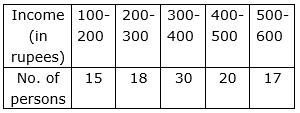
Here, the maximum number of persons i.e. 30 have income in the interval 300 – 400.
So, the modal class is 300 – 400.
lower limit (l) of modal class = 300,
class size(h) = 100
frequency (f1) of the modal class = 30
frequency (f0) of class preceding the modal class = 18
frequency (f2) of class succeeding the modal class = 20
Now, let us substitute these values in the formula
Mode $=1+\left(\frac{\mathrm{f}_{1}-\mathrm{f}_{0}}{2 \mathrm{f}_{1}-\mathrm{f}_{0}-\mathrm{f}_{2}}\right) \times \mathrm{h}$
$=300+\left(\frac{30-18}{2 \times 30-20-18}\right) \times 100$
$=300+\frac{12}{60-38} \times 100$
= 300 + 54.54
= Rs. 354.54
Question 11
Find the mode of the following data:
Sol :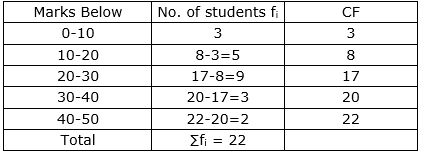
Here, the maximum no. of students is 9, and the class corresponding to the frequency is 20 – 30.
So, the modal class is 20 – 30.
lower limit (l) of modal class = 20,
class size(h) = 10
frequency (f1) of the modal class = 9
frequency (f0) of class preceding the modal class = 5
frequency (f2) of class succeeding the modal class = 3
Now, let us substitute these values in the formula
Mode $=1+\left(\frac{\mathrm{f}_{1}-\mathrm{f}_{0}}{2 \mathrm{f}_{1}-\mathrm{f}_{0}-\mathrm{f}_{2}}\right) \times \mathrm{h}$
$=20+\left(\frac{9-5}{2 \times 9-5-3}\right) \times 10$
$=20+\frac{4}{10} \times 10$
= 20 + 4
= 24
Question 12
Find the mode of the following distribution:
Sol :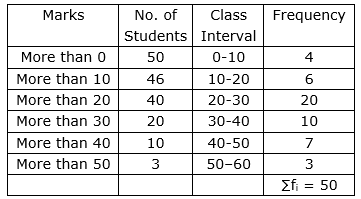
Here, the maximum no. of students is 20, and the class corresponding to this frequency is 20 – 30
So, the modal class is 20 – 30.
lower limit (l) of modal class = 20,
class size(h) = 10
frequency (f1) of the modal class = 20
frequency (f0) of class preceding the modal class = 6
frequency (f2) of class succeeding the modal class = 10
Now, let us substitute these values in the formula
Mode $=1+\left(\frac{\mathrm{f}_{1}-\mathrm{f}_{0}}{2 \mathrm{f}_{1}-\mathrm{f}_{0}-\mathrm{f}_{2}}\right) \times \mathrm{h}$
$=20+\left(\frac{20-6}{2 \times 20-6-10}\right) \times 10$
$=20+\frac{14}{24} \times 10$
= 20 + 5.83
= 25.83
Question 13
Find the mode of the following distribution:
Sol :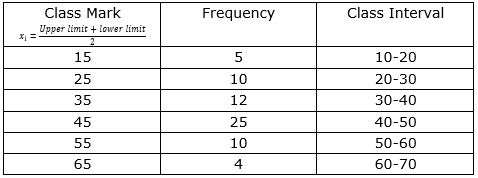
Here, the maximum frequency is 25, and the class corresponding to this frequency is 40 - 50
So, the modal class is 40 – 50.
lower limit (l) of modal class = 40,
class size(h) = 10
frequency (f1) of the modal class = 25
frequency (f0) of class preceding the modal class = 12
frequency (f2) of class succeeding the modal class = 10
Now, let us substitute these values in the formula
Mode $=1+\left(\frac{\mathrm{f}_{1}-\mathrm{f}_{0}}{2 \mathrm{f}_{1}-\mathrm{f}_{0}-\mathrm{f}_{2}}\right) \times \mathrm{h}$
$=40+\left(\frac{25-12}{2 \times 25-12-10}\right) \times 10$
$=40+\frac{13}{28} \times 10$
= 40 + 4.64
Mode = 44.64(approx.)
Question 14
If the mode of the following distribution is Rs. 24, find the missing frequency:
Sol :
Given: Mode = Rs. 24
Frequency (fi) = 100
Class size = 10
Let frequency of the class 10 – 20 be f0. Then, the frequency of the class 30 – 40 will be equal to 100 – 14 – f0 – 27 – 15 = 44 – f0.
It is given that mode = 24, therefore, modal class is 20 – 30.
Thus, lower limit of the modal class (l) = 20
frequency (f0) of class preceding the modal class = f0
frequency (f2) of class succeeding the modal class = 44 – f0
Mode $=1+\left(\frac{\mathrm{f}_{1}-\mathrm{f}_{0}}{2 \mathrm{f}_{1}-\mathrm{f}_{0}-\mathrm{f}_{2}}\right) \times \mathrm{h}$
$\Rightarrow 24=20+\left(\frac{27-f_{0}}{2 \times 27-f_{0}-44+f_{0}}\right) \times 10$
$\Rightarrow 24-20=\left(\frac{27-\mathrm{f}_{0}}{10}\right) \times 10$
⇒ 4 = 27 - f0
⇒ -23 = -f0
⇒ f0 = 23
∴ f2 = 44 – 23 = 21
Hence, the missing frequencies are 23 and 21.
Question 15
The following distribution gives the state-wise teacher-student ratio in higher secondary schools of India. Find the mode and mean of this data. Interpret, the two measures:
Sol :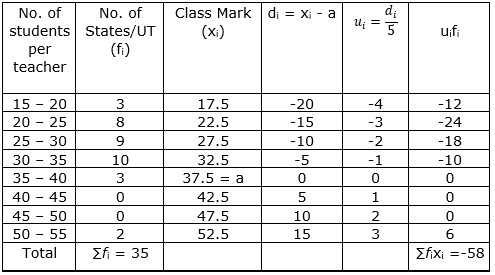
Now, $\overline{\mathrm{x}}=\mathrm{a}+\mathrm{h}\left(\frac{\sum \mathrm{f}_{\mathrm{i}} \mathrm{u}_{\mathrm{i}}}{\sum \mathrm{f}_{\mathrm{i}}}\right)$
$\Rightarrow \overline{\mathrm{x}}=37.5+5\left(\frac{-58}{35}\right)$
⇒x̄ = 37.5 – 8.28
⇒x̄ = 29.22
∴ Mean = 29.22
Here, the maximum no. of students per teacher i.e. 10, and the class corresponding to this frequency is 30 – 35
So, the modal class is 30 – 35 .
lower limit (l) of modal class = 30,
class size(h) = 5
frequency (f1) of the modal class = 10
frequency (f0) of class preceding the modal class = 9
frequency (f2) of class succeeding the modal class = 3
Now, let us substitute these values in the formula
Mode $=1+\left(\frac{\mathrm{f}_{1}-\mathrm{f}_{0}}{2 \mathrm{f}_{1}-\mathrm{f}_{0}-\mathrm{f}_{2}}\right) \times \mathrm{h}$
$=30+\left(\frac{10-9}{2 \times 10-9-3}\right) \times 5$
$=30+\frac{1}{8} \times 5$
= 30 + 0.625
Mode = 30.625(approx.)