
[mathjax]
Question 1
Find the median of the following data:
Sol :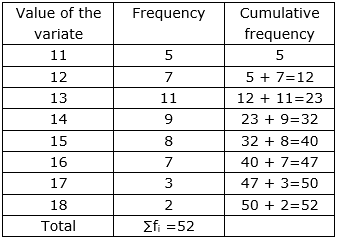
Median $=$ size of $\frac{(\text { cumulative frequency }+1)^{\text {th }}}{2}$ item or $\frac{(n+1)^{t h}}{2}$
Median $=\frac{(52+1)^{\mathrm{th}}}{2}$ item
$=\frac{53}{2}=26.5^{\text {th }}$ item
Now, items from 23 to 32 have value of variate 14 as shown by cumulative frequency.
∴ Median = 14
Question 2
Find the median of the following distribution:
Sol :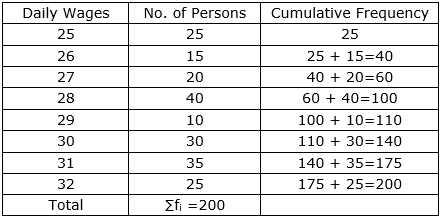
Median $=$ size of $\frac{(\text { cumulative frequency }+1)^{\text {th }}}{2}$ item or $\frac{(n+1)^{t h}}{2}$
Median $=\frac{(200+1)^{\mathrm{th}}}{2}$ observation
$=\frac{201}{2}=100.5^{\text {th }}$ observation
Now, persons from 100 to 110 have daily wages 29 as shown by cumulative frequency.
∴ Median = 29
Question 3
Find the median of the following data:
Sol :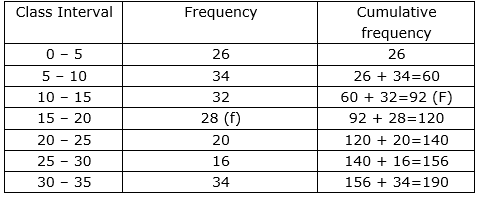
We have n = 190
So, $\frac{n}{2}=\frac{190}{2}=95$
The cumulative Frequency just greater than $\frac{n}{2}$ is 120 then the median class is 15 – 20 such that
the lower limit (l) = 15
cumulative frequency of the class preceding 15 – 20 (cf) = 92
the frequency of the median class 15 – 20 =28,
class size (h) = 5
Using the formula, Median $=1+\frac{\frac{n}{2}-c f}{f} \times h$, we have
Median $=15+\frac{95-92}{28} \times 5$
= 15 + 0.53
= 15.53
Question 4
The distribution below gives the weights of 30 students of a class. Find the median weight of the students.
Sol :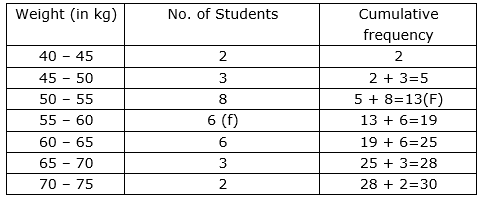
We have n = 30
So, $\frac{n}{2}=\frac{30}{2}=15$
The cumulative Frequency just greater than $\frac{n}{2}$ is 19 then the median class is 55 – 60 such that
the lower limit (l) = 55
cumulative frequency of the class preceding 55 – 60 (cf) = 13
frequency of the median class 55 – 60 =6,
class size (h) = 5
Using the formula,Median $=1+\frac{\frac{n}{2}-c f}{f} \times h$,we have
Median $=55+\frac{15-13}{6} \times 5$
= 55 + 1.66
= 56.66
So, the median weight of the students is 56.66kg
Question 5
Find the median of the following distribution:
Sol :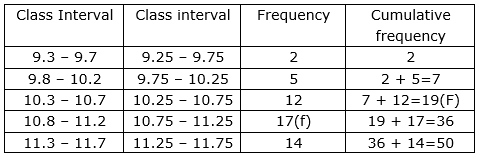
We have n = 50
So, $\frac{n}{2}=\frac{50}{2}=25$
The cumulative Frequency just greater than $\frac{n}{2}$ is 36 then the median class is 10.75 – 11.25 such that
the lower limit (l) = 10.75
cumulative frequency of the class preceding 10.75 – 11.25 (cf) = 19
frequency of the median class 10.75 – 11.25 = 17,
class size (h) = 0.5
Using the formula,Median $=1+\frac{\frac{n}{2}-c f}{f} \times h$, we have
Median $=10.75+\frac{25-19}{17} \times 0.5$
= 10.75 + 0.176
= 10.93
Question 6
Find the median from the following table:
Sol :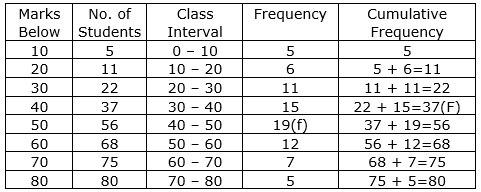
We have n = 80
So, $\frac{\mathrm{n}}{2}=\frac{80}{2}=40$
The cumulative Frequency just greater than $\frac{n}{2}$ is 56 then the median class is 40 – 50 such that
the lower limit (l) = 40
cumulative frequency of the class preceding 40 – 50 (cf) = 37
the frequency of the median class 40 – 50 =19,
class size (h) = 10
Using the formula, Median $=1+\frac{\frac{n}{2}-c f}{f} \times h$, we have
Median $=40+\frac{40-37}{19} \times 10$
= 40 + 1.58
=41.58
Question 7
A life insurance agent found the following data for the distribution of ages of 100 policy holders. Calculate the median age, if policies are only given to persons having age 18 years onwards but less than 60 years.
Sol :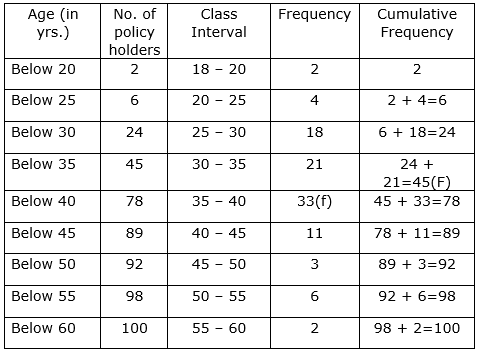
We have n = 100
So, $\frac{n}{2}=\frac{100}{2}=50$
The cumulative Frequency just greater than $\frac{n}{2}$ is 78 then the median class is 35 – 40 such that
the lower limit (l) = 35
cumulative frequency of the class preceding 35 – 40 (cf) = 45
frequency of the median class 35 – 40 = 33,
class size (h) = 5
Using the formula,Median $=1+\frac{\frac{n}{2}-c f}{f} \times h$, we have
Median $=35+\frac{50-45}{33} \times 5$
= 35 + 0.757
= 35.76
So, the median age of the policy holders is 35.76years
Question 8
A survey regarding the heights (in cm) of 51 girls of Class X of a school was conducted, and the following data was obtained:
Find the median height.
Sol :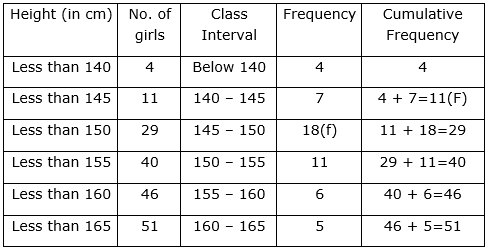
We have n = 51
So, $\frac{n}{2}=\frac{51}{2}=25.5$
The cumulative Frequency just greater than $\frac{n}{2}$ is 29 then the median class is 145-150 such that
the lower limit (l) = 145
cumulative frequency of the class preceding 145-150 (cf) = 11
frequency of the median class 145-150 = 18,
class size (h) = 5
Using the formula,Median $=1+\frac{\frac{n}{2}-c f}{f} \times h$, we have
Median $=145+\frac{25.5-11}{18} \times 5$
= 145 + 4.027
= 149.03
So, the median height of the girls is 149.03cm
Question 9
The following table gives the distribution of the life time of 400 neon lamps:
Sol :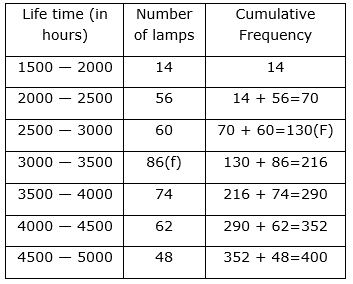
We have n = 400
So, $\frac{n}{2}=\frac{400}{2}=200$
The cumulative Frequency just greater than $\frac{n}{2}$ is 216 then the median class is 3000-3500 such that
the lower limit (l) = 3000
cumulative frequency of the class preceding 3000-3500 (cf) = 130
frequency of the median class 3000-3500 = 86,
class size (h) = 500
Using the formula,Median $=1+\frac{\frac{n}{2}-c f}{f} \times h$, we have
Median $=3000+\frac{200-130}{86} \times 500$
$=3000+\frac{70}{86} \times 500$
= 3000 + 406.98
= 3406.98
So, median life time of lamps is 3406.98hours
Question 10
Find the median life time of a lamp. 10. The frequency distribution of the number of letters in the English alphabets in the names of 100 students is as given below:
Determine the median numbers of letters in the names.
Sol :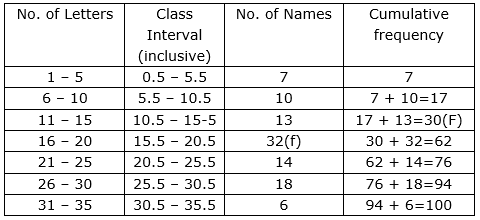
We have n = 100
So, $\frac{n}{2}=\frac{100}{2}=50$
The cumulative Frequency just greater than $\frac{n}{2}$ is 62 then the median class is 15.5 – 20.5 such that
the lower limit (l) = 15.5
cumulative frequency of the class preceding 15.5-20.5 (cf) = 30
frequency of the median class 15.5 – 20.5 = 32,
class size (h) = 5
Using the formula,Median $=1+\frac{\frac{n}{2}-c f}{f} \times h$, we have
Median $=15.5+\frac{50-30}{32} \times 5$
$=15.5+\frac{20}{32} \times 5$
= 15.5 + 3.125
= 18.625 = 18.63
So, the median numbers of letters in the names is 18.63
Question 11
The length of 40 leaves of a plant are measured correct to the nearest milli-metre and the date obtained is represented in the following table:
Find the median length of the leaves.
Sol :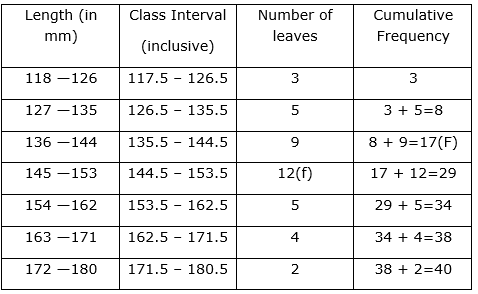
We have n = 40
So, $\frac{n}{2}=\frac{40}{2}=20$
The cumulative Frequency just greater than $\frac{n}{2}$ is 29 then the median class is 144.5 – 153.5 such that
the lower limit (l) = 144.5
cumulative frequency of the class preceding 144.5 – 153.5 (cf) = 17
frequency of the median class 144.5 – 153.5 = 12,
class size (h) = 9
Using the formula,Median $=1+\frac{\frac{n}{2}-c f}{f} \times h$, we have
Median $=144.5+\frac{20-17}{12} \times 9$
$=144.5+\frac{3}{12} \times 9$
= 144.5 + 2.25
= 146.75
So, the median length of the leaves is 146.75mm
Question 12
Find the median of the following data:
Sol :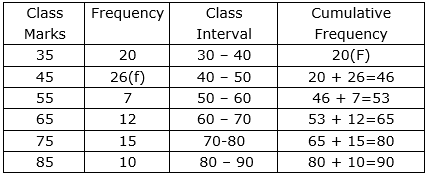
Here, the class mark is given.
∴Class size = 45 – 35 = 10
If a is a class mark and h is the size of the class interval, then the lower limit and upper limit of the class interval are $a-\frac{h}{2}$ and $a+\frac{h}{2}$ repectively.
∴, we have h = 10
∴Lower Limit of first class interval
$=35-\frac{10}{2}$
=35-5=30
The upper limit of first class interval
$=35+\frac{10}{2}$
=35+5=40
∴ The first class interval is 30 – 40
Hence, the class intervals are 30 – 40, 40 – 50, 50 – 60, 60 – 70, 70 – 80, 80 – 90.
Now, We find the median
We have n = 90
So, $\frac{n}{2}=\frac{90}{2}=45$
The cumulative Frequency just greater than $\frac{n}{2}$ is 46 then the median class is 40 – 50 such that
the lower limit (l) = 40
cumulative frequency of the class preceding 40 – 50 (cf) = 20
frequency of the median class 40 – 50 = 26,
class size (h) = 10
Using the formula,Median $=1+\frac{\frac{n}{2}-c f}{f} \times h$, we have
Median $=40+\frac{45-20}{26} \times 10$
$=40+\frac{25}{26} \times 10$
= 40 + 9.61
= 49.61
Question 13
Find the median from the following table:
Sol :
Here, we can see that the intervals are unequal.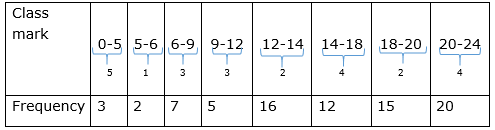
Firstly, we convert the unequal class intervals into equal class intervals.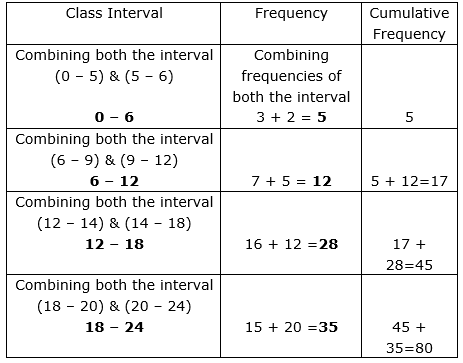
We have n = 80
So, $\frac{n}{2}=\frac{80}{2}=40$
The cumulative Frequency just greater than $\frac{n}{2}$ is 45 then the median class is 12-18 such that
the lower limit (l) = 12
cumulative frequency of the class preceding 12 – 18 (cf) = 17
frequency of the median class 12 – 18 = 28,
class size (h) = 6
Using the formula,Median $=1+\frac{\frac{n}{2}-c f}{f} \times h$,we have
Median $=12+\frac{40-17}{28} \times 6$
= 12 + 4.928
= 14.93
Question 14
Find the missing frequency of the following incomplete frequency distribution if the median is 46 and find the mean of the complete distribution.
Sol :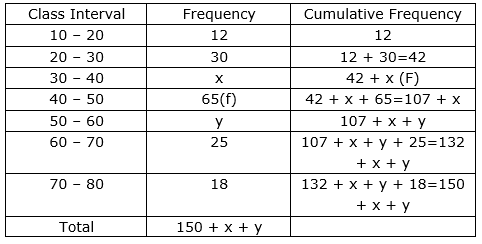
Given Median =46
Then, median Class = 40 – 50
the lower limit (l) = 40
cumulative frequency of the class preceding 40 – 50 (cf) = 42 + x
frequency of the median class 40 – 50 = 65,
class size (h) = 10
Total frequencies (n) = 229
So, 150 + x + y = 229
⇒ x + y = 229 – 150
⇒ x + y = 79 …(i)
and $\frac{n}{2}=\frac{229}{2}=114.5$
Using the formula,Median $=1+\frac{\frac{n}{2}-c f}{f} \times h$,we have
$46=40+\frac{114.5-(42+x)}{65} \times 10$
$\Rightarrow 46-40=\frac{114.5-42-x}{65} \times 10$
$\Rightarrow \frac{6 \times 65}{10}=72.5-\mathrm{x}$
⇒39 = 72.5 – x
⇒ x = 33.5
Putting the value of x in eq. (i), we get
⇒ 33.5 + y = 79
⇒ y = 79 – 33.5
⇒ y = 45.5
Question 15
If the median of the distribution given below is 28.5, find the values of x and y.
Sol :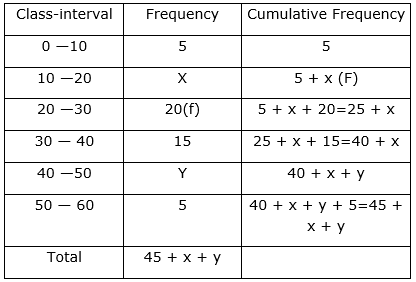
Given Median =28.5
Then, median Class = 20 – 30
the lower limit (l) = 20
cumulative frequency of the class preceding 20 – 30 (cf) = 5 + x
frequency of the median class 20 – 30 = 20,
class size (h) = 10
Total frequencies (n) = 60
So, 45 + x + y = 60
⇒ x + y = 60 – 45
⇒ x + y = 15 …(i)
and $\frac{n}{2}=\frac{60}{2}=30$
Using the formula,Median $=1+\frac{\frac{n}{2}-c f}{f} \times h$, we have
$28.5=20+\frac{30-(5+x)}{20} \times 10$
$\Rightarrow 28.5-20=\frac{30-5-x}{2}$
⇒8.5 × 2 = 25-x
⇒17 = 25 – x
⇒ x = 8
Putting the value of x in eq. (i), we get
⇒ 8 + y = 15
⇒ y = 15 – 8
⇒ y = 7
Question 16
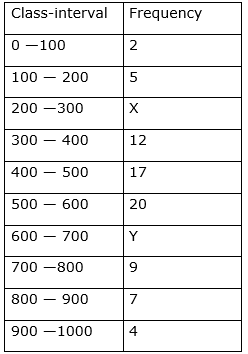
The median of the following data is 525. Find the values of x and y, if the total frequency is 100:
Sol :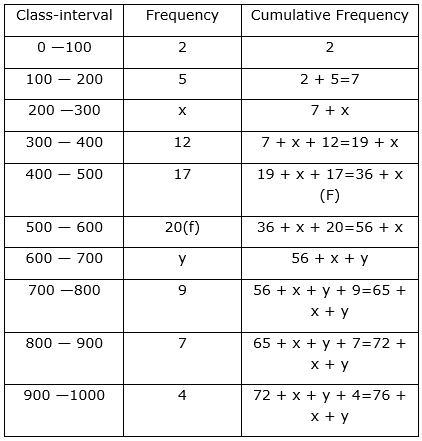
Given Median =525
Then, median Class = 500-600
the lower limit (l) = 500
cumulative frequency of the class preceding 500-600(cf) = 36 + x
frequency of the median class 500-600 = 20,
class size (h) = 100
Total frequencies (n) = 100
So, 76 + x + y = 100
⇒ x + y = 100 – 76
⇒ x + y = 24 …(i)
and $\frac{n}{2}=\frac{100}{2}=50$
Using the formula,Median $=1+\frac{\frac{n}{2}-c f}{f} \times h$,we have
$525=500+\frac{50-(36+x)}{20} \times 100$
$\Rightarrow 525-500=\frac{14-x}{20} \times 100$
⇒25 = (14 – x) × 5
⇒5 = 14 – x
⇒ x = 9
Putting the value of x in eq. (i), we get
⇒ 9 + y = 24
⇒ y = 24 – 9
⇒ y = 15
Question 17
Find the mean and median of the following data:
Sol :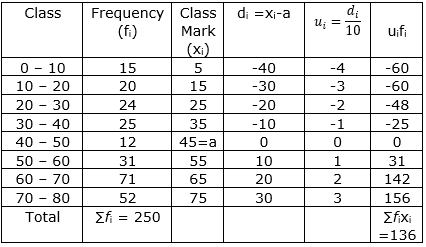
Now, $\operatorname{Mean} \overline{\mathrm{x}}=\mathrm{a}+\mathrm{h}\left(\frac{\sum \mathrm{f}_{\mathrm{i}} \mathrm{u}_{\mathrm{i}}}{\sum \mathrm{f}_{\mathrm{i}}}\right)$
$\Rightarrow \overline{\mathrm{x}}=45+10\left(\frac{136}{250}\right)$
⇒x̄ = 45 + 5.44
⇒x̄ = 50.44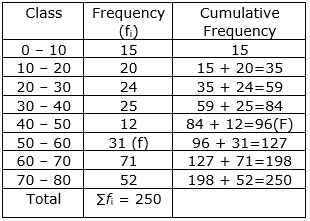
We have n = 250
So, $\frac{n}{2}=\frac{250}{2}=125$
The cumulative Frequency just greater than $\frac{n}{2}$ is 127 then the median class is 50-60 such that
the lower limit (l) = 50
cumulative frequency of the class preceding 50 – 60 (cf) = 96
frequency of the median class 50 – 60 = 31,
class size (h) = 10
Using the formula,Median $=1+\frac{\frac{n}{2}-c f}{f} \times h$,we have
Median $=50+\frac{125-96}{31} \times 10$
= 50 + 9.35
= 59.35
Question 18
Find the mean, median and mode from the following table:
Sol :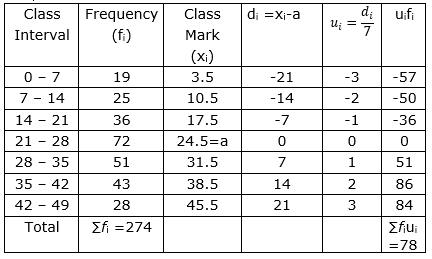
Now, $\overline{\mathrm{x}}=\mathrm{a}+\mathrm{h}\left(\frac{\sum \mathrm{f}_{\mathrm{i}} \mathrm{u}_{\mathrm{i}}}{\sum \mathrm{f}_{\mathrm{i}}}\right)$
$\Rightarrow \overline{\mathrm{x}}=24.5+7\left(\frac{78}{274}\right)$
⇒x̄ = 24.5 + 1.99
⇒x̄ = 26.5
Now, we calculate the median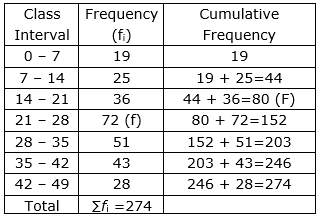
We have n = 274
So, $\frac{n}{2}=\frac{274}{2}=137$
The cumulative Frequency just greater than $\frac{n}{2}$ is 152 then the median class is 21 – 28 such that
the lower limit (l) = 21
cumulative frequency of the class preceding 21 – 28 (cf) = 80
frequency of the median class 21-28 = 72,
class size (h) = 7
Using the formula,Median $=1+\frac{\frac{n}{2}-c f}{f} \times h$,we have
Median $=21+\frac{137-80}{72} \times 7$
= 21 + 5.57
= 26.57
Now, we have to find the mode
Here, the maximum class frequency is 72, and the class corresponding to this frequency is 21 – 28.
So, the modal class is 21 – 28.
Now, modal class = 21 – 28, lower limit (l) of modal class = 21, class size(h) = 7
frequency (f1) of the modal class = 72
frequency (f0) of class preceding the modal class = 36
frequency (f2) of class succeeding the modal class = 51
Now, let us substitute these values in the formula
Mode $=1+\left(\frac{\mathrm{f}_{1}-\mathrm{f}_{0}}{2 \mathrm{f}_{1}-\mathrm{f}_{0}-\mathrm{f}_{2}}\right) \times \mathrm{h}$
$=21+\left(\frac{72-36}{2 \times 72-36-51}\right) \times 7$
$=21+\frac{36}{57} \times 7$
= 21 + 4.42
= 25.42
Question 19
100 surnames were randomly picked up from a local telephone directory and the frequency distribution of the number of letters in the English alphabets in the surname was obtained as follows:
Determine the median number of letters in the surnames. Find the mean number of letter in the surnames? Also, find the modal size of the surnames.
Sol :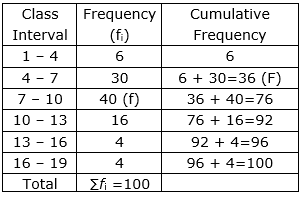
We have n = 100
So, $\frac{n}{2}=\frac{100}{2}=50$
The cumulative Frequency just greater than $\frac{n}{2}$ is 36 then the median class is 7 – 10 such that
the lower limit (l) = 7
cumulative frequency of the class preceding 7 – 10 (cf) = 36
frequency of the median class 7 – 10 = 40,
class size (h) = 3
Using the formula,Median $=1+\frac{\frac{n}{2}-c f}{f} \times h$,we have
Median $=7+\frac{50-36}{40} \times 3$
= 7 + 1.05
= 8.05
Now, we calculate the Mean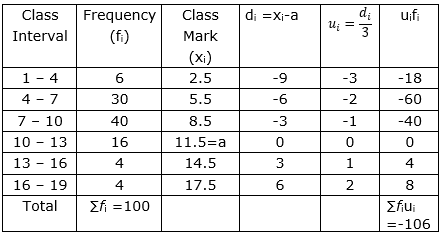
Now, $\overline{\mathrm{x}}=\mathrm{a}+\mathrm{h}\left(\frac{\sum \mathrm{f}_{\mathrm{i}} \mathrm{u}_{\mathrm{i}}}{\sum \mathrm{f}_{\mathrm{i}}}\right)$
$\Rightarrow \overline{\mathrm{x}}=11.5+3\left(\frac{-106}{100}\right)$
⇒ $\overline{\mathbf{X}}$ = 11.5 – 3.18
⇒ $\overline{\mathbf{X}}$ = 8.32
Now, we have to find the mode
Here, the maximum class frequency is 40, and the class corresponding to this frequency is 7 – 10.
So, the modal class is 7 – 10.
Now, modal class = 7 – 10, lower limit (l) of modal class = 7, class size(h) = 3
frequency (f1) of the modal class = 40
frequency (f0) of class preceding the modal class = 30
frequency (f2) of class succeeding the modal class = 16
Now, let us substitute these values in the formula
Mode $=1+\left(\frac{\mathrm{f}_{1}-\mathrm{f}_{0}}{2 \mathrm{f}_{1}-\mathrm{f}_{0}-\mathrm{f}_{2}}\right) \times \mathrm{h}$
$=7+\left(\frac{40-30}{2 \times 40-30-16}\right) \times 3$
$=7+\frac{10}{34} \times 3$
= 7 + 0.88
= 7.88