
Curriculum & Exam Preparation Note: Regular practice of NCERT textbook exercises and chapter-end questions establishes strong conceptual clarity for primary and secondary examinations.
NCERT Exemplar Class 11 Biology Chapter 17: Breathing and Exchange of Gases. NCERT Exemplar Solutions for Class 11 Biology Chapter 17 Breathing and Exchange of Gases prepare students for their Class 11 exams thoroughly.
Biology problems and solutions for the Class 11 pdf are provided here which are similar to the questions being asked in the previous year's board.
NCERT Exemplar Class 11 Biology Chapter 17: Breathing and Exchange of Gases
Class 11: Biology Chapter 17 solutions. Complete Class 11 Biology Chapter 17 Notes.
Multiple Choice Questions
- Respiration in insects is called direct because
- a. The tissues exchange O2 / CO2 directly with the air in the tubes
- b. The tissues exchange O2 / CO2 directly with coelomic fluid
- c. The tissues exchange O2 / CO2 directly with the air outside through body surface
- d. Tracheal tubes exchange O2 / CO2 directly with the haemocoel which then exchange with tissues
- Regarding the functions of our respiratory system, mark the wrong entry.
- a. Humidifies the air
- b. Warms up the air
- c. Diffusion of gases
- d. Cleans up the air
- A person suffers punctures in his chest cavity in an accident, without any damage to the lungs its effect could be
- a. Reduced breathing rate
- b. Rapid increase in breathing rate
- c. No change in respiration
- d. Cessation of breathing
- It is known that exposure to carbon monoxide is harmful to animals because
- a. It reduces CO2 transport
- b. It reduces O2 transport
- c. It increases CO2 transport
- d. It destroys hemoglobin
- Mark the true statement among the following with reference to normal breathing
- a. Inspiration is a passive process where as expiration is active
- b. Inspiration is a active process where as expiration is passive
- c. Inspiration and expiration are active processes
- d. Inspiration and expiration are passive processes
- A person breathes in some volume of air by forced inspiration after having a forced expiration. This quantity of air taken in is
- a. Total lung capacity
- b. Tidal volume
- c. Vital capacity
- d. Inspiratory capacity
- Mark the incorrect statement in context to O2 binding to Hb
- a. Higher pH
- b. Lower temperature
- c. Lower pCO2
- d. Higher PO2
- Mark the correct pair of muscles involved in the normal breathing in humans
- a. External and internal intercostal muscles
- b. Diaphragm and abdominal muscles
- c. Diaphragm and external intercostal muscles
- d. Diaphragm and internal intercostal muscles
- Incidence of Emphysema – a respiratory disorder is high in cigarette smokers. In such cases
- a. The bronchioles are found damaged
- b. The alveolar walls are found damaged
- c. The plasma membrane is found damaged
- d. The respiratory muscles are found damaged
- Respiratory process is regulated by certain specialized centres in the brain. One of the following listed centres can reduce the inspiratory duration upon stimulation
- a. Medullary inspiratory centre
- b. Pneumotaxic centre
- c. Apneustic centre
- d. Chemosensitive centre
- CO2 dissociates from carbamino haemoglobin when
- a. pCO2 is high & pO2 is low
- b. pO2 is high and pCO2 is low
- c. pCO2 and pO2 are equal
- d. None of the above
- In breathing movements, air volume can be estimated by
- a. Stethoscope
- b. Hygrometer
- c. Sphygmomanometer
- d. Spirometer
- Identify the correct and incorrect match about respiratory volume and capacities and mark the correct answer
i. Inspiratory capacity (IC) = Tidal Volume + Residual Volume
ii. Vital Capacity (VC) = Tidal Volume (TV) + Inspiratory Reserve Volume (IRV) + Expiratory Reserve Volume (ERV).
iii. Residual Volume (RV) = V ital Capacity (VC) – Inspiratory Reserve Volume (IRV)
iv. Tidal Volume (TV) = Inspiratory Capacity (IC) – Inspiratory Reserve Volume (IRV)
Options:- a. (i) Incorrect, (ii) Incorrect, (iii) Incorrect, (iv) Correct
- b. (i) Incorrect, (ii) Correct, (iii) Incorrect, (iv) Correct
- c. (i) Correct, (ii) Correct, (iii) Incorrect, (iv) Correct
- d. (i) Correct, (ii) Incorrect, (iii) Correct, (iv) Incorrect
- The oxygen – haemoglobin dissociation curve will show a right shift in case of
- a. High pCO2
- b. High pO2
- c. Low pCO2
- d. Less H+ concentration
- Match the following and mark the correct options
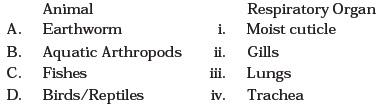
Options:- a. A-ii, B-i, C-iv, D-iii
- b. A-i, B-iv, C-ii, D-iii
- c. A-i, B-iii, C-ii, D-iv
- d. A-i, B-ii, C-i.v, D-iii
Very Short Answer Type Questions
- Define the following terms?
- a. Tidal volume
- b. Residual volume
- c. Asthma
- A fluid filled double membranous layer surrounds the lungs. Name it and mention its important function.
- Name the primary site of exchange of gases in our body?
- Cigarette smoking causes emphysema. Give reason.
- What is the amount of O2 supplied to tissues through every 100 ml. of oxygenated blood under normal physiological conditions?
- A major percentage (97%) of O2 is transported by RBCs in the blood. How does the remaining percentage (3%) of O2 transported?
- Arrange the following terms based on their volumes in an ascending order
- a. Tidal Volume (TV)
- b. Residual Volume (RV)
- c. Inspiratory Reserve Volume (IRV)
- d. Expiratory Capacity (EC)
- Complete the missing terms
- a. Inspiratory Capacity (IC) = _____ +IRV
- b. ___________________ = TV + ERV
- c. Functional Residual Capacity (FRC) = ERV + ____
- Name the organs of respiration in the following organisms:

- Name the important parts involved in creating a pressure gradient between lungs and the atmosphere during normal respiration.
Short Answer Type Questions
- State the different modes of CO2 transport in blood.
- Compared to O2, diffusion rate of CO2 through the diffusion membrane per unit difference in partial pressure is much higher. Explain.
- For completion of respiration process, write the given steps in sequential manner
- a. Diffusion of gases (O2 and CO2) across alveolar membrane.
- b. Transport of gases by blood.
- c. Utilisation of O2 by the cells for catabolic reactions and resultant release of CO2.
- d. Pulmonary ventilation by which atmospheric air is drawn in and CO2 rich alveolar air is released out.
- e. Diffusion of O2 and CO2between blood and tissues.
- Differentiate between
- a. Inspiratory and expiratory reserve volume
- b. Vital capacity and total lung capacity
- c. Emphysema and occupational respiratory disorder
Long Answer Type Questions
- Explain the transport of O2 and CO2 between alveoli and tissue with diagram.
- Explain the mechanism of breathing with neat labelled sketches.
- Explain the role of neural system in regulation of respiration.
Answers to Multiple Choice Questions
| 1- d; | 2- d; | 3- d; | 4- d; | 5- b; | 6- a; |
| 7- d; | 8- d; | 9- b; | 10- b; | 11- b; | 12- d; |
| 13 -b; | 14- b; | 15 -b |