
Curriculum & Exam Preparation Note: Regular practice of NCERT textbook exercises and chapter-end questions establishes strong conceptual clarity for primary and secondary examinations.
NCERT Exemplar Class 11 Biology Chapter 19: Excretory Products and their Elimination. NCERT Exemplar Solutions for Class 11 Biology Chapter 19 Excretory Products and their Elimination prepare students for their Class 11 exams thoroughly.
Biology problems and solutions for the Class 11 pdf are provided here which are similar to the questions being asked in the previous year's board.
NCERT Exemplar Class 11 Biology Chapter 19: Excretory Products and their Elimination
Class 11: Biology Chapter 19 solutions. Complete Class 11 Biology Chapter 19 Notes.
Multiple Choice Questions
- The following substances are the excretory products in animals. Choose the least toxic form among them?
- a. Urea
- b. Uric acid
- c. Ammonia
- d. Carbon dioxide
- Filtration of the blood takes place at
- a. PCT
- b. DCT
- c. Collecting ducts
- d. Malpighian body
- Which of the following statements is incorrect
- a. ADH – prevents conversion of angiotensinogen in blood to angiotensin
- b. Aldosterone – facilitates water reabsorption
- c. ANF – enhances sodium reabsorption
- d. Renin – causes vasodilation
- A large quantity of one of the following is removed from our body by lungs.
- a. CO2 only
- b. H2O only
- c. CO2 and H2O
- d. ammonia
- The pH of human urine is approximately
- a. 6.5
- b. 7
- c. 6
- d. 7.5
- Different types of excretory structures and animals are given below. Match them appropriately and mark the correct answer from among those given below:
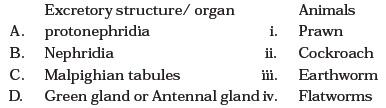
- a. (D) i, (C) ii, (B) iii and (A) iv
- b. (B) i, (C) ii, (A) iii and (B) iv
- c. (D) i, (C) ii, (A) iii and (B) iv
- d. (B) i, (C) ii, (B) iii and (D) iv
- Which one of the following statements is incorrect?
- a. Birds and land snails are uricotelic animals.
- b. Mammals and frogs are ureotelic animals
- c. Aquatic amphibians and aquatic insects are ammonotelic animals
- d. Birds and reptiles are ureotelic
- Which of the following pairs is wrong?
- a. Uricotelic ———- Birds
- b. Ureotelic ———- Insects
- c. Ammonotelic ———- Tadpole
- d. Ureotelic ———- Elephant
- Which one of the following statements is incorrect?
- a. The medullary zone of kidney is divided into a few conical masses called medullary pyramids projecting into the calyces.
- b. Inside the kidney the cortical region extends in between the medullary pyramids as renal pelvis.
- c. Glomerulus alongwith Bowman’s capsule is called the renal corpuscle.
- d. Renal corpuscle, proximal convoluted tubule (PCT) and distal convoluted tubule (DCT) of the nephron are situated in the cortical region of kidney
- The condition of accumulation of urea in the blood is termed as
- a. Renal Calculi
- b. Glomerulonephritis
- c. Uremia
- d. Ketonuria
- Which one of the following is also known as antidiuretic hormone?
- a. Oxytocin
- b. Vasopressin
- c. Adrenaline
- d. Calcitonin
- Match the terms given in Column I with their physiological processes given in Column II and choose the correct answer
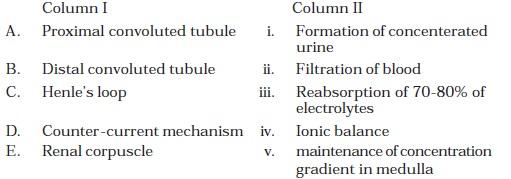
- a. A-iii, B-v, C-iii, D-ii, E-i
- b. A-iii, B-iv, C-i, D-v, E-ii
- c. A-i, B-iii, C-ii, D-v, E-iv
- d. A-iii, B-i, C-iv, D-v, E-ii
- Match the abnormal conditions given in Column A with their explanations given in Column B and Choose the correct option
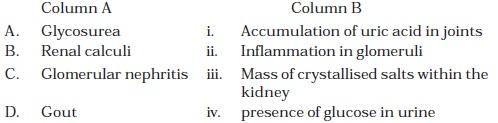
Options:- a. A-i, B-iii, C-ii, D-iv
- b. A-iii, B-ii, C-iv, D-i
- c. A-iv, B-iii, C-ii, D-i
- d. A-iv, B-ii, C-iii, D-i
- We can produce a concentrated/ dilute urine. This is facilitated by a special mechanism. Identify the mechanism.
- a. Reabsorption from PCT
- b. Reabsorption from Collecting Duct
- c. Reabsorption/ Secretion in DCT
- d. Counter current mechanism in Henle’s loop/ Vasa recta
- Dialysing unit (artificial kidney) contains a fluid which is almost same as plasma except that it has
- a. High glucose
- b. High urea
- c. No urea
- d. High uric acid
Very Short Answer Type Questions
- Where does the selective reabsorption of Glomerular filtrate take place?
- What is the excretory product from kidneys of reptiles?
- What is the composition of sweat produced by sweat glands?
- Identify the glands that perform the excretory function in prawns.
- What is the excretory structure in amoeba?
- The following abbreviations are used in the context of excretory functions, what do they stand for?
- a. ANF
- b. ADH
- c. GFR
- d. DCT
- Differentiate Glycosuria from Ketonuria.
- What is the role of sebaceous glands?
- Name two actively transported substances in Glomerular filtrate.
- Mention any two metabolic disorders, which can be diagnosed by analysis of urine.
- What are the main processes of urine formation?
- Sort the following into actively or passively transported substances during reabsorption of GFR. glucose, amino acids, nitrogenous wastes, Na+, water
- Complete the following:
- a. urinary excretion = tubular reabsorption + tubular secretion –
- b. Dialysis fluid = Plasma–
- Mention the substances that exit from the tubules in order to maintain a concentration gradient in the medullary interstitium.
- Fill in the blanks appropriately
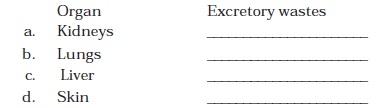
Short Answer Type Questions
- Show the structure of a renal corpuscle with the help of a diagram.
- What is the role played by Renin-Angiotensin in the regulation of kidney function?
- Aquatic animals generally are ammonotelic in nature where as terrestual forms are not. Comment.
- The composition of glomerular filtrate and urine is not same. Comment.
- What is the procedure advised for the correction of extreme renal failure?
Give a brief account of it. - How have the terrestrial organisms adapted themselves for conservation of water?
- Label the parts in the following diagram.
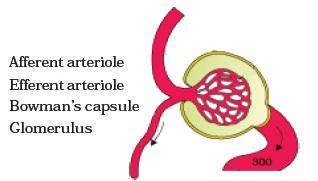
- Explain, why a haemodialysis unit called artificial kidney?
- Comment upon the hormonal regulation of selective reabsorption.
Long Answer Type Questions
- Explain the mechanism of formation of concentrated urine in mammals.
- Draw a labelled diagram showing reabsorption and secretion of major substances at different parts of the nephron.
- Explain briefly, micturition and disorders of the excretory system.
- How does tubular secretion help in maintaining ionic and acid-base balance in body fluids?
- The glomerular filtrate in the loop of Henle gets concentrated in the descending and then gets diluted in the ascending limbs. Explain.
- Describe the structure of a human kidney with the help of a labelled diagram.
Answers to Multiple Choice Questions
| 1- b; | 2- d; | 3- a; | 4- c; | 5- c; | 6- a; |
| 7- d; | 8- b; | 9- b; | 10- c; | 11- b; | 12- b; |
| 13- c; | 14- d; | 15- b |