
Curriculum & Exam Preparation Note: Regular practice of NCERT textbook exercises and chapter-end questions establishes strong conceptual clarity for primary and secondary examinations.
NCERT Exemplar Class 11 Biology Chapter 20: Locomotion and Movement. NCERT Exemplar Solutions for Class 11 Biology Chapter 20 Locomotion and Movement prepare students for their Class 11 exams thoroughly.
Biology problems and solutions for the Class 11 pdf are provided here which are similar to the questions being asked in the previous year's board.
NCERT Exemplar Class 11 Biology Chapter 20: Locomotion and Movement
Class 11: Biology Chapter 20 solutions. Complete Class 11 Biology Chapter 20 Notes.
Multiple Choice Questions
- Match the following and mark the correct option
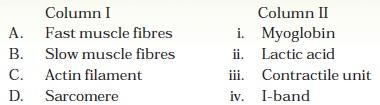
Options:- a. A-i, B-ii, C-iv, D-iii
- b. A-ii, B-i, C-iii, D-iv
- c. A-ii, B-i, C-iv, D-iii
- d. A-iii, B-ii, C-iv, D-i
- Ribs are attached to
- a. Scapula
- b. Sternum
- c. Clavicle
- d. Ilium
- What is the type of movable joint present between the atlas and axis?
- a. Pivot
- b. Saddle
- c. Hinge
- d. Gliding
- ATPase of the muscle is located in
- a. Actinin
- b. Troponin
- c. Myosin
- d. Actin
- Intervertebral disc is found in the vertebral column of
- a. Birds
- b. Reptiles
- c. Mammals
- d. Amphibians
- Which one of the following is showing the correct sequential order of vertebrae in the vertebral column of human beings?
- a. Cervical — lumbar — thoracic — sacral — coccygeal
- b. Cervical — thoracic — sacral — lumbar — coccygeal
- c. Cervical — sacral — thoracic — lumbar — coccygeal
- d. Cervical — thoracic — lumbar — sacral — coccygeal
- Which one of the following options is incorrect?
- a. Hinge joint – between Humerus and Pectoral girdle
- b. Pivot joint – between atlas, axis and occipital condyle
- c. Gliding joint – between the carpals
- d. Saddle joint – between carpel and metacarpals of thumb
- Knee joint and elbow joints are examples of
- a. Saddle joint
- b. Ball and socket joint
- c. Pivot joint
- d. Hinge joint
- Macrophages and leukocytes exhibit
- a. Ciliary movement
- b. Flagellar movement
- c. Amoeboid movement
- d. Gliding movement
- Which one of the following is not a disorder of bone?
- a. Arthritis
- b. Osteoporosis
- c. Rickets
- d. Atherosclerosis
- Which one of the following statement is incorrect?
- a. Heart muscles are striated and involuntary
- b. The muscles of hands and legs are striated and voluntary
- c. The muscles located in the inner walls of alimentary canal are striated and involuntary
- d. Muscles located in the reproductive tracts are unstriated and involuntary
- Which one of the following statements is true:
- a. Head of humerus bone articulates with acetabulum of pectoral girdle.
- b. Head of humerus bone articulates with glenoid cavity of pectoral girdle.
- c. Head of humerus bone articulates with a cavity called acetabulum of pelvic girdle.
- d. Head of humerus bone articulates with a glenoid cavity of pelvic girdle.
- Muscles with characteristic striations and involuntary are
- a. Muscles in the wall of alimentary canal
- b. Muscles of the heart
- c. Muscles assisting locomotion
- d. Muscles of the eyelids
- Match the followings and mark the correct option
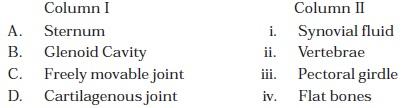
Options:- a. A-ii, B-i, C-iii, D-iv
- b. A-iv, B-iii, C-i, D-ii
- c. A-ii, B-i, C-iv, D-iii
- d. A-iv, B-i, C-ii, D-iv
Very Short Answer Type Questions
- Name the cells/tissues in human body which
- a. exhibit ameboid movement
- b. exhibit ciliary movement
- Locomotion requires a perfect coordinated activity of muscular, _____, _______ systems
- Sarcolemma, sarcoplasm and sarcoplasmic reticulum refer to a particular type of cell in our body. Which is this cell and to what parts of that cell do these names refer to?
- Label the different components of actin filament in the diagram given below.
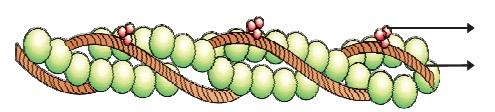
- The three tiny bones present in middle ear are called ear ossicles. Write them in correct sequence beginning from ear drum.
- What is the difference between the matrix of bones and cartilage?
- Which tissue is afflicted by Myasthenia gravis? What is the underlying cause?
- How do our bone joints function without grinding noise and pain?
- Give the location of a ball and socket joint in a human body
- Our fore arm is made of three different bones. Comment.
Short Answer Type Questions
- With respect to rib cage, explain the following:
- a. Bicephalic ribs
- b. True ribs
- c. Floating ribs
- In old age, people often suffer from stiff and inflamed joints. What is this condition called? What are the possible reasons for these symptoms?
- Exchange of calcium between bone and extracellular fluid takes place under the influence of certain hormones
- a. What will happen if more of Ca++ is in extracellular fluid?
- b. What will happen if very less amount of Ca++ is in the extracellular fluid?
- Name atleast two hormones which result in fluctuation of Ca++ level.
- Rahul exercises regularly by visiting a gymnasium. Of late he is gaining weight. What could be the reason? Choose the correct answer and elaborate.
- a. Rahul has gained weight due to accumulation of fats in body.
- b. Rahul has gained weight due to increased muscle and less of fat.
- c. Rahul has gained weight because his muscle shape has improved.
- d. Rahul has gained weight because he is accumulating water in the body.
- Radha was running on a treadmill at a great speed for 15 minutes continuously. She stopped the treadmill and abruptly came out. For the next few minutes, she was breathing heavily/fast. Answer the following questions.
- a. What happened to her muscles when she did strenuously exercised?
- b. How did her breathing rate change?
- Write a few lines about Gout.
- What is the source of energy for muscle contraction?
- What are the points for articulation of Pelvic and Pectoral girdles?
Long Answer Type Questions
- Calcium ion concentration in blood affects muscle contraction. Does it lead to tetany in certain cases? How will you correlate fluctuation in blood calcium with tetany?
- An elderly woman slipped in the bathroom and had severe pain in her lower back. After X-ray examination doctors told her it is due to a slipped disc. What does that mean? How does it affect our health
- Explain sliding filament theory of muscle contraction with neat sketches.
- How does a muscle shorten during its contraction and return to its original form during relaxation?
- Discuss the role of Ca2+ ions in muscle contraction. Draw neat sketches to illustrate your answer.
- Differentiate between Pectoral and Pelvic girdle.
Answers to Multiple Choice Questions
| 1- c; | 2-b; | 3- a; | 4- b; | 5- c; | 6- d; |
| 7- a; | 8- d; | 9- c; | 10- d; | 11- c; | 12- b; |
| 13- b; | 14- b |