
NCERT Exemplar Class 11 Maths Chapter 1: Sets. NCERT Exemplar Solutions for Class 11 Maths Chapter 1 Sets prepare students for their Class 11 exams thoroughly.
Maths problems and solutions for the Class 11 pdf are provided here which are similar to the questions being asked in the previous year's board.
NCERT Exemplar Class 11 Maths Chapter 1: Sets
Class 11: Maths Chapter 1 solutions. Complete Class 11 Maths Chapter 1 Notes.
1.1 Overview
This chapter deals with the concept of a set, operations on sets. Concept of sets will be useful in studying the relations and functions.
1.1.1 Set and their representations A set is a well-defined collection of objects. There are two methods of representing a set
(i) Roaster or tabular form
(ii) Set builder form
1.1.2 The empty set A set which does not contain any element is called the empty set or the void set or null set and is denoted by { } or φ.
1.1.3 Finite and infinite sets A set which consists of a finite number of elements is called a finite set otherwise, the set is called an infinite set.
1.1.4 Subsets A set A is said to be a subset of set B if every element of A is also an element of B. In symbols we write A ⊂ B if a ∈ A ⇒ a ∈ B.
We denote,
set of real numbers by R
set of natural numbers by N
set of integers by Z
set of rational numbers by Q
set of irrational numbers by T
We observe that
N ⊂ Z ⊂ Q ⊂ R,
T ⊂ R, Q ⊄ T, N ⊄ T
1.1.5 Equal sets Given two sets A and B, if every elements of A is also an element of B and if every element of B is also an element of A, then the sets A and B are said to be equal. The two equal sets will have exactly the same elements.
1.1.6 Intervals as subsets of R Let a, b ∈ R and a < b. Then
(a) An open interval denoted by (a, b) is the set of real numbers {x : a < x < b}
(b) A closed interval denoted by [a, b] is the set of real numbers {x : a ≤ x ≤ b)
(c) Intervals closed at one end and open at the other are given by
[a, b) = {x : a ≤ x < b}
(a, b] = {x : a < x ≤ b}
1.1.7 Power set The collection of all subsets of a set A is called the power set of A. It is denoted by P(A). If the number of elements in A = n , i.e., n(A) = n, then the number of elements in P(A) = 2 n .
1.1.8 Universal set This is a basic set; in a particular context whose elements and subsets are relevant to that particular context. For example, for the set of vowels in English alphabet, the universal set can be the set of all alphabets in English. Universal set is denoted by U.
https://googleads.g.doubleclick.net/pagead/ads?gdpr=0&us_privacy=1---&gpp_sid=-1&client=ca-pub-6709000355577070&output=html&h=280&adk=144910138&adf=1698921666&pi=t.aa~a.4023996182~i.32~rp.4&daaos=1714561828384&w=750&fwrn=4&fwrnh=100&lmt=1713707618&num_ads=1&rafmt=1&armr=3&sem=mc&pwprc=5796625295&ad_type=text_image&format=750x280&url=https%3A%2F%2Fschools.aglasem.com%2Fncert-exemplar-class-11-mathematics-unit-1%2F&fwr=0&pra=3&rh=188&rw=750&rpe=1&resp_fmts=3&wgl=1&fa=27&uach=WyJMaW51eCIsIjYuNS4wIiwieDg2IiwiIiwiMTI0LjAuNjM2Ny43OCIsbnVsbCwwLG51bGwsIjY0IixbWyJDaHJvbWl1bSIsIjEyNC4wLjYzNjcuNzgiXSxbIkdvb2dsZSBDaHJvbWUiLCIxMjQuMC42MzY3Ljc4Il0sWyJOb3QtQS5CcmFuZCIsIjk5LjAuMC4wIl1dLDBd&dt=1714567944927&bpp=3&bdt=2488&idt=-M&shv=r20240429&mjsv=m202404250101&ptt=9&saldr=aa&abxe=1&cookie=ID%3D522d0b6e5f487262-2213ac71c5e20073%3AT%3D1691662146%3ART%3D1714567941%3AS%3DALNI_MYNOJZZFKi8Gup3wY3uFsqyVVwZqA&gpic=UID%3D00000c2a0a4c88d5%3AT%3D1691662146%3ART%3D1714567941%3AS%3DALNI_MajeKuHpL9r7ujqhKfU2RIZVnRePA&eo_id_str=ID%3Daa5b82f62b43a0cf%3AT%3D1709550195%3ART%3D1714567941%3AS%3DAA-AfjYYRdoDi_w0C98-Qgelj2qW&prev_fmts=0x0&nras=2&correlator=2501958162052&frm=20&pv=1&ga_vid=2091936445.1691662146&ga_sid=1714567944&ga_hid=1214212134&ga_fc=1&u_tz=330&u_his=1&u_h=768&u_w=1360&u_ah=741&u_aw=1290&u_cd=24&u_sd=1&dmc=8&adx=71&ady=3032&biw=1281&bih=620&scr_x=0&scr_y=0&eid=44759875%2C44759926%2C44759837%2C31083069%2C95331690%2C31083214%2C95331042%2C95331982%2C31078663%2C31078665%2C31078668%2C31078670&oid=2&pvsid=1708466697730157&tmod=778554877&uas=0&nvt=1&ref=https%3A%2F%2Fschools.aglasem.com%2Fncert-exemplar-class-11-mathematics%2F&fc=1408&brdim=70%2C27%2C70%2C27%2C1290%2C27%2C1296%2C741%2C1296%2C620&vis=1&rsz=%7C%7Cs%7C&abl=NS&fu=128&bc=31&bz=1&td=1&psd=W251bGwsbnVsbCxudWxsLDNd&nt=1&ifi=2&uci=a!2&btvi=1&fsb=1&dtd=256
1.1.9 Venn diagrams Venn Diagrams are the diagrams which represent the relationship between sets. For example, the set of natural numbers is a subset of set of whole numbers which is a subset of integers. We can represent this relationship through Venn diagram in the following way.
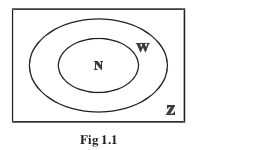
1.1.10 Operations on sets
Union of Sets : The union of any two given sets A and B is the set C which consists of all those elements which are either in A or in B. In symbols, we write

Intersection of sets: The intersection of two sets A and B is the set which consists of all those elements which belong to both A and B. Symbolically, we write A ∩ B = {x : x ∈ A and x ∈ B}.

Difference of sets The difference of two sets A and B, denoted by A – B is defined as set of elements which belong to A but not to B. We write,
A – B = {x : x ∈ A and x ∉ B}
also, B – A = { x : x ∈ B and x ∉A}
https://googleads.g.doubleclick.net/pagead/ads?gdpr=0&us_privacy=1---&gpp_sid=-1&client=ca-pub-6709000355577070&output=html&h=280&adk=144910138&adf=1840275879&pi=t.aa~a.4023996182~i.48~rp.4&daaos=1714561828384&w=750&fwrn=4&fwrnh=100&lmt=1713707618&num_ads=1&rafmt=1&armr=3&sem=mc&pwprc=5796625295&ad_type=text_image&format=750x280&url=https%3A%2F%2Fschools.aglasem.com%2Fncert-exemplar-class-11-mathematics-unit-1%2F&fwr=0&pra=3&rh=188&rw=750&rpe=1&resp_fmts=3&wgl=1&fa=27&uach=WyJMaW51eCIsIjYuNS4wIiwieDg2IiwiIiwiMTI0LjAuNjM2Ny43OCIsbnVsbCwwLG51bGwsIjY0IixbWyJDaHJvbWl1bSIsIjEyNC4wLjYzNjcuNzgiXSxbIkdvb2dsZSBDaHJvbWUiLCIxMjQuMC42MzY3Ljc4Il0sWyJOb3QtQS5CcmFuZCIsIjk5LjAuMC4wIl1dLDBd&dt=1714567944921&bpp=1&bdt=2482&idt=1&shv=r20240429&mjsv=m202404250101&ptt=9&saldr=aa&abxe=1&cookie=ID%3D522d0b6e5f487262-2213ac71c5e20073%3AT%3D1691662146%3ART%3D1714567941%3AS%3DALNI_MYNOJZZFKi8Gup3wY3uFsqyVVwZqA&gpic=UID%3D00000c2a0a4c88d5%3AT%3D1691662146%3ART%3D1714567941%3AS%3DALNI_MajeKuHpL9r7ujqhKfU2RIZVnRePA&eo_id_str=ID%3Daa5b82f62b43a0cf%3AT%3D1709550195%3ART%3D1714567941%3AS%3DAA-AfjYYRdoDi_w0C98-Qgelj2qW&prev_fmts=0x0%2C750x280%2C750x280%2C750x280&nras=5&correlator=2501958162052&frm=20&pv=1&ga_vid=2091936445.1691662146&ga_sid=1714567944&ga_hid=1214212134&ga_fc=1&u_tz=330&u_his=1&u_h=768&u_w=1360&u_ah=741&u_aw=1290&u_cd=24&u_sd=1&dmc=8&adx=71&ady=4033&biw=1281&bih=620&scr_x=0&scr_y=1634&eid=44759875%2C44759926%2C44759837%2C31083069%2C95331690%2C31083214%2C95331042%2C95331982%2C31078663%2C31078665%2C31078668%2C31078670&oid=2&pvsid=1708466697730157&tmod=778554877&uas=0&nvt=1&ref=https%3A%2F%2Fschools.aglasem.com%2Fncert-exemplar-class-11-mathematics%2F&fc=1408&brdim=70%2C27%2C70%2C27%2C1290%2C27%2C1296%2C741%2C1296%2C620&vis=1&rsz=%7C%7Cs%7C&abl=NS&fu=128&bc=31&bz=1&td=1&psd=W251bGwsbnVsbCxudWxsLDNd&nt=1&ifi=4&uci=a!4&btvi=4&fsb=1&dtd=13097
Complement of a set Let U be the universal set and A a subset of U. Then the complement of A is the set of all elements of U which are not the elements of A. Symbolically, we write
A′ = {x : x ∈ U and x ∉ A}. Also A′ = U – A
Some properties of complement of sets
(i) Law of complements:
(a) A ∪ A′ = U (b) A ∩ A′ = φ
(ii) De Morgan’s law
(a) (A ∪ B)′ = A′ ∩ B′ (b) (A ∩ B)′ = A′ ∪ B′
(iii) (A′ )′ = A
(iv) U′ = φ and φ′ = U
1.1.11 Formulae to solve practical problems on union and intersection of two sets
Let A, B and C be any finite sets. Then
(a) n (A ∪ B) = n (A) + n (B) – n (A ∩ B)
(b) If (A ∩ B) = φ, then n (A ∪ B) = n (A) + n (B)
(c) n (A ∪ B ∪ C) = n (A) + n (B) + n (C) – n (A ∩ B) – n (A ∩ C) – n (B ∩ C) + n (A ∩ B ∩ C)
Short Answer Type Questions

Long Answer Type Questions

Objective Type Questions

Fill In Blanks Type Questions

Match Type Questions

True or False Statements Type Questions

Answers to Objective Type Questions
| 29. C | 30. B | 31. B | 32. D |
| 33. C | 34. D | 35. B | 36. B |
| 37. C | 38. C | 39. C | 40. A |
| 41. B | 42. B | 43. C |