NCERT Exemplar Class 11 Maths Chapter 14: Mathematical Reasoning. NCERT Exemplar Solutions for Class 11 Maths Chapter 14 Mathematical Reasoning prepare students for their Class 11 exams thoroughly.
Maths problems and solutions for the Class 11 pdf are provided here which are similar to the questions being asked in the previous year's board.
NCERT Exemplar Class 11 Maths Chapter 14: Mathematical Reasoning
Class 11: Maths Chapter 14 solutions. Complete Class 11 Maths Chapter 14 Notes.
NCERT Exemplar Class 11 Maths Unit 14 is for Mathematical Reasoning. The type of questions that will be asked from NCERT Class 11 Maths Unit 14 are displayed in the below provided NCERT Exemplar Class 11 Maths Unit 14. With the help of it, candidates can prepare well for the examination.

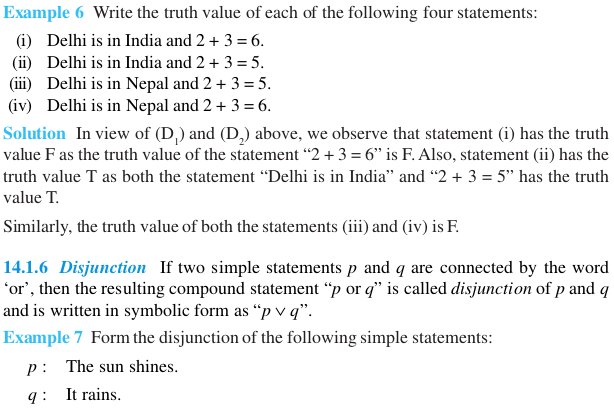
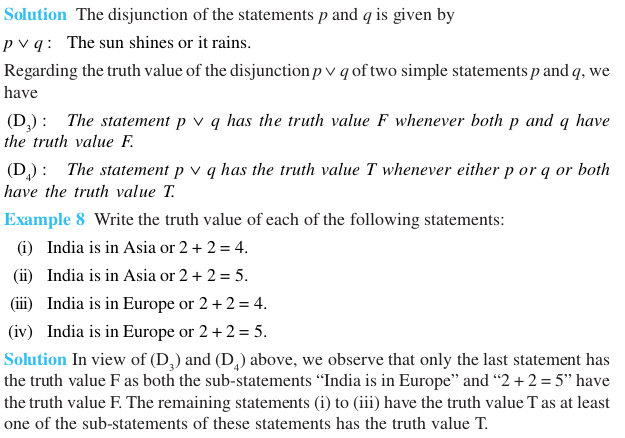
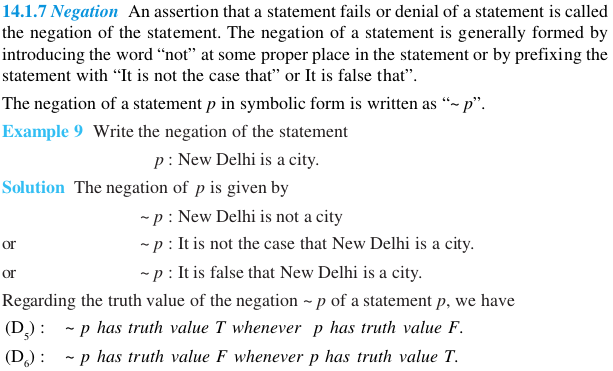


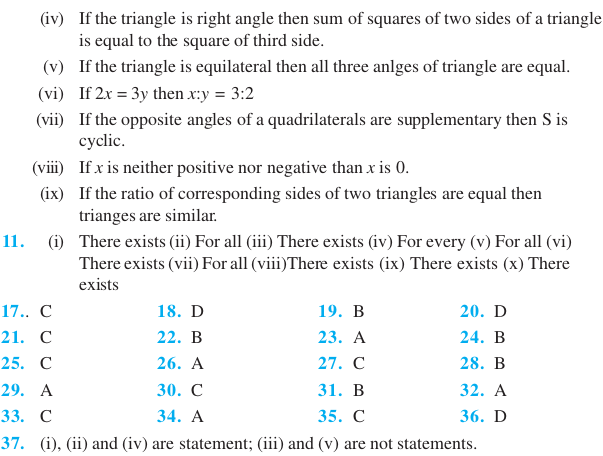
Click here to download NCERT Exemplar Class 11 Maths for Unit 14 Mathematical Reasoning.



Maths Important Questions Class 11 are given below.
14.1 Overview
If an object is either black or white, and if it is not black, then logic leads us to the conclusion that it must be white. Observe that logical reasoning from the given hypotheses can not reveal what “black” or “white” mean, or why an object can not be both. Infact, logic is the study of general patterns of reasoning, without reference to particular meaning or context.
14.1.1 Statements
A statement is a sentence which is either true or false, but not both simultaneously.
Note: No sentence can be called a statement if
(i) It is an exclamation
(ii) It is an order or request
(iii) It is a question
(iv) It involves variable time such as ‘today’, ‘tomorrow’, ‘yesterday’ etc.
(v) It involves variable places such as ‘here’, ‘there’, ‘everywhere’ etc.
(vi) It involves pronouns such as ‘she’, ‘he’, ‘they’ etc.
Example 1
(i) The sentence ‘New Delhi is in India; is true. So it is a statement.
(ii) The sentence “Every rectangle is a square” is false. So it is a statement.
(iii) The sentence “Close the door” can not be assigned true or false (Infact, it is a command). So it can not be called a statement.
(iv) The sentence “How old are you?” can not be assigned true or false (In fact, it is a question). So it is not a statement.
(v) The truth or falsity of the sentence “x is a natural number” depends on the value of x. So it is not considered as a statement. However, in some books it is called an open statement.
Note: Truth and falisity of a statement is called its truth value.
14.1.2 Simple statements A statement is called simple if it can not be broken down into two or more statements.
Example 2 The statements “2 is an even number”, “A square has all its sides equal” and “ Chandigarh is the capital of Haryana” are all simple statements.
14.1.3 Compound statements A compound statement is the one which is made up of two or more simple statements.
Example 3 The statement “11 is both an odd and prime number” can be broken into two statements
“11 is an odd number” and “11 is a prime number” so it is a compound statement.
Note: The simple statements which constitutes a compound statement are called component statements.
14.1.4 Basic logical connectives There are many ways of combining simple statements to form new statements. The words which combine or change simple statements to form new statements or compound statements are called Connectives. The basic connectives (logical) conjunction corresponds to the English word ‘and’; disjunction corresponds to the word ‘or’; and negation corresponds to the word
‘not’.
Throughout we use the symbol ‘∧’ to denote conjunction; ‘∨’ to denote disjunction and the symbol ‘~’ to denote negation.
Note: Negation is called a connective although it does not combine two or more statements. In fact, it only modifies a statement.
14.1.5 Conjunction If two simple statements p and q are connected by the word ‘and’, then the resulting compound statement “p and q” is called a conjunction of p and q and is written in symbolic form as “p ∧ q”.
Short Answer Type Questions (Solved Examples)


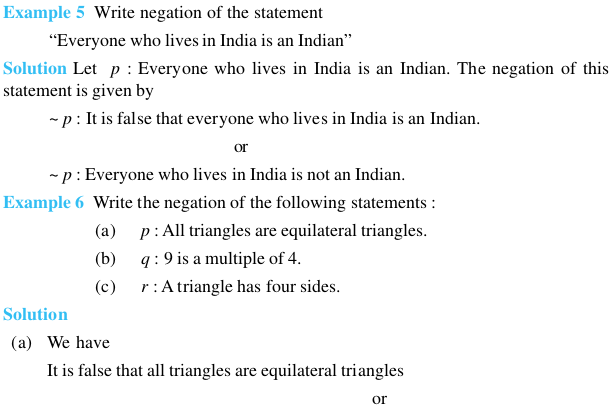
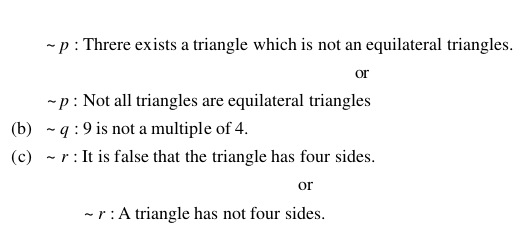
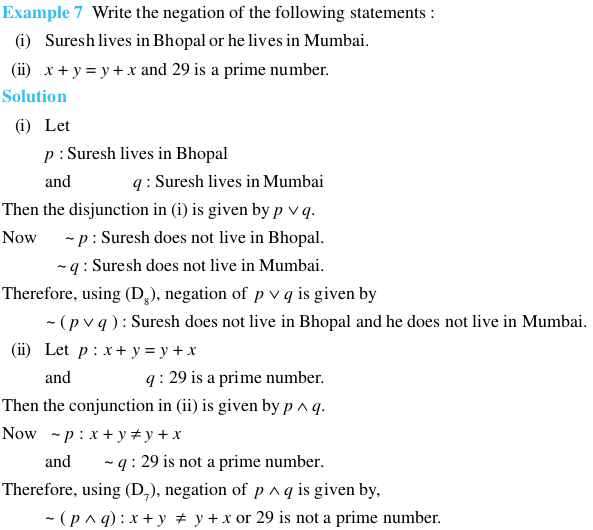


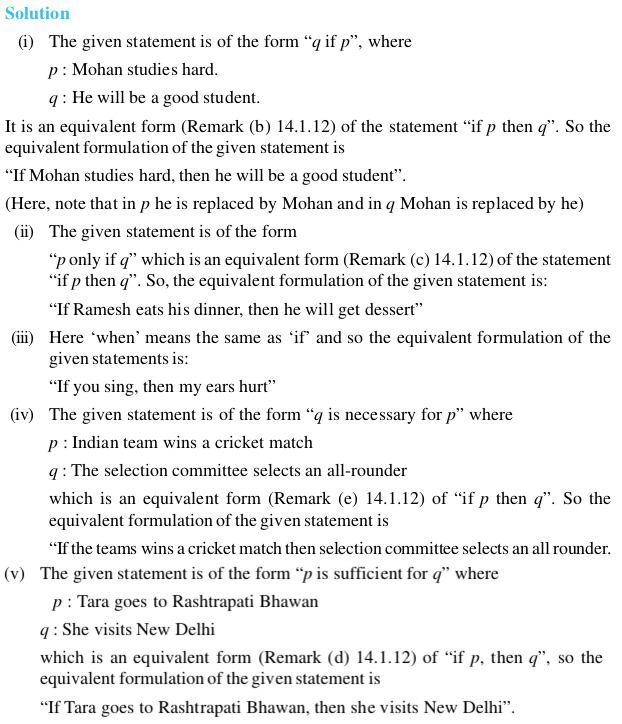
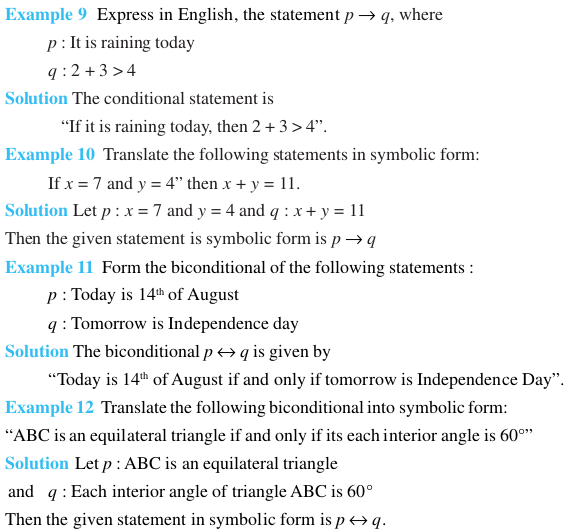
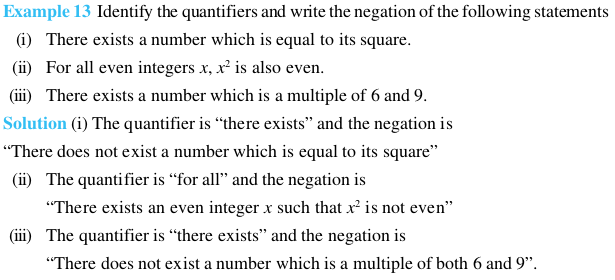
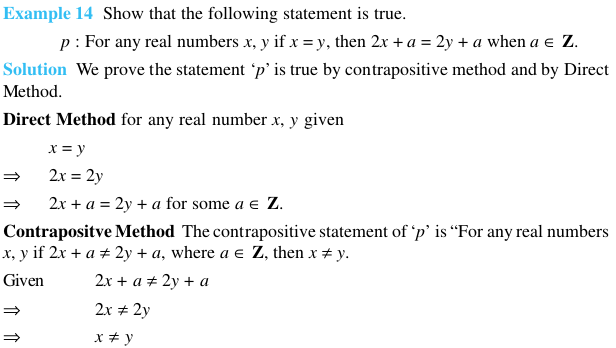
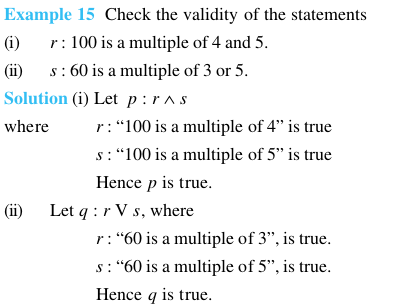
Objective Type Questions (Solved Examples)
Short Answer Type Questions (Exercise)

Objective Type Questions (Exercise)

True or False Type Questions (Exercise)

Answers