NCERT Exemplar Class 11 Maths Chapter 2: Relations and Functions. NCERT Exemplar Solutions for Class 11 Maths Chapter 2 Relations and Functions prepare students for their Class 11 exams thoroughly.
Maths problems and solutions for the Class 11 pdf are provided here which are similar to the questions being asked in the previous year's board.
NCERT Exemplar Class 11 Maths Chapter 2: Relations and Functions
Class 11: Maths Chapter 2 solutions. Complete Class 11 Maths Chapter 2 Notes.
2.1 Overview
This chapter deals with linking pair of elements from two sets and then introduce relations between the two elements in the pair. Practically in every day of our lives, we pair the members of two sets of numbers. For example, each hour of the day is paired with the local temperature reading by T.V. Station’s weatherman, a teacher often pairs each set of score with the number of students receiving that score to see more clearly how well the class has understood the lesson. Finally, we shall learn about special relations called functions.
2.1.1 Cartesian products of sets
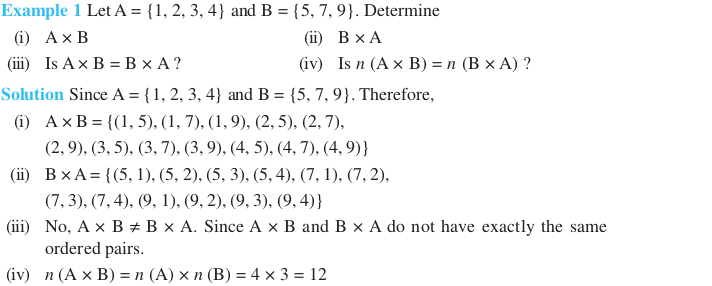
Definition : Given two non-empty sets A and B, the set of all ordered pairs (x, y), where x ∈ A and y ∈ B is called Cartesian product of A and B; symbolically, we write
A × B = {(x, y) | x ∈ A and y ∈ B}
If
A = {1, 2, 3} and B = {4, 5}, then
A × B = {(1, 4), (2, 4), (3, 4), (1, 5), (2, 5), (3, 5)}
and B × A = {(4, 1), (4, 2), (4, 3), (5, 1), (5, 2), (5, 3)}
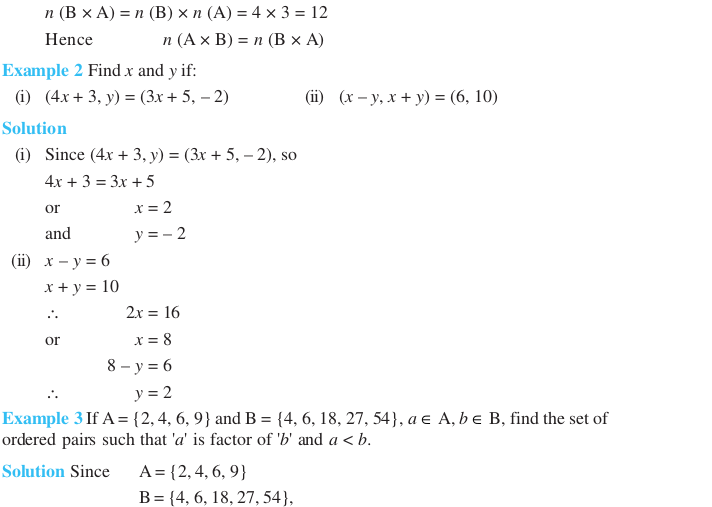
(i) Two ordered pairs are equal, if and only if the corresponding first elements are equal and the second elements are also equal, i.e. (x, y) = (u, v) if and only if x = u, y = v.
(ii) If n(A) = p and n (B) = q, then n (A × B) = p × q.
(iii) A × A × A = {(a, b, c) : a, b, c ∈ A}. Here (a, b, c) is called an ordered triplet.
2.1.2 Relations
A Relation R from a non-empty set A to a non empty set B is a subset of the Cartesian product set A × B. The subset is derived by describing a relationship between the first element and the second element of the ordered pairs in A × B.
The set of all first elements in a relation R, is called the domain of the relation R, and the set of all second elements called images, is called the range of R.
For example, the set R = {(1, 2), (– 2, 3), ( 1/2, 3)} is a relation; the domain of R = {1, – 2, 1/2} and the range of R = {2, 3}.

(i) A relation may be represented either by the Roster form or by the set builder form, or by an arrow diagram which is a visual representation of a relation.
(ii) If n (A) = p, n (B) = q; then the n (A × B) = pq and the total number of possible relations from the set A to set B =
2.1.3 Functions
A relation f from a set A to a set B is said to be function if every element of set A has one and only one image in set B. In other words, a function f is a relation such that no two pairs in the relation
has the same first element.
https://googleads.g.doubleclick.net/pagead/ads?gdpr=0&us_privacy=1---&gpp_sid=-1&client=ca-pub-6709000355577070&output=html&h=280&adk=144910138&adf=3960455850&pi=t.aa~a.4023996182~i.36~rp.4&daaos=1714561828384&w=750&fwrn=4&fwrnh=100&lmt=1713656406&num_ads=1&rafmt=1&armr=3&sem=mc&pwprc=5796625295&ad_type=text_image&format=750x280&url=https%3A%2F%2Fschools.aglasem.com%2Fncert-exemplar-class-11-mathematics-unit-2%2F&fwr=0&pra=3&rh=188&rw=750&rpe=1&resp_fmts=3&wgl=1&fa=27&uach=WyJMaW51eCIsIjYuNS4wIiwieDg2IiwiIiwiMTI0LjAuNjM2Ny43OCIsbnVsbCwwLG51bGwsIjY0IixbWyJDaHJvbWl1bSIsIjEyNC4wLjYzNjcuNzgiXSxbIkdvb2dsZSBDaHJvbWUiLCIxMjQuMC42MzY3Ljc4Il0sWyJOb3QtQS5CcmFuZCIsIjk5LjAuMC4wIl1dLDBd&dt=1714568286206&bpp=1&bdt=2871&idt=1&shv=r20240429&mjsv=m202404250101&ptt=9&saldr=aa&abxe=1&cookie=ID%3D522d0b6e5f487262-2213ac71c5e20073%3AT%3D1691662146%3ART%3D1714567941%3AS%3DALNI_MYNOJZZFKi8Gup3wY3uFsqyVVwZqA&gpic=UID%3D00000c2a0a4c88d5%3AT%3D1691662146%3ART%3D1714567941%3AS%3DALNI_MajeKuHpL9r7ujqhKfU2RIZVnRePA&eo_id_str=ID%3Daa5b82f62b43a0cf%3AT%3D1709550195%3ART%3D1714567941%3AS%3DAA-AfjYYRdoDi_w0C98-Qgelj2qW&prev_fmts=0x0%2C750x280&nras=3&correlator=4203533366853&frm=20&pv=1&ga_vid=2091936445.1691662146&ga_sid=1714568285&ga_hid=615730501&ga_fc=1&u_tz=330&u_his=1&u_h=768&u_w=1360&u_ah=741&u_aw=1290&u_cd=24&u_sd=1&dmc=8&adx=71&ady=2927&biw=1281&bih=620&scr_x=0&scr_y=1288&eid=44759875%2C44759926%2C44759837%2C31083068%2C31083214%2C95331042%2C95331982%2C31078663%2C31078665%2C31078668%2C31078670%2C95331578&oid=2&pvsid=4422362912968825&tmod=778554877&uas=0&nvt=1&ref=https%3A%2F%2Fschools.aglasem.com%2Fncert-exemplar-class-11-mathematics%2F&fc=1408&brdim=70%2C27%2C70%2C27%2C1290%2C27%2C1296%2C741%2C1296%2C620&vis=1&rsz=%7C%7Cs%7C&abl=NS&fu=128&bc=31&bz=1&td=1&psd=W251bGwsbnVsbCxudWxsLDNd&nt=1&ifi=3&uci=a!3&btvi=2&fsb=1&dtd=457
The notation f : X → Y means that f is a function from X to Y. X is called the domain of f and Y is called the co-domain of f. Given an element x ∈ X, there is a unique element y in Y that is related to x. The unique element y to which f relates x is denoted by f (x) and is called f of x, or the value of f at x, or the image of x under f.
The set of all values of f (x) taken together is called the range of f or image of X under f. Symbolically.
range of f = { y ∈ Y | y = f (x), for some x in X}
Definition: A function which has either R or one of its subsets as its range, is called a real valued function. Further, if its domain is also either R or a subset of R, it is called a real function.
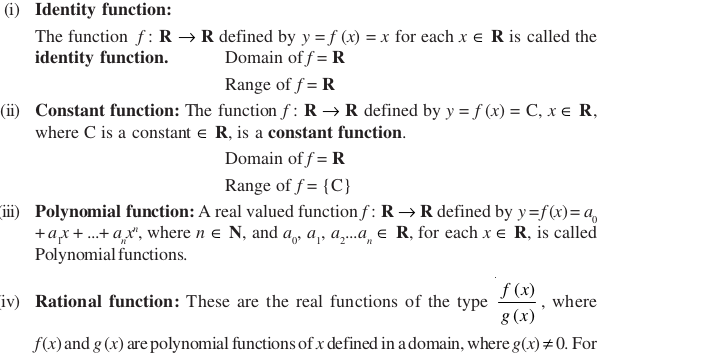
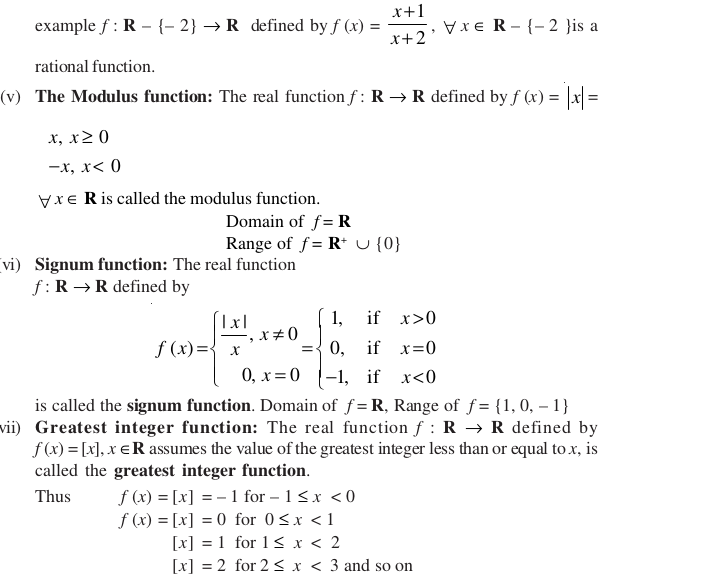
2.1.4 Some specific types of functions
2.1.5 Algebra of real functions
i) Addition of two real functions
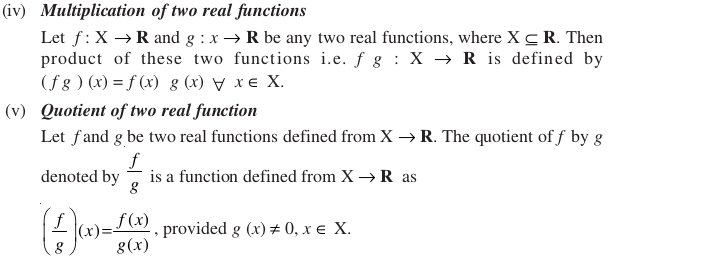
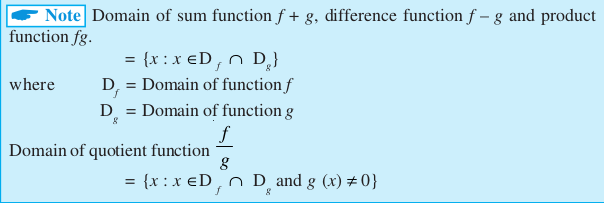
Let f : X → R and g : X → R be any two real functions, where X ∈ R.
Then we define ( f + g) : X → R by ( f + g) (x) = f (x) + g (x), for all x ∈ X.
(ii) Subtraction of a real function from another
Let f : X → R and g : X → R be any two real functions, where X ⊆ R.
Then, we define (f – g) : X → R by (f – g) (x) = f (x) – g (x), for all x ∈ X.
(iii) Multiplication by a Scalar
Let f : X → R be a real function and α be any scalar belonging to R. Then the
product αf is function from X to R defined by (α f ) (x) = α f (x), x ∈ X.
Short Answer Type Questions (Solved Examples)
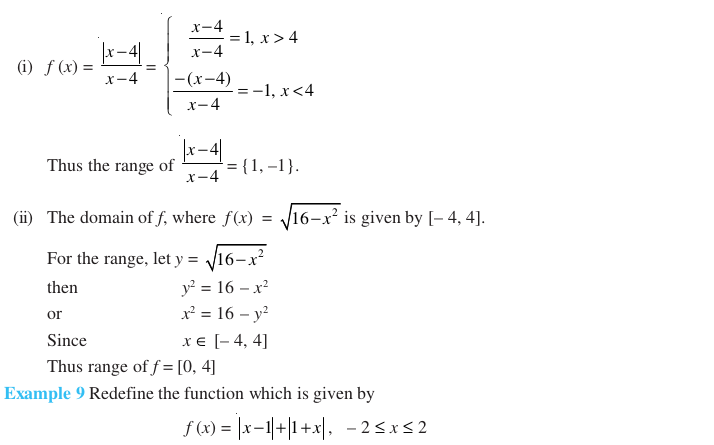
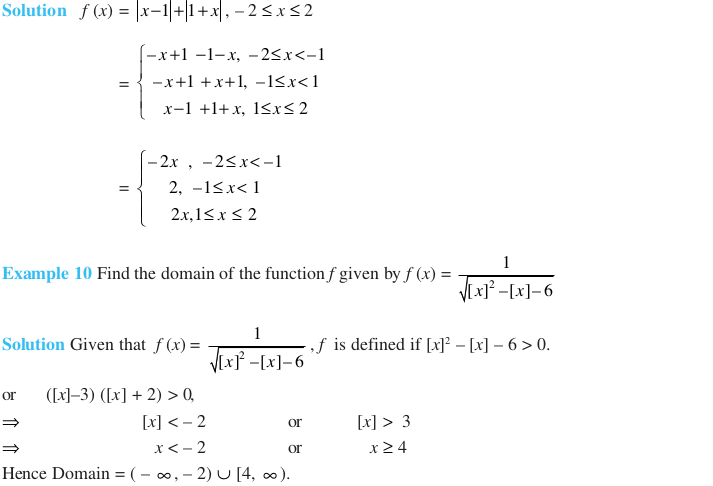
Objective Type Questions (Solved Examples)
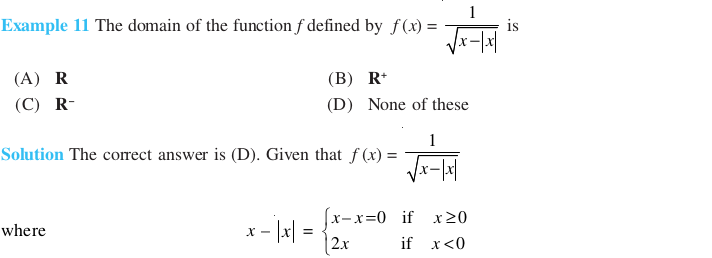
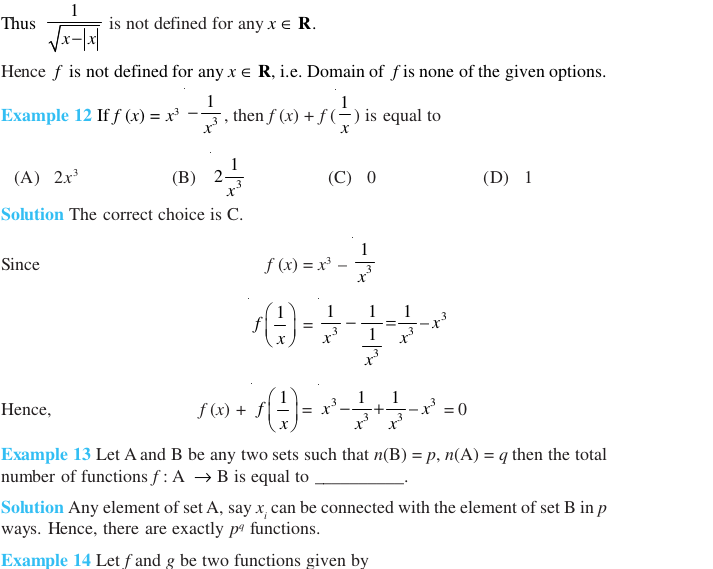

Short Answer Type Questions
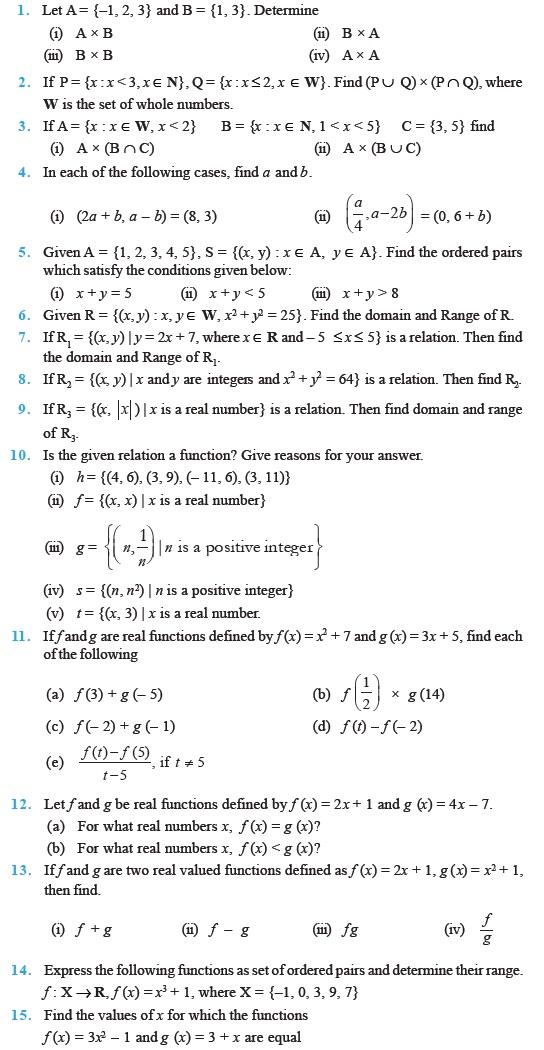
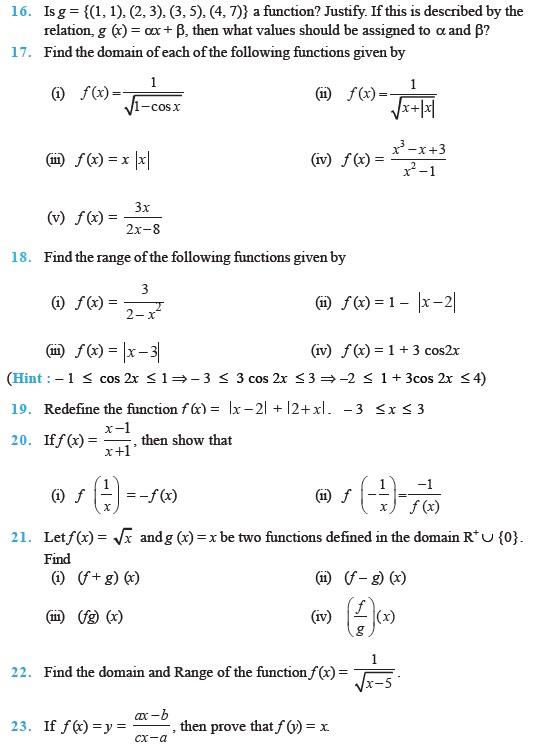
Long Answer Type Questions
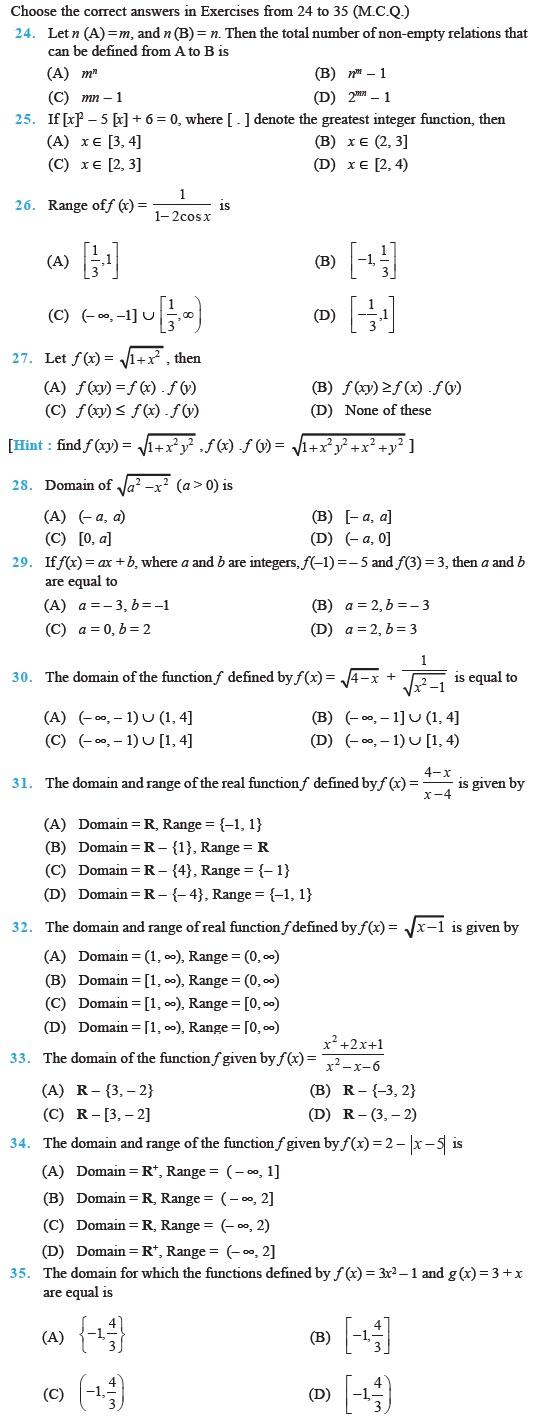
Objective Type Questions
Fill In Blanks Type Questions

Match Type Questions
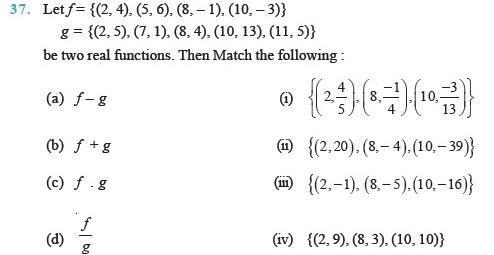
True or False Statements Type Questions
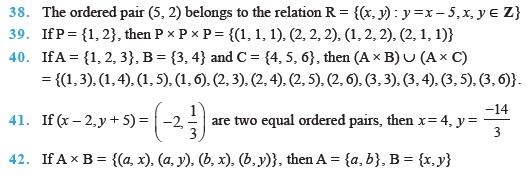
Answers