NCERT Exemplar Class 12 Maths Chapter 12: Linear Programming. NCERT Exemplar Solutions for Class 12 Maths Chapter 12 Linear Programming prepare students for their Class 12 exams thoroughly.
Maths problems and solutions for the Class 12 pdf are provided here which are similar to the questions being asked in the previous year's board.
NCERT Exemplar Class 12 Maths Chapter 12: Linear Programming
Class 12: Maths Chapter 12 solutions. Complete Class 12 Maths Chapter 12 Notes.
12.1 Overview
12.1.1 An Optimisation Problem A problem which seeks to maximise or minimise a function is called an optimisation problem. An optimisation problem may involve maximisation of profit, production etc or minimisation of cost, from available resources etc.
12.1.2 A Linnear Programming Problem (LPP)
A linear programming problem deals with the optimisation (maximisation/ minimisation) of a linear function of two variables (say x and y) known as objective function subject to the conditions that the variables are non-negative and satisfy a set of linear inequalities (called linear constraints). A linear programming problem is a special type of optimisation problem.
12.1.3 Objective Function Linear function Z = ax + by, where a and b are constants, which has to be maximised or minimised is called a linear objective function.
12.1.4 Decision Variables In the objective function Z = ax + by, x and y are called decision variables.
12.1.5 Constraints The linear inequalities or restrictions on the variables of an LPP are called constraints. The conditions x ≥ 0, y ≥ 0 are called non-negative constraints.
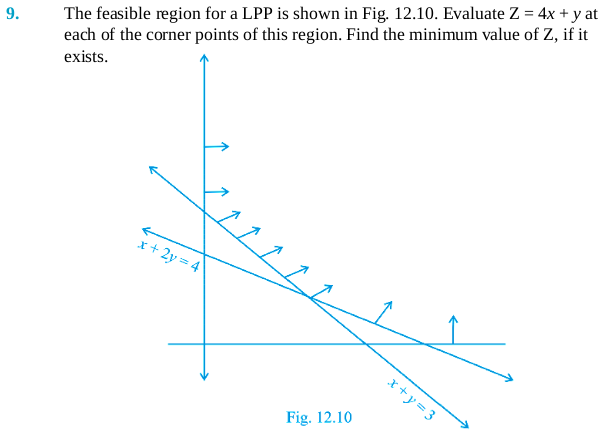
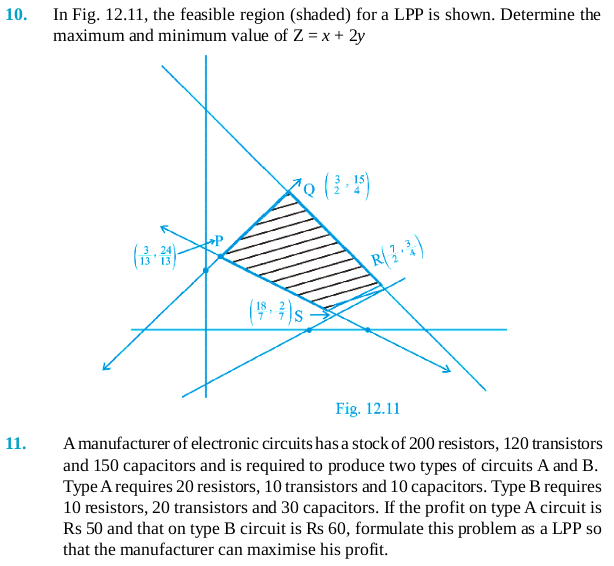
12.1.6 Feasible Region The common region determined by all the constraints including non-negative constraints x ≥ 0, y ≥ 0 of an LPP is called the feasible region for the problem.
12.1.7 Feasible Solutions Points within and on the boundary of the feasible region for an LPP represent feasible solutions.
12.1.8 Infeasible Solutions Any Point outside feasible region is called an infeasible solution.
12.1.9 Optimal (feasible) Solution Any point in the feasible region that gives the optimal value (maximum or minimum) of the objective function is called an optimal solution.
Following theorems are fundamental in solving LPPs.
12.1.10 Theorem 1 Let R be the feasible region (convex polygon) for an LPP and let Z = ax + by be the objective function. When Z has an optimal value (maximum or minimum), where x and y are subject to constraints described by linear inequalities, this optimal value must occur at a corner point (vertex) of the feasible region.
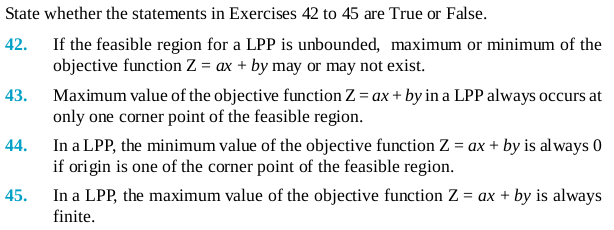
Theorem 2 Let R be the feasible region for a LPP and let Z = ax + by be the objective function. If R is bounded, then the objective function Z has both a maximum and a minimum value on R and each of these occur at a corner point of R. If the feasible region R is unbounded, then a maximum or a minimum value of the objective function may or may not exist. However, if it exits, it must occur at a
corner point of R.
12.1.11 Corner point method for solving a LPP
The method comprises of the following steps :
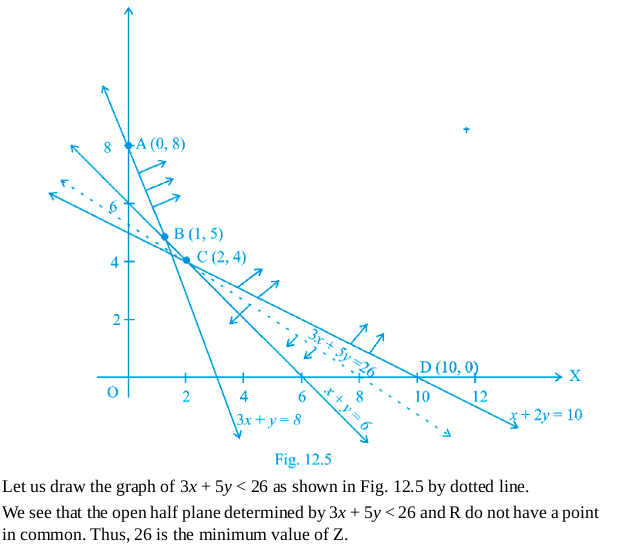
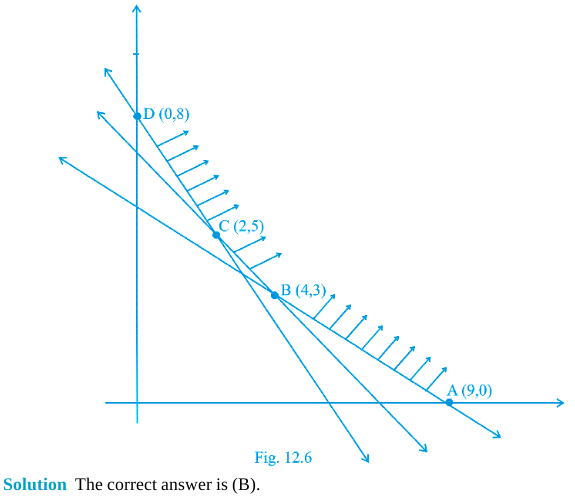
(1) Find the feasible region of the LPP and determine its corner points (vertices) either by inspection or by solving the two equations of the lines intersecting at that point.
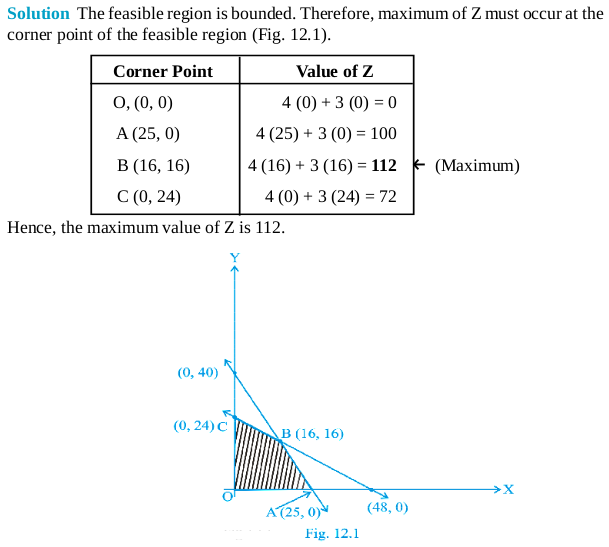
(2) Evaluate the objective function Z = ax + by at each corner point. Let M and m, respectively denote the largest and the smallest values of Z.
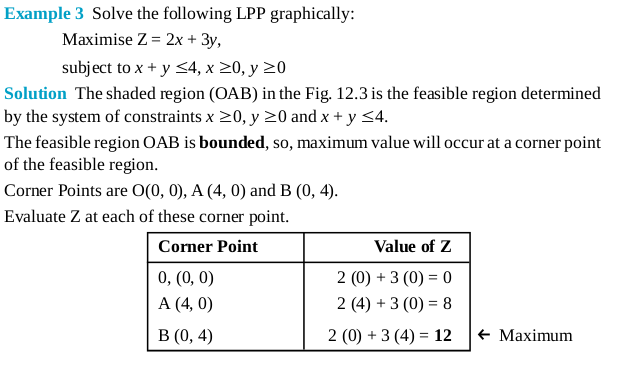
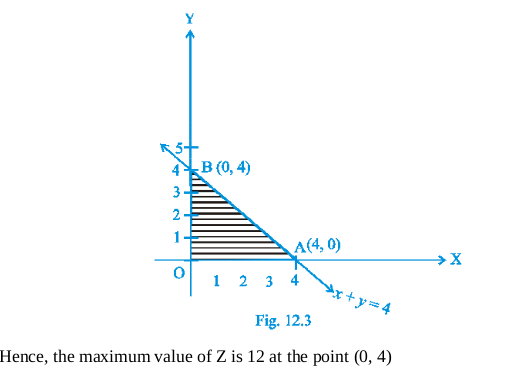
(3) (i) When the feasible region is bounded, M and m are, respectively, the maximum and minimum values of Z.
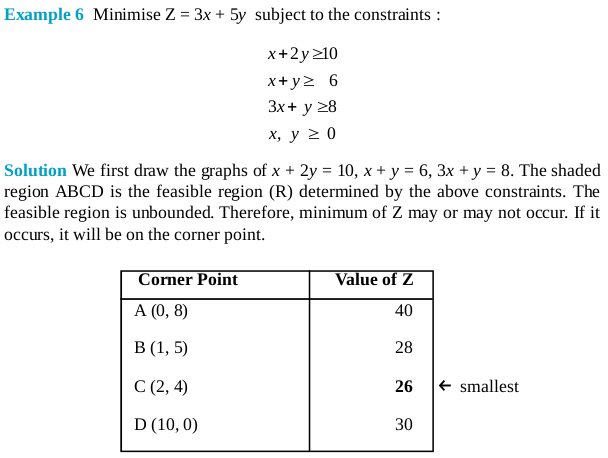
(ii) In case, the feasible region is unbounded.
(a) M is the maximum value of Z, if the open half plane determined by ax + by > M has no point in common with the feasible region. Otherwise, Z has no maximum value.
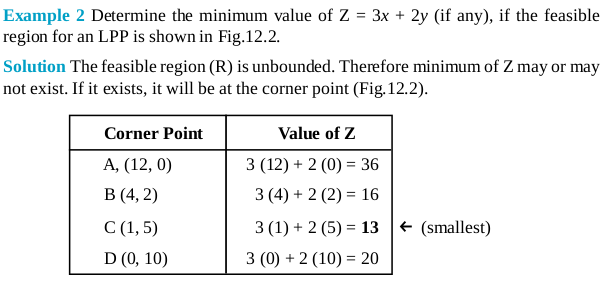
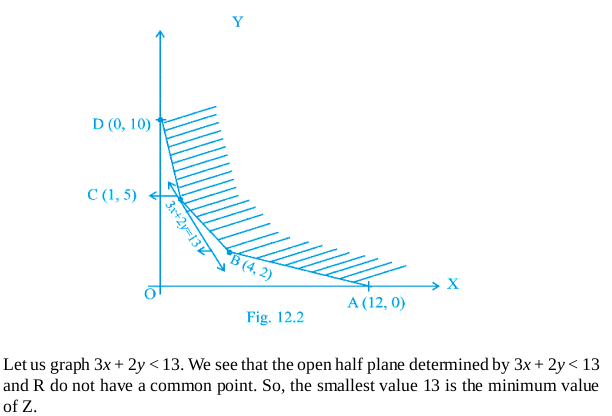
(b) Similarly, m is the minimum of Z, if the open half plane determined by ax + by < m has no point in common with the feasible region. Otherwise, Z has no minimum value.
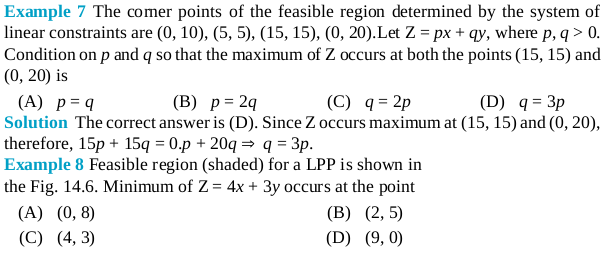
12.1.12 Multiple optimal points If two corner points of the feasible region are optimal solutions of the same type, i.e., both produce the same maximum or minimum, then any point on the line segment joining these two points is also an optimal solution of the same type.
Short Answer Type Questions (Solved Examples)

Long Answer Type Questions (Solved Examples)
Objective Type Questions (Solved Examples)
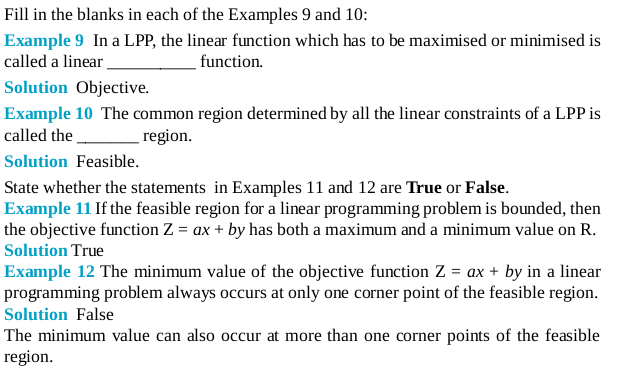
Short Answer Type Questions (Exercise)
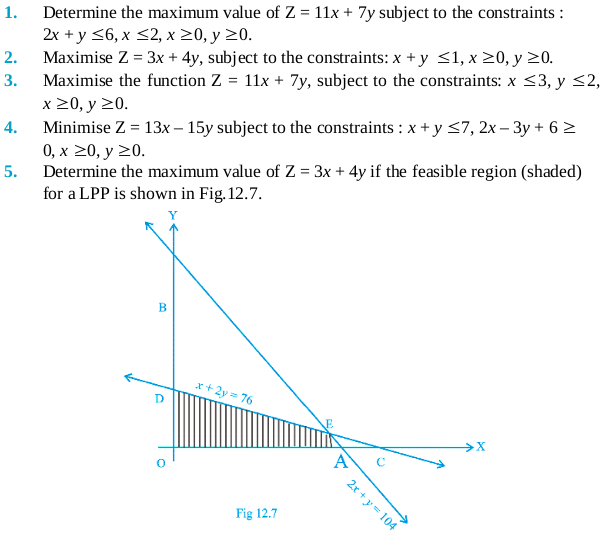
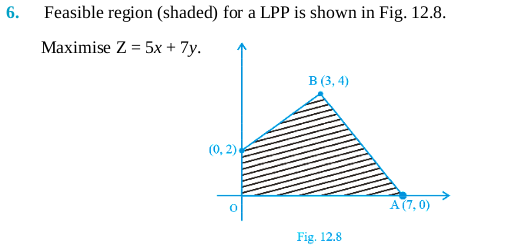
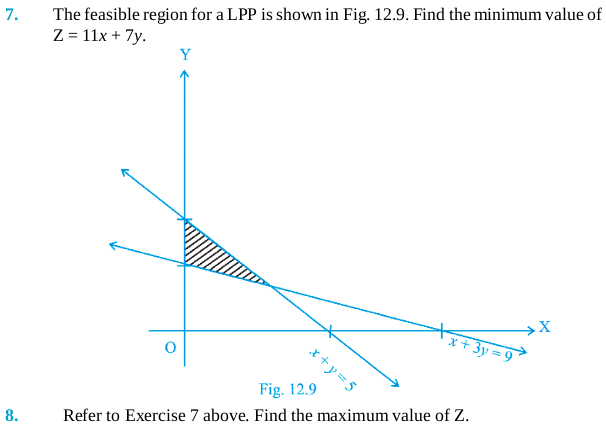
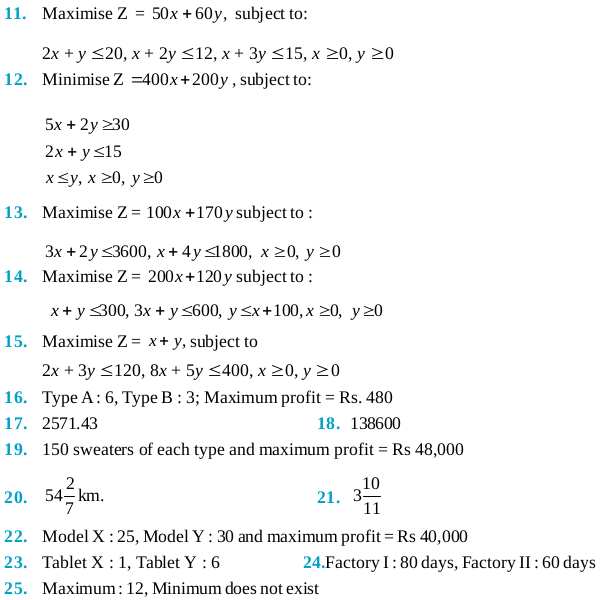
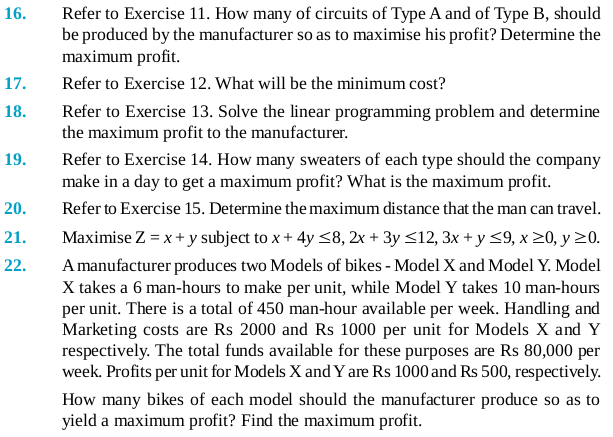
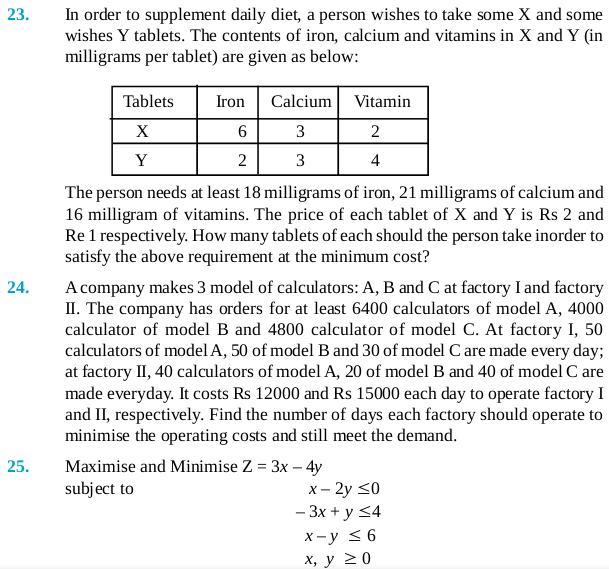
Long Answer Type Questions (Exercise)
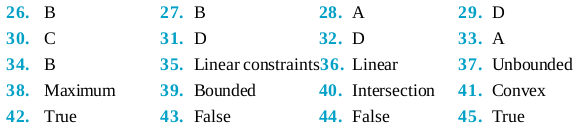
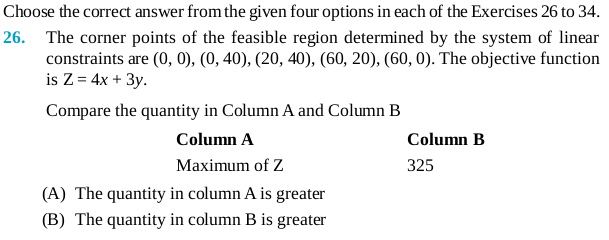
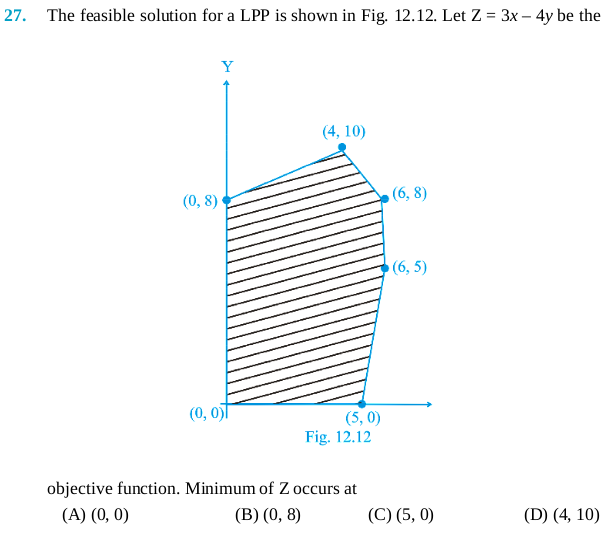
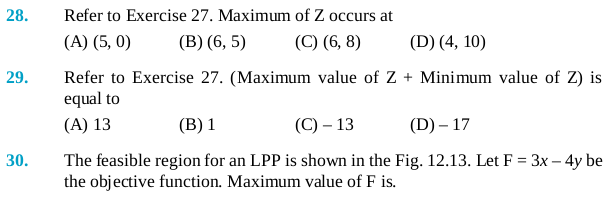
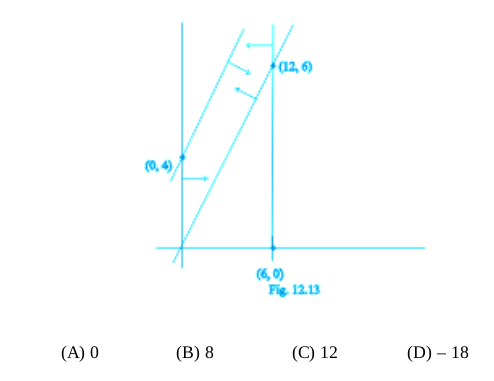
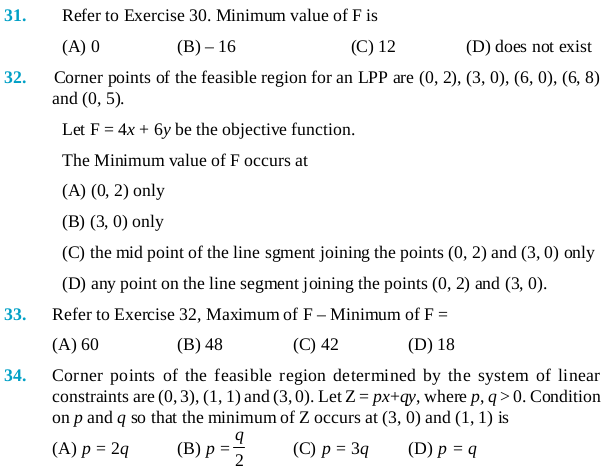
Multiple Choice Questions

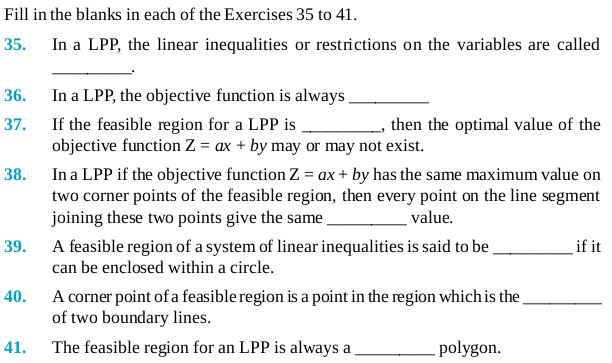
Fill In Blanks Type Questions
True or False Statements Type Questions
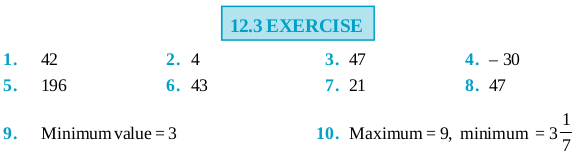
Answers