Curriculum & Exam Preparation Note: Regular practice of NCERT textbook exercises and chapter-end questions establishes strong conceptual clarity for primary and secondary examinations.
NCERT Exemplar Class 6 Science Chapter 15: Air Around Us. NCERT Exemplar Solutions for Class 6 Science Chapter 15 Air Around Us prepare students for their Class 6 exams thoroughly.
Science problems and solutions for the Class 6 pdf are provided here which are similar to the questions being asked in the previous year's board.
NCERT Exemplar Class 6 Science Chapter 15: Air Around Us
Class 6: Science Chapter 15 solutions. Complete Class 6 Science Chapter 15 Notes.
Multiple Choice Questions
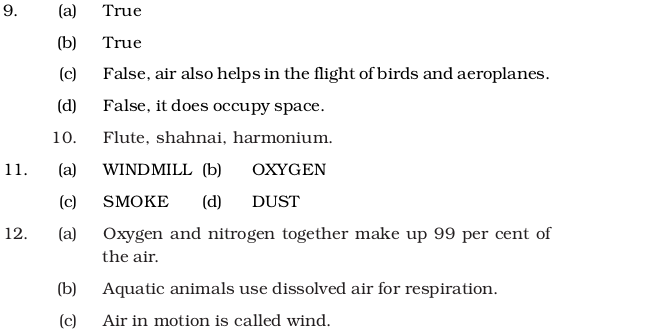
- Which of the following statements is incorrect?
- (a) All living things require air to breathe.
- (b) We can feel air but we cannot see it.
- (c) Moving air makes it possible to fly a kite.
- (d) Air is present everywhere but not in soil.
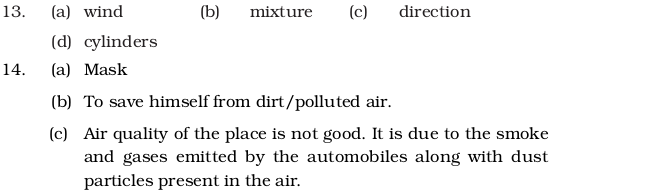
- Wind does not help in the movement of which of the following?
- (a) Firki
- (b) Weather cock
- (c) Ceiling fan
- (d) Sailing yacht
- What is not true about air?
- (a) It makes the windmill rotate.
- (b) It helps in the movements of aeroplanes.
- (c) Birds can fly due to presence of air.
- (d) It has no role in water cycle.
- Mountaineers carry oxygen cylinders with them because
- (a) there is no oxygen on high mountains.
- (b) there is deficiency of oxygen on mountains at high altitude.
- (c) oxygen is used for cooking.
- (d) oxygen keeps them warm at low temperature.
- Boojho took an empty plastic bottle, turned it upside down and dipped its open mouth into a bucket filled with water. He then tilted the bottle slightly and made the following observations.
(i) Bubbles of air came out from the bottle.
(ii) Some water entered the bottle.
(iii) Nitrogen gas came out in the form of bubbles and oxygen got dissolved in water.
(iv) No bubbles formed, only water entered the bottle.
Which observations is/are correct?- (a) (i) and (ii)
- (b) (iv) only
- (c) (iii) and (iv)
- (d) (i) only
- Which of the following components of air is present in the largest amount in the atmosphere?
- (a) Nitrogen
- (b) Oxygen
- (c) Water vapour
- (d) Carbon dioxide
- The components of air which are harmful to living beings are
- (a) nitrogen and carbon dioxide.
- (b) dust and water vapour.
- (c) dust and smoke.
- (d) smoke and water vapour.
- Usha took a lump of dry soil in a glass and added water to it till it was completely immersed. She observed bubbles coming out. The bubbles contain
- (a) water vapour
- (b) only oxygen gas
- (c) air
- (d) none of these
Very Short Answer Type Questions
- State whether the following statements are true or false. If false, correct them.
- (a) Plants consume oxygen for respiration.
- (b) Plants produce oxygen during the process of making their own food.
- (c) Air helps in the movements of sailing yachts and glider but plays no role in the flight of birds and aeroplanes.
- (d) Air does not occupy any space.
- In a number of musical instruments, air plays an important role. Can you name some such instruments?
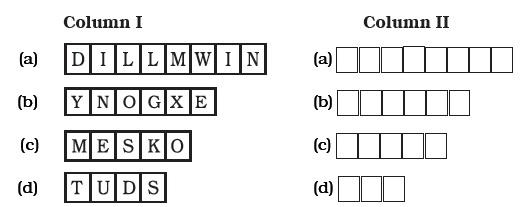
- In the boxes of Column I the letters of some words got jumbled. Arrange them in proper form in the boxes given in Column II
- Make sentences using the given set of words.
- (a) 99%, oxygen, nitrogen, air, together
- (b) Respiration, dissolved, animals, air, aquatic
- (c) Air, wind, motion, called
Short Answer Type Questions
- A list of words is given in a box. Use appropriate words to fill up the blanks in the following statements
Air, oxygen, wind, water vapour, mixture, combination, direction, road, bottles, cylinders.- (a) The ______ makes the windmill rotate.
- (b) Air is a ______ of some gases.
- (c) A weather cock shows the ______ in which the air is moving at that place.
- (d) Mountaineers carry oxygen ______ with them, while climbing high mountains.
- Observe the picture given in Fig. 15.1 carefully and answer the following questions.
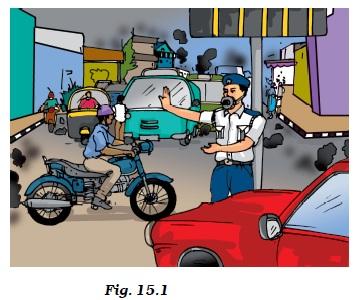
- (a) What is covering the nose and mouth of the police man?
- (b) Why is he putting a cover on his nose?
- (c) Can you comment on air quality of the place shown in the Fig.15.1?
- Garima observed that when she left her tightly capped bottle full of water in the open sunlight, tiny bubbles were formed all around inside the bottle. Help Garima to know why it so happened?
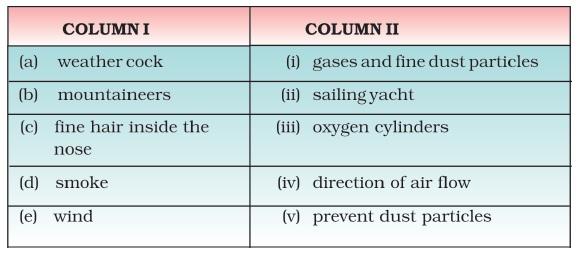
- Match the items of Column I with the items of Column II
Long Answer Type Questions
- Explain the following observations very briefly
- (a) A firki does not rotate in a closed area.
- (b) The arrow of weather cock points towards a particular direction at a particular moment.
- (c) An empty glass in fact is not empty.
- (d) Breathing through mouth may harm you.
- Write just a few sentences for an imaginary situation if any of the following gases disappear from the atmosphere
- (a) oxygen
- (b) nitrogen
- (c) carbon dioxide
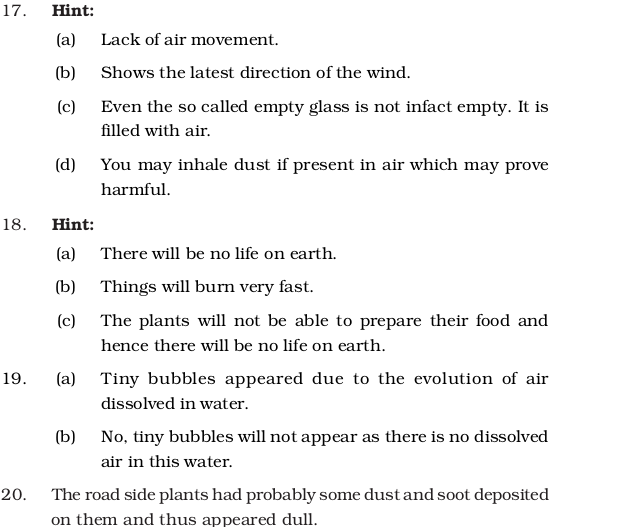
- Paheli kept some water in a beaker for heating. She observed that tiny bubbles appeared before the water started to boil. She boiled the water for about 5 minutes and filled it in a bottle up to the brim and kept the bottle air tight till it cooled down to room temperature.
- (a) Why did the tiny bubbles appeared?
- (b) Do you think tiny bubbles will appear on heating the water taken out from the bottle? Justify your answer.
- On a Sunday morning Paheli’s friend visited her home. She wanted to see some flowering plants in the nearby garden. Both of them went to the garden. While returning from the garden they also observed some flowering plants on the road side. But to their surprise they found that the leaves and flowers of these roadside plants were comparatively very dull. Can you help them to know why?
Answers