Curriculum & Exam Preparation Note: Regular practice of NCERT textbook exercises and chapter-end questions establishes strong conceptual clarity for primary and secondary examinations.
NCERT Exemplar Class 6 Science Chapter 3: Fibre to Fabric. NCERT Exemplar Solutions for Class 6 Science Chapter 3 Fibre to Fabric prepare students for their Class 6 exams thoroughly.
Science problems and solutions for the Class 6 pdf are provided here which are similar to the questions being asked in the previous year's board.
NCERT Exemplar Class 6 Science Chapter 3: Fibre to Fabric
Class 6: Science Chapter 3 solutions. Complete Class 6 Science Chapter 3 Notes.
Multiple Choice Questions
- Paheli wants to present her friend a gift made of plant-fibre.
Which out of the following will she select?- (a) Jute bag
- (b) Woollen shawl
- (c) Silk saree
- (d) Nylon scarf
- Which statement out of the following is incorrect?
- (a) Use of Charkha was popularised by Mahatma Gandhi as a part of the Independence Movement.
- (b) In India, jute is mainly grown in Kerala and Punjab.
- (c) To make fabric, the fibres are first converted into yarns.
- (d) Sufi saint Kabir was a weaver.
- Which of the following materials did people use in ancient times for making clothes?
(i) Leaves of trees
(ii) Newspaper
(iii) Metal foils
(iv) Animal skins and furs- (a) (i) and (ii)
- (b) (i) and (iii)
- (c) (ii) and (iii)
- (d) (i) and (iv)
- Which of the following is not a natural fibre?
- (a) Cotton
- (b) Jute
- (c) Nylon
- (d) Flax
- Which set of substances is not used for making fibres?
- (a) Silk, chemicals
- (b) Yak hair, camel hair
- (c) Husk, bones
- (d) Flax, wool
- Boojho went to a cloth shop. There he found a fabric which was smooth to touch, had vibrant colour and shine. The fabric could be
- (a) Cotton
- (b) Wool
- (c) Silk
- (d) Jute
- Which part of the jute plant is used for getting jute fibre?
- (a) Flower
- (b) Stem
- (c) Fruit
- (d) Leaf
- Yarn is woven to get fabric using
- (a) charkha
- (b) spinning machines
- (c) looms
- (d) knitting needles
- Beera is a farmer. His field has black soil and the climate is warm. Which fibre yielding plant should he grow in his field?
- (a) Jute
- (b) Cotton
- (c) Coconut
- (d) Wool
- The correct sequence to get cloth is :
- (a) fibre → fabric → yarn
- (b) fibre → yarn → fabric
- (c) fabric → yarn → fibre
- (d) yarn → fibre → fabric
- Boojho wants to make yarn from fibre at home. Which of the following will he use to carry out the task?
- (a) Powerloom
- (b) Handloom
- (c) Charkha
- (d) Knitting needles
Very Short Answer Type Questions
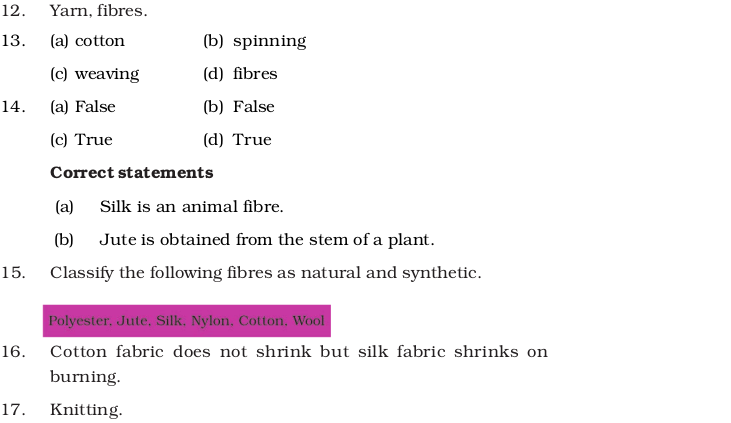
- Yarn, fabric and fibres are related to each other. Show the relationship by filling the blanks in the following sentence.
Fabric of cotton saree is made by weaving cotton_ _ _ _ _ _which in turn is made by spinning thin cotton _ _ _ _ _ _. - Some terms related to fabrics are jumbled up and given below.
Write them in their correct form.- (a) onttoc
- (b) sinnping
- (c) vingwea
- (d) bisref
- State whether the following statements are true or false. If false, correct them.
- (a) Silk is a plant fibre.
- (b) Jute is obtained from the leaves of a plant.
- (c) Weaving is a process of arranging two sets of yarn together.
- (d) Cotton yarn on burning gives an odour similar to that of a burning paper.
- The following is an answer given by Boojho to a question asked by his teacher— “Cotton, wool, silk and jute are classified as natural fibres whereas nylon and polyester are classified as synthetic fibres.”
Can you tell what question the teacher has asked? - Once, Paheli visited a tailor shop and brought home some cuttings of fabric to study their properties. She took two pieces and found that one of the pieces were shrinking when it was burnt with a candle. However the other did not shrink on burning. Can you help her to find out which of the two was a cotton fabric and which a silk fabric?
- One way of making fabric from yarn is weaving, what is the other?
Short Answer Type Questions
- Boojho with perfect eyesight was finding it difficult to pass a thread through the eye of a needle. What can be the possible reason for this?
- In ancient times stitching was not known. People used to simply drape the fabrics around different parts of their body. Even today a number of unstitched fabrics are used by both men and women. Can you give four such examples of clothes?
- Match the articles given in Column I with the articles of Column II
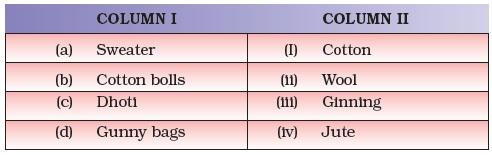
- Fill in the blanks to complete the life story of cotton fibre.
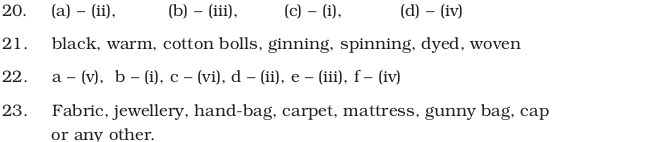
My parents, cotton plants were grown in _______soil and _____- climate. The plants bore fruits called ______ . I, the cotton fibre was separated from seeds in the cotton bolls by the process of ______. Other cotton fibres and myself were made into yarn by the process of ______. The yarn was _______to give beautiful colours and then_______to get cotton fabric. - Match the terms given in Column I with the statements given in Column II.
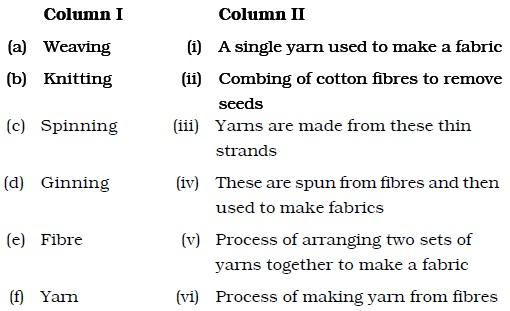
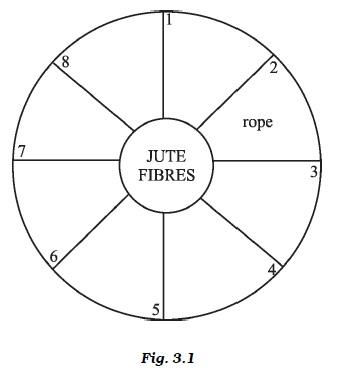
- Fill in the names of useful items made from jute fibres in Fig. 3.1. One such example is given.
Long Answer Type Questions
- A cotton shirt, before it reaches you, completes a long journey. Elaborate this journey starting from cotton bolls.
- Describe the two main processes of making fabric from yarn.
Answers