NCERT K-12 (All Classes) Private Session 2025-26 Free Open Access

NCERT Exemplar Class 7 Maths Chapter 7: Comparing Quantities

NCERT Exemplar Class 7 Maths Chapter 7: Comparing Quantities. NCERT Exemplar Solutions for Class 7 Maths Chapter 7 Comparing Quantities prepare students for their Class 7 exams thoroughly. Maths...

Curriculum NCERT
Applicable Grade Class 7
Medium English & Hindi
Resource Format Chapter Q&A / PDF

Textbook Solutions & Academic Guide

Verified chapter-wise solutions, answers, and study notes

Curriculum & Exam Preparation Note: Regular practice of NCERT textbook exercises and chapter-end questions establishes strong conceptual clarity for primary and secondary examinations.

NCERT Exemplar Class 7 Maths Chapter 7: Comparing Quantities. NCERT Exemplar Solutions for Class 7 Maths Chapter 7 Comparing Quantities prepare students for their Class 7 exams thoroughly.

Maths problems and solutions for the Class 7 pdf are provided here which are similar to the questions being asked in the previous year's board.

NCERT Exemplar Class 7 Maths Chapter 7: Comparing Quantities

Class 7: Maths Chapter 7 solutions. Complete Class 7 Maths Chapter 7 Notes.

Main Concepts and Results

To compare two quantities, their units must be the same.
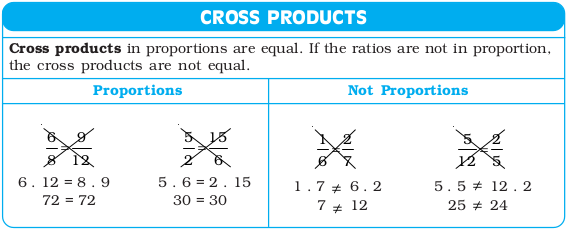
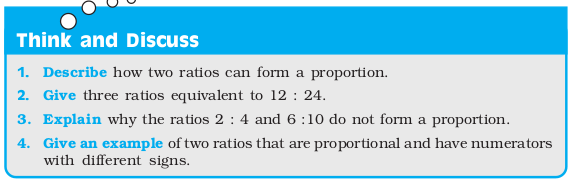
Two ratios can be compared by converting them into like fractions. If the two fractions are equal, we say that the two given ratios are equivalent.
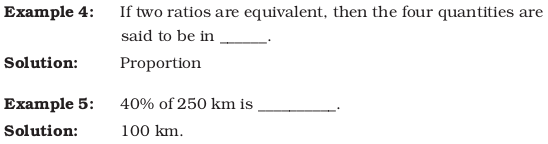
If two ratios are equivalent (or equal), then the involved four quantities are said to be in proportion.
One of the ways of comparing quantities is percentage. Per cent is derived from Latin word ‘per centum’ meaning ‘per hundred’.
Percent is represented by the symbol % and means hundredth too.
Fractions can be converted into percentages and vice-versa.
Decimals can also be converted into percentages and vice-versa.
The buying price of any item is known as its cost price. It is written in short as CP.
The price at which an item is sold, is known as its selling price or in short SP.
If CP < SP, then a profit is made and Profit = SP – CP.
If CP = SP, there is no profit or loss.
If CP > SP, then a loss is made and Loss = CP – SP.
Profit per cent =

Loss per cent =

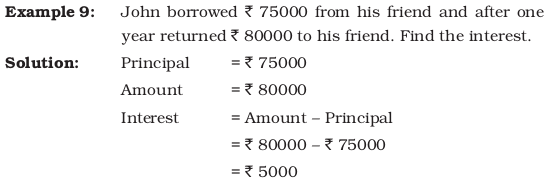
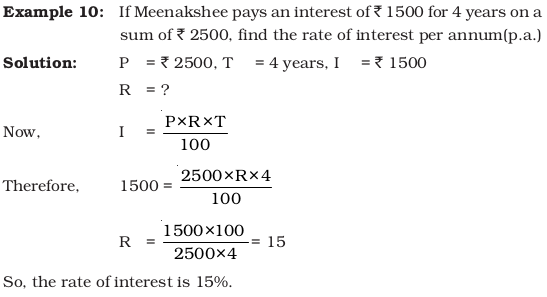
Principal’ P, means the borrowed money.
The extra money paid by borrower for using borrowed money for given time is called ‘Interest’ I.
The period for which the money is borrowed is called ‘Time Period’ T.
To determine Interest to be paid, we have ‘Rate of Interest’.
Rate of Interest is generally given in per cent per year.
On a principal of ₹ P at R % rate of interest per year, the interest (simple) I paid for T years is given by
The total money paid alongwith interest or principal P is called amount (A). Thus A = P + I.

Solved Examples

Multiple Choice Questions

Class 7 Important Questions for Maths – Comparing Quantities

Fill in the Blanks Type Questions

Class 7 Important Questions for Maths – Comparing Quantities

True False Type Questions

Class 7 Important Questions for Maths – Comparing Quantities

Other Important Type Questions

Class 7 Important Questions for Maths – Comparing Quantities

Application

Click here to download NCERT Exemplar Class 7 Maths for Unit 7 Comparing Quantities.

« PreviousNext »

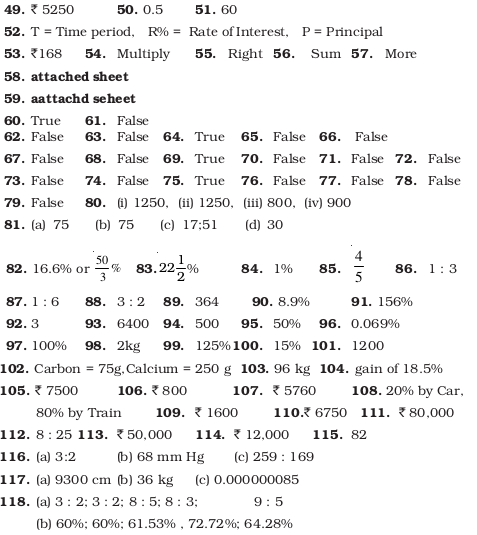
Answers

NCERT Solutions for All Classes (1 to 12)

Jump to free NCERT solutions, chapter Q&A, and textbooks for any grade

Popular Reference Solutions & Help Books

Step-by-step solutions for Mathematics and Science reference textbooks

Latest School & Board Updates

Real-time date sheets, admit cards, syllabus revisions, and exam notifications

Haryana Board Senior Secondary (12th) 20 Feb 2025
HBSE 12th 2024 Question Papers
View
Haryana Board Secondary (10th) 20 Feb 2025
HBSE 10th 2024 Question Papers
View
Haryana Board Senior Secondary (12th) 19 Feb 2025
HBSE 9th Model Papers 2025
View
Haryana Board Senior Secondary (12th) 19 Feb 2025
HBSE 11th Model Papers 2025
View
State Board Primary (1-5) 15 Feb 2025
BHU SET 2025 Application Form
View

Frequently Asked Questions

Common queries regarding NCERT textbook solutions & school curriculum

Are these NCERT solutions available 100% free of charge?

Yes. All NCERT solutions, chapter questions, textbook exercises, and download guides published on IndCareer Schools are completely free for students, parents, and educators without requiring any paid subscription or login.

Which subjects are covered for Class 7?

For Class 1, comprehensive NCERT solutions are provided for Mathematics (Math-Magic / गणित का जादू), English (Marigold & Mridang), and Hindi (Rimjhim / रिमझिम), alongside printable worksheets and textbook PDF downloads.

Are these solutions updated according to the latest CBSE / NCERT guidelines?

Yes. Our academic editorial team continually aligns all solutions and textbook references with the latest National Education Policy (NEP) and the rationalized curriculum issued by NCERT and the Central Board of Secondary Education (CBSE).

How can I download the official NCERT books in PDF format?

You can access official NCERT textbooks by clicking on the textbook links provided in the study content section above or by visiting the Class 1 to 12 NCERT Directory on IndCareer Schools.