Curriculum & Exam Preparation Note: Regular practice of NCERT textbook exercises and chapter-end questions establishes strong conceptual clarity for primary and secondary examinations.
NCERT Exemplar Class 7 Science Chapter 1: Nutrition in Plants. NCERT Exemplar Solutions for Class 7 Science Chapter 1 Nutrition in Plants prepare students for their Class 7 exams thoroughly.
Science problems and solutions for the Class 7 pdf are provided here which are similar to the questions being asked in the previous year's board.
NCERT Exemplar Class 7 Science Chapter 1: Nutrition in Plants
Class 7: Science Chapter 1 solutions. Complete Class 7 Science Chapter 1 Notes.
Multiple Choice Questions
- Organisms which prepare food for themselves using simple naturally available raw materials are referred to as
- (a) heterotrophs
- (b) autotrophs
- (c) parasites
- (d) saprophytes
- In the absence of which of the following will photosynthesis not occur in leaves?
- (a) Guard cells
- (b) Chlorophyll
- (c) Vacuole
- (d) Space between cells
- Which of the following statements is/are correct?
(i) All green plants can prepare their own food.
(ii) Most animals are autotrophs.
(iii) Carbon dioxide is not required for photosynthesis.
(iv) Oxygen is liberated during photosynthesis.
Choose the correct answer from the options below:- (a) (i) and (iv)
- (b) (ii) only
- (c) (ii) and (iii)
- (d) (i) and (ii)
- Pitcher plant traps insects because it
- (a) is a heterotroph.
- (b) grows in soils which lack in nitrogen.
- (c) does not have chlorophyll.
- (d) has a digestive system like human beings.
- The term that is used for the mode of nutrition in yeast, mushroom and bread-mould is
- (a) autotrophic
- (b) insectivorous
- (c) saprophytic
- (d) parasitic
- When we observe the lower surface of a leaf through a magnifying lens we see numerous small openings. Which of the following is the term given to such openings?
- (a) Stomata
- (b) Lamina
- (c) Midrib
- (d) Veins
- Two organisms are good friends and live together. One provides shelter, water, and nutrients while the other prepares and provides food. Such an association of organisms is termed as
- (a) saprophyte
- (b) parasite
- (c) autotroph
- (d) symbiosis
- Which of the following raw material is available in the air for photosynthesis?
- (a) Oxygen
- (b) Carbon dioxide
- (c) Nitrogen
- (d) Hydrogen
Very Short Answer Type Questions
- Potato and ginger are both underground parts that store food. Where is the food prepared in these plants?

Short Answer Type Questions
- A goat eats away all the leaves of a small plant (balsam). However, in a few days, new leaves could be seen sprouting in the plant again. How did the plant survive without leaves?
- Unscramble the following to form terms related to modes of nutrition.
(i) RASPAEIT
(ii) ROPEHYTSAP
(iii) TOROPHAUT
(iv) SIBIOMSYS - Nitrogen is an essential nutrient for plant growth. But farmers who cultivate pulse crops like green gram, bengal gram, black gram, etc. do not apply nitrogenous fertilizers during cultivation. Why?
- Wheat dough if left in the open, after a few days, starts to emit a foul smell and becomes unfit for use. Give reason.
- Sunlight, chlorophyll, carbon dioxide, water and minerals are raw materials essential for photosynthesis. Do you know where they are available? Fill in the blanks with the appropriate raw materials.
(a) Available in the plant : _______________
(b) Available in the soil : _______________, _______________
(c) Available in the air : _______________
(d) Available during day : _______________ - Observe the diagram given as Figure 1.1 and label the following terms given in the box.
stomatal opening, guard cell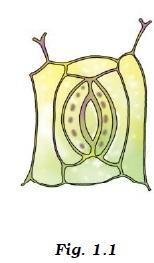
Long Answer Type Questions
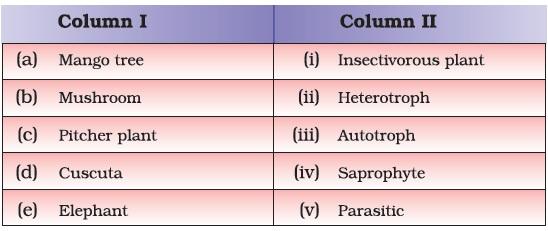
- Match the organisms given in Column I with their mode of nutrition given in Column II.
- Wild animals like tiger, wolf, lion and leopard do not eat plants. Does this mean that they can survive without plants? Can you provide a suitable explanation?
- Fill in the blanks of the paragraph given below with the words provided in the box.
chlorophyll, energy, food, carbon dioxide, water, photosynthesis
Note: A word can be used more than once. 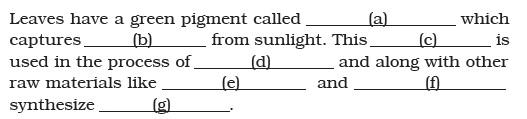
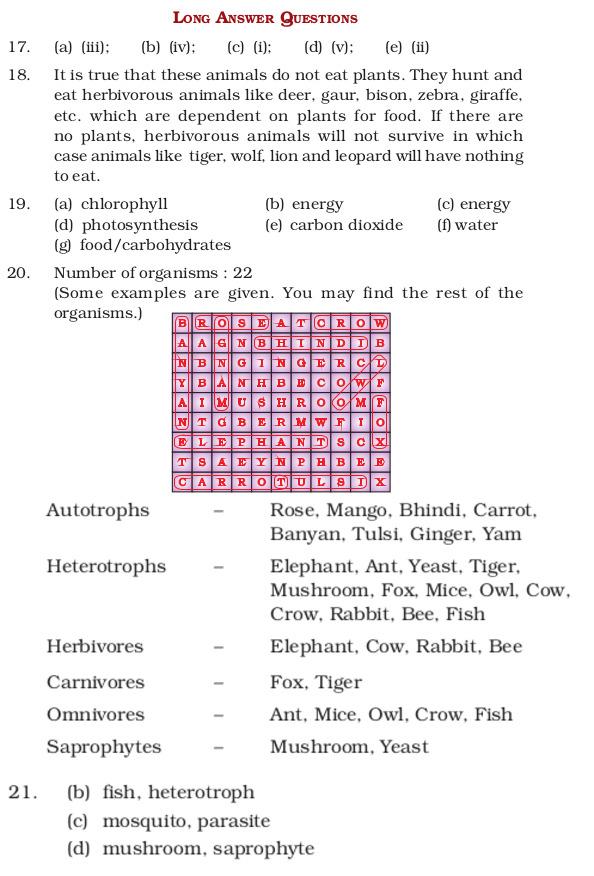
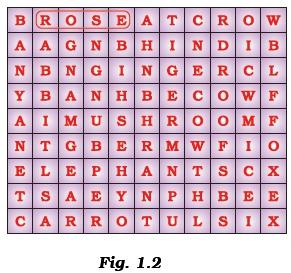
- Spot as many organisms as possible in the puzzle given as Figure 1.2 by encircling them as shown. Write the names on a sheet of paper and categorise them into autotrophs and heterotrophs. Classify the heterotrophs into herbivores, carnivores, omnivores and saprophytes.
- Can you give me a name?
Solve each of the following riddles by writing the name of the organism and its mode of nutrition. One riddle is solved to help you.- (a) I am tall but I cannot move. I am green and can prepare my own food. tree, autotroph
- (b) I live in water; people keep me in an aquarium and feed me. ___________, ______________
- (c) I am small and I can fly. I disturb your sleep, bite you and suck your blood which is my food. _______________, _______________
- (d) I am white and soft. I grow well in the rainy season. Children pluck me from the ground and admire me. I absorb nutrients from decomposed dead parts of plants and animals in the soil. ______________, _________________.
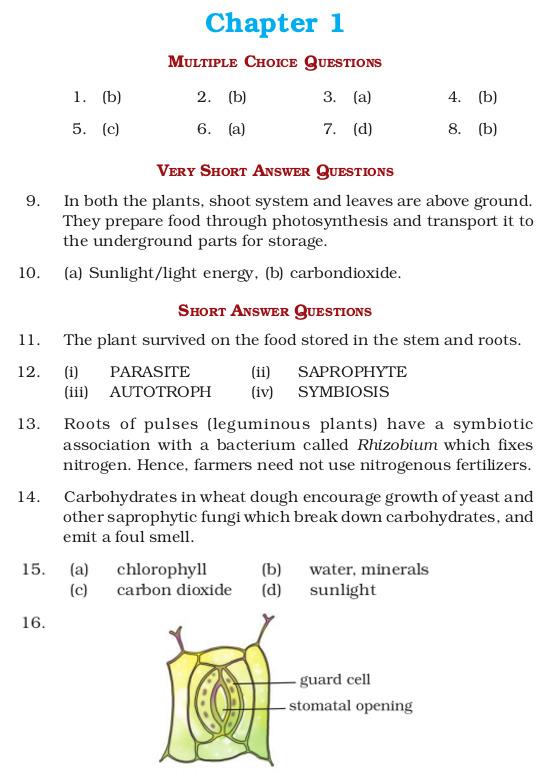
Answers