Curriculum & Exam Preparation Note: Regular practice of NCERT textbook exercises and chapter-end questions establishes strong conceptual clarity for primary and secondary examinations.
NCERT Exemplar Class 7 Science Chapter 12: Reproduction in Plants. NCERT Exemplar Solutions for Class 7 Science Chapter 12 Reproduction in Plants prepare students for their Class 7 exams thoroughly.
Science problems and solutions for the Class 7 pdf are provided here which are similar to the questions being asked in the previous year's board.
NCERT Exemplar Class 7 Science Chapter 12: Reproduction in Plants
Class 7: Science Chapter 12 solutions. Complete Class 7 Science Chapter 12 Notes.
Multiple Choice Questions
- Which of the following parts of a plant take part in sexual reproduction?
(i) Flower
(ii) Seed
(iii) Fruit
(iv) Branch
Choose the correct answer from below.- (a) (i) and (ii)
- (b) (i), (ii) and (iii)
- (c) (iii) and (iv)
- (d) (ii), (iii) and (iv)
- Lila observed that a pond with clear water was covered up with a green algae within a week. By which method of reproduction did the algae spread so rapidly?
- (a) Budding
- (b) Sexual reproduction
- (c) Fragmentation
- (d) Pollination
- Seeds of drumstick and maple are carried to long distances by wind because they possess
- (a) winged seeds
- (b) large and hairy seeds
- (c) long and ridged fruits
- (d) spiny seeds
- The ‘eye’ of the potato plant is what
- (a) the root is to any plant.
- (b) the bud is to a flower.
- (c) the bud is to Bryophyllum leaf.
- (d) the anther is to stamen.
- The ovaries of different flowers may contain
- (a) only one ovule
- (b) many ovules
- (c) one to many ovules
- (d) only two ovules
- Which of the following statements is/are true for sexual reproduction in plants?
(i) Plants are obtained from seeds.
(ii) Two plants are always essential.
(iii) Fertilisation can occur only after pollination.
(iv) Only insects are agents of pollination.
Choose from the options given below.- (a) (i) and (iii)
- (b) (i) only
- (c) (ii) and (iii)
- (d) (i) and (iv)
- Pollination refers to the
- (a) transfer of pollen from anther to ovary.
- (b) transfer of male gametes from anther to stigma.
- (c) transfer of pollen from anther to stigma.
- (d) transfer of pollen from anther to ovule.
Very Short Answer Type Questions
- Fungus, moss and fern reproduce by a common method of asexual reproduction. Name the method.
- Pick the odd one out from the following on the basis of mode of reproduction and give reason for it.
Sugarcane, Potato, Rice, Rose - Boojho had the following parts of a rose plant – a leaf, roots, a branch, a flower, a bud and pollen grains. Which of them can be used to grow a new rose plant?
- Which type of pollination does the Figure 12.1 indicate?
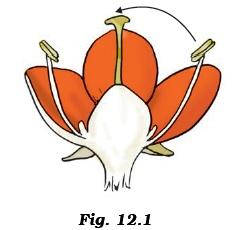
- One morning as Paheli strolled in her garden she noticed many small plants which were not there a week ago. She wondered where they had come from as nobody had planted them there. Explain the reason for the growth of these plants.
Short Answer Type Questions
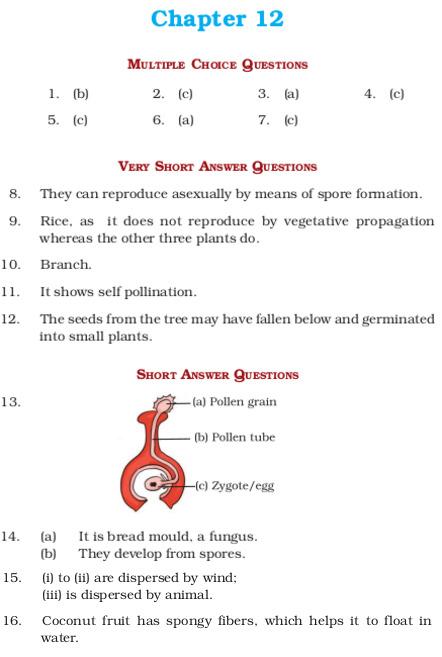
- In the diagram given in Figure 12.2 label the parts marked (a), (b) and (c).
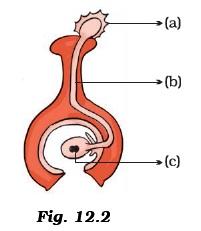
- When you keep food items like bread and fruits outside for a long time especially during the rainy season, you will observe a cottony growth on them.
- (a) What is this growth called?
- (b) How does the growth take place?
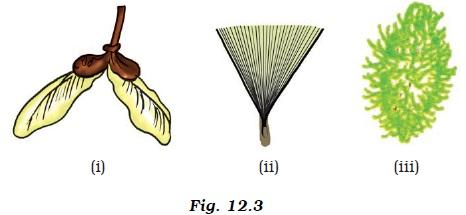
- Group the seeds given in Figure 12.3 (i) to (iii) according to their means of dispersion.
- (a) Seed dispersed by wind
- (b) Seed dispersed by water
- (c) Seed dispersed by animal
- Coconut is a large and heavy fruit. How is it adapted for dispersal by water?
Long Answer Type Questions
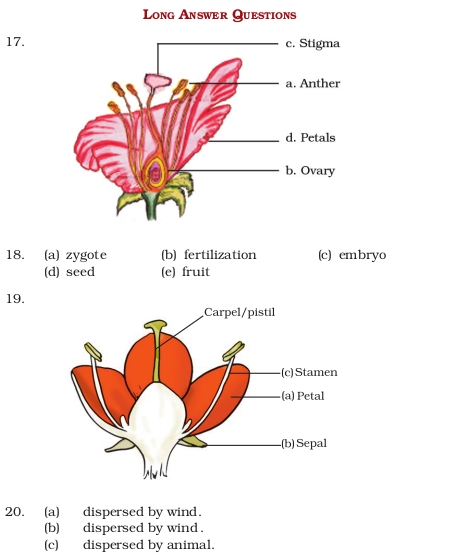
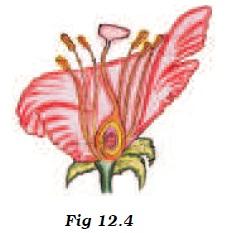
- In the figure of a flower given in Figure 12.4, label the parts whose functions are given below and give their names.
- (a) The part which contains pollen grains.
- (b) The part where the female gamete is formed.
- (c) The female reproductive part where pollen grains germinate.
- (d) The colourful part of flower which attracts insects.
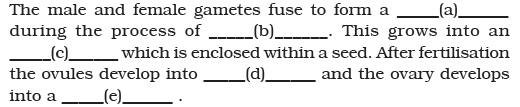
- Fill in the blanks with correct terms.
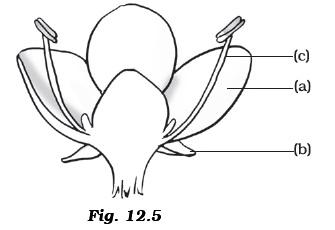
- In the diagram of a bisexual flower given as Figure 12.5, draw the missing part and label the parts marked (a), (b) and (c). Also label the missing part that you draw.
- Write how the following seeds are dispersed.
- (a) Seeds with wings.
- (b) Small and light seeds.
- (c) Seeds with spines/hooks.
Answers