Curriculum & Exam Preparation Note: Regular practice of NCERT textbook exercises and chapter-end questions establishes strong conceptual clarity for primary and secondary examinations.
NCERT Exemplar Class 7 Science Chapter 14: Electric Current and Its Effects. NCERT Exemplar Solutions for Class 7 Science Chapter 14 Electric Current and Its Effects prepare students for their Class 7 exams thoroughly.
Science problems and solutions for the Class 7 pdf are provided here which are similar to the questions being asked in the previous year's board.
NCERT Exemplar Class 7 Science Chapter 14: Electric Current and Its Effects
Class 7: Science Chapter 14 solutions. Complete Class 7 Science Chapter 14 Notes.
Multiple Choice Questions
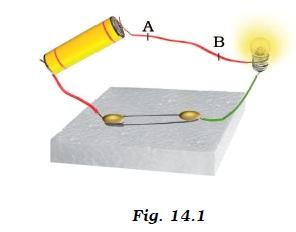
- When an electric current flows through a copper wire AB as shown in Figure 14.1, the wire
- (a) deflects a magnetic needle placed near it.
- (b) becomes red hot.
- (c) gives electric shock.
- (d) behaves like a fuse.
- Choose the statement which is not correct in the case of an electric fuse.
- (a) Fuses are inserted in electric circuits of all buildings.
- (b) There is a maximum limit on the current which can safely flow through the electric circuits.
- (c) There is a minimum limit on the current which can safely flow in the electric circuits.
- (d) If a proper fuse is inserted in a circuit it will blow off if current exceeds the safe limit.
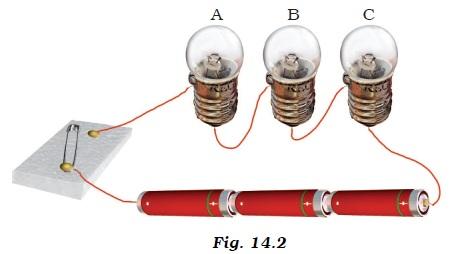
- Three bulbs A, B, C are connected in a circuit as shown in Figure 14.2. When the switch is ‘ON’
- (a) bulb C will glow first.
- (b) bulb B and C will glow simultaneously and bulb A will glow after some time.
- (c) all the bulbs A,B and C will glow at the same time.
- (d) the bulbs will glow in the order A, B and C.
- When a switch is in OFF position,
(i) circuit starting from the positive terminal of the cell stops at the switch.
(ii) circuit is open.
(iii) no current flows through it.
(iv) current flows after some time.
Choose the combination of correct answer from the following.- (a) all are correct
- (b) (ii) and (iii) are correct
- (c) only (iv) is correct
- (d) only (i) and (ii) are correct
- Which of the following precautions need not be taken while using electric gadgets/appliances/circuit?
- (a) We should never touch a lighted electric bulb connected to the mains.
- (b) We should never experiment with the electric supply from the mains or a generator or an inverter.
- (c) We should never use just any wire or strip of metal in place of a fuse.
- (d) We should never turn the switch in ON position.
Very Short Answer Type Questions
- Which property of a conducting wire is utilised in making electric fuse?
- Name the device used these days in place of electric fuses in electrical circuits.
- Fill in the blanks:
- (i) Our body is a ________________ of electricity.
- (ii) An electric cell produces electricity from the _____________________ in it.
- (iii) In an electric circuit a fuse is a _________ _______ to prevent possible fire.
- (iv) A combination of two or more cells is called a _________.
- Unscramble the following words:
- (i) TBTAYER
- (ii) SFEU
- (iii) HTRCO
- (iv) HICWTS
- Paheli does not have a night lamp in her room. She covered the bulb of her room with a towel in the night to get dim light. Has she taken the right step? Give one reason to justify your answer.
- Why are compact fluorescent lamps (CFLs) preferred over electric bulbs?
- Why is an electric fuse required in all electrical appliances?
Short Answer Type Questions
- Can we use the same fuse in a geyser and a television set? Explain.
- Name two electric devices for each where (i) heating effect of current is used and (ii) magnetic effect of current is used.
- Why do we cover plug pin holes which are within the reach of children with cellotape or a plastic cover when not in use?
- Boojho made an electromagnet by winding 50 turns of wire over an iron screw. Paheli also made an electromagnet by winding 100 turns over a similar iron screw. Which electro magnet will attract more pins? Give reason.
Long Answer Type Questions
- Your teacher has shown you the following activity.
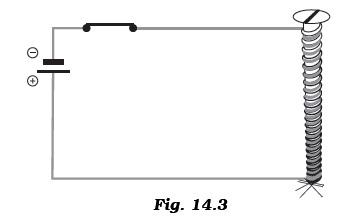
Activity: Teacher has wound a long insulated piece of wire around an iron nail in the form of a coil. Free ends of the wire are connected to a cell through a switch as shown in the Figure 14.3. The current is switched on and some pins are placed near the ends of the nail.
Write down any three questions that come to your mind about this activity. - Paheli took a wire of length 10 cm. Boojho took a wire of 5 cm of the same material and thickness. Both of them connected the wires as shown in the circuit given in Figure 14.4. The current flowing in both the circuits is the same.
(i) Will the heat produced in both the cases be equal? Explain.
(ii) Will the heat produced be the same if the wires taken by them are of equal lengths but of different thickness? Explain.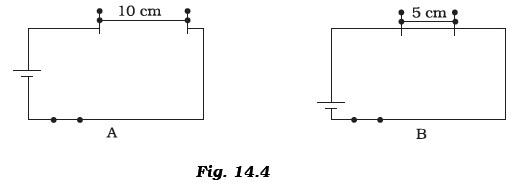
- How does the magnetic effect of electric current help in the working of an electric bell? Explain with the help of a diagram.
- Draw the symbols of the following circuit components.
- (i) electric cell
- (ii) switch in off position
- (iii) electric bulb
- (iv) battery
Answers