Curriculum & Exam Preparation Note: Regular practice of NCERT textbook exercises and chapter-end questions establishes strong conceptual clarity for primary and secondary examinations.
NCERT Exemplar Class 7 Science Chapter 5: Acids, Bases and Salts. NCERT Exemplar Solutions for Class 7 Science Chapter 5 Acids, Bases and Salts prepare students for their Class 7 exams thoroughly.
Science problems and solutions for the Class 7 pdf are provided here which are similar to the questions being asked in the previous year's board.
NCERT Exemplar Class 7 Science Chapter 5: Acids, Bases and Salts
Class 7: Science Chapter 5 solutions. Complete Class 7 Science Chapter 5 Notes.
Multiple Choice Questions
- The correct way of making a solution of acid in water is to
- (a) add water to acid.
- (b) add acid to water.
- (c) mix acid and water simultaneously.
- (d) add water to acid in a shallow container.
- Products of a neutralisation reaction are always
- (a) an acid and a base.
- (b) an acid and a salt.
- (c) a salt and water.
- (d) a salt and a base.
- Turmeric is a natural indicator. On adding its paste to acid and base separately, which colours would be observed
- (a) Yellow in both acid and base.
- (b) Yellow in acid and red in base.
- (c) Pink in acid and yellow in base.
- (d) Red in acid and blue in base.
- Phenolphthalein is a synthetic indicator and its colours in acidic and basic solutions, respectively are
- (a) red and blue.
- (b) blue and red.
- (c) pink and colourless.
- (d) colourless and pink
- When the soil is too basic, plants do not grow well in it. To improve its quality what must be added to the soil?
- (a) Organic matter
- (b) Quick lime
- (c) Slaked lime
- (d) Calamine solution
- ‘Litmus’, a natural dye is an extract of which of the following?
- (a) China rose (Gudhal)
- (b) Beetroot
- (c) Lichen
- (d) Blue berries (Jamun)
- Neutralisation reaction is a
- (a) physical and reversible change.
- (b) physical change that cannot be reversed.
- (c) chemical and reversible change.
- (d) chemical change that cannot be reversed.
- A solution changes the colour of turmeric indicator from yellow to red. The solution is
- (a) basic
- (b) acidic
- (c) neutral
- (d) either neutral or acidic
- Which of the following set of substances contain acids?
- (a) Grapes, lime water
- (b) Vinegar, soap
- (c) Curd, milk of magnesia
- (d) Curd, vinegar
- On adding phenolphthalein indicator to a colourless solution, no change is observed. What is the nature of this solution?
- (a) Basic
- (b) Either acidic or basic
- (c) Either acidic or neutral
- (d) Either basic or neutral
- Which of the following is an acid-base indicator?
- (a) Vinegar
- (b) Lime water
- (c) Turmeric
- (d) Baking soda
Very Short Answer Type Questions
- Look at the given reaction.
Hydrochloric acid + Sodium hydroxide (base) → Sodium chloride (salt) + Water
Sodium chloride formed in this reaction remains in solution form. Can we get solid sodium chloride from this solution? Suggest a method (if any). - State whether the following statements are true or false.
Correct the false statements.- (a) All substances are either acidic or basic.
- (b) A compound if acidic will turn all indicators red.
- (c) Lime water turns red litmus blue.
- (d) Common salt dissolved in water turns blue litmus red.
- (e) Phenolphthalein is a natural indicator.
- (f) Calamine can be used to treat ant’s sting.
- (g) Lemon water is basic in nature.
- Paheli is suffering from indigestion due to acidity. Is it advisable to give her orange juice in this situation and why?
Short Answer Type Questions
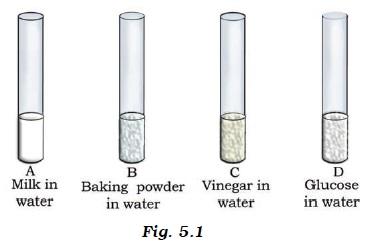
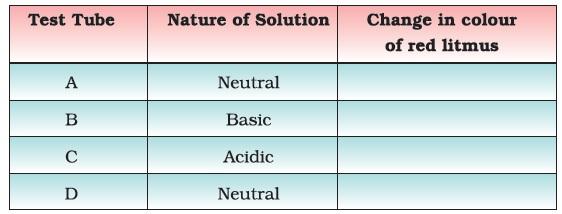
- Look at Figure 5.1 which shows solutions taken in test tubes A,B,C and D. What colour is expected when a piece of red litmus paper is dropped in each test tube? Nature of the solutions is given in the table for your help.
- While playing in a park, a child was stung by a wasp. Some elders suggested applying paste of baking soda and others lemon juice as remedy. Which remedy do you think is appropriate and why?
- Form a sentence using the following words – baking soda, antbite, moist, effect, neutralised, rubbing.
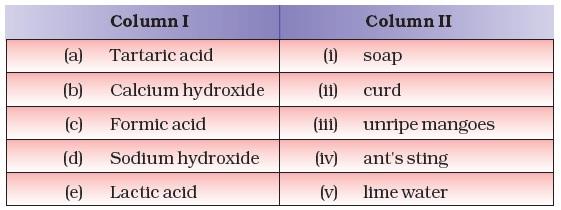
- Match the substances in Column I with those in Column II.
- Fill the blanks in the following sentences
- (a) Lemon juice and vinegar taste ___________ because they contain ___________.
- (b) Turmeric and litmus are _________ acid-base indicators.
- (c) Phenolphthalein gives _________ colour with lime water.
- (d) When an acidic solution is mixed with a basic solution, they _________ each other forming _________ and water.
Long Answer Type Questions
- Boojho, Paheli and their friend Golu were provided with a test tube each containing China rose solution which was pink in colour. Boojho added two drops of solution ‘A’ in his test tube and got dark pink colour. Paheli added 2 drops of solution ‘B’ to her test tube and got green colour. Golu added 2 drops of solution ‘C’ but could not get any change in colour. Suggest the possible cause for the variation in their results.
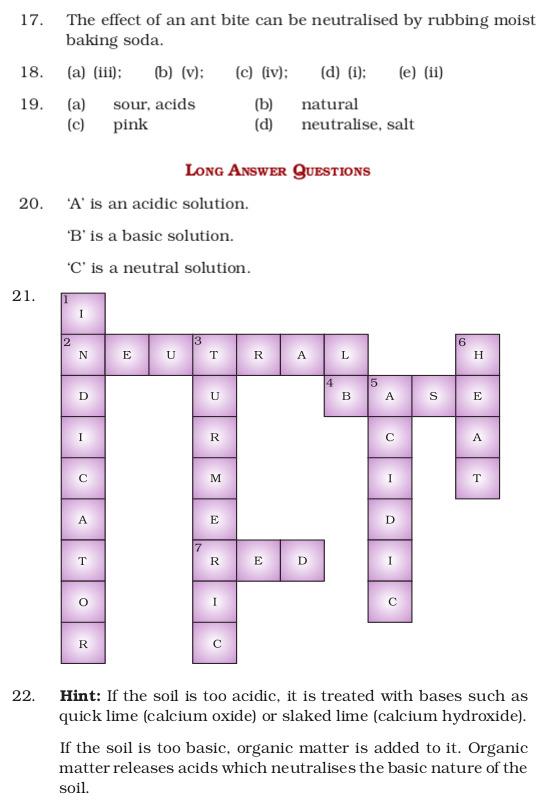
- Fill in the cross word given as Figure 5.2 with the help of the clues provided.
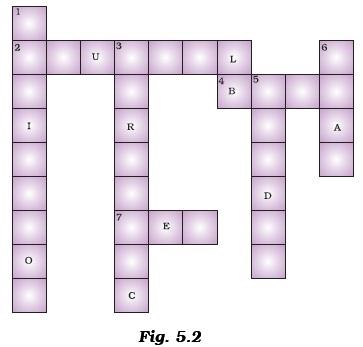
Across- (2) The solution which does not change the colour of either red or blue litmus.
- (4) Phenolphthalein gives pink colour in this type of solution.
- (7) Colour of blue litmus in lemon juice.
- (1) It is used to test whether a substance is acidic or basic.
- (3) It is a natural indicator and gives pink colour in basic solution.
- (5) Nature of ant’s sting.
- (6) It is responsible for increase in temperature during a neutralisation reaction.
- A farmer was unhappy because of his low crop yield. He discussed the problem with an agricultural scientist and realised that the soil of his field was either too acidic or too basic. What remedy would you suggest the farmer to neutralise the soil?
- You are provided with four test tubes containing sugar solution, baking soda solution, tamarind solution, salt solution. Write down an activity to find the nature (acidic/basic/neutral) of each solution.
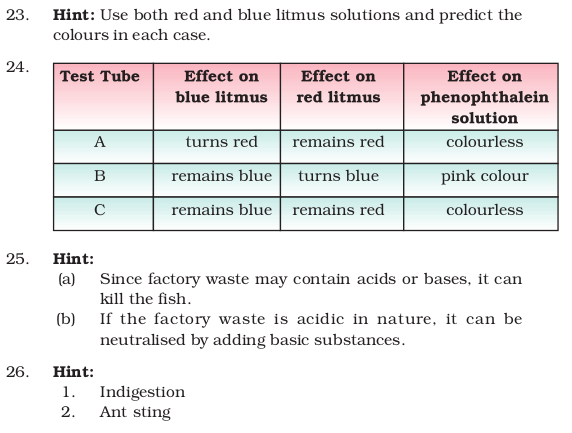
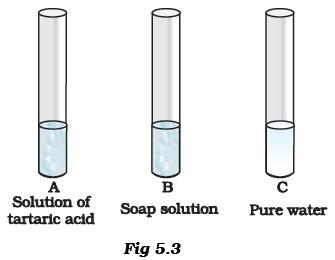
- You are provided with three test tubes A, B and C as shown in Figure 5.3 with different liquids. What will you observe when you put
- (a) a piece of blue litmus paper in each test tube.
- (b) a piece of red litmus paper in each test tube.
- (c) a few drops of phenolphthalein solution to each test tube.
- Paheli observed that most of the fish in the pond of her village were gradually dying. She also observed that the waste of a factory in their village is flowing into the pond which probably caused the fish to die.
- (a) Explain why the fish were dying.
- (b) If the factory waste is acidic in nature, how can it be neutralised?
- Explain two neutralisation reactions related to daily life situation.
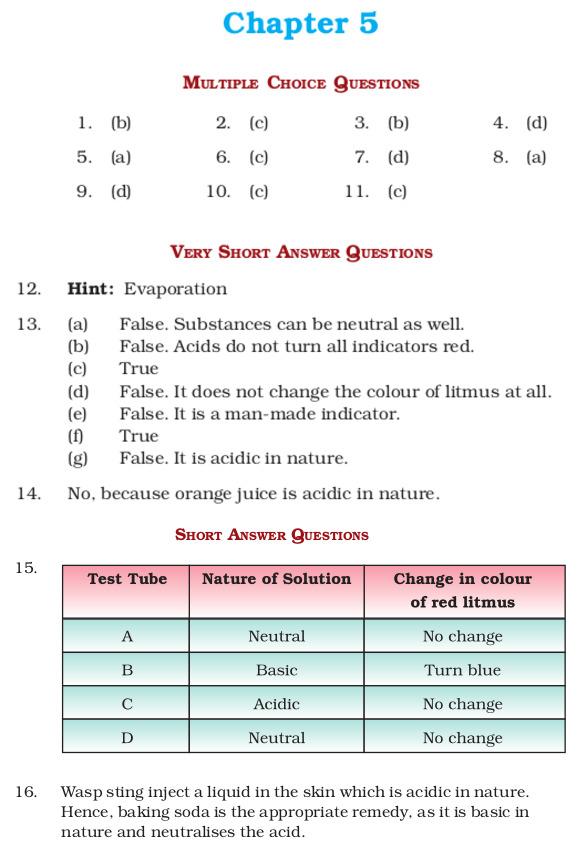
Answers