Curriculum & Exam Preparation Note: Regular practice of NCERT textbook exercises and chapter-end questions establishes strong conceptual clarity for primary and secondary examinations.
NCERT Exemplar Class 7 Science Chapter 6: Physical and Chemical Changes. NCERT Exemplar Solutions for Class 7 Science Chapter 6 Physical and Chemical Changes prepare students for their Class 7 exams thoroughly.
Science problems and solutions for the Class 7 pdf are provided here which are similar to the questions being asked in the previous year's board.
NCERT Exemplar Class 7 Science Chapter 6: Physical and Chemical Changes
Class 7: Science Chapter 6 solutions. Complete Class 7 Science Chapter 6 Notes.
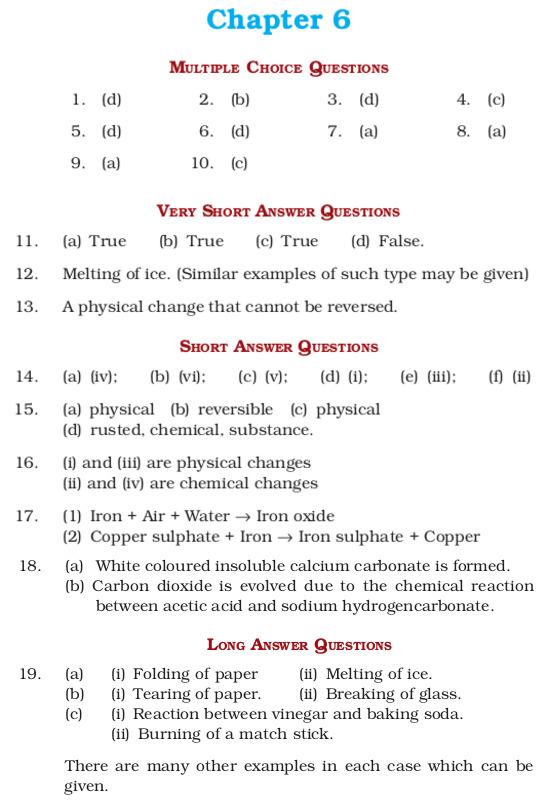
Multiple Choice Questions
- Which of the following is a physical change?
- (a) Rusting of iron
- (b) Combustion of magnesium ribbon
- (c) Burning of candle
- (d) Melting of wax
- Which of the following is a chemical change?
- (a) Twinkling of stars
- (b) Cooking of vegetables
- (c) Cutting of fruits
- (d) Boiling of water
- A chemical change may involve –
- (a) change in colour only
- (b) change in temperature only
- (c) evolution of gas only
- (d) any or all of the above
- Which of the following is/are true when milk changes into curd?
(i) Its state is changed from liquid to semi solid.
(ii) It changes colour.
(iii) It changes taste.
(iv) The change cannot be reversed.
Choose the correct option from below :- (a) (i) and (ii) are correct
- (b) (ii) and (iii) are correct
- (c) (i), (iii) and (iv) are correct
- (d) (i) to (iv) are correct
- A man painted his main gate made up of iron, to
(i) prevent it from rusting.
(ii) protect it from sun.
(iii) make it look beautiful.
(iv) make it dust free.
Which of the above statement(s) is/are correct?- (a) (i) and (ii)
- (b) (ii) and (iii)
- (c) only (ii)
- (d) (i) and (iii)
- Iron pillar near the Qutub Minar in Delhi is famous for the following facts. Which of these facts is responsible for its long stability?
- (a) It is more than 7 metres high.
- (b) It weighs about 6000 kg.
- (c) It was built more than 1600 years ago.
- (d) It has not rusted after such a long period.
- Galvanisation is a process used to prevent the rusting of which of the following?
- (a) Iron
- (b) Zinc
- (c) Aluminium
- (d) Copper
- Paheli’s mother made a concentrated sugar syrup by dissolving sugar in hot water. On cooling, crystals of sugar got separated. This indicates a –
- (a) physical change that can be reversed.
- (b) chemical change that can be reversed.
- (c) physical change that cannot be reversed.
- (d) chemical change that cannot be reversed.
- Which of the following statement is incorrect for a chemical reaction?
- (a) Heat may be given out but never absorbed.
- (b) Sound may be produced.
- (c) A colour change may take place.
- (d) A gas may be evolved.
- Two drops of dilute sulphuric acid were added to 1 g of copper sulphate powder and then small amount of hot water was added to dissolve it (step I). On cooling, beautiful blue coloured crystals got separated (step II). Step I and step II are:
- (a) physical and chemical changes respectively.
- (b) chemical and physical changes respectively.
- (c) both physical change.
- (d) both chemical change.
Very Short Answer Type Questions
- State whether the following statements are true or false:
- (a) When a candle burns, both physical and chemical changes take place.
- (b) Anaerobic bacteria digest animal waste and produce biogas.
- (c) Ships suffer a lot of damage though they are painted.
- (d) Stretching of rubber band is not a physical change.
- Melting of wax is a change where a solid changes to liquid state. Give one more such change which you observe in your surroundings.
- What kind of change is shown by tearing of paper?
Short Answer Type Questions
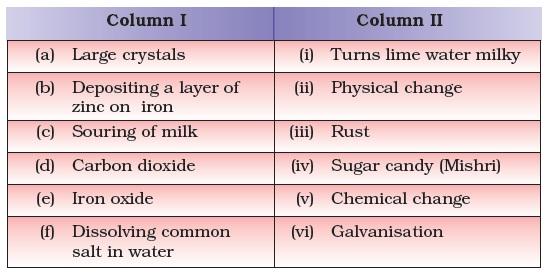
- Match the items of Column I with the items of Column II.
- Fill in the blanks in the following statements using the words given in the box.
rusted, colourful, substance, chemical, physical, reversible, iron oxide, object- (a) Making sugar solution is a ____________ change.
- (b) A physical change is generally____________.
- (c) Grinding of wheat grain changes its size. It is a ____________ change.
- (d) Iron benches kept in lawns and gardens get____________.
It is a _________ change because a new _________ is formed.
- Classify the following processes into physical or chemical changes:
- (i) Beating of aluminium metal to make aluminium foil.
- (ii) Digestion of food.
- (iii) Cutting of a log of wood into pieces.
- (iv) Burning of crackers.
- Write word equations for two chemical reactions with the help of materials given in the box.
Air, copper sulphate, iron, vinegar, iron oxide, carbon dioxide, iron sulphate, copper, lime water, water - Explain the following:
- (a) Lime water turns milky on passing carbon dioxide gas into it.
- (b) Bubbles are produced when acetic acid is added to a solution of sodium hydrogencarbonate.
Long Answer Type Questions
- Give two examples for each of the following cases:
- (a) Physical changes which are reversible.
- (b) Physical changes which are not reversible.
- (c) Chemical changes.
- Give an example of a chemical reaction for each of the following situations:
- (a) A change in colour is observed.
- (b) A gas is evolved.
- (c) Sound is produced.
- If you leave a piece of iron in the open for a few days, it acquires a film of brownish substance, called rust.
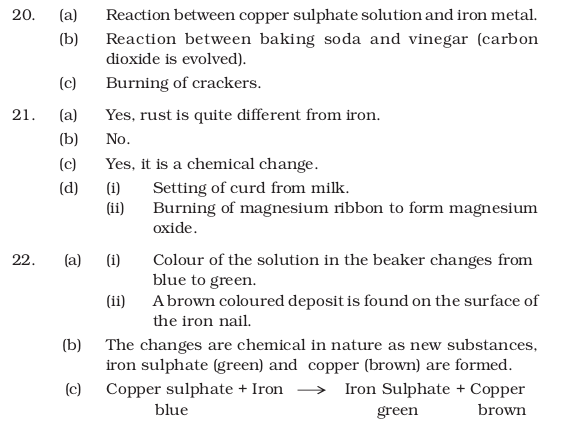
- (a) Do you think rust is different from iron?
- (b) Can you change rust back into iron by some simple method?
- (c) Do you think formation of rust from iron is a chemical change?
- (d) Give two other examples of a similar type of change.
- A student took a solution of copper sulphate in a beaker and put a clean iron nail into it and left it for about an hour.
- (a) What changes do you expect?
- (b) Are these changes chemical in nature?
- (c) Write a word equation for the chemical change, if any.
Answers