
Curriculum & Exam Preparation Note: Regular practice of NCERT textbook exercises and chapter-end questions establishes strong conceptual clarity for primary and secondary examinations.
NCERT Exemplar Class 8 Science Chapter 13: Sound. NCERT Exemplar Solutions for Class 8 Science Chapter 13 Sound prepare students for their Class 8 exams thoroughly.
Science problems and solutions for the Class 8 pdf are provided here which are similar to the questions being asked in the previous year's board.
NCERT Exemplar Class 8 Science Chapter 13: Sound
Class 8: Science Chapter 13 solutions. Complete Class 8 Science Chapter 13 Notes.
Multiple Choice Questions
- A list of mediums is given below.
(i) wood
(ii) water
(iii) air
(iv) vacuum
In which of these mediums can sound travel?- (a) i & ii only
- (b) i, ii & iii only
- (c) iii & iv only
- (d) ii, iii & iv only
- The loudness of sound depends on:
- (a) its amplitude.
- (b) its frequency.
- (c) its time period.
- (d) its speed.
- Which of the following statements are correct?
(i) Sound is produced by vibrations.
(ii) Sound requires a medium for propagation.
(iii) Light and sound both require a medium for propagation.
(iv) Sound travels slower than light.- (a) i & ii only
- (b) i, ii & iii only
- (c) ii, iii & iv only
- (d) i, ii & iv only
- An object is vibrating at 50 hertz. What is its time period?
- (a) 0.02 s
- (b) 2 s
- (c) 0.2 s
- (d) 20.0 s
- In order to reduce the loudness of a sound we have to
- (a) decrease its frequency of vibration of the sound.
- (b) increase its frequency of vibration of the sound.
- (c) decrease its amplitude of vibration of the sound.
- (d) increase its amplitude of vibration of the sound.
- Loudness of sound is measured in units of
- (a) decibel (dB)
- (b) hertz (Hz)
- (c) metre (m)
- (d) metre/second (m/s)
- The loudness of sound is determined by the
- (a) amplitude of vibration
- (b) ratio of amplitude and frequency of vibration
- (c) frequency of vibration
- (d) product of amplitude and frequency of vibration
- 1 hertz is equal to
- (a) 1 vibration per minute
- (b) 10 vibrations per minute
- (c) 60 vibrations per minute
- (d) 600 vibrations per minute
- Pitch of sound is determined by its
- (a) frequency
- (b) amplitude
- (c) speed
- (d) loudness
- Ultrasound has frequency of vibration
- (a) between 20 and 20,000 Hz
- (b) below 20 Hz
- (c) above 20,000 Hz
- (d) between 500 and 10,000 Hz
Very Short Answer Type Questions
- Lightning can be seen the moment it occurs. Paheli observes lightning in her area. She hears the sound 5 s after she observed lightning. How far is she from the place where lightning occurs? (speed of sound = 330 m/s).
- Does any part of our body vibrate when we speak? Name the part.
- Boojho saw a cracker burst at night at a distance from his house. He heard the sound of the cracker a little later after seeing the cracker burst. Give reason for the delay in hearing the sound.
- When we hear a sound, does any part of our body vibrate? Name the part.
- Name two musical instruments which produce sound by vibrating strings?
Short Answer Type Questions
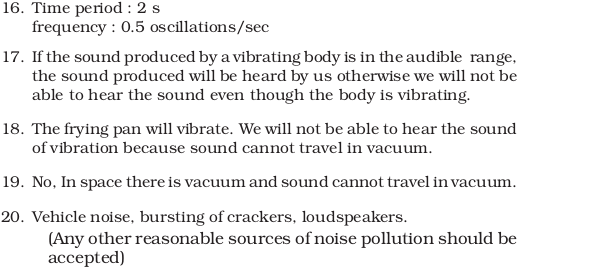
- A simple pendulum makes 10 oscillations in 20 seconds. What is the time period and frequency of its oscillation?
- We have learnt that vibration is necessary for producing sound. Explain why the sound produced by every vibrating body cannot be heard by us?
- Suppose a stick is struck against a frying pan in vacuum. Will the frying pan vibrate? Will we be able to hear the sound? Explain.
- Two astronauts are floating close to each other in space. Can they talk to each other without using any special device? Give reasons.
- List three sources of noise pollution in your locality.
Long Answer Type Questions
- We have a stringed musical instrument. The string is plucked in the middle first with a force of greater magnitude and then with a force of smaller magnitude. In which case would the instrument produce a louder sound?
- How is sound produced and how is it transmitted and heard by us?
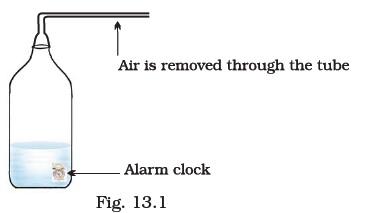
- An alarm bell is kept inside a vessel as shown in Fig. 13.1. A person standing close to it can distinctly hear the sound of alarm. Now if the air inside the vessel is removed completely how will the loudness of alarm get affected for the same person?
- The town hall building is situated close to Boojho’s house. There is a clock on the top of the town hall building which rings the bell every hour. Boojho has noticed that the sound of the clock appears to be much clearer at night. Explain.
- Suggest three measures to limit noise pollution in your locality.
Answers to Multiple Choice Questions
Mutiple Choice Questions

Very Short Answer Questions

Short Answer Questions
Long Answer Questions
