Curriculum & Exam Preparation Note: Regular practice of NCERT textbook exercises and chapter-end questions establishes strong conceptual clarity for primary and secondary examinations.
NCERT Exemplar Class 8 Science Chapter 17: Stars and Solar System. NCERT Exemplar Solutions for Class 8 Science Chapter 17 Stars and Solar System prepare students for their Class 8 exams thoroughly.
Science problems and solutions for the Class 8 pdf are provided here which are similar to the questions being asked in the previous year's board.
NCERT Exemplar Class 8 Science Chapter 17: Stars and Solar System
Class 8: Science Chapter 17 solutions. Complete Class 8 Science Chapter 17 Notes.
Multiple Choice Questions
- Morning star is the name given to
- (a) pole star
- (b) star Sirius
- (c) planet Jupiter
- (d) planet Venus
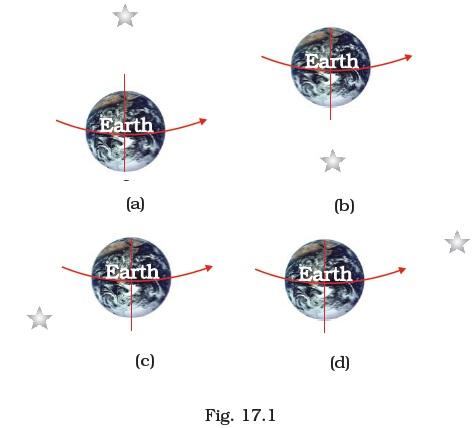
- Which of the following figures depicts the position of pole star correctly?
- Sun appears to move from east to west around the earth. This means that earth rotates from
- (a) east to west
- (b) west to east
- (c) north to south
- (d) west to north
- An astronaut standing on the surface of the moon throws a ball upwards. The ball would
- (a) directly fall down from the point it is released.
- (b) hang in space.
- (c) go up and then come back to the surface of the moon.
- (d) keep going up never to come back.
- Suppose a new planet is discovered between Uranus and Neptune. Its time period would be
- (a) less than that of Neptune.
- (b) more than that of Neptune.
- (c) equal to that of Neptune or Uranus.
- (d) less than that of Uranus.
- The change in seasons on the earth occurs because
- (a) the distance between the earth and the sun is not constant.
- (b) the axis of rotation of the earth is parallel to the plane of its orbit.
- (c) the axis of rotation of the earth is perpendicular to the plane of its orbit.
- (d) the axis of rotation of the earth is tilted with respect to the plane of its orbit.
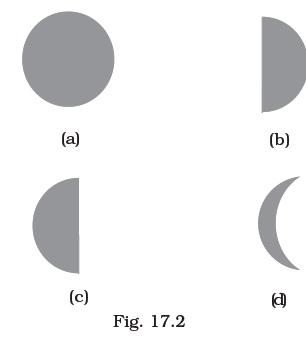
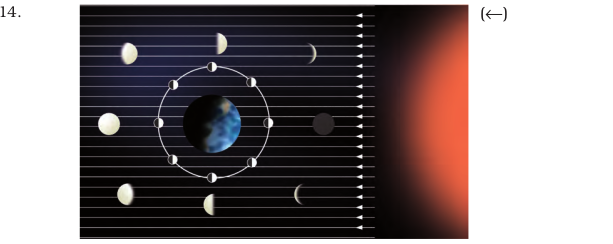
- The first of a month is the new moon day. On fifteenth of the same month, which of the following figures would represent the phase of the moon?
Very Short Answer Type Questions
- Do stars emit light only during night?
- Paheli and Boojho observe a bright object in the night sky which was not twinkling. Paheli says, it is a star and Boojho says it is a planet. Who is correct?
- State whether the following statements are ‘True’ or ‘False’.
- (a) The planet nearest to us is Jupiter.
- (b) All the stars are at the same distance from us.
- (c) The planets do not emit light of their own.
- (d) The planets keep changing their position with respect to stars.
- (e) The planet Venus appears in the eastern sky before sunrise.
- (f) The plane in which the earth revolves around the sun is called equatorial plane of earth.
- John saw full moon on a particular day. After how many days will he be able to see the full moon again?
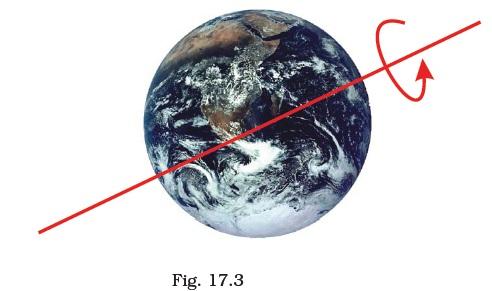
- In the picture of rotating earth given as Fig. 17.3 mark the position of pole star.
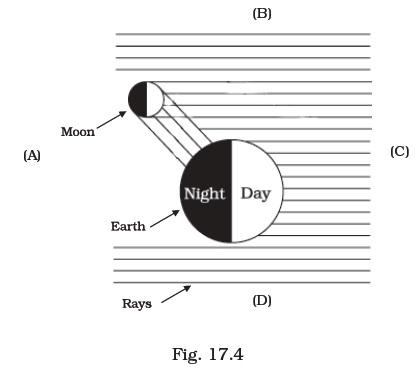
- In the given Fig. 17.4 out of the positions A,B,C and D which will indicate the position of the sun? Draw the sun at the appropriate position.
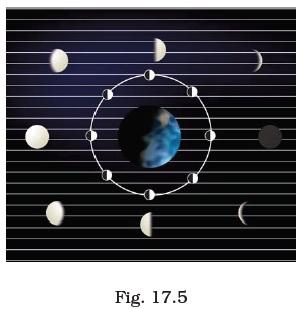
- In Fig. 17.5 mark the arrows ( ← ), ( → ), (↓), or (↑) to show the direction of sunlight.
Short Answer Type Questions
- A star is ten light years away from the earth. Suppose it brightens up suddenly today. After how much time shall we see this change?
- Meteors are not visible during the daytime. Explain the reason.
- Why does the moon change its shape daily?
- Paheli saw the moon through a glass window at 8:00 p.m. She marked the position of the moon on the glass pane. She got up at 4 a.m. in the morning. Will the moon be visible at the same position?
Long Answer Type Questions
- Suppose the moon emits light of its own. Would it still have phases? Justify your answer.
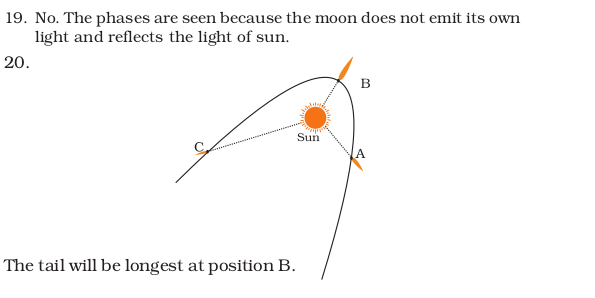
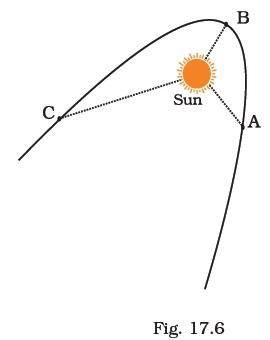
- Fig. 17.6 shows comets without their tail. Show the tails of the comets at position A, B, and C. In which position will the tail be longest?
- Explain why we always see the same side of moon.
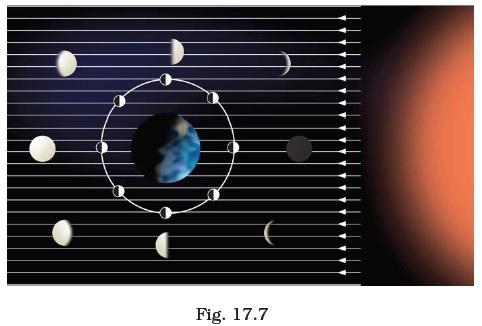
Look at Fig. 17.7 carefully and answer the following question:- (a) In which part of the sky would you see the full moon in the evening?
- (b) In which part of the sky would you see the crescent moon in the evening?
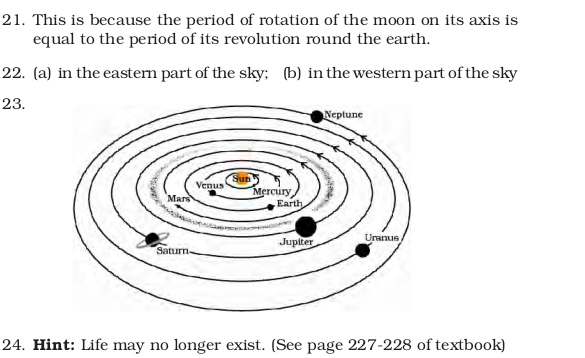
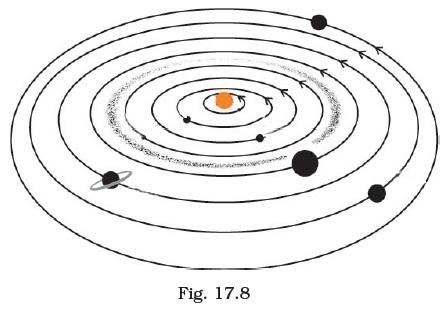
- Write the names of all planets in Fig. 17.8.
- Suppose the distance between earth and sun becomes half of its present distance. What is likely to happen to life?
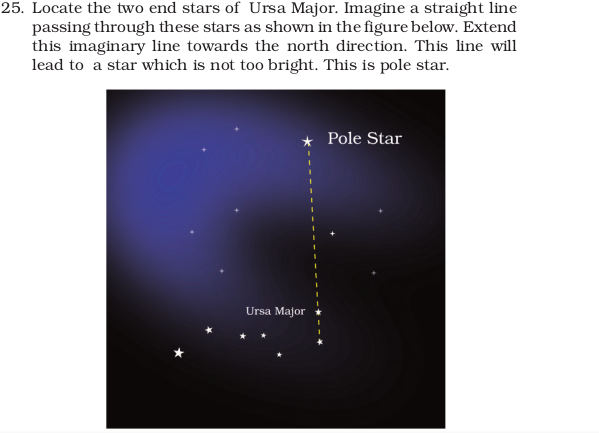
- Explain with a diagram how you can locate pole star with the help of the constellation Great Bear (Ursa Major).
Answers to Multiple Choice Questions

Mutiple Choice Questions
Very Short Answer Question
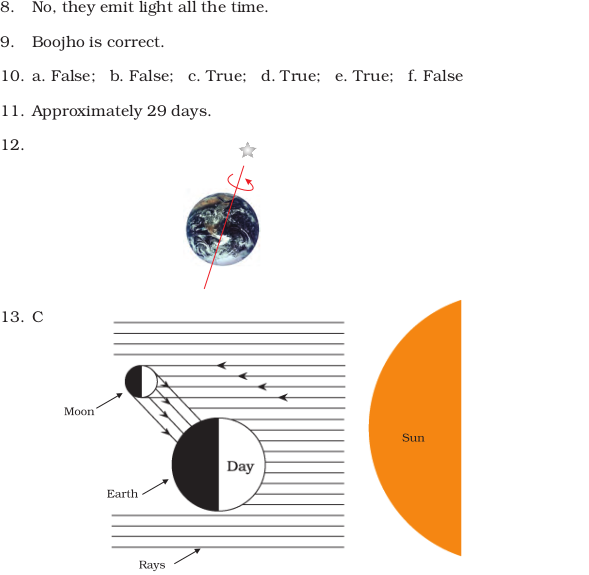
Short Answer Questions