
NCERT Exemplar Class 9 Maths Chapter 5: Introduction to Euclid’s Geometry. NCERT Exemplar Solutions for Class 9 Maths Chapter 5 Introduction to Euclid’s Geometry prepare students for their Class 9 exams thoroughly.
Maths problems and solutions for the Class 9 pdf are provided here which are similar to the questions being asked in the previous year's board.
NCERT Exemplar Class 9 Maths Chapter 5: Introduction to Euclid’s Geometry
Class 9: Maths Chapter 5 solutions. Complete Class 9 Maths Chapter 5 Notes.
Main Concepts and Results
Points, Line, Plane or surface, Axiom, Postulate and Theorem, The Elements, Shapes of altars or vedis in ancient India, Equivalent versions of Euclid’s fifth Postulate, Consistency of a system of axioms.
Ancient India
- The geometry of the Vedic period originated with the construction of altars (or vedis) and fireplaces for performing Vedic rites. Square and circular altars were used for household rituals, while altars, whose shapes were combinations of rectangles, triangles and trapeziums, were required for public worship.
Egypt, Babylonia and Greece
- Egyptians developed a number of geometric techniques and rules for calculating simple areas and doing simple constructions. Babylonians and Egyptains used geometry mostly for practical purposes and did very little to develop it as a systematic science. The Greeks were interested in establishing the truth of the statements they discovered using deductive reasoning. A Greek mathematician, Thales is credited with giving the first known proof.
Euclid’s Elements
- Euclid around 300 B.C. collected all known work in the field of mathematics and arranged it in his famous treatise called Elements. Euclid assumed certain properties, which were not to be proved. These assumptions are actually “obvious universal truths”. He divided them into two types.
Axioms
- The things which are equal to the same thing are equal to one another.
- If equals be added to the equals, the wholes are equal.
- If equals be subtracted from equals, the remainders are equals.
- Things which coincide with one another are equal to one another.
- The whole is greater than the part.
- Things which are double of the same thing are equal to one another.
- Things which are halves of the same thing are equal to one another.
Postulates
- A straight line may be drawn from any point to any other point.
- A terminated line (line segment) can be produced indefinitely.
- A circle may be described with any centre and any radius.
- All right angles are equal to one another.
- If a straight line falling on two straight lines makes the interior angles on the sam side of it, taken together less than two right angles, then the the two straight lines if produced indefinitely, meet on that side on which the sum of angles is taken together less than two right angles.
Euclid used the term postulate for the assumptions that were specific to geometry and otherwise called axioms. A theorem is a mathematical statement whose truth has been logically established.
Present Day Geometry
- A mathematical system consists of axioms, definitions and undefined terms.
- Point, line and plane are taken as undefined terms.
- A system of axioms is said to be consistent if there are no contradictions in the axioms and theorems that can be derived from them.
- Given two distinct points, there is a unique line passing through them.
- Two distinct lines can not have more than one point in common.
- Playfair’s Axiom (An equivalent version of Euclid’s fifth postulate).

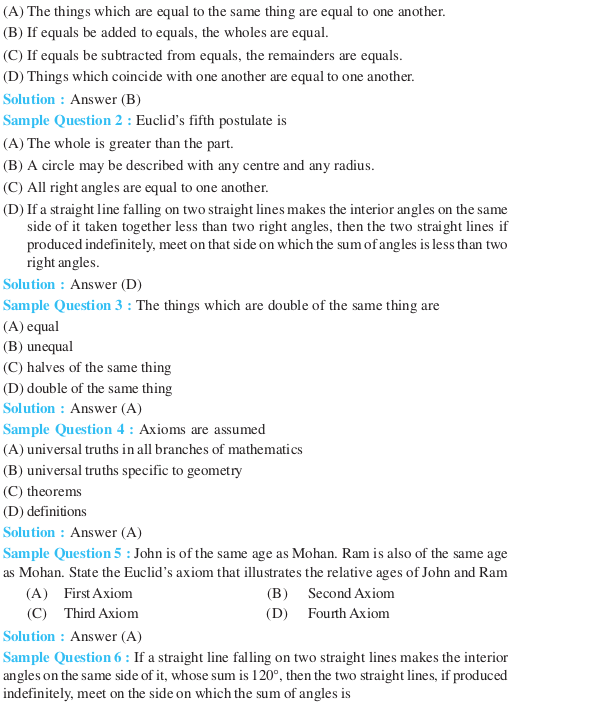

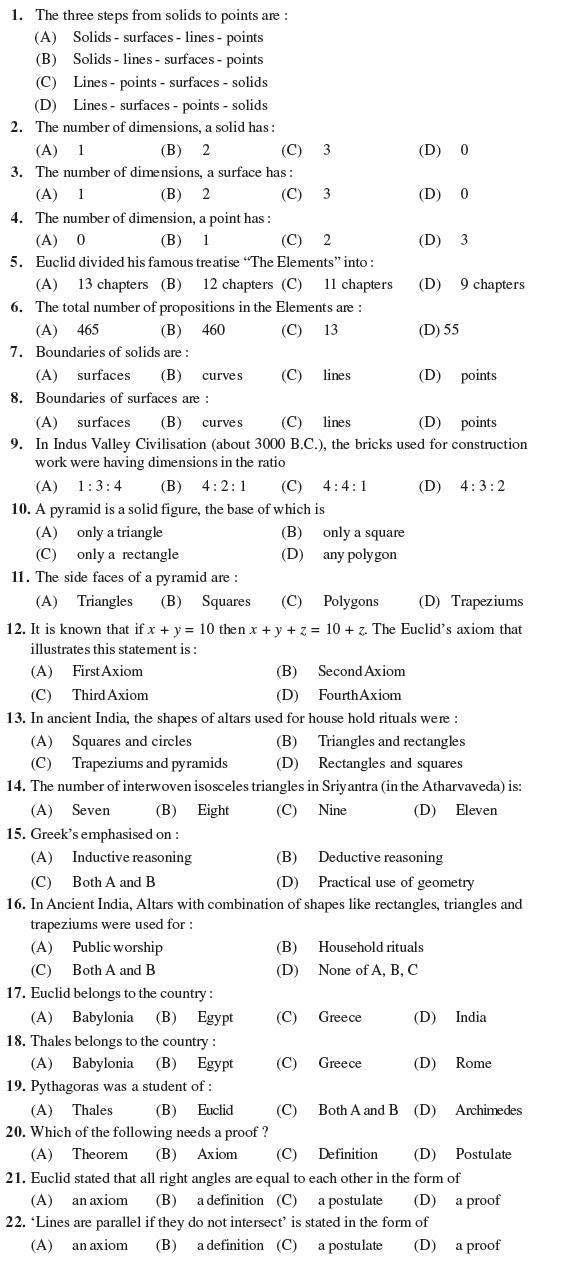
Multiple Choice Questions
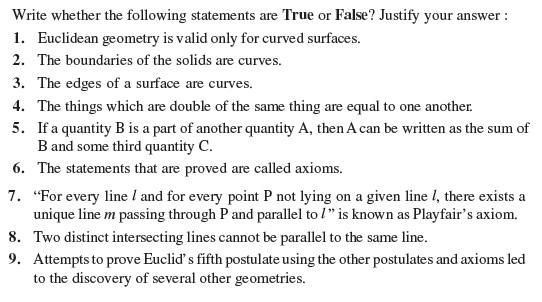
Short Answer Questions with Reasoning
Short Answer Type Questions
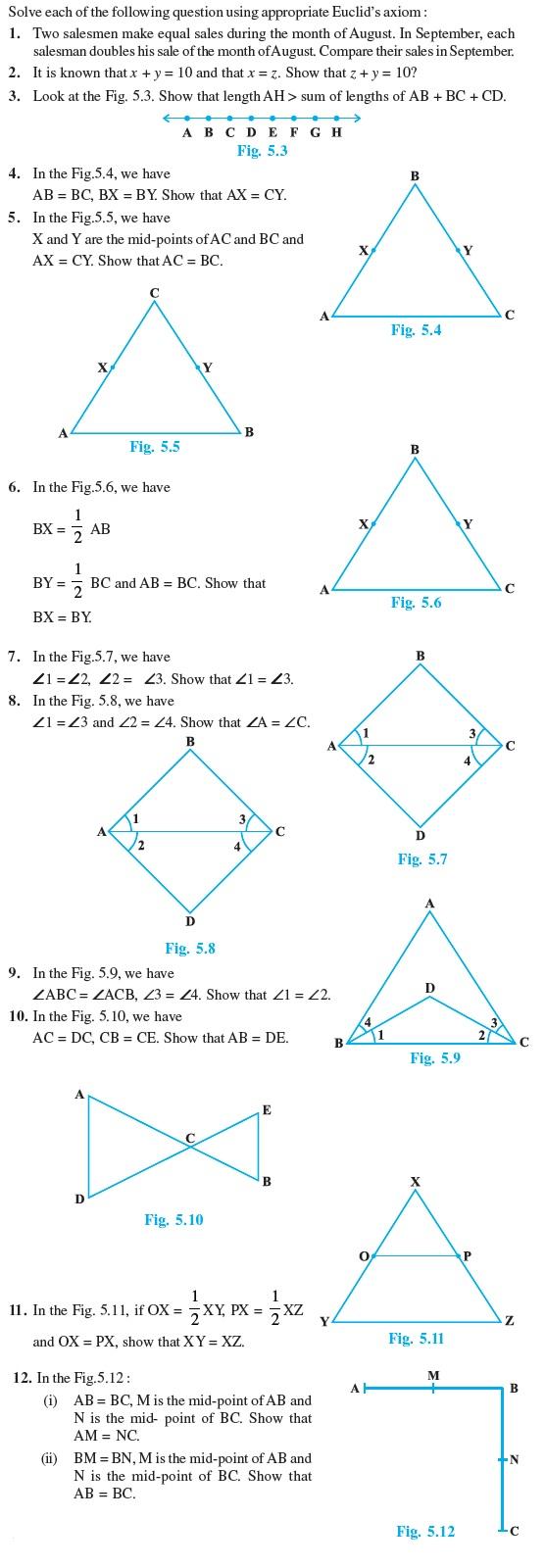
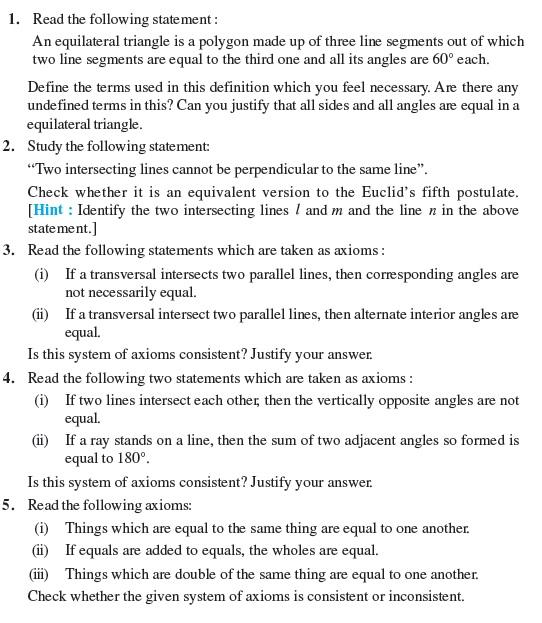
Long Answer Type Questions
Answers
Multiple Choice Questions (Exercise)

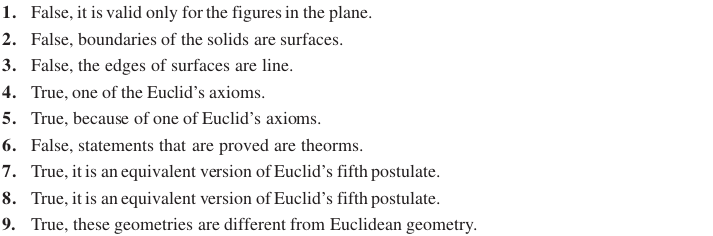
Short Answer Questions with Reasoning (Exercise)
Long Answer Type Questions (Exercise)
