
NCERT Solutions for 8th Class Science: Chapter 6-Combustion and Flame
Page No: 75
Excercise
1. List conditions under which combustion can take place.
Answer
The conditions required for combustion to take place are:
→ Presence of a fuel
→ Air (or oxygen)
→ Ignition temperature (minimum temperature at which a substance catches fire).
2. Fill in the blanks:
(a) Burning of wood and coal causes _________of air.
(b) A liquid fuel used in homes is ___________.
(c) Fuel must be heated to its ___________ before it starts burning.
(d) Fire produced by oil cannot be controlled by _________.
Answer
(a) Burning of wood and coal causes pollution of air.
(b) A liquid fuel used in homes is LPG.
(c) Fuel must be heated to its ignition temperature before it starts burning.
(d) Fire produced by oil cannot be controlled by water.
3. Explain how the use of CNG in automobiles has reduced pollution in our cities.
Answer
Combustion of fuels like petroleum causes formation of un-burnt carbon particles along with carbon monoxide gas. These harmful pollutants enter the air and cause respiratory diseases. Compressed Natural Gas (CNG) produces these harmful products in very less quantity. It is a comparatively cleaner fuel. Therefore, the use of CNG has reduced pollution in our cities.
4. Compare LPG and wood as fuels.
Answer
| LPG | Wood |
| It has more calorific value about 55000 kJ/kg | It has less calorific value about 17000 to 22000 kJ/kg |
| It does not cause any environmental problem. | On burning wood release unburnt carbon particles which cause diseases such as asthma |
| It is smokeless fuel. | It gives out lot of smoke |
| It is easy to store and can be easily transported in cylinders and pipelines. | It needs a lot of space to store also very difficult to transport. |
| Low Ignition temprature | High Ignition temprature |
5. Give reasons.
(a) Water is not used to control fires involving electrical equipment.
(b) LPG is a better domestic fuel than wood.
(c) Paper by itself catches fire easily whereas a piece of paper wrapped around an aluminium pipe does not.
Answer
(a) Water is a conductor of electricity, so it can easily conduct electric current and cause danger of electric shocks or short-circuits. Therefore, water can not be used to control the fire involving electrical equipment.
(b) LPG is a better domestic fuel as it does not produce smoke and un-burnt carbon particles, which cause respiratory problems.
(c) Paper by itself catches fire easily because it has low ignition temperature but when wrapped around an aluminium pipe its temperature is lowered due to aluminium metal absorbing the heat supplied to paper. So it does not catch fire.
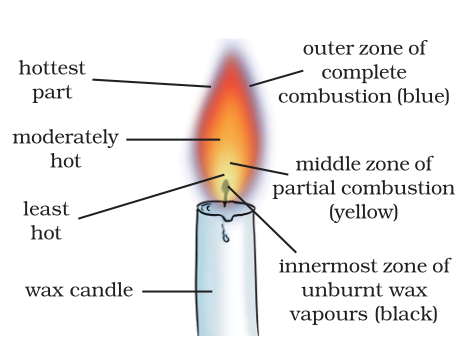
6. Make a labelled diagram of a candle flame.
Answer
7. Name the unit in which the calorific value of a fuel is expressed.
Answer
The calorific value of a fuel is expressed in kilojoules per kilogram (kJ/kg).
8. Explain how CO2 is able to control fires.
Answer
Being heavier than oxygen, CO2 covers the fire like a blanket. Since the contact between the fuel and
oxygen is cut off, the fire is controlled.
9. It is difficult to burn a heap of green leaves but dry leaves catch fire easily. Explain.
Answer
Green leaves have a lot of moisture in them. This moisture does not allow them to catch fire easily. However, dry leaves have no moisturein them. Therefore, they catch fire easily.
10. Which zone of a flame does a goldsmith use for melting gold and silver and why?
Answer
A goldsmith uses the outer part of the candle flame for melting gold and silver because in this zone the temperature is the highest which helps to melt these metals easily.
11. In an experiment 4.5 kg of a fuel was completely burnt. The heat produced was measured to be 180,000 kJ. Calculate the calorific value of the fuel.
Answer
The calorific value of fuel is the amount of heat produced by the complete combustion of 1 kg of fuel.
Now,
Heat produced by 4.5 kg of fuel = 180000 kJTherefore, heat produced by 1Kg of fuel = 180000/4.5 = 1KJ/Kg
= 40,000 kJ/kg
Hence, the calorific value of the fuel is 40,000 kJ/kg.
12. Can the process of rusting be called combustion? Discuss.
Answer
Combustion is a chemical process in which a substance reacts with oxygen and gives out energy during the process in the form of either heat or light or both. Rusting of iron is an exothermic process as heat is released during rusting. Hence, it is a kind of slow combustion.
13. Abida and Ramesh were doing an experiment in which water was to be heated in a beaker. Abida kept the beaker near the wick in the yellow part of the candle flame. Ramesh kept the beaker in the outermost part of the flame. Whose water will get heated in a shorter time?
Answer
The water in the Ramesh's beaker will heat up in a shorter time. This is because the outermost zone of a flame is the hottest zone, while the yellow zone (in which Abida had kept the beaker) is less hot.
Chapterwise NCERT Solutions for 8th Class Science
About
The National Council of Educational Research and Training is an autonomous organization of the Government of India which was established in 1961 as a literary, scientific, and charitable Society under the Societies Registration Act. Its headquarters are located at Sri Aurbindo Marg in New Delhi. Visit the Official NCERT website to learn more.