
Class 6: Science Chapter 8 solutions. Complete Class 6 Science Chapter 8 Notes.
Lakhmir Singh Manjit Kaur Solutions for Class 6 Science : Chapter 8- Body Movements
Lakhmir Singh Manjit Kaur 6th Science Chapter 8, Class 6 Science Chapter 8 solutions
(1) Ans. Spinal Cord.
(2) Ans. Vertebrae.
(3) Ans. Cartilage.
(4) Ans. Ribs.
(5) Ans. Cartilage.
(6) Ans. Pivot joint.
(7) Ans. Fixed joint.
(8) Ans. Ball and socket.
(9) Ans. Pivot joint.
(10) Ans. Cockroach – Exoskeleton; Human – Endoskelaton.
(11) Ans. Earthworm.
(12) Ans. Snail.
(13) Ans. Earthworm.
(14) Ans. Fish.
(15) Ans. Snake.
(16) State whether the following statements are true or false.
Answer: (a)- T,
(b)- F,
(c)- F,
(d)- T,
(e)- T,
(f)- f,
(g)- f.
(17) Ans. (a) shoulder bone (b) hip.
(18) Ans. Both are ball and socket joint.
(19) Ans. Hinge joint.
(20) Ans. (a) – Fixed joint.
(b) Hinge joint.
(21) Ans. (a) Biceps
(b) Triceps.
(22) (a) which of the muscle contracts
(b) which of the muscle stretches (or relaxes)
Ans. (a) Triceps (b) Biceps.
(23) Ans. (a) Triceps
(b) Biceps
(24) Ans. Forearm, Neck.
(25) Fill in the following blanks with suitable words:
(a) A combination of bones and cartilages forms the Skelaton of the body
(b) The upper part of our ear contains cartilage
(c) Joints of the bones help in the movement of the body.
(d) The bones at the elbow are joined d by a hinge joint.
(e) The contraction of the Muscle pulls the bones during movement.
(f) Side to side movements of Tail move the fish forward in water.
Short Type Questions:
(26) Ans. Duck, Swan.
They have webbed feet.
(27) Ans. Birds fly by a constant flapping (up and down movement) of their wings.
(28) Ans. (a) When biceps muscle contracts and bends the arm, the triceps muscle stretches or relaxes.
(b) When triceps muscle contracts and straightens the arm, then the biceps muscle stretches or relaxes.
(29) Ans. Two animals which move with legs- Elephant, Tiger.
Two animals which move without legs- Snake, Earthworm.
(30) (a) snail (b) Humans (c) snake (d) Fish (e) Cockroach
Ans. Move with legs: Humans, Cockroach.
Move without legs: Snail, Snake, Fish.
(31) Ans.
| (i) Upper jaw | (d) is an immovable joint |
| (ii) Fish | (a) have fins on the body |
| (iii) Ribs | (e) protect the heart |
| (iv) Snail | (f) shows very slow movement |
| (v) Cockroach | (c) can fly in the air |
(32) Ans. An earthworm moves by lengthening and shortening its body alternately by using the circular muscles and longitudinal muscles, respectively.
(33) Ans. (a) skull- brain
(b) rib cage- heart
(c) backbone- spinal cord.
(34) (a) brain (b) heart and lungs (c) spinal cord (d) eyes
Ans. (a) brain- Skull
(b) heart and lungs- rib cage
(c) spinal cord- backbone
(d) eyes- skull
(35) Ans. (a) fixed joint- skull
(b) a hinge joint- elbow
(c) a ball and socket joint- shoulder.
(d) a pivot joint- skull
(36) Ans. The skull protects the brain.
(37) Ans. Ribs are the curved bones in our chest.
The function rib cage:- The rib cage protects the delicate internal organs like heart, lungs and liver.
(38) Ans. The two shoulder bones are:- collar bone and shoulder blade.
The functions of shoulder bones are:
(i) Collar bones on the two sides of the neck keep our shoulders apart.
(ii) Shoulder blades attach the arms to our body.
(iii) Shoulder blades provide sites for muscle attachments which move the arms, neck and upper part of our body.
(39) Ans. The hip bone forms a large basin shaped frame at the lower end of the backbone, to which the legs are attached.
The functions of hip bone are following:-
(i) Hip bone supports and protects the lower organs of the body such as intestines, urinary bladder and internal sex organs.
(ii) Hip bone attaches the legs to our body.
(40) Ans. Cartilage is a kind of softer and elastic bone.
Some of our body parts where cartilage are found: ears and nose.
(41) Ans. Cartilage is present at the end of bones in a joint.
The layer of smooth cartilage reduces friction and allows the ends of bones to move easily over each other without damaging them.
(42) Ans. Two hinge joints are- Elbow, Knee.
Two ball and socket joints are- shoulder, hip joint.
(43) Ans. This is because, when we tie the wooden plank under the arm, then the elbow joint can not work, the whole arms behaves like a single bone and hence cannot bend.
(44) Ans. The snail moves with the help of a large disc shaped muscular foot.
(45) Ans. A snake moves forward by moving its body sideways in the form of many loops, and pushing against the ground.
Long Answer Type Questions:
(46) Ans. The bony framework inside our body is called skeleton.
The various functions of skeleton are:
(i) Skeleton holds the whole body together and give it a shape.
(ii) Skeleton protects many delicate internal organs of the body from outside damage.
(iii) skeleton provides numerous points for the attachments of muscle of the body.
(iv) Skeleton provides numerous points for the attachments of muscle of the body.
(47) Ans. The backbone is a long, hollow, rod like structure running from the neck to the hips, inside our body.
The scientific name of backbone is vertebral column.
The main functions of backbone are, it supports out body as well, supports the head at its top.
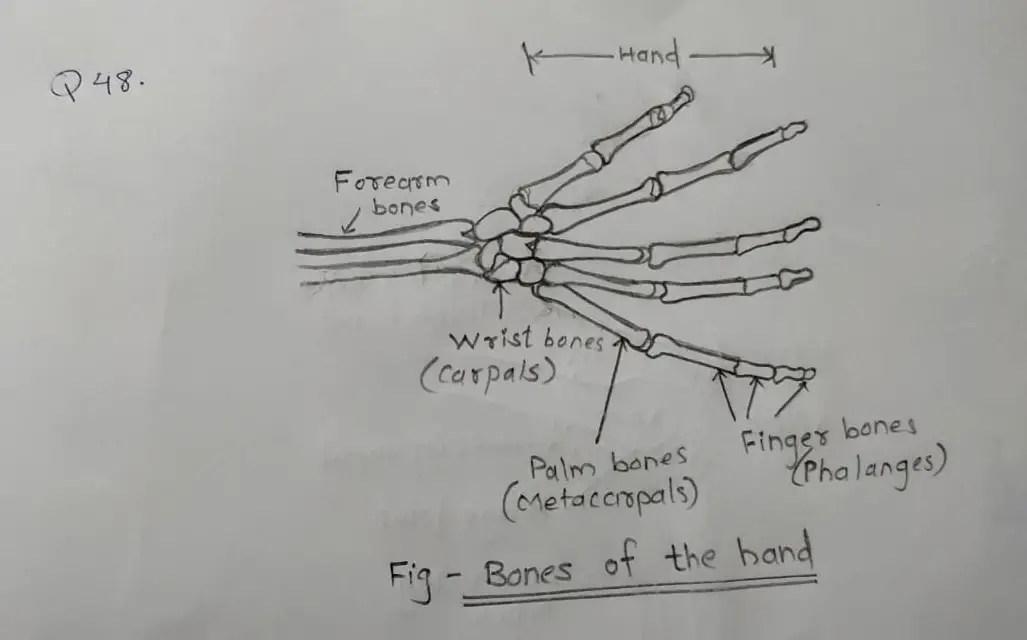
(48) Ans. The various parts of our hand are:- Wrist, Palm and Fingers.
(49) Ans. The place where two or more bones meet in the skeleton is called a joint.
The four types of join in the human body are:- (a) Hinge joint (b) Ball and Socket joint (c) Pivot joints (d) Fixed joints.
(50) Ans. Knee joint is a hinge joint.
The construction and working of a knee joint:- At the knee the lower end of upper leg bone is in a form of a knob and the upper end of the lower leg bones is in the form of a cup. The knob of upper leg bone fits into the cup of lower leg bones to form a hinge joint at the knee. The ligaments hold the upper leg bone and lower leg bones together at the knee joint.
(51) Ans. Bird walk on the ground by using their hind limbs.
The various ways in which birds are adapted for flying:-
(i) Their forelimbs are modified to form wings for flying.
(ii) Their flight feathers provide a large flat surface which is light but strong.
(iii) Their bones are hollow and light.
(iv) Their bodies are streamlined and extremely light.
(52) Ans. The muscles joined to our bones work in pairs. When one muscle of the pair contracts then the other muscle of the pair is stretched.
The two types of muscles which are involved in bending and straightening of arm are biceps and triceps.
(53) Ans. Cockroach have six legs.
The cockroach moves on the ground by using its legs. Each leg of cockroach consist of stiff, hollow tubes joined together. The legs of cockroach can be moved easily by the muscles. The muscles which move the legs of cockroach are attached to the inside of the exoskeleton. The flexor muscles bend the legs whereas extensor muscles straighten the legs and make the cockroach move.
(55) Ans. The adaptation which make the fish move in water:-
(a) The fish has streamlined body.
(b) The fish has flexible backbone.
(c) The fish has powerful body muscles.
(d) The fish has fins.
A fish swims in water by moving its tail from side to side. The side to side movements of tail are brought about by the alternate contractions and relaxation of muscles on the two sides of the body. Of fish. When the fishes tail moves from side to side, it pushes the water sideways as well as backwards. The backward push of tail on water makes the fish moves forward.
Download PDF
Lakhmir Singh Manjit Kaur Solutions for Class 6 Science: Chapter 8- Body Movements
Download PDF: Lakhmir Singh Manjit Kaur Solutions for Class 6 Science: Chapter 8- Body Movements PDF
Chapterwise Lakhmir Singh Manjit Kaur Solutions for Class 6 Science :
- Food: Where does it come from
- Components of Food Part-1 / Components of Food Part-2
- Fibre to Fabric
- Sorting Materials Into Groups
- Separation of Substances
- Changes Around Us
- Getting to Know Plants
- Body Movements
- The Living Organisms and Their Surroundings
- Motion and Measurement of Distances
- Light Shadows and Reflection
- Electricity and Circuits
- Fun with Magnets
- Water
- Air Around Us
- Garbage In Garbage Out
About Lakhmir Singh Manjit Kaur
Students studying under the Central Board of Secondary Education find the textbooks of Lakhmir Singh and Manjit Kaur as one of their go-to textbooks for references. These books are designed based on the latest CBSE syllabus. Every concept that is explained in this textbook comes with supporting examples and problems that give students an opportunity to understand the application of formulas and equations.