
Class 10: Maths Chapter 5 solutions. Complete Class 10 Maths Chapter 5 Notes.
Maharashtra Board Solutions for Class 10-Maths (Part 2): Chapter 5- Co-ordinate Geometry
Maharashtra Board 10th Maths Chapter 5, Class 10 Maths Chapter 5 solutions
Practice Set 5.1
Question 1. Find the distance between each of the following pairs of points.
i. A (2, 3), B (4,1)
ii. P (-5, 7), Q (-1, 3)
iii. R (0, -3), S (0,52)
iv. L (5, -8), M (-7, -3)
v. T (-3, 6), R (9, -10)
vi. W(−72,4), X(11, 4)
Solution:
i. Let A (x1, y1) and B (x2, y2) be the given points.
∴ x1 = 2, y1 = 3, x2 = 4, y2 = 1
By distance formula,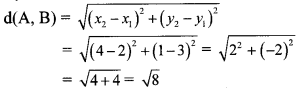
∴ d(A, B) = 22–√ units
∴ The distance between the points A and B is 22–√ units.
ii. Let P (x1, y1 ) and Q (x2, y2) be the given points.
∴ x1 = -5, y1 = 7, x2 = -1, y2 = 3
By distance formula,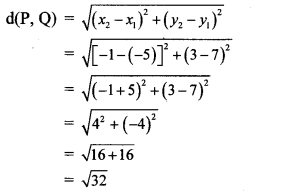
∴ d(P, Q) = 42–√ units
∴ The distance between the points P and Q is 42–√ units.
iii. Let R (x1, y1) and S (x2, y2) be the given points.
∴ x1 = 0, y1 = -3, x2 = 0, y2 = 52
By distance formula,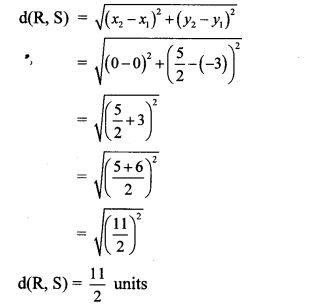
∴ d(R, S) = 112 units
∴ The distance between the points R and S is 112 units.
iv. Let L (x1, y1) and M (x2, y2) be the given points.
∴ x1 = 5, y1 = -8, x2 = -7, y2 = -3
By distance formula,
∴ d(L, M) = 13 units
∴ The distance between the points L and M is 13 units.
v. Let T (x1,y1) and R (x2, y2) be the given points.
∴ x1 = -3, y1 = 6,x2 = 9,y2 = -10
By distance formula,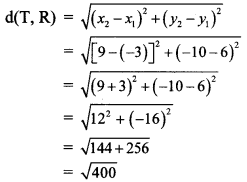
∴ d(T, R) = 20 units
∴ The distance between the points T and R 20 units.
vi. Let W (x1, y1) and X (x2, y2) be the given points.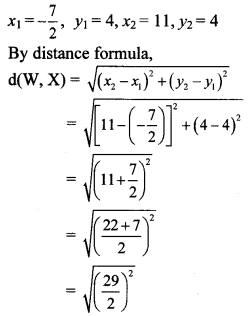
∴ d(W, X) = 292 units
∴ The distance between the points W and X is 292 units.
Practice Set 5.1 Geometry 10th Question 2. Determine whether the points are collinear.
i. A (1, -3), B (2, -5), C (-4, 7)
ii. L (-2, 3), M (1, -3), N (5, 4)
iii. R (0, 3), D (2, 1), S (3, -1)
iv. P (-2, 3), Q (1, 2), R (4, 1)
Solution:
i. By distance formula,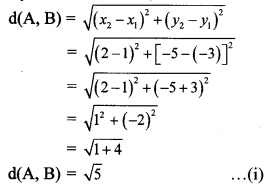
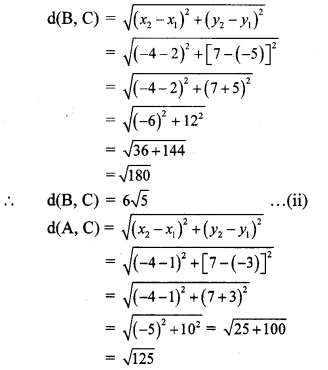
∴ d(A, B) = 5–√ …(i)
On adding (i) and (iii),
d(A, B) + d(A, C)= 5–√ + 55–√ = 65–√
∴ d(A, B) + d(A, C) = d(B, C) … [From (ii)]
∴ Points A, B and C are collinear.
ii. By distance formula,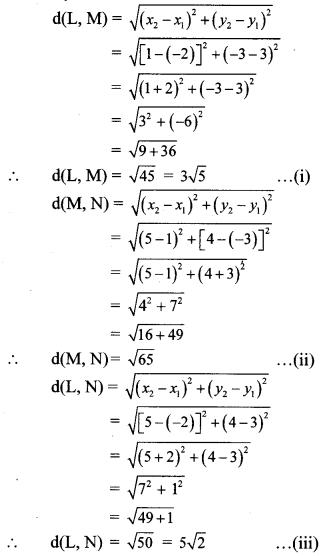
On adding (i) and (iii),
d(L, M) + d(L, N) = 35–√ + 52–√ ≠ 65−−√
∴ d(L, M) + d(L, N) ≠ d(M, N) … [From (ii)]
∴ Points L, M and N are not collinear.
iii. By distance formula,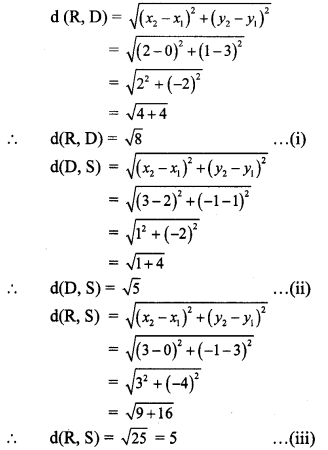
On adding (i) and (ii),
∴ d(R, D) + d(D, S) = 8–√ + 5–√ ≠ 5
∴ d(R, D) + d(D, S) ≠ d(R, S) … [From (iii)]
∴ Points R, D and S are not collinear.
iv. By distance formula,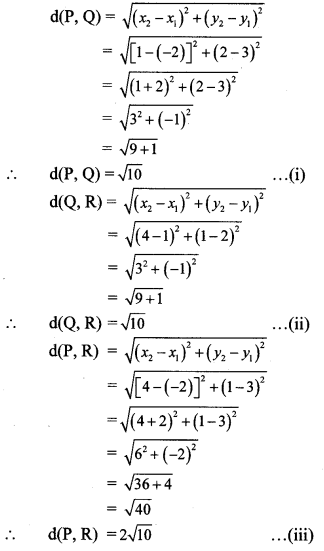
On adding (i) and (ii),
d(P, Q) + d(Q, R) = 10−−√ + 10−−√ = 210−−√
∴ d(P, Q) + d(Q, R) = d(P, R) … [From (iii)]
∴ Points P, Q and R are collinear.
Coordinate Geometry Class 10 Practice Set 5.1 Question 3. Find the point on the X-axis which is equidistant from A (-3,4) and B (1, -4).
Solution:
Let point C be on the X-axis which is equidistant from points A and B.
Point C lies on X-axis.
∴ its y co-ordinate is 0.
Let C = (x, 0)
C is equidistant from points A and B.
∴ AC = BC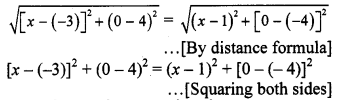
∴ (x + 3)2 + (-4)2 = (x- 1)2 + 42
∴ x2 + 6x + 9 + 16 = x2 – 2x + 1 + 16
∴ 8x = – 8
∴ x = – 88 = -1
∴ The point on X-axis which is equidistant from points A and B is (-1,0).
Question 4. Verify that points P (-2, 2), Q (2, 2) and R (2, 7) are vertices of a right angled triangle.
Solution:
Distance between two points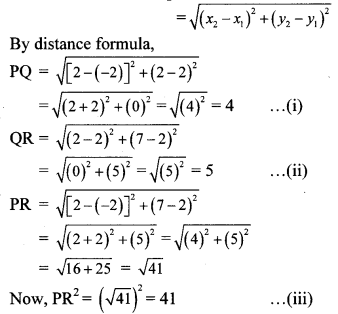
Consider, PQ2 + QR2 = 42 + 52 = 16 + 25 = 41 … [From (i) and (ii)]
∴ PR2 = PQ2 + QR2 … [From (iii)]
∴ ∆PQR is a right angled triangle. … [Converse of Pythagoras theorem]
∴ Points P, Q and R are the vertices of a right angled triangle.
Question 5.
Show that points P (2, -2), Q (7, 3), R (11, -1) and S (6, -6) are vertices of a parallelogram.
Proof:
Distance between two points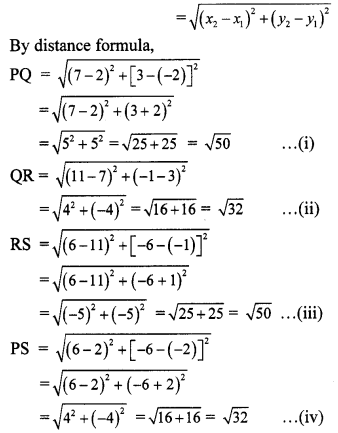
PQ = RS … [From (i) and (iii)]
QR = PS … [From (ii) and (iv)]
A quadrilateral is a parallelogram, if both the pairs of its opposite sides are congruent.
∴ □ PQRS is a parallelogram.
∴ Points P, Q, R and S are the vertices of a parallelogram.
Question 6.
Show that points A (-4, -7), B (-1, 2), C (8, 5) and D (5, -4) are vertices of rhombus ABCD.
Proof:
Distance between two points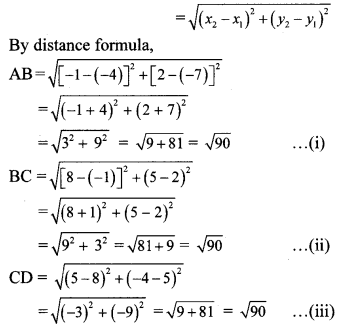

∴ AB = BC = CD = AD …[From (i), (ii), (iii) and (iv)]
In a quadrilateral, if all the sides are equal, then it is a rhombus.
∴ □ ABCD is a rhombus.
∴ Points A, B, C and D are the vertices of rhombus ABCD.
Question 7. Find x if distance between points L (x, 7) and M (1,15) is 10.
Solution:
X1 = x, y1 = 7, x2 = 1, y2 = 15
By distance formula,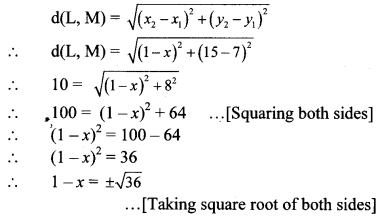
∴ 1 – x = ± 6
∴ 1 – x = 6 or l – x = -6
∴ x = – 5 or x = 7
∴ The value of x is – 5 or 7.
Question 8. Show that the points A (1, 2), B (1, 6), C (1 + 23–√, 4) are vertices of an equilateral triangle.
Proof:
Distance between two points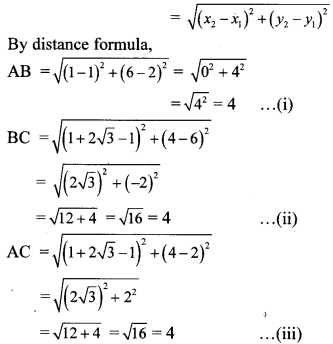
∴ AB = BC = AC … [From (i), (ii) and (iii)]
∴ ∆ABC is an equilateral triangle.
∴ Points A, B and C are the vertices of an equilateral triangle.
Question 1.
In the figure, seg AB || Y-axis and seg CB || X-axis. Co-ordinates of points A and C are given. To find AC, fill in the boxes given below. (Textbook pa. no. 102)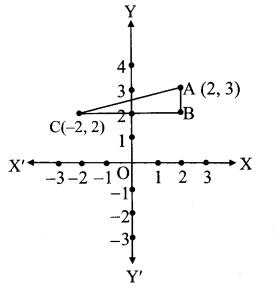
Solution:
In ∆ABC, ∠B = 900
∴ (AB)2 + (BC)2 = [(Ac)2 …(i) … [Pythagoras theorem]
seg CB || X-axis
∴ y co-ordinate of B = 2
seg BA || Y-axis
∴ x co-ordinate of B = 2
∴ co-ordinate of B is (2, 2) = (x1,y1)
co-ordinate of A is (2, 3) = (x2, Y2)
Since, AB || to Y-axis,
d(A, B) = Y2 – Y1
d(A,B) = 3 – 2 = 1
co-ordinate of C is (-2,2) = (x1,y1)
co-ordinate of B is (2, 2) = (x2, y2)
Since, BC || to X-axis,
d(B, C) = x2 – x1
d(B,C) = 2 – -2 = 4
∴ AC2 = 12 + 42 …[From (i)]
= 1 + 16 = 17
∴ AC = 17−−√ units …[Taking square root of both sides]
Practice Set 5.2
Question 1.
Find the co-ordinates of point P if P divides the line segment joining the points A (-1, 7) and B (4, -3) in the ratio 2:3.
Solution:
Let the co-ordinates of point P be (x, y) and A (x1, y1) B (x2, y2) be the given points.
Here, x1 = -1, y1 = 7, x2 = 4, y2 = -3, m = 2, n = 3
∴ By section formula,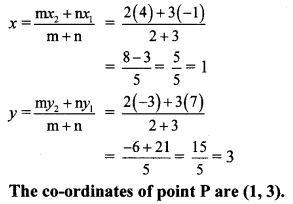
∴ The co-ordinates of point P are (1,3).
Question 2.
In each of the following examples find the co-ordinates of point A which divides segment PQ in the ratio a : b.
i. P (-3, 7), Q (1, -4), a : b = 2 : 1
ii. P (-2, -5), Q (4, 3), a : b = 3 : 4
iii. P (2, 6), Q (-4, 1), a : b = 1 : 2
Solution:
Let the co-ordinates of point A be (x, y).
i. Let P (x1, y1), Q (x2, y2) be the given points.
Here, x1 = -3, y1 = 7, x2 = 1, y2 = -4, a = 2, b = 1
∴ By section formula,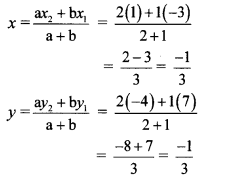
∴ The co-ordinates of point A are (−13,−13).
ii. Let P (x1,y1), Q (x2, y2) be the given points.
Here, x1 = -2, y1 = -5, x2 = 4, y2 = 3, a = 3, b = 4
By section formula,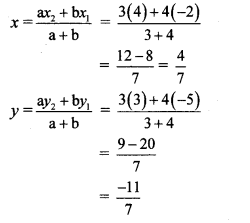
∴ The co-ordinates of point A are (47,−117)
iii. Let P (x1, y1), Q (x2, y2) be the given points.
Here,x1 = 2,y1 = 6, x2 = -4, y2 = 1, a = 1,b = 2
∴ By section formula,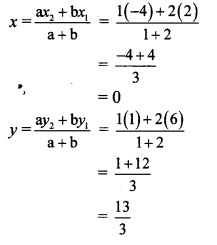
∴ The co-ordinates of point A are (0,133)
Question 3.
Find the ratio in which point T (-1, 6) divides the line segment joining the points P (-3,10) and Q (6, -8).
Solution:
Let P (x1, y1), Q (x2, y2) and T (x, y) be the given points.
Here, x1 = -3, y1 = 10, x2 = 6, y2 = -8, x = -1, y = 6
∴ By section formula,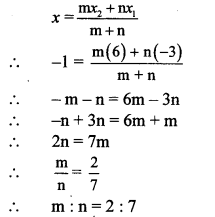
∴ Point T divides seg PQ in the ratio 2 : 7.
Question 4.
Point P is the centre of the circle and AB is a diameter. Find the co-ordinates of point B if co-ordinates of point A and P are (2, -3) and (-2,0) respectively.
Solution:
Let A (x1, y1), B (x2, y2) and P (x, y) be the given points.
Here, x1 = 2, y1 =-3,
x = -2, y = 0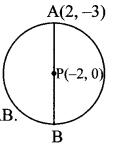
Point P is the midpoint of seg AB.
∴ By midpoint formula,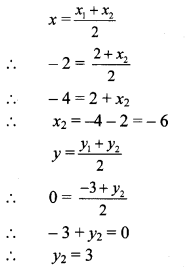
∴ The co-ordinates of point B are (-6,3).
Question 5.
Find the ratio in which point P (k, 7) divides the segment joining A (8, 9) and B (1,2). Also find k.
Solution:
Let A (x1, y1), B (x2, y2) and P (x, y) be the given points.
Here, x1 = 8, y1 = 9, x2 = 1, y2 = 2, x = k, y = 7
∴ By section formula,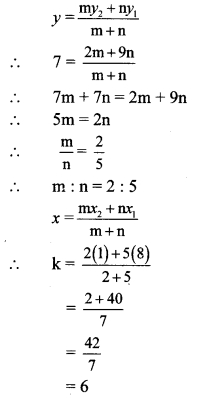
∴ Point P divides seg AB in the ratio 2 : 5, and the value of k is 6.
Question 6.
Find the co-ordinates of midpoint of the segment joining the points (22, 20) and (0,16).
Solution:
Let A (x1, y1) = A (22, 20),
B (x2,y2) = B (0, 16)
Let the co-ordinates of the midpoint be P (x,y).
∴ By midpoint formula,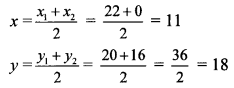
The co-ordinates of the midpoint of the segment joining (22, 20) and (0, 16) are (11,18).
Question 7.
Find the centroids of the triangles whose vertices are given below.
i. (-7, 6), (2,-2), (8, 5)
ii. (3, -5), (4, 3), (11,-4)
iii. (4, 7), (8, 4), (7, 11)
Solution:
i. Let A (x1, y1) = A (-7, 6),
B (x2, y2) = B (2, -2),
C (x3, y3) = C(8, 5)
∴ By centroid formula,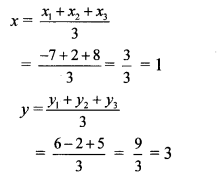
∴ The co-ordinates of the centroid are (1,3).
ii. Let A (x1 y1) = A (3, -5),
B (x2, y2) = B (4, 3),
C(x3, y3) = C(11,-4)
∴ By centroid formula,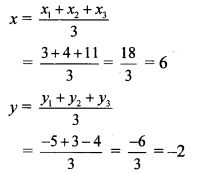
∴ The co-ordinates of the centroid are (6, -2).
iii. Let A (x1, y1) = A (4, 7),
B (x2, y2) = B (8,4),
C (x3, y3) = C(7,11)
∴ By centroid formula,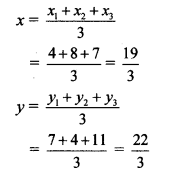
∴ The co-ordinates of the centroid are (193,223)
Question 8.
In ∆ABC, G (-4, -7) is the centroid. If A (-14, -19) and B (3, 5), then find the co-ordinates of C.
Solution:
G (x, y) = G (-4, -7),
A (x1, y1) = A (-14, -19),
B(x2, y2) = B(3,5)
Let the co-ordinates of point C be (x3, y3).
G is the centroid.
By centroid formula,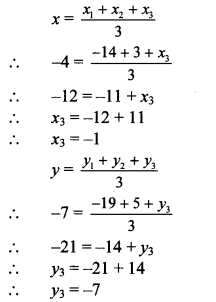
∴ The co-ordinates of point C are (-1, – 7).
Question 9.
A (h, -6), B (2, 3) and C (-6, k) are the co-ordinates of vertices of a triangle whose centroid is G (1,5). Find h and k.
Solution:
A(x1,y1) = A(h, -6),
B (x2, y2) = B(2, 3),
C (x3, y3) = C (-6, k)
∴ centroid G (x, y) = G (1, 5)
G is the centroid.
By centroid formula,
∴ 3 = h – 4
∴ h = 3 + 4
∴ h = 7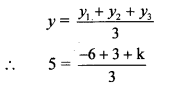
∴ 15 = -3 + k
∴ k = 15 + 3
∴ k = 18
∴ h = 7 and k = 18
Question 10.
Find the co-ordinates of the points of trisection of the line segment AB with A (2,7) and B (-4, -8).
Solution:
A (2, 7), B H,-8)
Suppose the points P and Q trisect seg AB.
∴ AP = PQ = QB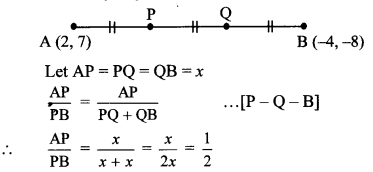
∴ Point P divides seg AB in the ratio 1:2.
∴ By section formula,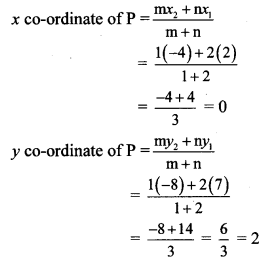
Co-ordinates of P are (0, 2).
Point Q is the midpoint of PB.
By midpoint formula,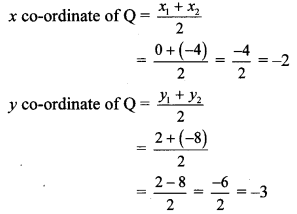
Co-ordinates of Q are (-2, -3).
∴ The co-ordinates of the points of trisection seg AB are (0,2) and (-2, -3).
Question 11.
If A (-14, -10), B (6, -2) are given, find the co-ordinates of the points which divide segment AB into four equal parts.
Solution:
Let the points C, D and E divide seg AB in four equal parts.
Point D is the midpoint of seg AB.
∴ By midpoint formula,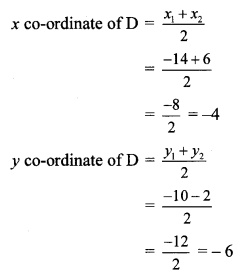
∴ Co-ordinates of D are (-4, -6).
Point C is the midpoint of seg AD.
∴ By midpoint formula,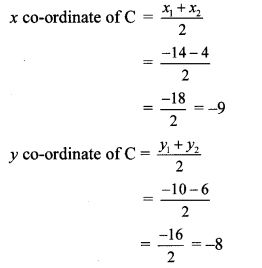
∴ Co-ordinates of C are (-9, -8).
Point E is the midpoint of seg DB.
∴ By midpoint formula,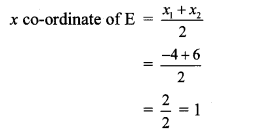
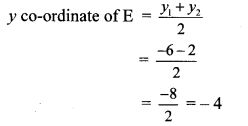
∴ Co-ordinates of E are (1,-4).
∴ The co-ordinates of the points dividing seg AB in four equal parts are C(-9, -8), D(-4, -6) and E(1, – 4).
Question 12.
If A (20, 10), B (0, 20) are given, find the co-ordinates of the points which divide segment AB into five congruent parts.
Solution:
Suppose the points C, D, E and F divide seg AB in five congruent parts.
∴ AC = CD = DE = EF = FB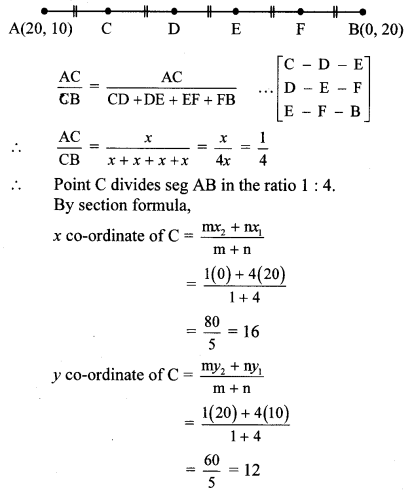
∴ co-ordinates of C are (16, 12).
E is the midpoint of seg CB.
By midpoint formula,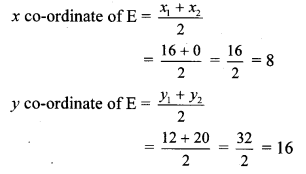
∴ co-ordinates of E are (8, 16).
D is the midpoint of seg CE.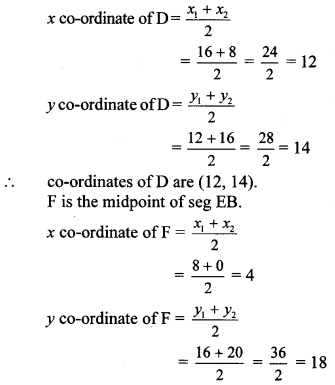
∴ co-ordinates of F are (4, 18).
∴ The co-ordinates of the points dividing seg AB in five congruent parts are C (16, 12), D (12, 14), E (8, 16) and F (4, 18).
Question 1.
A (15, 5), B (9, 20) and A-P-B. Find the ratio in which point P (11, 15) divides segment AB. Find the ratio using x and y co-ordinates. Write the conclusion. (Textbook pg. no. 113)
Solution:
Suppose point P (11,15) divides segment AB in the ratio m : n.
By section formula,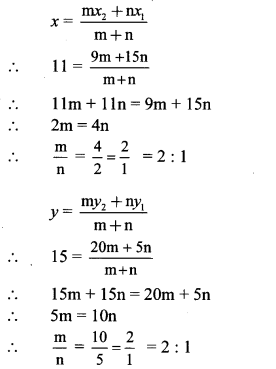
∴ Point P divides seg AB in the ratio 2 : 1.
The ratio obtained by using x and y co-ordinates is the same.
Question 2.
External division: (Textbook pg. no. 115)
Suppose point R divides seg PQ externally in the ratio 3:1.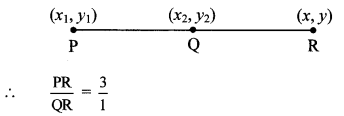
Let the common multiple be k.
Let PR = 3k and QR = k
Now, PR = PQ + QR … [P – Q – R]
∴ 3k = PQ + k
∴ PQQR = 2kk = 21
∴ Point Q divides seg PR in the ratio 2 : 1 internally.
Thus, we can find the co-ordinates of point R, when co-ordinates of points P and Q are given.
Practice Set 5.3
Question 1. Angles made by the line with the positive direction of X-axis are given. Find the slope of these lines.
i. 45°
ii. 60°
iii. 90°
Solution:
i. Angle made with the positive direction of
X-axis (θ) = 45°
Slope of the line (m) = tan θ
∴ m = tan 45° = 1
∴ The slope of the line is 1.
ii. Angle made with the positive direction of X-axis (θ) = 60°
Slope of the line (m) = tan θ
∴ m = tan 60° = 3–√
∴ The slope of the line is 3–√.
iii. Angle made with the positive direction of
X-axis (θ) = 90°
Slope of the line (m) = tan θ
∴ m = tan 90°
But, the value of tan 90° is not defined.
∴ The slope of the line cannot be determined.
Question 2. Find the slopes of the lines passing through the given points.
i. A (2, 3), B (4, 7)
ii. P(-3, 1), Q (5, -2)
iii. C (5, -2), D (7, 3)
iv. L (-2, -3), M (-6, -8)
v. E (-4, -2), F (6, 3)
vi. T (0, -3), s (0,4)
Solution:
i. A (x1, y1) = A (2, 3) and B (x2, y2) = B (4, 7)
Here, x1 = 2, x2 = 4, y1 = 3, y2 = 7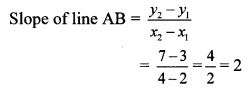
∴ The slope of line AB is 2.
ii. P (x1, y1) = P (-3, 1) and Q (x2, y2) = Q (5, -2)
Here, x1 = -3, x2 = 5, y1 = 1, y2 = -2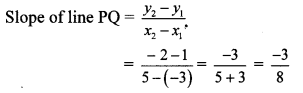
∴ The slope of line PQ is −38
iii. C (x1, y1) = C (5, -2) and D (x2, y2) = D (7, 3)
Here, x1 = 5, x2 = 7, y1 = -2, y2 = 3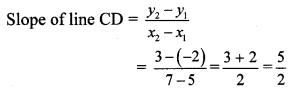
∴ The slope of line CD is 52
iv. L (x1, y1) = L (-2, -3) and M (x2,y2) = M (-6, -8)
Here, x1 = -2, x2 = – 6, y1 = – 3, y2 = – 8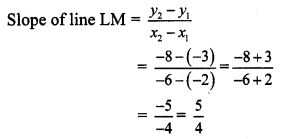
∴ The slope of line LM is 54
v. E (x1, y1) = E (-4, -2) and F (x2, y2) = F (6, 3)
Here,x1 = -4, x2 = 6, y1 = -2, y2 = 3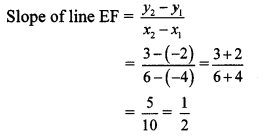
∴ The slope of line EF is 12.
vi. T (x1, y1) = T (0, -3) and S (x2, y2) = S (0, 4)
Here, x1 = 0, x2 = 0, y1 = -3, y2 = 4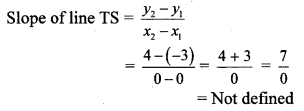
∴ The slope of line TS cannot be determined.
Question 3. Determine whether the following points are collinear.
i. A (-1, -1), B (0, 1), C (1, 3)
ii. D (- 2, -3), E (1, 0), F (2, 1)
iii. L (2, 5), M (3, 3), N (5, 1)
iv. P (2, -5), Q (1, -3), R (-2, 3)
v. R (1, -4), S (-2, 2), T (-3,4)
vi. A(-4,4),K[-2,52], N (4,-2)
Solution:

∴ slope of line AB = slope of line BC
∴ line AB || line BC
Also, point B is common to both the lines.
∴ Both lines are the same.
∴ Points A, B and C are collinear.
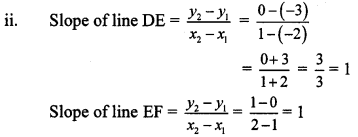
∴ slope of line DE = slope of line EF
∴ line DE || line EF
Also, point E is common to both the lines.
∴ Both lines are the same.
∴ Points D, E and F are collinear.
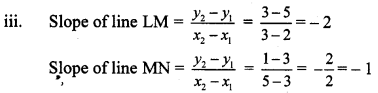
∴ slope of line LM ≠ slope of line MN
∴ Points L, M and N are not collinear.

∴ slope of line PQ = slope of line QR
∴ line PQ || line QR
Also, point Q is common to both the lines.
∴ Both lines are the same.
∴ Points P, Q and R are collinear.
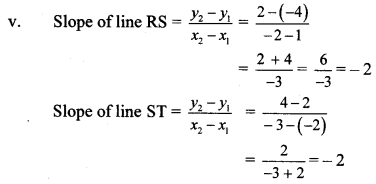
∴ slope of line RS = slope of line ST
∴ line RS || line ST
Also, point S is common to both the lines.
∴ Both lines are the same.
∴ Points R, S and T are collinear.
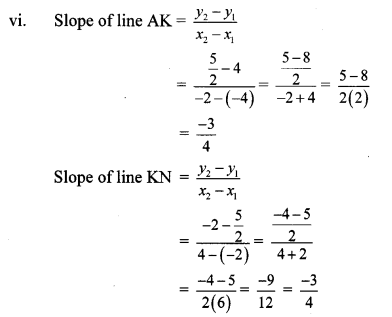
∴ slope of line AK = slope of line KN
∴ line AK || line KN
Also, point K is common to both the lines.
∴ Both lines are the same.
∴ Points A, K and N are collinear.
Practice Set 5.3 Geometry 9th Standard Question 4. If A (1, -1), B (0,4), C (-5,3) are vertices of a triangle, then find the slope of each side.
Solution: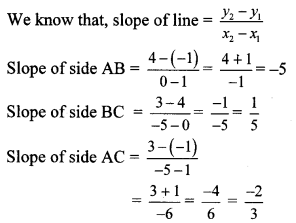
∴ The slopes of the sides AB, BC and AC are -5, 15 and −23 respectively.
Question 5. Show that A (-4, -7), B (-1, 2), C (8, 5) and D (5, -4) are the vertices of a parallelogram.
Proof: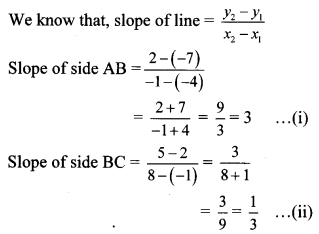
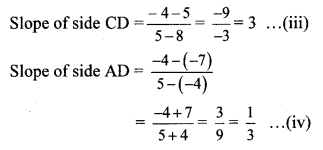
∴ Slope of side AB = Slope of side CD … [From (i) and (iii)]
∴ side AB || side CD
Slope of side BC = Slope of side AD … [From (ii) and (iv)]
∴ side BC || side AD
Both the pairs of opposite sides of ꠸ABCD are parallel.
꠸ABCD is a parallelogram.
Points A(-4, -7), B(-1, 2), C(8, 5) and D(5, -4) are the vertices of a parallelogram.
Question 6.
Find k, if R (1, -1), S (-2, k) and slope of line RS is -2.
Solution:
R(x1, y1) = R (1, -1), S (x2, y2) = S (-2, k)
Here, x1 = 1, x2 = -2, y1 = -1, y2 = k
But, slope of line RS is -2. … [Given]
∴ -2 = k+1−3
∴ k + 1 = 6
∴ k = 6 – 1
∴ k = 5
Question 7. Find k, if B (k, -5), C (1, 2) and slope of the line is 7.
Solution:
B(x1, y1) = B (k, -5), C (x2, y2) = C (1, 2)
Here, x1 = k, x2 = 1, y1 = -5, y2 = 2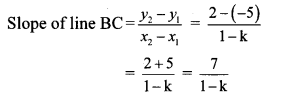
But, slope of line BC is 7. …[Given]
∴ 7 = 71−k
∴ 7(1 – k) = 7
∴ 1 – k = 77
∴ 1 – k = 1
∴ k = 0
Question 8.
Find k, if PQ || RS and P (2, 4), Q (3, 6), R (3,1), S (5, k).
Solution: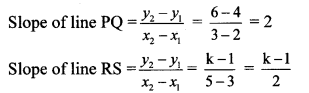
But, line PQ || line RS … [Given]
∴ Slope of line PQ = Slope of line RS
∴ 2 = k−12
∴ 4 = k – 1
∴ k = 4 + 1
∴ k = 5
Download PDF
Maharashtra Board Solutions for Class 10-Maths (Part 2): Chapter 5- Co-ordinate Geometry
Chapterwise Maharashtra Board Solutions Class 10 Maths (Part 2) :
- Chapter 1- Similarity
- Chapter 2- Pythagoras Theorem
- Chapter 3- Circle
- Chapter 4- Geometric Constructions
- Chapter 5- Co-ordinate Geometry
- Chapter 6- Trigonometry
- Chapter 7- Mensuration