
Class 6: English Chapter 3.7 solutions. Complete Class 6 English Chapter 3.7 Notes.
Maharashtra Board Solutions for Class 6- English (Voyage 3): Chapter 3.7- At the Science Fair
Maharashtra Board 6th English Chapter 3.7, Class 6 English Chapter 3.7 solutions
Questions and Answers
1. Answer the following questions:
Question a.
What two basic rules were followed in the Science Fair?
Answer:
The two basic rules to be followed in the Science Fair were:
- Everything should be handled by students
- The entertainment booths and refreshment stalls had to have a scientific base.
Question b.
How early did the preparations for the Science Fair begin?
Answer:
The preparations for the Science Fair began a couple of months in advance.
Question c.
How was the committee formed?
Answer:
A committee of parents and teachers was set up to look after all the work of the fair. Some students representative were also taken on the committee to give them a firsthand experience of managing big programmes.
Question d.
What themes did the committee identify?
Answer:
The themes identified by the committee were – Plant, Animals, Properties of Substances, Energy, Science in our Everyday Life, Latest News from the World of Science and Food and Nutrition.
Question e.
How did the students prepare for their stalls/ presentations?
Answer:
Stalls were allotted to many groups of children. Each group selected a topic/idea from the chosen themes. The young scientists began collecting a lot of information about their topic using their science text book, their school library and the internet. They shared and discussed this information in their groups and decided the exact activity for their stall deciding whether they would build and display a model, give a demonstration, present their project through posters or simply exhibit a collection.
Question f.
What did Mr Gizare appreciate the most?
Answer:
Mr Gizare appreciated the fact that in most of the stalls, visitors could try out the various science experiments and models.
Question g.
What did the Clean Brigade do?
Answer:
The Clean Brigade members made rounds of the Fair spreading the message of cleanliness and they had vowed to keep the school premises spick and span during the Fair.
2. Make charts to show the important points to remember while making –
Question a.
A graphic presentation
Answer:
Graphic Presentation:
- Write to the point so that a visitor may read a chart or poster at a glance.
- Make use of bullet points or bulleted lists.
- Use pictures and diagrams and label them.
- Use pictograms, graphs, pie-charts etc. to show numerical data.
- Plan all your posters, charts properly before you start making them.
- Make a rough ‘mini-copy’ before you begin work on the big, final poster or chart.
- Don’t forget to check your spellings, sentences or other errors in the ‘mini-copy’ itself.
- Use different colours to highlight important features, but use them judiciously.
- If you have used any text, pictures, diagrams, etc. from elsewhere, acknowledge the source.
Question b.
An oral presentation
Answer:
| Do’s | Don’ts |
| a. Keep the oral presentation short and to the point | a. Don’t cross the allotted time |
| b. Be confident | b. Don’t fidget |
| c. Rehearse the speech well | c. Don’t use ‘umms’ and ‘errs’ |
| d. Relate to the topics exhibited directly | d. Don’t talk irrelevant things |
| e. Be ready to answer relevant questions | e. Don’t give irrelevant answers |
| f. Use visuals or graphics | f. Don’t leave the walls of the stalls empty |
| g. Point to the relevant graphic or visual while speaking | g. Don’t speak without pointing to visuals or graphics |
| h. Wear clean and tidy clothes | h. Don’t dress up to show off |
| i. Be polite and pleasant when you talk to visitors | i. Don’t be rude or fast while talking to visitors |
| j. Say out if you don’t know an answer | j. Don’t talk everything else other than the answer |
| k. Smile, it makes others feel nice | k. Don’t keep a grumpy face |
3. Relate the themes of the fair to your science text book by writing the relevant chapter numbers under each theme.
Question 1.
Relate the themes of the fair to your science text book by writing the relevant chapter numbers under each theme.
Answer:
To be done by students.
4. Find in your science textbook, the topics of the stalls handled by the students of VI A (Write the page number).
Question 1.
Find in your science textbook, the topics of the stalls handled by the students of VI A (Write the page number).
Answer:
To be done by students.
5. What themes would you like to add to the themes given in this passage?
Question 1.
What themes would you like to add to the themes given in this passage?
Answer:
- Why does honey crystallize?
- How to make a lemon battery?
- Build your own telescope.
6. Imagine you are visiting the Science Fair. What other stalls (apart from the ones mentioned here) are you likely to find there? Try to list at least five more stalls.
Question 1.
Imagine you are visiting the Science Fair. What other stalls (apart from the ones mentioned here) are you likely to find there? Try to list at least five more stalls.
Answer:
- Use of empty aerated bottles as life belts to save from drowning.
- Manually rotating a wheel to generate electric energy.
- Replantation of a tree instead of cutting it down.
7. Using your imagination, and information from other sources, describe anyone stall in detail.
Question 1.
Using your imagination, and information from other sources, describe anyone stall in detail.
Answer:
I visited a stall at the Science Fair. The theme of the stall was ‘Energy’, The experiments shown were to produce electricity at home and the method was very simple, but the part of the experiment was that it was so simple that anyone could try it out themselves at the stall.
- The prize winning project was how to make lemon Battery.
- The aim of the experiment was to make Lemon Battery.
The material used were 2 lemons, Copper wires, 2 large paper chips, 2 coins, a digital clock, scissors and a knife.
Besides the Lemon Battery Projects, there were other projects which focussed on the use of Kinetic Energy, Uses of Potential Energy, Electrostatic Energy, Sound, Food adulteration, Mechanical Energy and Fun with Magnets. Also Charts were put up best with bold writing.
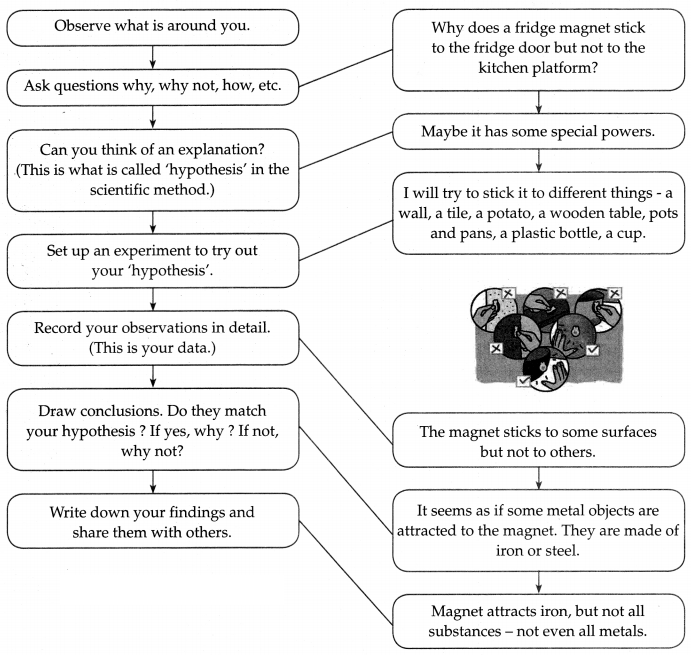
8. Choose a ‘question’ through your own observation. Try to follow the scientific method to find the answer to that question. Take the help of your teacher/parents to set up the experiment.
Question 1.
Choose a ‘question’ through your own observation. Try to follow the scientific method to find the answer to that question. Take the help of your teacher/parents to set up the experiment.
Answer:
9. Visit a library: Find and read the biography of your favourite scientist.
Question 1.
Visit a library: Find and read the biography of your favourite scientist.
Introduction:
Science Fair is an opportunity for students to apply the scientific method to conduct independent research. The result is presented in a schoolwide science fair, where the student’s efforts are displayed, where students are questioned too. Students are helped by teachers and parents. They have to follow guidelines and be thoroughly prepared to answer any questions put across by visitors, regarding their topic.
Glossary:
- basic (adj) – necessary
- volunteered (v) – to do or offer to do something
- allotted (v) – to distribute, to assign
- themes (n) – an idea
- graphic (adj) (n) – a drawing or a picture
- inaugurated (adj) – marking the beginning of a venture
- adulteration (n) – mixing other matter of inferior quality with food or drink which is to be sold
Download PDF
Maharashtra Board Solutions for Class 6- English (Voyage 3): Chapter 3.7- At the Science Fair
Chapterwise Maharashtra Board Solutions Class 6 English :
Voyage 1
- Chapter 1.1- Don’t Give Up!
- Chapter 1.2- Who’s the Greatest?
- Chapter 1.3- Autobiography of a Great Indian Bustard
- Chapter 1.4- Children are Going to School ...
- Chapter 1.5- Kabaddi Match
- Chapter 1.6- The Peacock and the Crane
- Chapter 1.7- Param Vir Chakra: Our Heroes
Voyage 2
- Chapter 2.1- The Clothesline
- Chapter 2.2- The Worth of a Fabric
- Chapter 2.3- A Wall Magazine for your Class!
- Chapter 2.4- Anak Krakatoa
- Chapter 2.5- The Silver House
- Chapter 2.6- Ad‘wise’ Customers
- Chapter 2.7- Yonamine and Bushi
Voyage 3
- Chapter 3.1- It Can Be Done
- Chapter 3.2- Seven Sisters
- Chapter 3.3- Stone Soup
- Chapter 3.4-Sushruta
- Chapter 3.5- The Donkey
- Chapter 3.6- The Merchant of Venice
- Chapter 3.7- At the Science Fair
Voyage 4