
Class 12: Physics Chapter 12 solutions. Complete Class 12 Physics Chapter 12 Notes.
NCERT Solutions for 12th Class Physics: Chapter 12-Atoms
NCERT 12th Physics Chapter 12, Class 12 Physics Chapter 12 solutions
Question 1.
Choose the correct alternative from the clues given at the end of each statement:
(a) The size of the atom in Thomson’s model is _____ the atomic size in Rutherford’s model. (Much greater than / no different from / much less than).
(b) In the ground state of _____ electrons are in stable equilibrium, while in _____ electrons always experience a net force. (Thomson’s model / Rutherford’s model).
(c) A classical atom based on _____ is doomed to collapse. (Thomson’s model / Rutherford’s model)
(d) An atom has a nearly continuous mass distribution in a _____ but has a highly non-uniform mass distribution in _____ (Thomson’s model / Rutherford’s model).
(e) The positively charged part of the atom possesses most of the mass in _____ (Rutherford’s model / both the models).
Solution:
(a) not different from
(b) Thomson’s model, Rutherford’s model
(c) Rutherford’s model
(d) Thomson’s model, Rutherford’s model
(e) both the models
Question 10.
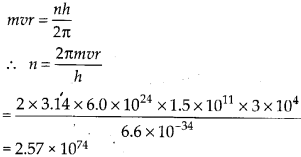
ln accordance with the Bohr’s model, find the quantum number that characterises the earth’s revolution around the sun in an orbit of radius 1.5 × 10¹¹ m with orbital speed 3 × 10⁴ m s-1. (Mass of earth = 6.0 × 10224kg)
Solution:
According to Bohr’s quantization condition of angular momentum, Angular momentum of the earth around the sun,
Question 11.
Answer the following questions, which helpyou understand the difference between Thomson’s model and Rutherford’s model better.
(a) Is the average angle of deflection of a-particles by a thin gold foil predicted by Thomson’s model much less, about the same, or much greater than that predicted by Rutherford’s model?
(b) Is the probability of backward scattering (i.e., scattering of a-particles at angles greater than 90°) predicted by Thomson’s model much less, about the same, or much greater than that predicted by Rutherford’s model?
(c) Keeping other factors fixed, it is found experimentally that for small thickness t, the number of a-particles scattered at moderate angles is proportional to What clue does this linear dependence on f provide?
(d) In which model is it completely wrong to ignore multiple scattering for the calculation of average angle of scattering of a-particles by a thin foil?
Solution:
(a) Nearly the same. This is because we are considering the average angle of deflection.
(b) Much less, because there is no such massive core (nucleus) in Thomson’s model as in Rutherford’s model.
(c) This suggests that scattering is mainly due to a single collision, because the chance of a single collision increases linearly with the number of the target atoms, and hence linearly with the thickness of the foil.
(d) In Thomson model, positive charge is distributed uniformly in the atom. So single collision causes very little deflection. The observed average scattering angle can be explained only by considering multiple scattering. Hence, it is wrong to ignore multiple scattering in Thomson’s model.
Question 12.
The gravitational attraction between electron and proton in a hydrogen atom is weaker than the coulomb attraction by a factor of about 10-40. An alternative way of looking at this fact is to estimate the radius of the first Bohr orbit of a hydrogen atom if the electron and proton were bound by gravitational attraction. You will find the answer interesting.
Solution:
The radius of the first orbit in Bohr’s model is calculated by considering the electrostatic force between electrons and proton in nucleus.
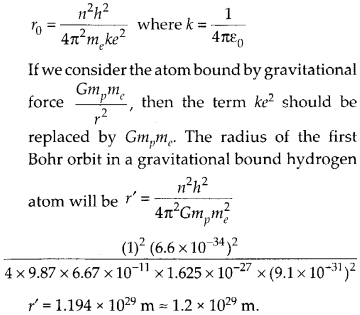
This radius is much greater than the estimated size of the whole universe.
Question 13.
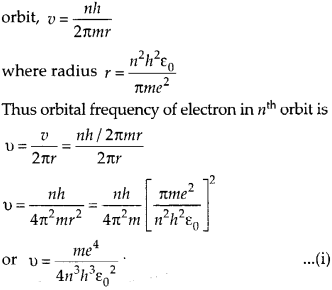
Obtain an expression for the frequency of radiation emitted when a hydrogen atom de-excites from level n to level (n – 1). For large n, show that this frequency equals the classical frequency of revolution of the electron in the orbit.
Solution:
Let us first find the frequency of revolution of electron in the orbit classically. In Bohr’s model velocity of electron in nth
Now, let us find the frequency of radiation emitted when a hydrogen atom de-excites from level h to level (n – 1).
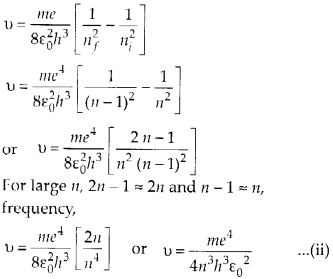
Equation (i) and (ii) are equal, hence for large value of n, the classical frequency of revolution of electron in nth orbit is same as frequency of radiation when electron de-excite from level n to(n – l).
Question 14.
Classically, an electron can be in any orbit around the nucleus of an atom. Then what determines the typical atomic size? Why is an atom not, say, thousand times bigger than its typical size? The question had greatly puzzled Bohr before he arrived at his famous model of the atom that you have learnt in the text. To simulate what he might well have done before his discovery, let us play as follows with the basic constants of nature and see if we can get a quantity with the dimensions of length that is roughly equal to the known size of an atom 10 10 m)
(a) Construct a quantity with the dimensions of length from the fundamental constants e, me, and c. Determine its numerical value.
(b) You will find that the length obtained in (a) is many orders of magnitude smaller than the atomic dimensions. Further, it involves c. But energies of atoms are mostly in non-relativistic domain where c is not expected to play any role. This is what may have suggested Bohrto discard c and look for ‘something else’ to get the right atomic size. Now, the Planck’s constant h had already made its appearance elsewhere. Bohr’s great insight lay in recognising that h, me, and e will yield the right atomic size. Construct a quantity with the dimension of length from h, me, and e and confirm that its numerical value has indeed the correct order of magnitude.
Solution:
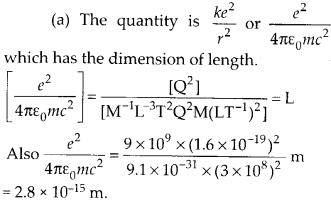
(b) A quantity with the dimension of length from h, me and e
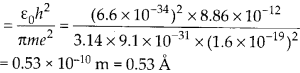
The length is of the order of atomic size (10-10m)
Question 15.
The total energy of an electron in the first excited state of the hydrogen atom is about – 3.4 eV.
(a) What is the kinetic energy of the electron in this state?
(b) What is the potential energy of the electron in this state?
(c) Which of the answers above would change if the choice of the zero of potential energy is changed?
Solution:
Kinetic energy of an electron in an orbit,
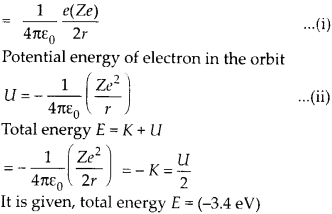
(a) Kinetic energy of electron in this state E = -K
(b) Potential energy E = U/2, U = 2E = 2 (-3.4) = -6.8 eV
(c) If thg zero of the potential energy is chosen differently, the kinetic energy remain the same. Although potential energy and hence total energy changes.
Question 16.
If Bohr’s quantisation postulate (angular momentum = nh/2n) is a basic law of nature, it should be equally valid for the case of planetary motion also. Why then do we never speak of quantisation of orbits of planets around the sun?
Solution:
Angular momentum mvr = n

associated with planetary motion are incomparably large relative to h. For example angular momentum of earth in its orbital motion is of the order of 1070
.
For such large value of n, the difference in successive energies and angular momenta of the quantised levels of the Bohr model are so small that one can predict the energy level continuous.
Question 17.
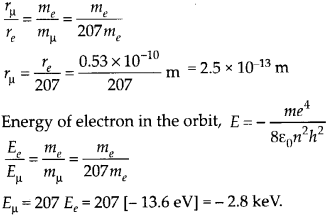
Obtain the first Bohr’s radius and the ground state energy of a muonic hydrogen atom [/.e., an atom in which a negatively charged muon (μ) of mass about 207 me orbits around a proton].
Solution:
In Bohr’s model, the radius of nth orbit,

In the given muonic hydrogen atom, a negatively charged muon (μ–) of mass 207 me revolve around a proton. Therefore radius of electron and muon can be written as
NCERT Solutions for 12th Class Physics: Chapter 12: Download PDF
NCERT Solutions for 12th Class Physics: Chapter 12-Atoms
Download PDF: NCERT Solutions for 12th Class Physics: Chapter 12-Atoms PDF
Chapterwise NCERT Solutions for Class 12 Physics :
- Chapter 1: Electric Charges and Fields
- Chapter-2: Electrostatic Potential and Capacitance
- Chapter 3: Current Electricity
- Chapter 4: Moving Charges and Magnetism
- Chapter 5: Magnetism and Matter
- Chapter 6: Electromagnetic Induction
- Chapter 7: Alternating Current
- Chapter 8: Electromagnetic Waves
- Chapter 9: Ray Optics And Optical Instruments
- Chapter 10: Wave Optics
- Chapter 11: Dual Nature Of Radiation And Matter
- Chapter 12: Atoms
- Chapter 13: Nuclei
- Chapter 14: Semiconductor Electronics Materials Devices And Simple Circuit
- Chapter 15: Communication Systems
About NCERT
The National Council of Educational Research and Training is an autonomous organization of the Government of India which was established in 1961 as a literary, scientific, and charitable Society under the Societies Registration Act. Its headquarters are located at Sri Aurbindo Marg in New Delhi. Visit the Official NCERT website to learn more.