
Class 6: Science Chapter 16 solutions. Complete Class 6 Science Chapter 16 Notes.
NCERT Solutions for 6th Class Science: Chapter 16-Garbage in, Garbage out
NCERT 6th Science Chapter 16, class 6 Science Chapter 16 solutions
Page No: 164
Exercises
1. (a) Which kind of garbage is not converted into compost by the redworms?
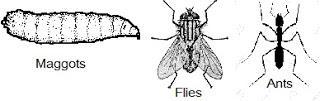
(b) Have you seen any other organism besides redworms, in your pit? If yes, try to find out their names. Draw pictures of these.
Answer
(a) The garbage which are non-biodegradable in nature like iron strips, plastics, poly bags etc. are not converted into compost by the redworms.
(b) Yes, these organisms include maggots, flies, cockroaches etc.
2. Discuss :
(a) Is garbage disposal the responsibility only of the government?
(b) Is it possible to reduce the problems relating to disposal of garbage?
Answer
(a) No, garbage disposal is not only the responsibility of the government. It is sole responsibility of both government and the people. Each and every citizen must be responsible for maintaining proper sanitation and disposable of waste materials produced. People should not litter at public places. They should also take care for the effective disposal of the waste produced at home, schools, hospitals etc.
(b) Yes, it is possible to reduce the problems relating to disposal of garbage by taking following measures:
(i) People should concern about generating less waste products and creating awareness among them.
(ii) Each and every product should be used efficiently.
(iii) Biodegradable and non-biodegradable wastes should be separated.
(iv) Waste products or garbage must be recycled and setting up centre for the treatment of them.
(v) We should minimize the use of plastic bags and use recyclable products.
3. (a) What do you do with the left over food at home?
(b) If you and your friends are given the choice of eating in a plastic plate or a banana leaf platter at a party, which one would you prefer and why?
Answer
(a) The left over food at home is given to animals on road, thrown in garbage or some times we use it to make compost.
(b) I will prefer to eat in banana leaf because it is a biodegradable product and environment friendly and can be decomposed.
4. (a) Collect pieces of different kinds of paper. Find out which of these can be recycled.
(b) With the help of a lens look at the pieces of paper you collected for the above question. Do you see any difference in the material of recycled paper and a new sheet of paper ?
Answer
(a) Papers without having plastic coating on it can be recycled.
(b) The recycled is slightly yellowish in color than the new sheet of paper. Recycled paper is also rough and of low quality than new sheet of paper.
5. (a) Collect different kinds of packaging material. What was the purpose for which each one was used? Discuss in groups.
(b) Give an example in which packaging could have been reduced?
(c) Write a story on how packaging increases the amount of garbage.
Answer
(a) Different kinds of packaging materials and its uses:
(i) Paper packaging materials: Mostly used for packing of light and durable and hard products like soaps, blades, chocolates etc.
(ii) Plastic packaging materials: Used for liquid items and medium weighted too like oils, drinking water bottles, shampoo etc.
(iii) Poly bags: Used for carrying groceries, vegetables etc.
(iv) Clothes and Jute packaging materials: Used for heavy weighted as well as medium weighted too like carrying clothes, grains, vegetables, fruits etc.
(b) If people started carrying their own carry bags for buying groceries and vegetables and fruits then there will be no need for packing those materials by using plastics and thus the packaging could have been reduced.
(c) Packaging increase the amount of garbage as the it is quite useless ones the product is delivered or been utilised. These useless packaging materials are thrown away and just add loads to the garbage. Many packaging materials can't even be reused. Some of them are made of plastics and thus a non-biodegradable item which add hazards to the environment.
6. Do you think it is better to use compost instead of chemical fertilisers? Why?
Answer
Yes, i think it is better to use compost instead of chemical fertilisers because:
(i) It is environment friendly and add natural fertility to the soil.
(ii) It doesn't have adverse effect on nature and creates no pollution.
(iii) The food items grown are also healthy and do not contains any chemicals.
(iv) It is cheaper than the chemical fertiliser.
(v) Soil will never loss its fertility if we use compost.
NCERT 6th Science Chapter 16, class 6 Science Chapter 16 solutions
NCERT Solutions for 6th Class Science: Chapter 16: Download PDF
NCERT Solutions for 6th Class Science: Chapter 16-Garbage in, Garbage out
Download PDF: NCERT Solutions for 6th Class Science: Chapter 16-Garbage in, Garbage out PDF
Chapterwise NCERT Solutions for Class 6 Science :
- Chapter 1 Food: Where Does It Come From?
- Chapter 2 Components of Food
- Chapter 3 Fibre to Fabric
- Chapter 4 Sorting Materials Into Groups
- Chapter 5 Separation of Substances
- Chapter 6 Changes Around Us
- Chapter 7 Getting to Know Plants
- Chapter 8 Body Movements
- Chapter 9 The Living Organisms and Their Surroundings
- Chapter 10 Motion and Measurement of Distances
- Chapter 11 Light, Shadows and Reflection
- Chapter 12 Electricity and Circuits
- Chapter 13 Fun with Magnets
- Chapter 14 Water
- Chapter 15 Air Around Us
- Chapter 16 Garbage In, Garbage Out
About NCERT
The National Council of Educational Research and Training is an autonomous organization of the Government of India which was established in 1961 as a literary, scientific, and charitable Society under the Societies Registration Act. Its headquarters are located at Sri Aurbindo Marg in New Delhi. Visit the Official NCERT website to learn more.