
Class 7: Maths Chapter 5 solutions. Complete Class 7 Maths Chapter 5 Notes.
NCERT Solutions for 7th Class Maths: Chapter 5-Lines and Angles
NCERT 7th Maths Chapter 5, class 7 Maths Chapter 5 solutions
Page No: 101
Exercise 5.1
1. Find the complement of each of the following angles: 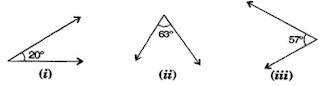
Answer
Complementary angle = 90° - given angle
(i) Complement of 20° = 90°-20° = 70°
(ii) Complement of 63° = 90° - 63° = 27°
(iii) Complement of 57° = 90°- 57° = 33°
2. Find the supplement of each of the following angles: 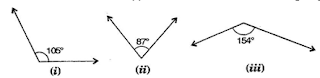
Answer
Supplementary angle = 180° - given angle
(i) Supplement of 105° = 180° -105° = 75°
(ii) Supplement of 87° = 180° - 87° = 93°
(iii) Supplement of 154° = 180° - 154° = 26°
3. Identify which of the following pairs of angles are complementary and which are supplementary: (i) 65°, 115°
(ii) 63°, 27°
(iii) 112°, 68°
(iv) 130∘, 50°
(v) 45°, 45°
(vi) 80°, 10°
Answer
If sum of two angles is 180°, then they are called supplementary angles. If sum of two angles is 90°, then they are called complementary angles.
(i) 65°+115° =180° These are supplementary angles.
(ii) 63°+27° =90° These are complementary angles.
(iii) 112° + 68° =180° These are supplementary angles.
(iv) 130°+50° =180° These are supplementary angles.
(v) 45° +45° =90° These are complementary angles.
(vi) 80°+10° =90°
These are complementary angles.
4. Find the angle which is equal to its complement:
Answer
Let one of the two equal complementary angles be x.
∴ x + x = 90°
⇒ 2x = 90°
⇒x= 90°/2 = 45°
Thus, 45° is equal to its complement.
5. Find the angle which is equal to its supplement.
Answer
Let x be two equal angles of its supplement.
Therefore, x + x = 180° [Supplementary angles]
⇒ 2x = 180 ⇒ x = 180°/2 = 90°
Thus, 90° is equal to its supplement.
6. In the given figure, ∠1 and ∠2 are supplementary angles. If ∠1 is decreased, what changes should take place in ∠2 so that both the angles still remain supplementary?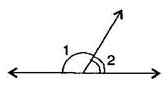
Answer
If ∠1 is decreased then, ∠2 will increase with the same measure, so that both the angles still remain supplementary.
7. Can two angles be supplementary if both of them are:
(i) acute
(ii) obtuse
(iii) right?
Answer
(i) No, because sum of two acute angles is less than 180°
(ii) No, because sum of two obtuse angles is more than 180°
(iii) Yes, because sum of two right angles is 180°
8. An angle is greater than 45°. Is its complementary angle greater than 45° or equal to 45° or less than 45°?
Answer
Let the complementary angles be x and y i.e., x + y = 90°
It is given that x >45°
Adding y both sides, x+ y > 45° + y
⇒ 90° > 45°+ y
⇒ 90° - 45° > y
⇒ y < 45°
Thus, its complementary angle is less than 45°
9. In the adjoining figure:
Is ∠1 adjacent to ∠2? Is ∠AOC adjacent to ∠AOE? Do ∠COE and ∠EOD form a linear pair? Are ∠BOD and ∠DOA supplementary? Is ∠1 vertically opposite to ∠4? What is the vertically opposite angle of ∠5?
Answer
(i) Yes, in ∠AOE, OC is common arm.
(ii) No, they have no non-common arms on opposite side of common arm.
(iii) Yes, they form linear pair.
(iv) Yes, they are supplementary.
(v) Yes, they are vertically opposite angles.
(vi) Vertically opposite angles of ∠5 is ∠COB.
10. Indicate which pairs of angles are:
Vertically opposite angles? Linear pairs?
Answer
(i) Vertically opposite angles, ∠1, ∠4; ∠5, ∠2 + ∠3.
(ii) Linear pairs ∠1, ∠5; ∠5, ∠4.
11. In the following figure, is ∠1 adjacent to ∠2? Give reasons.
Answer
∠1 and ∠2 are not adjacent angles because their vertex is not common.
12. Find the values of the angles x,y and z in each of the following: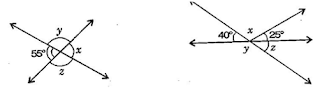
Answer
(i) x = 55° [Vertically opposite angles]
Now 55° + y = 180°[Linear pair]
⇒ y = 180° - 55° = 125°
Also, y=z=125° [Vertically opposite angles]
Thus, x=55°,y=125° and z=125°.
(ii) 40°+x+25°=180° [Angles on straight line]
⇒ 65° +x=180°
⇒ x=180°−65°= 115°
Now, 40°+y=180° [Linear pair]
⇒ y=180°−40°=140° ....(i)
Also, y+z=180° [Linear pair]
⇒ 140°+z=180° [From eq. (i)]
⇒ z=180°−140°=40°
Thus, x=115°,y=140° and z=40°
NCERT 7th Maths Chapter 5, class 7 Maths Chapter 5 solutions
13. Fill in the blanks:
1. If two angles are complementary, then the sum of their measures is _______.
2. If two angles are supplementary, then the sum of their measures is __________.
3. Two angles forming a linear pair are ___________.
4. If two adjacent angles are supplementary, they form a _________.
5. If two lines intersect a point, then the vertically opposite angles are always _____.
6. If two lines intersect at a point and if one pair of vertically opposite angles are acute angles, then the other pair of vertically opposite angles are ____________.
Answer
(i) 90°
(ii) 180°
(iii) supplementary
(iv) linear pair
(v) equal
(vi) obtuse angles
14. In the adjoining figure, name the following pairs of angles: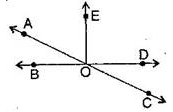
1. Obtuse vertically opposite angles.
2. Adjacent complementary angles.
3. Equal supplementary angles.
4. Unequal supplementary angles.
5. Adjacent angles that d° n°t f°rm a linear pair.
Answer
(i) Obtuse vertically opposite angles means greater than 90° and equal ∠AOD = ∠BOC.
(ii) Adjacent c°mplementary angles means angles have common vertex, common arm, non-common arms are on either side of common arm and sum of angles is 90°.
(iii) Equal supplementary angles means sum of angles is 180° and supplement angles are equal.
(iv) Unequal supplementary angles means sum of angles is 180° and supplement angles are unequal. i.e., ∠AOE, ∠EOC; ∠AOD, ∠DOC and ∠AOB, ∠BOC
(v) Adjacent angles that do not form a linear pair mean, angles have common ray but the angles in a linear pair are not supplementary. i.e., ∠AOB, ∠AOE; ∠AOE, ∠EOD and ∠EOD, ∠COD
Page No. 108
1. State the property that is used in each of the following statements:

1. If a∥b, then ∠1 = ∠5.
2. If ∠4 = ∠6, then a∥b.
3. If ∠4 + ∠5 + 180∘, then a∥b.
Answer
(i) Given, a∥ba∥b then ∠1 = ∠5 [Corresponding angles]
If two parallel lines are cut by a transversal, each pair of corresponding angles are equal in measure.
(ii) Given, ∠4 = ∠6, then a∥b [Alternate interior angles]
When a transversal cuts two lines such that pairs of alternate interior angles are equal, the lines have to be parallel.
(iii) Given, ∠4 + ∠5 = 180∘, then a∥b [Co-interior]
When a transversal cuts two lines, such that pairs of interior angles on the same side of transversal are supplementary, the lines have to be parallel.
2. In the adjoining figure, identify:

1. the pairs of corresponding angles.
2. the pairs of alternate interior angles.
3. the pairs of interior angles on the same side of the transversal.
4. the vertically opposite angles.
Answer
(i) The pairs of corresponding angles:
∠1, ∠5; ∠2, ∠6; ∠4, ∠8 and ∠3, ∠7
(ii) The pairs of alternate interior angles are:
∠3, ∠5 and ∠2, ∠8
(iii) The pair of interior angles on the same side of the transversal:
∠3, ∠8 and ∠2, ∠5
(iv) The vertically opposite angles are:
∠1, ∠3; ∠2, ∠4; ∠6, ∠8 and ∠5, ∠7
3. In the adjoining figure, p∥q. Find the unknown angles.

Answer
Given, p∥q and cut by a transversal line.
∵ 125 ̊+e=180 ̊ [Linear pair]
∴ e=180 ̊−125 ̊=55 ̊ ….(i)
Now e=f=55 ̊ [Vertically opposite angles]
Also a=f=55 ̊ [Alternate interior angles]
a+b=180 ̊ [Linear pair]
⇒ 55 ̊+b=180 ̊ [From eq. (i)]
⇒ b=180 ̊−55 ̊=125 ̊
Now a=c=55 ̊ and b=d=125 ̊ [Vertically opposite angles]
Thus, a=55 ̊,b=125 ̊,c=55 ̊,d=125 ̊,e=55 ̊ and f=55 ̊.
4. Find the values of x in each of the following figures if l∥m.

Answer
(i) Given, l∥m and t is transversal line.
∴ Interior vertically opposite angle between lines ll and t=110 ̊.
∴ 110 ̊+x=180 ̊ [Supplementary angles]
⇒ x=180 ̊−110 ̊=70 ̊
(ii) Given, l∥m and t is transversal line.
x+2x=180 ̊ [Interior opposite angles]
⇒ 3x=180 ̊
⇒ x=180 ̊/3=60 ̊
(iii) Given, l∥m and a∥b
x=100 ̊ [Corresponding angles]
NCERT 7th Maths Chapter 5, class 7 Maths Chapter 5 solutions
5. In the given figure, the arms of two angles are parallel. If ΔABC = 70 ̊, then find:

(i) DGC
(ii) DEF
Answer
(i) Given, AB ∥ DE and BC is a transversal line and ∠ABC=70 ̊
∵ ∠ABC = ∠DGC [Corresponding angles]
∴ ∠DGC = 70 ̊ ….(i)
(ii) Given, BC ∥ EF and DE is a transversal line and ∠DGC=70 ̊
∵ ∠DGC = ∠DEF [Corresponding angles]
∴ ∠DEF = 70 ̊ [From eq. (i)]
6. In the given figures below, decide whether ll is parallel to m.

Answer
(i) 126 ̊+44 ̊=170 ̊
ll is not parallel to mm because sum of interior opposite angles should be 180∘.
(ii) 75 ̊+75 ̊=150 ̊
ll is not parallel to mm because sum of angles does not obey the property of parallel lines.
(iii) 57 ̊+123 ̊=180 ̊
ll is parallel to mm due to supplementary angles property of parallel lines.
(iv) 98 ̊+72 ̊=170 ̊
ll is not parallel to mm because sum of angles does not obey the property of parallel lines.
NCERT Solutions for 7th Class Maths: Chapter 5: Download PDF
NCERT Solutions for 7th Class Maths: Chapter 5-Lines and Angles
Download PDF: NCERT Solutions for 7th Class Maths: Chapter 5-Lines and Angles PDF
Chapter-wise NCERT Solutions Class 7 Maths
About NCERT
The National Council of Educational Research and Training is an autonomous organization of the Government of India which was established in 1961 as a literary, scientific, and charitable Society under the Societies Registration Act. Its headquarters are located at Sri Aurbindo Marg in New Delhi. Visit the Official NCERT website to learn more.