
NCERT Solutions for 8th Class Maths: Chapter 3-Understanding Quadrilaterals
Page: 41
Exercise 3.1
1. Given here are some figures.
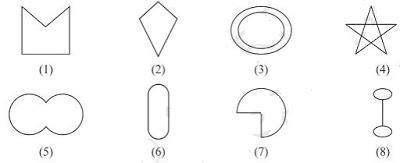
Classify each of them on the basis of the following.
Simple curve (b) Simple closed curve (c) Polygon
(d) Convex polygon (e) Concave polygon
Solution:
a) Simple curve: 1, 2, 5, 6 and 7
b) Simple closed curve: 1, 2, 5, 6 and 7
c) Polygon: 1 and 2
d) Convex polygon: 2
e) Concave polygon: 1
2. How many diagonals does each of the following have?
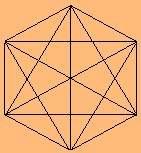
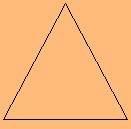
a) A convex quadrilateral (b) A regular hexagon (c) A triangle
Solution:
a) A convex quadrilateral: 2.
b) A regular hexagon: 9.
c) A triangle: 0
3. What is the sum of the measures of the angles of a convex quadrilateral? Will this property hold if the quadrilateral is not convex? (Make a non-convex quadrilateral and try!)
Solution:
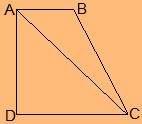
Let ABCD be a convex quadrilateral.
From the figure, we infer that the quadrilateral ABCD is formed by two triangles,
i.e. ΔADC and ΔABC.
Since, we know that sum of interior angles of triangle is 180°,
the sum of the measures of the angles is 180° + 180° = 360°
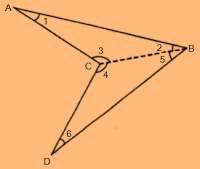
Let us take another quadrilateral ABCD which is not convex .
Join BC, Such that it divides ABCD into two triangles ΔABC and ΔBCD. In ΔABC,
∠1 + ∠2 + ∠3 = 180° (angle sum property of triangle)
In ΔBCD,
∠4 + ∠5 + ∠6 = 180° (angle sum property of triangle)
∴, ∠1 + ∠2 + ∠3 + ∠4 + ∠5 + ∠6 = 180° + 180°
⇒ ∠1 + ∠2 + ∠3 + ∠4 + ∠5 + ∠6 = 360°
⇒ ∠A + ∠B + ∠C + ∠D = 360°
Thus, this property hold if the quadrilateral is not convex.
4. Examine the table. (Each figure is divided into triangles and the sum of the angles deduced from that.)
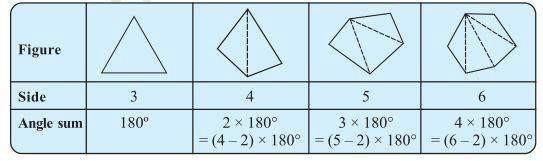
What can you say about the angle sum of a convex polygon with number of sides? (a) 7 (b) 8 (c) 10 (d) n
Solution:
The angle sum of a polygon having side n = (n-2)×180°
a) 7
Here, n = 7
Thus, angle sum = (7-2)×180° = 5×180° = 900°
b) 8
Here, n = 8
Thus, angle sum = (8-2)×180° = 6×180° = 1080°
c) 10
Here, n = 10
Thus, angle sum = (10-2)×180° = 8×180° = 1440°
d) n
Here, n = n
Thus, angle sum = (n-2)×180°
5. What is a regular polygon?
State the name of a regular polygon of
(i) 3 sides (ii) 4 sides (iii) 6 sides Solution:
Regular polygon: A polygon having sides of equal length and angles of equal measures is called regular polygon. i.e., A regular polygon is both equilateral and equiangular.
(i) A regular polygon of 3 sides is called equilateral triangle.
(ii) A regular polygon of 4 sides is called square.
(iii) A regular polygon of 6 sides is called regular hexagon.
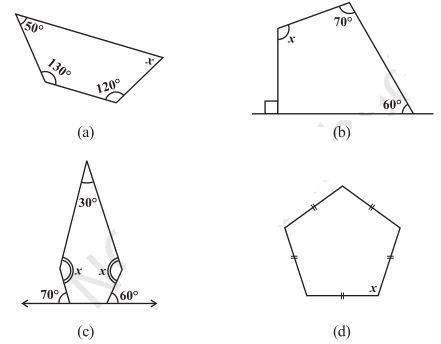
6. Find the angle measure x in the following figures.
Solution:
a) The figure is having 4 sides. Hence, it is a quadrilateral. Sum of angles of the quadrilateral = 360°
⇒ 50° + 130° + 120° + x = 360°
⇒ 300° + x = 360°
⇒ x = 360° – 300° = 60°
b) The figure is having 4 sides. Hence, it is a quadrilateral. Also, one side is perpendicular forming right angle.
Sum of angles of the quadrilateral = 360°
⇒ 90° + 70° + 60° + x = 360°
⇒ 220° + x = 360°
⇒ x = 360° – 220° = 140°
c) The figure is having 5 sides. Hence, it is a pentagon.
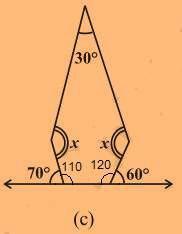
Sum of angles of the pentagon = 540° Two angles at the bottom are linear pair.
∴, 180° – 70° = 110°
180° – 60° = 120°
⇒ 30° + 110° + 120° + x + x = 540°
⇒ 260° + 2x = 540°
⇒ 2x = 540° – 260° = 280°
⇒ 2x = 280°
= 140°
d) The figure is having 5 equal sides. Hence, it is a regular pentagon. Thus, its all angles are equal.
5x = 540°
⇒ x = 540°/5
⇒ x = 108°
7.
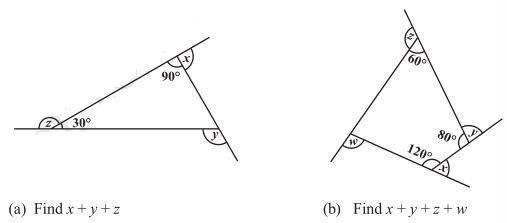
Solution:
a) Sum of all angles of triangle = 180°
One side of triangle = 180°- (90° + 30°) = 60°
x + 90° = 180° ⇒ x = 180° – 90° = 90°
y + 60° = 180° ⇒ y = 180° – 60° = 120°
z + 30° = 180° ⇒ z = 180° – 30° = 150°
x + y + z = 90° + 120° + 150° = 360°
b) Sum of all angles of quadrilateral = 360°
One side of quadrilateral = 360°- (60° + 80° + 120°) = 360° – 260° = 100°
x + 120° = 180° ⇒ x = 180° – 120° = 60°
y + 80° = 180° ⇒ y = 180° – 80° = 100°
z + 60° = 180° ⇒ z = 180° – 60° = 120°
w + 100° = 180° ⇒ w = 180° – 100° = 80°
x + y + z + w = 60° + 100° + 120° + 80° = 360°
Chapterwise NCERT Solutions for 8th Class Maths
Chapter 1 – Rational Numbers
Chapter 2 – Linear Equations in One Variable
Chapter 3 – Understanding Quadrilaterals
Chapter 4 – Practical Geometry
Chapter 5 – Data Handling
Chapter 6 – Squares and Square Roots
Chapter 7 – Cubes and Cube Roots
Chapter 8 – Comparing Quantities
Chapter 9 – Algebraic Expressions and Identities
Chapter 10 – Visualizing Solid Shapes
Chapter 11 – Mensuration
Chapter 12 – Exponents and Powers
Chapter 13 – Direct and Inverse Proportions
Chapter 14 – Factorization
Chapter 15 – Introduction to Graphs
Chapter 16 – Playing with Numbers
About
The National Council of Educational Research and Training is an autonomous organization of the Government of India which was established in 1961 as a literary, scientific, and charitable Society under the Societies Registration Act. Its headquarters are located at Sri Aurbindo Marg in New Delhi. Visit the Official NCERT website to learn more.