
Class 10: Civics Chapter 2 solutions. Complete Class 10 Civics Chapter 2 Notes.
NCERT Solutions for Class 10 Civics Chapter 2- Federalism
NCERT 10th Civics Chapter 2, class 10 Civics Chapter 2 solutions
NCERT Solutions for Class 10 Civics Chapter 2- Federalism is provided on this page. Answers to all exercises are provided in details. These solutions are provided by expert teachers at IndCareer. Students looking for NCERT Solutions for Federalism Chapter in Civics (Social Science) Democratic Politics-II subject of Class 10 can also download the chapter-wise PDFs.
Page No: 27
Exercises
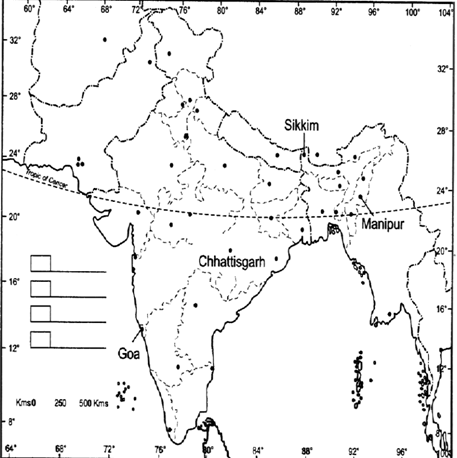
1. Locate the following States on a blank outline political map of India:
Manipur, Sikkim, Chhattisgarh and Goa
Answer
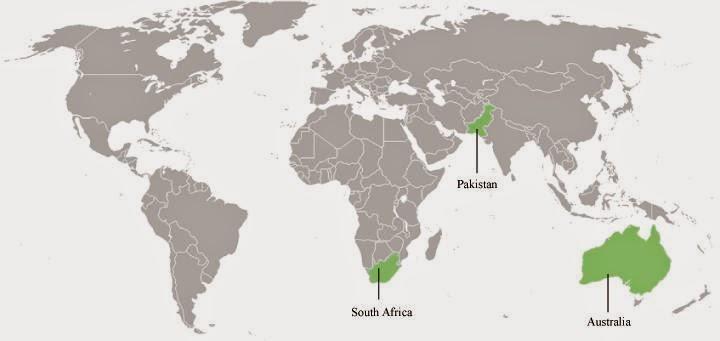
2. Identify and shade three federal countries (other than India) on a blank outline political map of the world.
Answer
3. Point out one feature in the practice of federalism in India that is similar to and one feature that is different from that of Belgium.
Answer
In India, just like in Belgium, the central government has to share its powers with the regional governments. However, unlike India, Belgium has a community government in addition to the central and the state government.
4. What is the main difference between a federal form of government and a unitary one? Explain with an example.
Answer
In a federal form of government, the central government shares its powers with the various constituent units of the country. For example, in India, power is divided between the government at the Centre and the various State governments.
In a unitary form of government, all the power is exercised by only one government. For example, in Sri Lanka, the national government has all the powers.
5. State any two differences between the local government before and after the constitutional amendment in 1992.
Answer
| Local governments Before 1992 | Local governments After 1992 |
| Elections were controlled by the state and not held regularly. | An independent State Election Commissionis responsible to conduct elections regularly. |
| Local governments did not have any powers or resources of their own. | The State governments are required to share some powers and revenue with local government bodies. |
6. Fill in the blanks:
Since the United States is a ____________________ type of federation, all the constituent States have equal powers and States are _______________ vis-à-vis the federal government. But India is a _________________ type of federation and some States have more power than others. In India, the ___________________ government has more powers.
Answer
Since the United States is a coming together
type of federation, all the constituent States have equal powers and States are strong
vis-à-vis the federal government. But India is a holding together
type of federation and some States have more power than others. In India, the Central
government has more powers.
7. Here are three reactions to the language policy followed in India. Give an argument and an example to support any of these positions.
Sangeeta: The policy of accommodation has strengthened national unity.
Arman: Language-based States have divided us by making everyone conscious of their language.
Harish: This policy has only helped to consolidate the dominance of English over all other languages.
Answer
I agree with Sangeeta's reaction. If the policy of accommodation was not followed, and states were not created on linguistic basis, there would have been further partition of India. For example, imposition of Hindi as the national language would have led the South to break away from the North and Tamil Nadu would have become an independent nation.
8. The distinguishing feature of a federal government is:
(a) National government gives some powers to the provincial governments.
(b) Power is distributed among the legislature, executive and judiciary.
(c) Elected officials exercise supreme power in the government.
(d) Governmental power is divided between different levels of government.
Answer
(d) Governmental power is divided between different levels of government.
9. A few subjects in various Lists of the Indian Constitution are given here. Group them under the Union, State and Concurrent Lists as provided in the table below.
A. Defence
B. Police
C. Agriculture
D. Education
E. Banking
F. Forests
G. Communications
H. Trade
I. Marriages
| Union List | - |
| State List | - |
| Concurrent List | - |
Answer
| Union List | Defence, Banking, Communications |
| State List | Police, Agriculture, Trade |
| Concurrent List | Education, Forests, Marriages |
Page No: 28
10. Examine the following pairs that give the level of government in India and the powers of the government at that level to make laws on the subjects mentioned against each. Which of the following pairs is not correctly matched?
| (a) | State government | State List |
| (b) | Central government | Union List |
| (c) | Central and State government | Concurrent List |
| (d) | Local governments | Residuary powers |
Answer
| (d) | Local governments | Residuary powers |
11. Match List I with List II and select the correct answer using the codes given below the lists:
| List I | List II |
| 1. Union of India | A. Prime Minister |
| 2. State | Β. Sarpanch |
| 3. Municipal | C. Governor |
| 4. Gram Panchayat | D. Mayor |
| 1 | 2 | 3 | 4 | |
| (a) | D | A | B | C |
| (b) | B | C | D | A |
| (c) | A | C | D | B |
| (d) | C | D | A | B |
Answer
12. Consider the following statements.
A. In a federation the powers of the federal and provincial governments are clearly demarcated.
B. India is a federation because the powers of the Union and State Governments are specified in the Constitution and they have exclusive jurisdiction on their respective subjects.
C. Sri Lanka is a federation because the country is divided into provinces.
D. India is no longer a federation because some powers of the states have been devolved to the local government bodies.
Which of the statements given above are correct?
(a) A, B and C
(b) A, C and D
(c) A and B only
(d) B and C only
Answer
(c) A and B only
NCERT 10th Civics Chapter 2, class 10 Civics Chapter 2 solutions
NCERT Solutions for Class 10 Civics Chapter 2: Download PDF
NCERT Solutions for Class 10 Civics Chapter 2- Federalism
Download PDF: NCERT Solutions for Class 10 Civics Chapter 2- Federalism PDF
Chapterwise NCERT Solutions for Class 10 Civics Democratic Politics-II
Chapter 1- Power Sharing
Chapter 2- Federalism
Chapter 3- Democracy and Diversity
Chapter 4- Gender, Religion and Caste
Chapter 5- Popular Struggles and Movements
Chapter 6- Political Parties
Chapter 7- Outcomes of Democracy
About NCERT
The National Council of Educational Research and Training is an autonomous organization of the Government of India which was established in 1961 as a literary, scientific, and charitable Society under the Societies Registration Act. Its headquarters are located at Sri Aurbindo Marg in New Delhi. Visit the Official NCERT website to learn more.