
Class 8: Maths Chapter 19 solutions. Complete Class 8 Maths Chapter 19 Notes.
RD Sharma Solutions for Class 8 Maths Chapter 19–Visualising Shapes
RD Sharma 8th Maths Chapter 19, Class 8 Maths Chapter 19 solutions
EXERCISE 19.1 PAGE NO: 19.9
1. What is the least number of planes that can enclose a solid? What is the name of the solid?
Solution:
The least number of planes that are required to enclose a solid is 4.
The name of solid is tetrahedron.
2. Can a polyhedron have for its faces?
(i) 3 triangles?
(ii) 4 triangles?
(iii) a square and four triangles?
Solution:
(i) 3 triangles?
No, because a polyhedron is a solid shape bounded by polygons.
(ii) 4 triangles?
Yes, because a tetrahedron as 4 triangles as its faces.
(iii) a square and four triangles?
Yes, because a square pyramid has a square and four triangles as its faces.
3. Is it possible to have a polyhedron with any given number of faces?
Solution:
Yes, if number of faces is four or more.
4. Is a square prism same as a cube?
Solution:
Yes. We know that a square is a three dimensional shape with six rectangular shaped sides, out of which two are squares. Cubes are of rectangular prism length, width and height of same measurement.
5. Can a polyhedron have 10 faces, 20 edges and 15 vertices?
Solution:
No.
Let us use Euler’s formula
V + F = E + 2
15 + 10 = 20 + 2
25 ≠ 22
Since the given polyhedron is not following Euler’s formula, therefore it is not possible to have 10 faces, 20 edges and 15 vertices.
6. Verify Euler’s formula for each of the following polyhedrons:
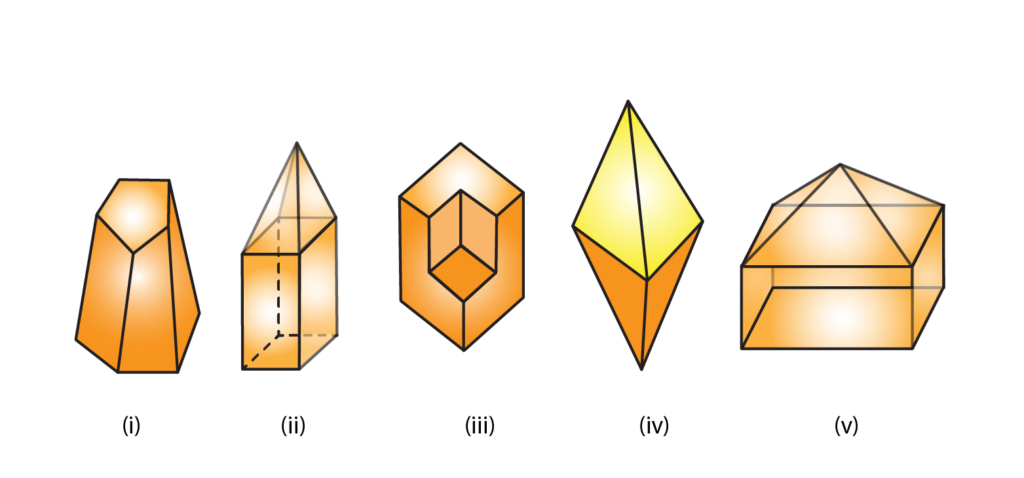
Solution:
(i) Vertices = 10
Faces = 7
Edges = 15
By using Euler’s formula
V + F = E + 2
10 + 7 = 15 + 2
17 = 17
Hence verified.
(ii) Vertices = 9
Faces = 9
Edges = 16
By using Euler’s formula
V + F = E + 2
9 + 9 = 16 + 2
18 = 18
Hence verified.
(iii) Vertices = 14
Faces = 8
Edges = 20
By using Euler’s formula
V + F = E + 2
14 + 8 = 20 + 2
22 = 22
Hence verified.
(iv) Vertices = 6
Faces = 8
Edges = 12
By using Euler’s formula
V + F = E + 2
6 + 8 = 12 + 2
14 = 14
Hence verified.
(v) Vertices = 9
Faces = 9
Edges = 16
By using Euler’s formula
V + F = E + 2
9 + 9 = 16 + 2
18 = 18
Hence verified.
7. Using Euler’s formula find the unknown:
| Faces | ? | 5 | 20 |
| Vertices | 6 | ? | 12 |
| Edges | 12 | 9 | ? |
Solution:
(i)
By using Euler’s formula
V + F = E + 2
6 + F = 12 + 2
F = 14 – 6
F = 8
∴ Number of faces is 8
(ii)
By using Euler’s formula
V + F = E + 2
V + 5 = 9 + 2
V = 11 – 5
V = 6
∴ Number of vertices is 6
(iii)
By using Euler’s formula
V + F = E + 2
12 + 20 = E + 2
E = 32 – 2
E = 30
∴ Number of edges is 30
EXERCISE 19.2 PAGE NO: 19.12
1. Which among of the following are nets for a cube?
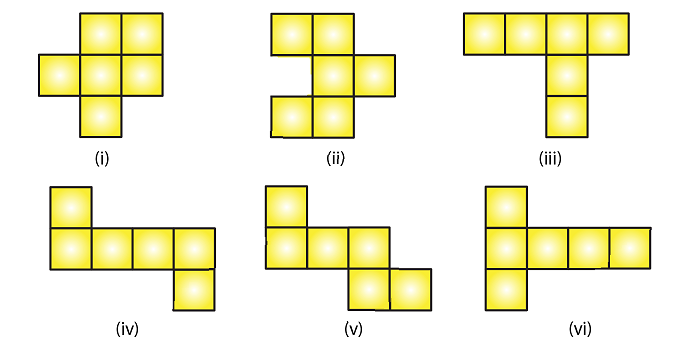
Solution:
Figure (iv), (v), (vi) are the nets for a cube.
2. Name the polyhedron that can be made by folding each net:
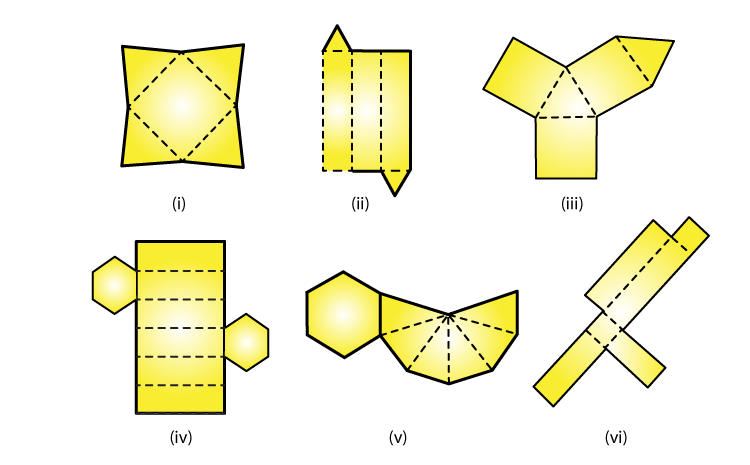
Solution:
(i) From figure (i), a Square pyramid can be made by folding each net.
(ii) From figure (ii), a Triangular prism can be made by folding each net.
(iii) From figure (iii), a Triangular prism can be made by folding each net.
(iv) From figure (iv), a Hexagonal prism can be made by folding each net.
(v) From figure (v), a Hexagonal pyramid can be made by folding each net.
(vi) From figure (vi), a Cuboid can be made by folding each net.
3. Dice are cubes where the numbers on the opposite faces must total 7. Which of the following are dice?
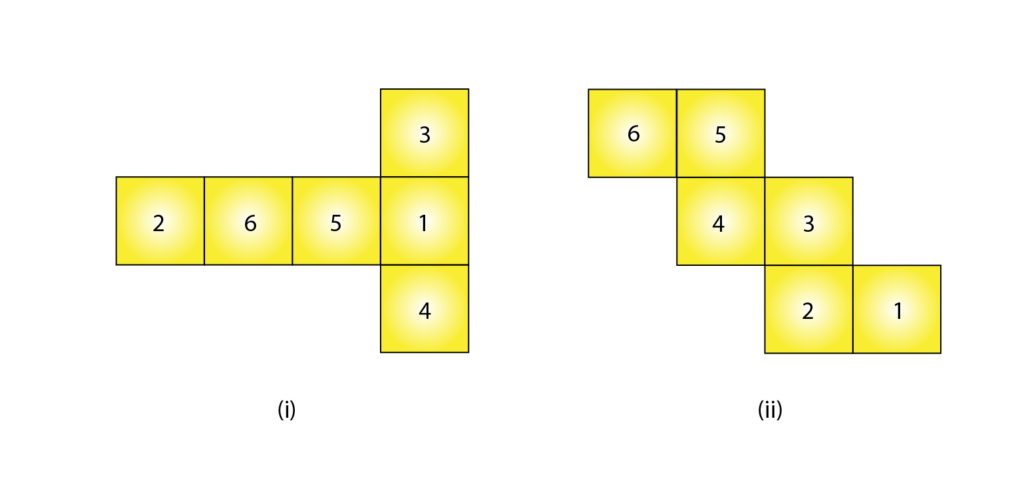
Solution:
Figure (i), is a dice. Since the sum of numbers on opposite faces is 7 (3 + 4 = 7 and 6 + 1 = 7).
4. Draw nets for each of the following polyhedrons:
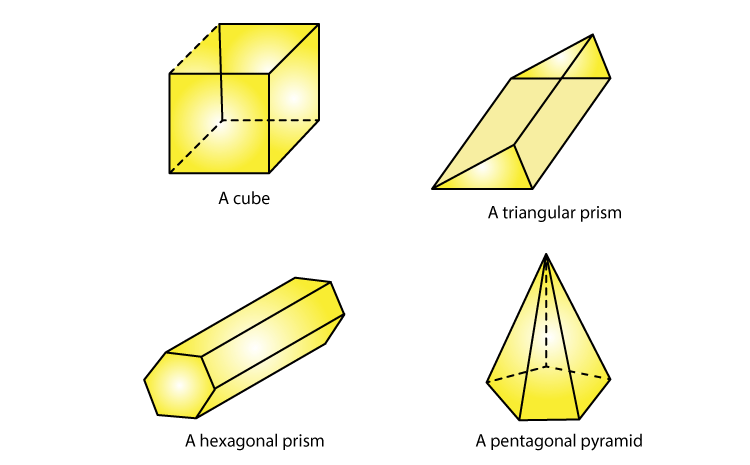
Solution:
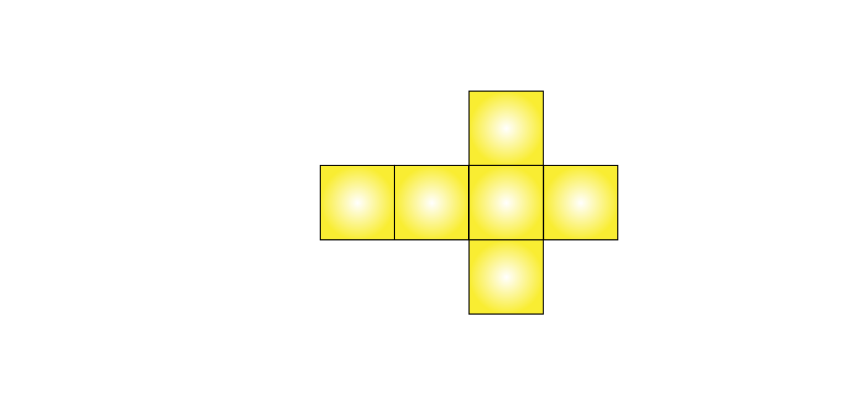
(i) The net pattern for cube is
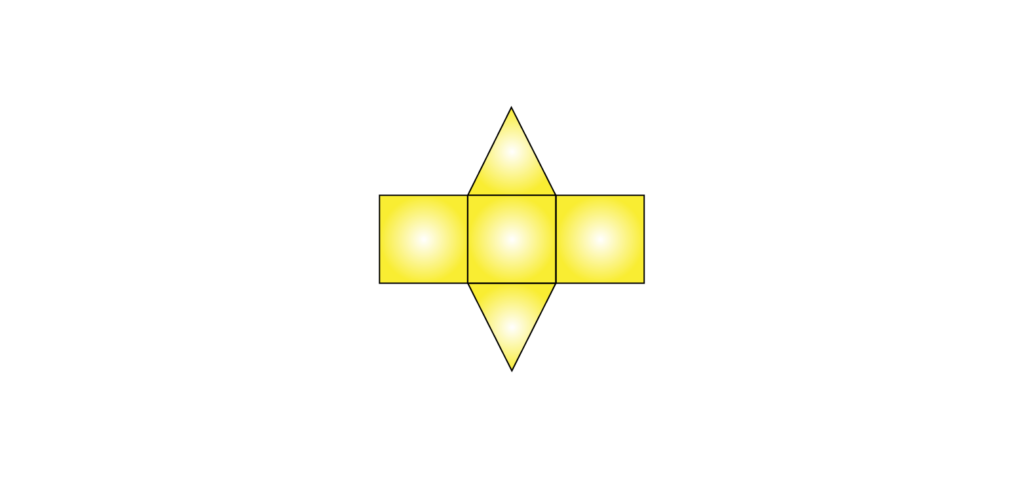
(ii) The pattern for triangular prism is
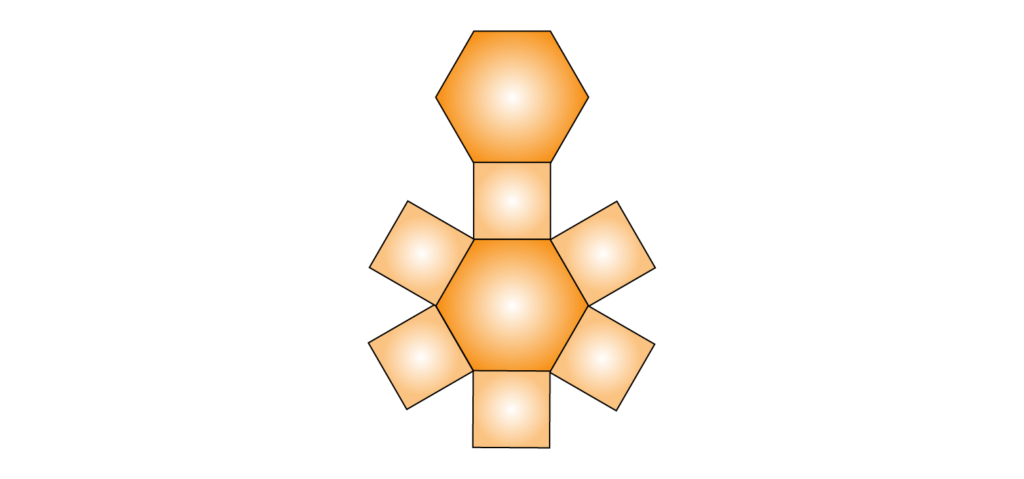
(iii) The net pattern for hexagonal prism is
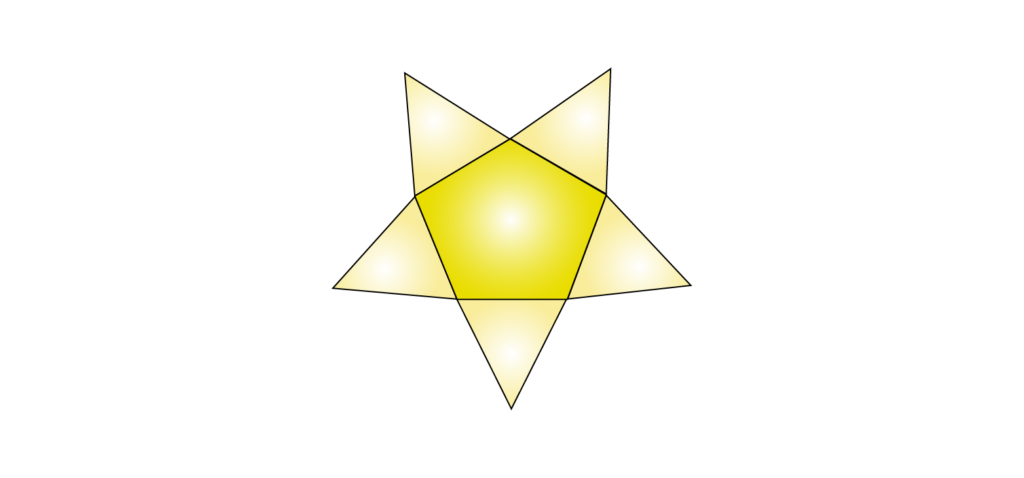
(iv) The net pattern for pentagonal pyramid is
5. Match the following figures:
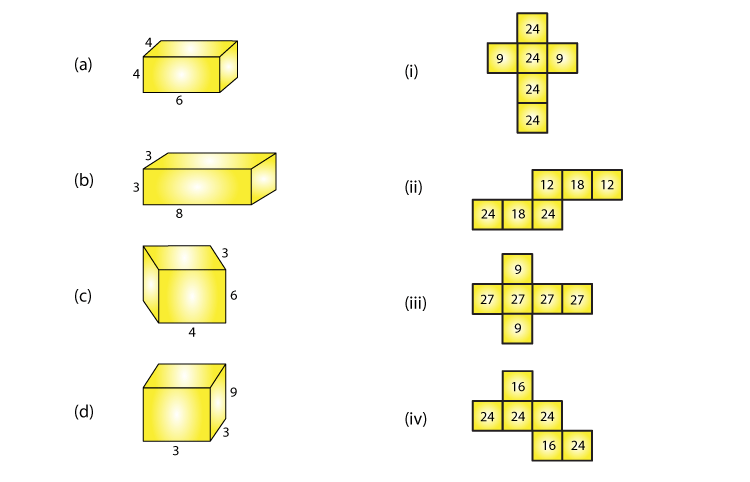
Solution:
(a)-(iv) Because multiplication of numbers on adjacent faces are equal, where 6×4 = 24 and 4×4 = 16
(b)-(i) Because multiplication of numbers on adjacent faces are equal, where 3×3 = 9 and 8×3 = 24
(c)-(ii) Because multiplication of numbers on adjacent faces are equal, where 6×4 = 24 and 6×3 = 18
(d)-(iii) Because multiplication of numbers on adjacent faces are equal, where 3×3 = 9 and 3×9 = 27
RD Sharma Solutions for Class 8 Maths Chapter 19: Download PDF
RD Sharma Solutions for Class 8 Maths Chapter 19–Visualising Shapes
Download PDF: RD Sharma Solutions for Class 8 Maths Chapter 19–Visualising Shapes PDF
Chapterwise RD Sharma Solutions for Class 8 Maths :
- Chapter 1–Rational Numbers
- Chapter 2–Powers
- Chapter 3–Squares and Square Roots
- Chapter 4–Cubes and Cube Roots
- Chapter 5–Playing with Numbers
- Chapter 6–Algebraic Expressions and Identities
- Chapter 7–Factorization
- Chapter 8–Division of Algebraic Expressions
- Chapter 9–Linear Equation in One Variable
- Chapter 10–Direct and Inverse Variations
- Chapter 11–Time and Work
- Chapter 12–Percentage
- Chapter 13–Profit, Loss, Discount and Value Added Tax (VAT)
- Chapter 14–Compound Interest
- Chapter 15–Understanding Shapes- I (Polygons)
- Chapter 16–Understanding Shapes- II (Quadrilaterals)
- Chapter 17–Understanding Shapes- III (Special Types of Quadrilaterals)
- Chapter 18–Practical Geometry (Constructions)
- Chapter 19–Visualising Shapes
- Chapter 20–Mensuration – I (Area of a Trapezium and a Polygon)
- Chapter 21–Mensuration – II (Volumes and Surface Areas of a Cuboid and a cube)
- Chapter 22–Mensuration – III (Surface Area and Volume of a Right Circular Cylinder)
- Chapter 23–Data Handling – I (Classification and Tabulation of Data)
- Chapter 24–Data Handling – II (Graphical Representation of Data as Histogram)
- Chapter 25–Data Handling – III (Pictorial Representation of Data as Pie Charts or Circle Graphs)
- Chapter 26–Data Handling – IV (Probability)
- Chapter 27–Introduction to Graphs
About RD Sharma
RD Sharma isn't the kind of author you'd bump into at lit fests. But his bestselling books have helped many CBSE students lose their dread of maths. Sunday Times profiles the tutor turned internet star
He dreams of algorithms that would give most people nightmares. And, spends every waking hour thinking of ways to explain concepts like 'series solution of linear differential equations'. Meet Dr Ravi Dutt Sharma — mathematics teacher and author of 25 reference books — whose name evokes as much awe as the subject he teaches. And though students have used his thick tomes for the last 31 years to ace the dreaded maths exam, it's only recently that a spoof video turned the tutor into a YouTube star.
R D Sharma had a good laugh but said he shared little with his on-screen persona except for the love for maths. "I like to spend all my time thinking and writing about maths problems. I find it relaxing," he says. When he is not writing books explaining mathematical concepts for classes 6 to 12 and engineering students, Sharma is busy dispensing his duty as vice-principal and head of department of science and humanities at Delhi government's Guru Nanak Dev Institute of Technology.