
Class 6: Maths Chapter 4 solutions. Complete Class 6 Maths Chapter 4 Notes.
RS Aggarwal Solutions for Class 6 Maths Chapter 4–Integers
RS Aggarwal 6th Maths Chapter 4, Class 6 Maths Chapter 4 solutions
Ex 4A Solutions
Question 1.
Solution:
(i) A decrease of 8
(ii) A gain of Rs. 7
(iii) Loosing a weight of 5 kg
(iv) 10 km below sea level
(v) 5°C above the freezing point
(vi) A withdrawal of Rs. 100
(vii) Spending Rs. 500
(viii) Going 6 m to the west
(ix) – 24
(x) 34
Question 2.
Solution:
(i) + Rs. 600
(ii) – Rs. 800
(iii) – 7°C
(iv) – 9
(v) + 2 km
(vi) – 3 km
(vii) + Rs. 200
(viii) – Rs. 300
Question 3.
Solution:
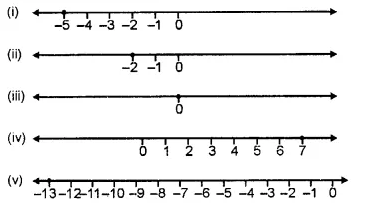
Question 4.
Solution:
(i) 0
(ii) – 3
(iii) 2
(iv) 8
(v) – 365
(vi) 8
Question 5.
Solution:
(i) – 7
(ii) – 1
(iii) – 27
(iv) – 26
(v) – 603
(vi) – 777
Question 6.
Solution:
(i) The integers between 0 and 6 are
1, 2, 3, 4, 5.
(ii) The integers between – 5 and 0 are
– 4, – 3, – 2, – 1.
(iii) The integers between – 3 and 3 are
– 2, – 1, 0, 1, 2.
(iv) The integer between – 7 and – 5 is – 6.
Question 7.
Solution:
(i) 0 < 7
(ii) 0 > – 3
(iii) – 5 < – 2
(iv) – 15 < 13
(v) – 231 < – 132
(vi) – 6 < 6
Question 8.
Solution:
(i) – 7, – 2, 0, 5, 8
(ii) – 100, – 23, – 6, – 1, 0, 12
(iii) – 501, – 363, – 17, 15, 165
(iv) – 106, – 81, – 16, – 2, 0, 16, 21.
Question 9.
Solution:
(i) 36, 7, 0, – 3, – 9, – 132
(ii) 51, 0, – 2, – 8, – 53
(iii) 36, 0, – 5, – 71, – 81
(iv) 413, 102, – 7, – 365, – 515.
Question 10.
Solution:
(i) We want to write an integer 4 more than 6. So, we start from 6 and proceed 4 steps to the right to obtain 10, as shown below:

∴ 4 more than 6 is 10.
(ii) We want to write an integer 5 more than – 6. So, we start from – 6 and proceed 5 steps to the right to obtain – 1, as shown below :

∴ 5 more than – 6 is – 1.
(iii) We want to write an integer 6 less than 2. So we start from 2 and come back to the left by 6 steps to obtain – 4, as shown below:

∴ 6 less than 2 is – 4.
(iv) We want to write an integer 2 less than – 3. So we start from – 3 and come back to the left by 2 steps to obtain – 5, as shown below :

∴ 2 less than – 3 is – 5.
Question 11.
Solution:
(i) False, as zero is greater than every negative integer.
(ii) False, as zero is an integer.
(iii) True, as zero is neither positive nor negative.
(iv) False, as – 10 is to the left of – 6 on a number line.
(v) False, as absolute value of an integer is always equal to the integer.
(vi) True, as 0 is to right of every negative integer, on a number line.
(vii) False, as every natural number is positive. False, the successor is – 186
(viii) False, the predecessor is – 216
Question 12.
Solution:
(i) | – 9 | = 9
(ii) | 36 | = 36
(iii) | 0 | = 0
(iv) | 15 | = 15
(v) – | – 3 | = – 3
(vi) 7 + | – 3 | = 7 + 3 = 10
(vii) |7 – 4| = | 3 | = 3
(viii) 8 – | – 7| = 8 – 7 = 1
Question 13.
Solution:
The required integers are – 6, – 5, – 4, – 3, – 2.
The required integers are – 21, – 22, – 23, – 24, – 25.
The required integers are – 21, – 22, – 23, – 24, – 25.
Ex 4B Solutions
Question 1.
Solution:
(i) On the number line we start from 0 and move 9 steps to the right to reach a point A. Now, starting from A, we move 6 steps to the left to reach a point B, as shown below :
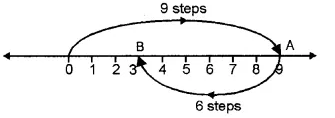
Now, B represents the integer 3
9 + ( – 6) = 3
(ii) On the number line, we start from 0 and move 3 steps to the left to reach a point A. Now, starting from A, we move 7 steps to the right to reach a point B, as shown below :
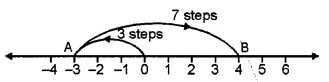
And B represents the integer 4
( – 3) + 7 = 4
(iii) On the number line, we start from 0 and move 8 steps to the right to reach a point A. Now, starting from A, we move 8 steps to the left to reach a point B, as shown below :
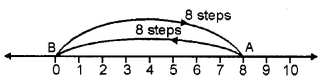
And, B represents the integer 0.
8 + ( – 8) = 0
(iv) On the number line, we start from 0 and move 1 step the left to reach a point A. Now, starting from point A, we move 3 steps to the left to reach g. point B, as shown below :
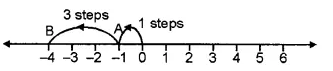
And, B represents the integer – 4
( – 1) + ( – 3) = – 4.
(v) On the number line, we start from 0 and move 4 steps to the left to reach a point A. Now, starting from point A, we move 7 steps to the left to reach a point B, as shown below :
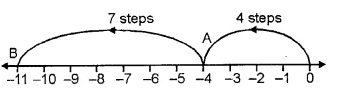
And, B represents the integer -11.
( – 4) + ( – 7) = – 11
(vi) On the number line we start from 0 and move 2 steps to the left to reach a point A. Now, starting from A, we move 8 steps to the left to reach a point B, as shown below :
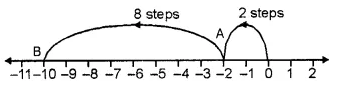
And, B represents the integer – 10
( – 2) + ( – 8) = – 10
(vii) On the number line we start from 0 and move 3 steps to the right to reach a point A. Now, starting from A, we move 2 steps to the left to reach a point B and again starting from left to reach a point B and again starting from B, we move 4 steps to the left to reach a point C, as shown below :
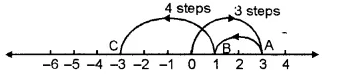
And, C represents the integer – 3
3 + ( – 2) + ( – 4) = – 3
(viii) On the number line we start from 0 and move 1 step to the left to reach a point A. Now, starting from A, we move 2 steps to the left to reach a point B and again starting from B, we move 3 steps to the left to reach point C, as shown below :
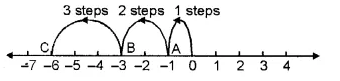
And, C represents the integer – 6
( – 1) + ( – 2) + ( – 3) = – 6.
(ix) On the number line we start from 0 and move 5 steps to the right to reach a point A. Now, starting from A, we move 2 steps to the left to reach a point B and again starting from point B, we move 6 steps to the left to reach a point C, as shown below :
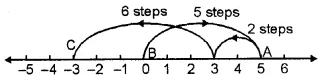
And, C represents the integer – 3.
5 + (- 2) + (- 6) = – 3
Question 2.
Solution:
(i) (- 3) + ( – 9) = – 12
(Using the rule for addition of integers having like signs)
(ii) ( – 7) + ( – 8) = – 15
(Using the rule for addition of integers having like signs)
(iii) ( – 9) + 16 = 7
(Using the rule for addition of integers having unlike signs)
(iv) ( – 13) + 25 = 12
(Using the rule for addition of integers having unlike signs)
(v) 8 + ( – 17) = – 9
(Using the rule for addition of integers having unlike signs)
(vi) 2 + ( – 12) = – 10
(Using the rule for addition of integers having unlike signs)
Question 3.
Solution:
(i) Using the rule for addition of integers with like signs, we get:
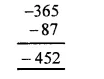
(ii) Using the rule for addition of integers with like signs, we get :

(iii) Using the rule for addition of integers with like signs, we get :

(iv) Using the rule for addition of integers with like signs, we get:

Question 4.
Solution:
(i) Using the rule for addition of integers with unlike signs, we get:

(ii) Using the rule for addition of integers with unlike signs, we get:

(iii) Using the rule for addition of integers with unlike signs, we have

(iv) Using the rule for addition of integers with unlike signs, we have

Question 5.
Solution:
(i) Using the rule for addition of integers with unlike signs, we get :
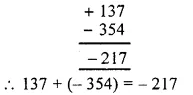
(ii) Using-the rule for addition of integers with unlike signs, we get
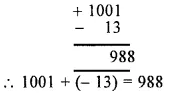
(iii) Using the rule for addition of integers with unlike signs, we get :
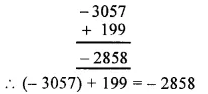
(iv) Using the rule for addition of integers with unlike signs, we get :
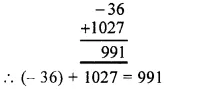
(v) Using the rule for addition of integers with like signs, we get:
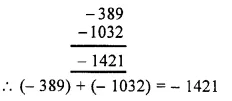
(vi) Using the rule for addition of integers with unlike signs, we get :
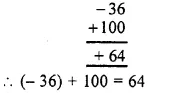
(vii) Using the rule for addition of integers with unlike signs, we get :
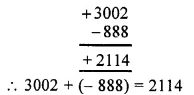
(viii) We have, ( – 18) + 25 + ( – 37)
= [( – 18) + 25] + ( – 37)
= 7 + ( – 37)
= – 30
(ix) We have, – 312 + 39 + 192
= ( – 312) + (39 + 192)
= ( – 312) + 231
= – 81
(x) We have ( – 51) + ( – 203) + 36 + ( – 28)
= [( – 51) + ( – 203)] + [36 + ( – 28)]
= ( – 254) + 8
= – 246
Question 6.
Solution:
(i) The additive inverse of – 57 is 57
(ii) The additive inverse of 183 is – 183
(iii) The additive inverse of 0 is 0
(iv) The additive inverse of – 1001 is 1001
(v) The additive inverse of 2054 is – 2054
Question 7.
Solution:
(i) Successor of 201 = 201 + 1 = 202
(ii) Successor of 70 = 70 + 1 = 71
(iii) Successor of – 5 = – 5 + 1 = – 4
(iv) Successor of – 99 = – 99 + 1 = – 98
(v) Successor of – 500 = – 500 + 1 = – 499 Ans.
Question 8.
Solution:
(i) Predecessor of 120 = 120 – 1 = 119
(ii) Predecessor of 79 = 79 – 1 = 78
(iii) Predecessor of – 8 = – 8 – 1 = – 9
(iv) Predecessor of – 141 = – 141 – 1 = – 142
(v) Predecessor of – 300 = – 300 – 1 = – 301 Ans.
Question 9.
Solution:
(i) ( – 7) + ( – 9) + 12 + ( – 16)
= – 7 – 9 + 12 – 16
= – 7 – 9 – 16 + 12
= – 32 + 12
= – 20
(ii) 37 + ( – 23) + ( – 65) + 9 + ( – 12)
= 37 – 23 – 65 + 9 – 12
= 37 + 9 – 23 – 65 – 12
= 46 – 100
= – 54
(iii) ( – 145) + 79 + ( – 265) + ( – 41) + 2
= – 145 + 79 – 265 – 41 + 2
= 79 + 2 – 145 – 265 – 41
= 81 – 451
= – 370
(iv) 1056 + ( – 798) + ( – 38) + 44 + ( – 1)
= 1056 – 798 – 38 + 44 – 1
= 1056 + 44 – 798 – 38 – 1
= 1100 – 837
= 263 Ans.
Question 10.
Solution:
Distance travelled from Patna to its north = 60 km
Distance travelled from that place to south of it = 90 km
Distance of the final place to Patna = 60 – 90
= – 30 km
= 30 km south
Ans.
Question 11.
Solution:
Total amount of pencils purchased = Rs. 30 + Rs. 25
= Rs 55
Total amount of pens purchased = Rs. 90
Total cost price = Rs. 55 + Rs. 90
= Rs. 145
Total sale price of pencils and pens = Rs 20 + Rs. 70
= Rs. 90
Loss = cost price – selling price
= Rs. 145 – Rs. 90
= Rs. 55 Ans.
Question 12.
Solution:
(i) True.
(ii) False : As if positive integer is greater then it will be positive.
(iii) True : As ( – a + a = 0).
(iv) False : As the sum of three integers can be zero or non-zero.
(v) False : As | – 5 | = 5 and | – 3 | = 3 and 5 ≮ 3.
(vi) False : | 8 – 5 | = | 3 | = 3 and | 8 | + | – 5 | = 8 + 5 = 13.
Question 13.
Solution:
(i) a + 6 = 0
Subtracting 6 from both sides,
a + 6 – 6 = 0 – 6
=> a = – 6
a = – 6.
(ii) 5 + a = 0
Subtracting 5 from both sides,
5 + a – 5 = 0 – 5
=> a = – 5
a = – 5
(iii) a + ( – 4) = 0
Adding 4 to both sides,
a + ( – 4) + 4 = 0 + 4
=> a = 4
a = 4
(iv) – 8 + a = 0
Adding 8 to both sides,
– 8 + a + 8 = 0 + 8
=> a – 8
a = 8 Ans.
Ex 4C Solutions
Question 1.
Solution:
(i) We have : – 34 – 18 = – 52
(ii) We have : 25 – ( – 15) = 25 + 15 = 40
(iii) We have : – 43 – ( – 28) = – 43 + 28 = – 15
(iv) We have : ( – 37) – 68 = ( – 37) + ( – 68) = – 105
(v) We have : 0 – 219 = 0 + ( – 219) = – 219
(vi) We have : 0 – ( – 92) = 0 + 92 = 92
(vii) We have : – 250 – ( – 135) = ( – 250) + 135 = – 115
(viii) We have : – 287 – ( – 2768) = ( – 287) + 2768 = 2481
(ix) We have: – 271 – 6240 = ( – 271) + ( – 6240) = – 6511
(x) We have : 6250 – ( – 3012) = 6250 + 3012 = 9262
Question 2.
Solution:
The sum of – 1050 and 813.
= ( – 1050) + 813 = – 237
Required number = – 23 – ( – 237)
= ( – 23) + 237 = 214h
Question 3.
Solution:
The sum of – 250 and 138
= ( – 250) + 138 = – 112
The sum of 136 and – 272
= 136 + ( – 272) = – 136
Required number = – 136 – ( – 112)
= ( – 136) + 112 = – 24
Question 4.
Solution:
The sum of 33 and – 47
= 33 + ( – 47)
= – 14
Required number = – 14 – ( – 84)
= ( – 14) + 84
= 70
Question 5.
Solution:
The difference of – 8 and – 68
= – 8 – ( – 68)
= ( – 8) + 68 = 60
Required sum = 60 + ( – 36)
= 24
Question 6.
Solution:
(i) We have :
[37 – ( – 8)] + [11 – ( – 30)]
= (37 + 8) + (11 + 30)
= 45 + 41
= 86
(ii) [ – 13 – ( – 17)] + [ – 22 – ( – 40)]
= ( – 13 + 17)+ ( – 22 + 40)
= 4 + 18
= 22
Question 7.
Solution:
We have :
34 – ( – 72) = 34 + 72 = 106 and ( – 72) – 34 = ( – 72) + ( – 34)
= – 106
Clearly, 34 – ( – 72) and ( – 72) – 34 are not equal.
Question 8.
Solution:
The sum of two integers = – 13
One number =170
The other number = – 13 – 170
= ( – 13) + ( – 170)
= – 183
Question 9.
Solution:
The sum of two integers = 65
One number = – 47
The other number = 65 – ( – 47)
= 65 + 47
= 112
Question 10.
Solution:
(i) True
(ii) True
(iii) The given statement is
– 14 > – 8 – ( – 7)
– 14 > – 8 + 7 .
– 14 > – 1 which is not true.
(iv) The given statement is – 5 – 2 > – 8
( – 5) + ( – 2) > – 8
– 7 > – 8 which is true
The given statement is true.
(v) The given statement is ( – 7) – 3 = ( – 3) – ( – 7)
( – 7) + ( – 3) = ( – 3) + 7
– 10 = 4
which is not true.
The given statement is false.
Question 11.
Solution:
The vertical distance between A and B = Distance of point A above sea level + distance of point B below sea level.
= 5700 m + 39600 m
= 45300 m.
The required distance between A and B
= 45300 metres.
Question 12.
Solution:
Temperature at 6 p.m. = 1°C
Temperature at mid-night = – 4°C
Required temperature fall = 1°C – ( – 4° C)
= 1°C + 4°C
= 5°C.
Ex 4D Solutions
Question 1.
Solution:
(i) 15 by 9 = 15 x 9 = 135
(ii) 18 by – 7 = 18 x ( – 7) = – 126
(iii) 29 by – 11 = 29 x ( – 11) = – 319
(iv) – 18 by 13 = ( – 18) x 13 = – 234
(v) – 56 by 16 = ( – 56) x 16 = – 896
(vi) 32 by – 21 = 32 x ( – 21) = – 672
(vii) – 57 x 0 = ( – 57) x 0 = 0
(viii) 0 by – 31 = 0 x ( – 31) = 0
(ix) – 12 by – 9 = ( – 12) x ( – 9) = 108
(x) – 746 by – 8 = ( – 746) x ( – 8) = 5968
(xi) 118 by – 7 = 118 x ( – 7) = – 826
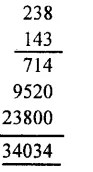
(xii) – 238 by – 143 = ( – 238) x ( – 143) = 238 x 143 = 34034
Question 2.
Solution:
(i) ( – 2) x 3 x ( – 4) = [( – 2) x 3] x ( – 4) = ( – 6) x ( – 4) = 24
(ii) 2 x ( – 5) x ( – 6) = 2 x [( – 5) x ( – 6)] = 2 x 30 = 60
(iii) ( – 8) x 3 x 5 = ( – 8) x (3 x 5) = ( – 8) x 15 = – 120
(iv) 8 x 7 x ( – 10) = (8 x 7) x ( – 10) = 56 x ( – 10) = – 560
(v) ( – 3) x ( – 7) x ( – 6) = [( – 3) x ( – 7)] x ( – 6) = 21 x ( – 6) = – 126
(vi) ( – 8) x ( – 3) x ( – 9) = ( – 8) x [( – 3) x ( – 9)] = ( – 8) x 27 = – 216
Question 3.
Solution:
(i) 18 x ( – 27) x 30 = 18 x [( – 27) x 30] = 18 x ( – 810) = – 14580
(ii) ( – 8) x ( – 63) x 9 = [( – 8) x ( – 63)] x 9 = 504 x 9 = 4536
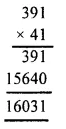
(iii) ( – 17) x ( – 23) x 41 = [( – 17) x ( – 23)] x 41 = 391 x 41 = 16031
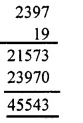
(iv) ( – 51) x ( – 47) x ( – 19) = [( – 51) x ( – 47)] x ( – 19) = 2397 x ( – 19) = – 45543
Question 4.
Solution:
(i) We have :
18 x [9 + ( – 7)] = 18 x 2 = 36
18 x 9 + 18 x ( – 7)
= (18 x 9) + [18 x ( – 7)]
= 162 – 126
= 36
18 x [9 x ( – 7)] = 18 x 9 + 18 x ( – 7) is verified.
(ii) We have :
( – 13) x [( – 6) x ( – 19)]
= ( – 13) x ( – 25) = 325
( – 13) x ( – 6) + ( – 13) x – 9
= [( – 13) x ( – 6)] + [( – 13) x ( – 19)]
= 78 + 247 = 325
( – 13) x [( – 6) + ( – 19)]
= ( – 13) x ( – 6) + ( – 13) x ( – 19) is verified.
Question 5.
Solution:
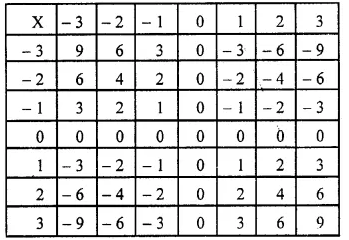
The complete multiplication table is given below
Question 6.
Solution:
(i) True
(ii) False
(iii) True
(iv) True
Question 7.
Solution:
(i) ( – 9) x 6 + ( – 9) x 4
= ( – 9) x (6 + 4)
(By distributive law)
= ( – 9) x 10
= – 90
(ii) 8 x ( – 12) + 7 x ( – 12)
= ( 8 + 7) x ( – 12)
(By distributive law)
= 15 x ( – 12)
= – 180
(iii) 30 x ( – 22) + 30 x (14)
= 30 x [( – 22) + 14]
(By distributive law)
= 30 x ( – 8)
= – 240
(iv) ( – 15) x ( – 14) + ( – 15) x ( – 6)
= ( – 15) x [( – 14) + ( – 6)]
(By distributive law)
= ( – 15) x ( – 20)
= 300
(v) 43 x ( – 33) + 43 x ( – 17)
= 43 x [( – 33) + ( – 17)]
(By distributive law)
= 43 x ( – 50) = – 2150
(vi) ( – 36) x 72 + ( – 36) x 28
= ( – 36) x (72 + 28)
(By distributive law)
= ( – 36) x 100
= – 3600
(vii)( – 27) x ( – 16) + ( – 27) x ( – 14)
= ( – 27) x [( – 16) + ( – 14)]
(By distributive law)
= ( – 27) x ( – 30)
= 810
Ex 4E Solutions
Question 1.
Solution:
(i) 85 ÷ ( – 17) = 85−17 = – 5
(ii) ( – 72) ÷ 18 = −7218 = – 4
(iii) ( – 80) ÷ 16 = −8016 = – 5
(iv) ( – 121) ÷ 11 = −12111 = – 11
(v) 108 ÷ ( – 12) = 108−12 = – 9
(vi) ( – 161) ÷ 23 = −16123 = – 7
(vii) ( – 76) ÷ ( – 19) = −76−19 = 4
(viii) ( – 147) + ( – 21) = −147−21 = 7
(ix) ( – 639) ÷ ( – 71) = −639−71 = 9
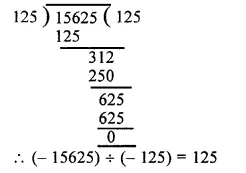
(x) ( – 15625) ÷ ( – 125) = −15625−125
(xi) 2067 ÷ ( – 1) = 2067−1 = – 2067
(xii) 1765 ÷ ( – 1765) = 1765−1765 = – 1
(xiii) 0 ÷ ( – 278) = 0−278 = 0
(xiv) 3000 ÷ ( – 100) = 3000−100 = – 30
Question 2.
Solution:
(i) 80 ÷ (…..) = – 5
Let 80 ÷ a = – 5
then, a = 80 ÷ ( – 5) = – 16
80 ÷ ( – 16) = – 5
(ii) – 84 + (…..) = – 7
Let – 84 ÷ a = – 7
then a = −84−7 = 12s
– 84 ÷ 12 = – 7
(iii)(….) ÷ ( – 5) = 25
Let a + ( – 5) = 25
a = 25 x ( – 5) = – 125
( – 125) ÷ ( – 5) = 25
(iv)(……) ÷ 372 = 0
Let a ÷ 372 = 0
Then a = 6 x 372 = 0
(0) ÷ 372 = 0
(v)(….) ÷ 1 = – 186
Let a ÷ 1 = – 186
Then a = – 186 x 1 = – 186
( – 186) ÷ 1 = – 186
(vi)(…..) ÷ 17 = – 2
Let a ÷ 17 = – 2
Then a = – 2 x 17 = – 34
( – 34) ÷ 17 = – 2
(vii) (….) ÷ 165 = – 1
Let a ÷ 165 = – 1
Then a = – 1 x 165 = – 165
( – 165) ÷ 165 = – 1
(viii) (….) + ( – 1) = 73
Let a ÷ ( – 1) = 73
Then a = 73 ( – 1) = – 73
( – 73) + ( – 1) = 73
(ix) 1 ÷ (…..) = – 1
Let 1 ÷ (a) = – 1
Then a = – 1 x 1 = – 1
1 ÷ ( – 1) = – 1 Ans.
Question 3.
Solution:
(i) True : as if zero is divided by any non-zero integer, then quotient is always zero.
(ii) False : As division by zero is not admissible.
(iii) True : As dividing by one integer by another having opposite signs is negative.
(iv) False : As dividing one integer by another having the same signs is positive not negative.
(v) True : As dividing one integer by another with same sign is always positive.
(vi) True : As dividing one integer by another having opposite signs is always negative.
(vii) True : As dividing one integer by another having opposite signs is always negative.
(viii) True : As dividing one integer by another having opposite signs is always negative.
(ix) False : As dividing one integer by another having same signs is always positive not negative
Ex 4F Solutions
OBJECTIVE QUESTIONS
Tick the correct answer in each of the following :
Question 1.
Solution:
(b) Because – 4 < – 3.
Question 2.
Solution:
Because – 3 – 2 = – 5.
Question 3.
Solution:
(c) Because 4 + ( – 5) = – 1.
Question 4.
Solution:
(a) Because – 7 – 2 = – 9.
Question 5.
Solution:
(b) Because 7 + | – 3| = 7 + 3 = 10.
Question 6.
Solution:
(c) Because – 42 + ( – 35) = – 42 – 35 = – 77.
Question 7.
Solution:
(b) Because ( – 37) + 6 = – 31.
Question 8.
Solution:
(c) Because 49 + ( – 27) = 49 – 27 = 22.
Question 9.
Solution:
(c) Because successor of – 18 = – 18 + 1 = – 17.
Question 10.
Solution:
(b) Because predecessor of – 16 is = – 16 – 1 = – 17.
Question 11.
Solution:
(a) Because additive inverse of – 5 is = – ( – 5) = 5.
Question 12.
Solution:
(b) Because – 12 – ( – 5) = – 12 + 5 = – 7
Question 13.
Solution:
(b) Because 5 – ( – 8) = 5 + 8 = 13.
Question 14.
Solution:
(c) Because other – 25 – 30 = – 55.
Question 15.
Solution:
(a) Because other 20 – ( – 5) = 20 + 5 = 25.
Question 16.
Solution:
(b) Because other – 13 – 8 = – 21.
Question 17.
Solution:
(b) Because 0 – ( – 8) = 0 + 8 = 8
Question 18.
Solution:
(c) Because 8 + ( – 8) = 8 – 8 = 0.
Question 19.
Solution:
(c)Because- 6 + 4 – ( – 3) = – 6 + 4 + 3 = 7 – 6 = 1.
Question 20.
Solution:
(c) Because 6 – ( – 4) = 6 + 4 = 10.
Question 21.
Solution:
(a) Because ( – 7) + ( – 9) + 12 + ( – 16) = – 7 – 9 + 12 – 16 = – 32 + 12 = – 20.
Question 22.
Solution:
(c) Because – 4 – (8) = – 4 – 8 = – 12.
Question 23.
Solution:
(c) Because – 6 – ( – 9) = – 6 + 9 = 3.
Question 24.
Solution:
(c) Because 10 – ( – 5) = 10 + 5 = 15.
Question 25.
Solution:
(b) Because ( – 6) x 9 = 54.
Question 26.
Solution:
(a) Because ( – 9) x 6 + ( – 9) x 4
= – 54 – 36 = – 90.
Question 27.
Solution:
(b) Because 36 + ( – 9) = 36−9 = – 4.
RS Aggarwal Solutions for Class 6 Maths Chapter 1: Download PDF
RS Aggarwal Solutions for Class 6 Maths Chapter 1–Number System
Download PDF: RS Aggarwal Solutions for Class 6 Maths Chapter 1–Number System PDF
Chapterwise RS Aggarwal Solutions for Class 6 Maths :
- Chapter 1–Number System
- Chapter 2–Factors and Multiples
- Chapter 3–Whole Numbers
- Chapter 4–Integers
- Chapter 5–Fractions
- Chapter 6–Simplification
- Chapter 7–Decimals
- Chapter 8–Algebraic Expressions
- Chapter 9–Linear Equations in One Variable
- Chapter 10–Ratio, Proportion and Unitary Method
- Chapter 11–Line Segment, Ray and Line
- Chapter 12–Parallel Lines
- Chapter 13–Angles and Their Measurement
- Chapter 14–Constructions (Using Ruler and a Pairs of Compasses)
- Chapter 15–Polygons
- Chapter 16–Triangles
- Chapter 17–Quadrilaterals
- Chapter 18–Circles
- Chapter 19–Three-Dimensional Shapes
- Chapter 20–Two-Dimensional Reflection Symmetry (Linear Symmetry)
- Chapter 21–Concept of Perimeter and Area
- Chapter 22–Data Handling
- Chapter 23–Pictograph
- Chapter 24–Bar Graph
About RS Aggarwal Class 6 Book
Investing in an R.S. Aggarwal book will never be of waste since you can use the book to prepare for various competitive exams as well. RS Aggarwal is one of the most prominent books with an endless number of problems. R.S. Aggarwal's book very neatly explains every derivation, formula, and question in a very consolidated manner. It has tonnes of examples, practice questions, and solutions even for the NCERT questions.
He was born on January 2, 1946 in a village of Delhi. He graduated from Kirori Mal College, University of Delhi. After completing his M.Sc. in Mathematics in 1969, he joined N.A.S. College, Meerut, as a lecturer. In 1976, he was awarded a fellowship for 3 years and joined the University of Delhi for his Ph.D. Thereafter, he was promoted as a reader in N.A.S. College, Meerut. In 1999, he joined M.M.H. College, Ghaziabad, as a reader and took voluntary retirement in 2003. He has authored more than 75 titles ranging from Nursery to M. Sc. He has also written books for competitive examinations right from the clerical grade to the I.A.S. level.
FAQs
Why must I refer to the RS Aggarwal textbook?
RS Aggarwal is one of the most important reference books for high school grades and is recommended to every high school student. The book covers every single topic in detail. It goes in-depth and covers every single aspect of all the mathematics topics and covers both theory and problem-solving. The book is true of great help for every high school student. Solving a majority of the questions from the book can help a lot in understanding topics in detail and in a manner that is very simple to understand. Hence, as a high school student, you must definitely dwell your hands on RS Aggarwal!
Why should you refer to RS Aggarwal textbook solutions on Indcareer?
RS Aggarwal is a book that contains a few of the hardest questions of high school mathematics. Solving them and teaching students how to solve questions of such high difficulty is not the job of any neophyte. For solving such difficult questions and more importantly, teaching the problem-solving methodology to students, an expert teacher is mandatory!
Does IndCareer cover RS Aggarwal Textbook solutions for Class 6-12?
RS Aggarwal is available for grades 6 to 12 and hence our expert teachers have formulated detailed solutions for all the questions of each edition of the textbook. On our website, you'll be able to find solutions to the RS Aggarwal textbook right from Class 6 to Class 12. You can head to the website and download these solutions for free. All the solutions are available in PDF format and are free to download!