
Class 6: Biology Chapter 8 solutions. Complete Class 6 Biology Chapter 8 Notes.
Selina Class 6 ICSE Solutions Biology (Unit 3) - Adaptation: Chapter 8- Habitat and Adaptation
Selina 6th Biology Chapter 8, Class 6 Biology Chapter 8 solutions
Multiple Choice questions:
1. Put a tick mark (✓ ) against the correct alternative in the following statements:
(a) In cactus plant found in desert regions, the photosynthesis occur in:
(i) leaves
(ii) spines
(iii) modified roots
(iv) modified stem
(b) The animals such as birds have:
(i) light pneumatic bones
(ii) solid heavy bones
(iii) heavy pointed bones
(iv) no bones
(c) The biotic components of environment includes:
(i) greeen plants
(ii) animals
(iii) decomposer
(iv) all of these
(d) The presence of hollow plant stems is the characterstics of:
(i) desert plants
(ii) aquatic plants
(iii) mountaineous trees
(iv) none of these
(e) Slow breathing is the characterstics of:
(i) desert animals
(ii) aquatic animals
(iii) aerial animals
(iv) mesophytic animals
(f) Diversity of organisms are found in the different habitats because of different for
(i) average temperature
(ii) soil type
(iii) annual precipitation
(iv) all the these
Short Answer Questions:
Question 1.
List any four abiotic factors which affect different living beings.
Answer:
The various non-living things, such as soil, rocks, air, water, temperature, etc. are its abiotic components.
Question 2.How is a whale similar to a fish in adaption to life in water ? Explain any two features.
Answer:
Whale are marine mammals. Its huge body is also spindle — shaped (streamlined). It front legs are modified into paddles or flippers for kicking water, hind limbs are absent. Whales have to periodically come up to the surface of water to breathe-inthe atmospheric air into their lungs.
Question 3.
Describe any two adaptations seen in desert plants.
Answer:
The adaptations seen in desert plants are :
- Well-developed root systems.
- Leaves either very small or converted to spines.
- Stem is green and fleshy in some plants.
Question 4.
Describe the aerial adaptations in birds.
Answer:
The bird’s body is perfectly adapted for aerial life. Various aerial adaptations found in birds are:
- Body shape: The body of birds is streamlined. Necks stretched forward with the head pointed in front and a narrowed tail at the end provide them a sleek shape. The body surface is smooth to minimize resistance against air.
- Wings: The forelimbs are modified into wings.The fingers are very much reduced. The whole length of the forelimb carries long flight feathers. .
- Steering and brakes: The feathers on the tail help to slow down the speed and also help in steering (changing direction).
- Wing muscles: These are the much strong, active and enlarged breast muscles.
- Cutting down the body weight: Except for the most necessary bulky heavy wing muscles, the rest of the bird’s body tends to be light to facilitate flight.
- Bones have air cavities.
- Much less water is required in the body. The birds excrete solid urine (formed of uric acid instead of urea which otherwise requires much water to be excreted out).
- Right ovaiy and oviduct are greatly reduced.
Question 5.
Briefly explain the term “Habitat”.
Answer:
The place where animals survive, flourish and reproduce is known as habitat. A suitable habitat should be safe and food should be available in plenty. The climate of the habitat should be favourable for the animals living there.
Question 6.
Give two adaptations in animals found in mountain habitat by which they protect themselves from the cold climate.
Answer:
Animals living in the mountain regions are also adapted. Such adaptations are basically to protect them from cold and snow. For example, yak has thick skin covered with fur to protect it from cold. Mountain goat has thick fur on its body including feet and toes. These animals have strong hooves for running up rocky slopes of the mountains.
- The oxygen content in the mountain air is thin. So the blood of most of these animals contains more red blood cells. This helps them to breathe in sufficient oxygen even when air pressure is low.
- Some animals hibernate or go for a long winter sleep when the temperatures are very low. In this way they conserve their energy and survive the winter without food. Frogs, and hedgehogs are some animals which hibernate.
Question 7.
Define the following: habitat, adaptation.
Answer:
Habitat — The place where a biotic community lives is called a habitat. It includes plants, animals along with their physical environment.
Question 8.
List the environmental factors that influence a habitat.
Answer:
Environment in which that organism generally lives. The special feature of habitat is that this environment includes all the physical characteristics around (air, water, temperature, etc.), along with the effective plants and animals. Forexample, a pond is the habitat of a fish where it lives with other organisms and also interacts with water, air, temperature, etc. The natural home of an organism (niche) and its immediate surroundings is called its habitat. The habitat of any living creature should be a place where it can find shelter, food, water and suitable conditions for breeding.
Question 9.
Differentiate between an aquatic habitat and a terrestrial habitat.
Answer:
Habitats of plants and animals that live in water are called aquatic habitat.The plants and animals that live on land are said to live in terrestrial habitats
Question 10.
Name any three types of terestrial habitat.
Answer:
The plants and animals that live on land are said to live in terrestrial habitats: For example, forests, grasslands, deserts, coastal and mountain region.
The three types of terrestrial habitat are:
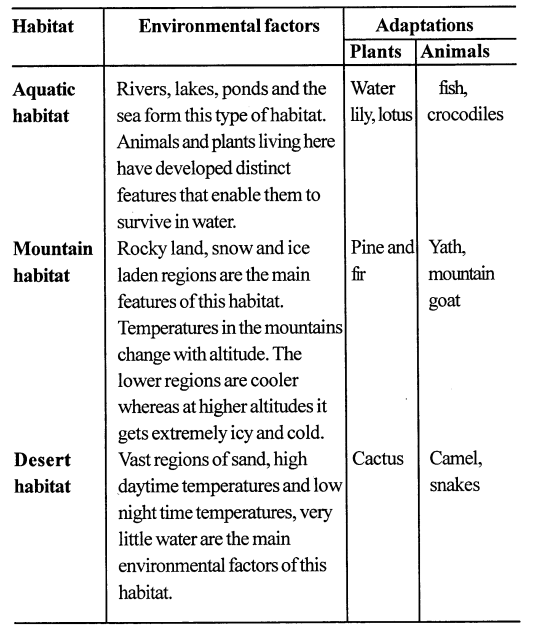
- Desert habitat — Vast regions of sand, high daytime temperatures and low night time temperatures, very little water are the main environmental factors of this habitat.
- Mountain habitat — Rocky land, snow and ice laden regions are the main features of this habitat. Temperatures in the mountains change with altitude. The lower regions are cooler whereas at higher altitudes it gets extremely icy and cold.
- Polar habitat—is extremely cold and covered with snow throughout the year. Polar bears, reindeer, penguins and very scanty plant growth survive in the cold regions.
Question 11.
Name two types of terrestrial habitats with low temperature.
Answer:
Desert habitat — Vast regions of sand, high daytime temperatures and low night time temperatures, very little water are the main environmental factors of this habitat.
Mountain habitat — Rocky land, snow and ice laden regions are the main features of this habitat. Temperatures in the mountains change with altitude. The lower regions are cooler whereas at higher altitudes it gets extremely icy and cold.
Question 12.
Complete the table given below. Write down two points in each given column.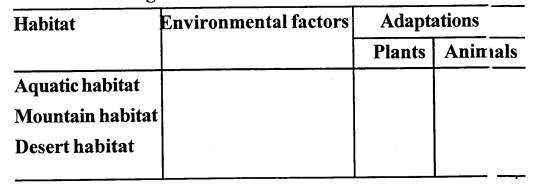
Answer:
Download PDF
Selina Class 6 ICSE Solutions Biology (Unit 3) - Adaptation: Chapter 8- Habitat and Adaptation
Chapterwise Selina Publishers ICSE Solutions for Class 6 Biology :
Unit 1
Unit 2
- Chapter 3- The Structure and Functions
- Chapter 4- Digestive System
- Chapter 5- Respiratory System
- Chapter 6- The Circulatory System
Unit 3
About Selina Publishers ICSE
Selina Publishers has been serving the students since 1976 and is one of the quality ICSE school textbooks publication houses. Mathematics and Science books for classes 6-10 form the core of our business, apart from certain English and Hindi literature as well as a few primary books. All these books are based upon the syllabus published by the Council for the I.C.S.E. Examinations, New Delhi. The textbooks are composed by a panel of subject experts and vetted by teachers practising in ICSE schools all over the country. Continuous efforts are made in complying with the standards and ensuring lucidity and clarity in content, which makes them stand tall in the industry.