
Class 11: Maths Chapter 2 solutions. Complete Class 11 Maths Chapter 2 Notes.
Maharashtra Board Solutions Class 11-Arts & Science Maths (Part 1): Chapter 2- Trigonometry – I
Maharashtra Board 11th Maths Chapter 2, Class 11 Maths Chapter 2 solutions
Ex 2.1
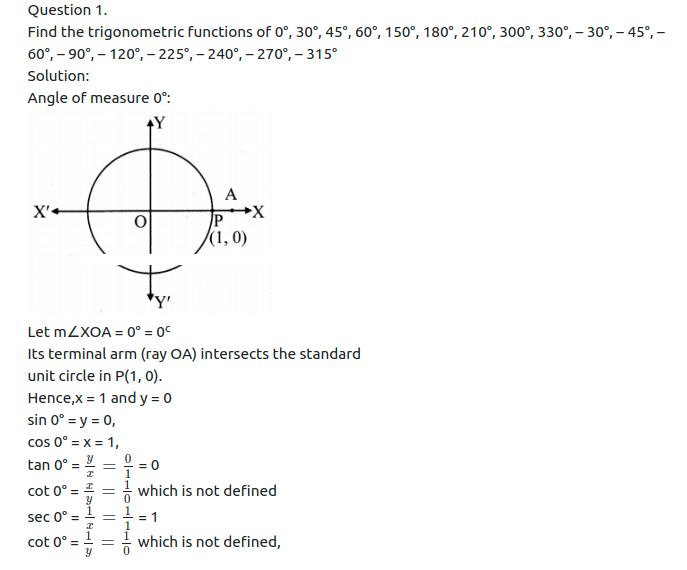
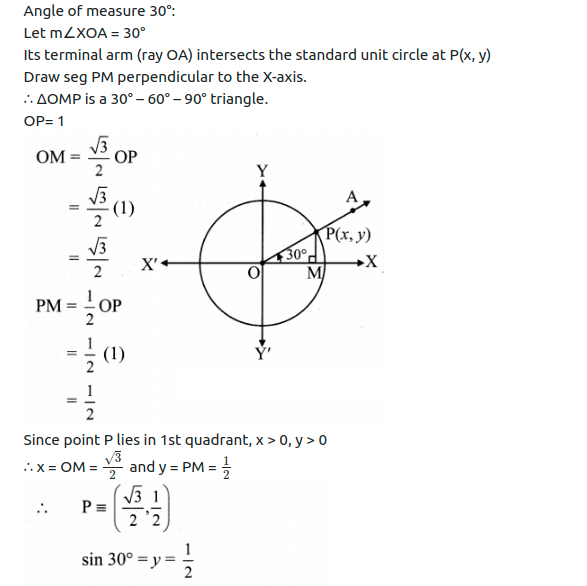
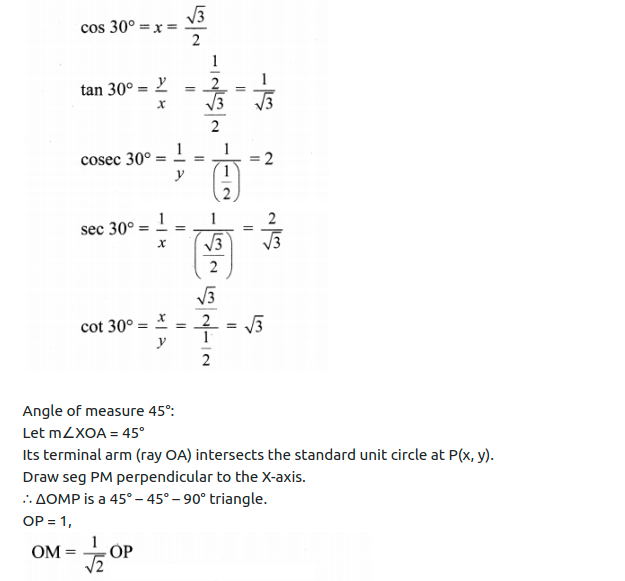
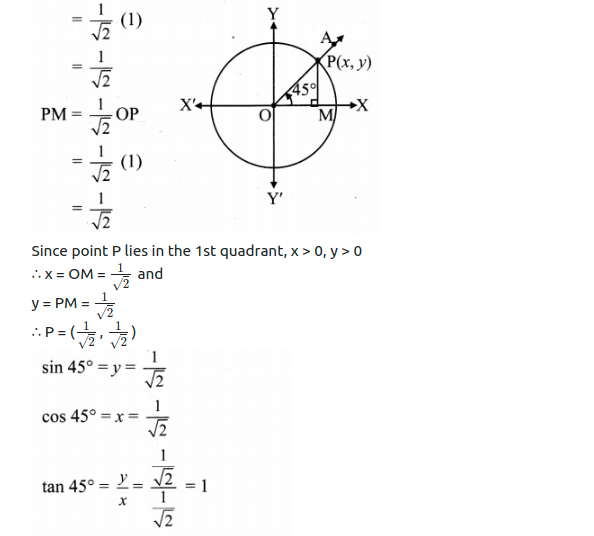
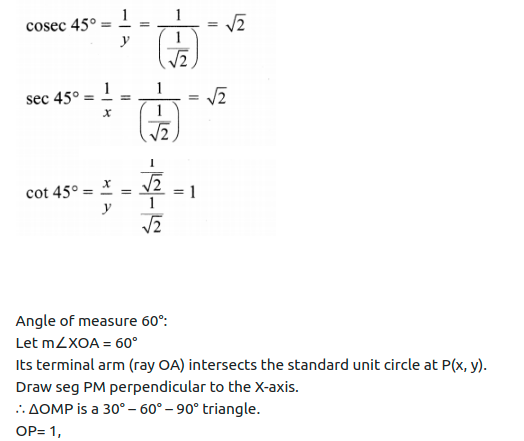
OP= 1,
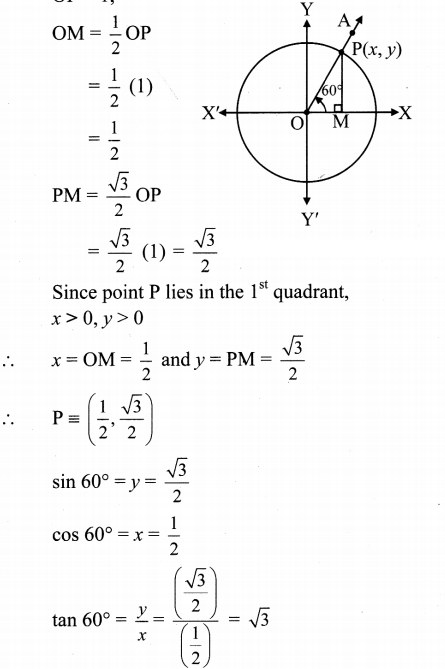
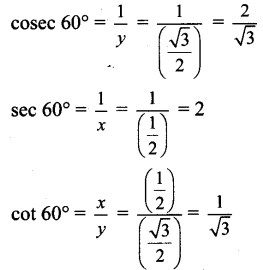
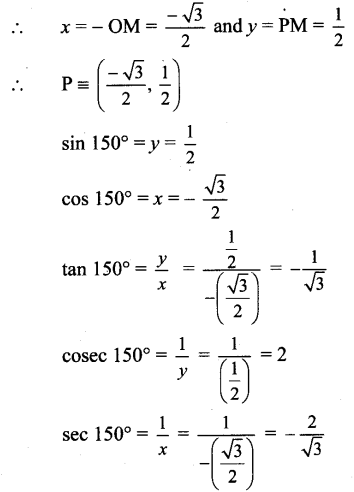
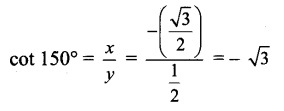
Angle of measure 150°:
Let m∠XOA = 150°
Its terminal arm (ray OA) intersects the standard unit circle at P(x, y).
Draw seg PM perpendicular to the X-axis.
∴ ΔOMP is a 30° – 60° – 90° triangle.
OP= 1,
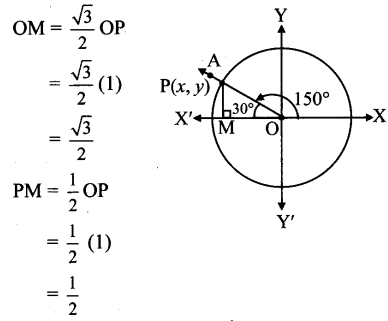
Since point P lies in the 2nd quadrant, x < 0, y > 0
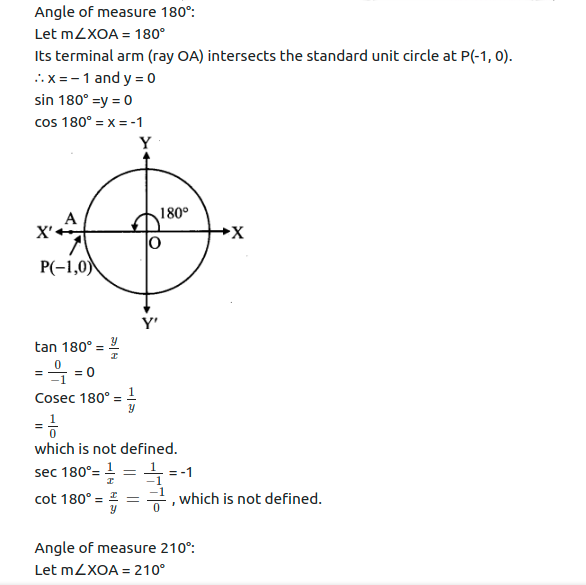
Its terminal arm (ray OA) intersects the standard unit circle at P(x, y).
Draw seg PM perpendicular to the X-axis.
∴ ΔOMP is a 30° – 60° – 90° triangle.
OP= 1,
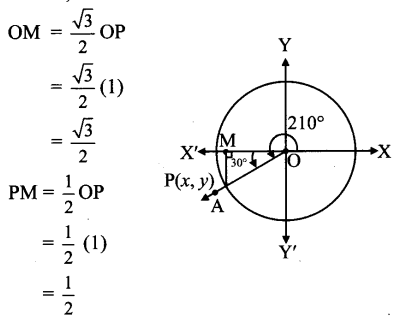
Since point P lies in the 3rd quadrant, x < 0,y < 0
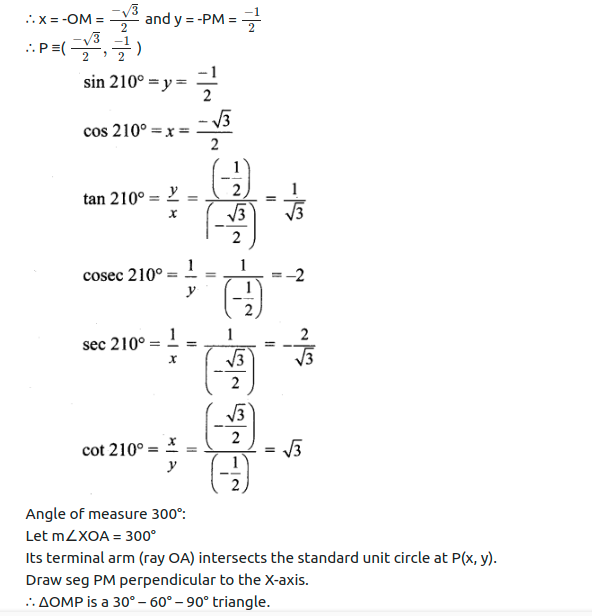
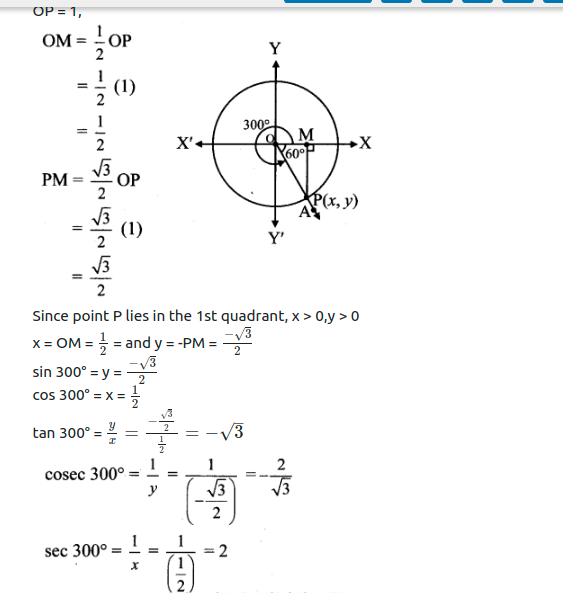
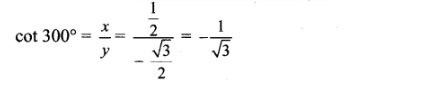
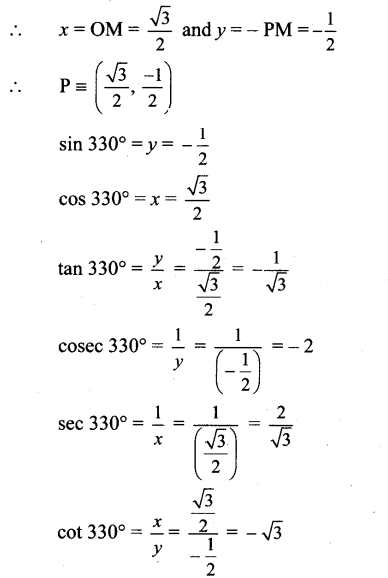
Angle of measure 330°:
Let m∠XOA = 330°
Its terminal arm (ray OA) intersects the standard unit circle at P(x, y).
Draw seg PM perpendicular to the X-axis.
∴ ΔOMP is a 30° – 60° – 90° triangle.
OP= 1,
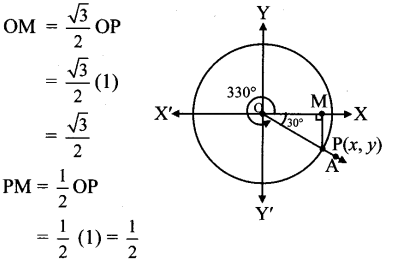
Since point P lies in the 4th quadrant, x > 0, y < 0
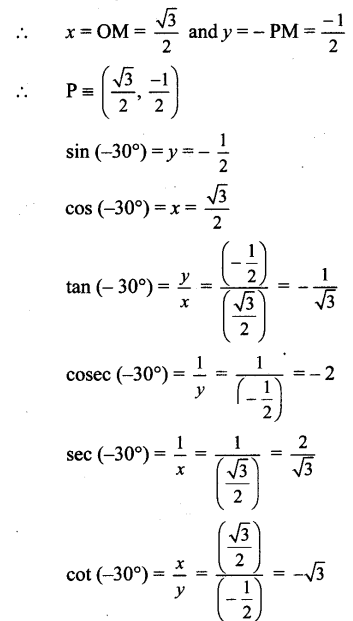
Angle of measure 30°
Let m∠XOA = -30°
Its terminal arm (ray OA) intersects the standard unit circle at P(x,y).
Draw seg PM perpendicular to the X-axis.
∴ ΔOMP is a 30° – 60 — 90° triangle.
op = 1,
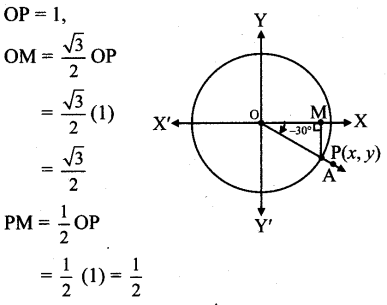
Since point P lies in the 4th quadrant x > 0, y < 0
Angle of measure 45°:
Let m∠XOA = 45°
Its terminal arm (ray OA) intersects the standard unit circle at P(x, y).
Draw seg PM perpendicular to the X-axis.
∴ ΔOMP is a 45° – 45° – 90° triangle.
OP = 1,
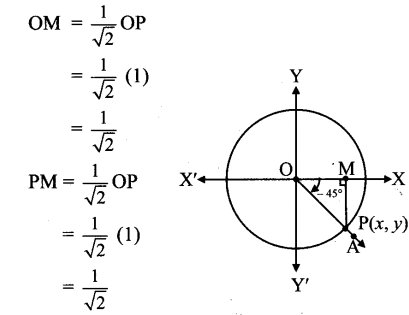
Since point P lies in the 4th quadrant x > 0, y < 0
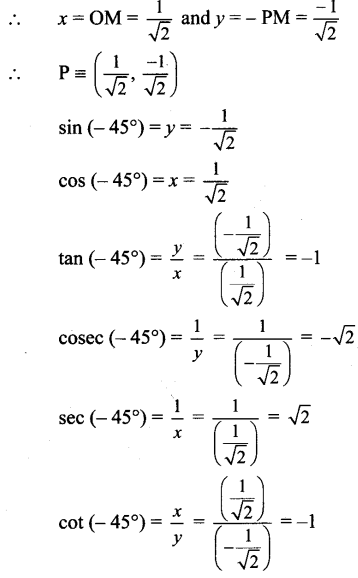
[Note : Answer given in the textbook of sin (45°) = – 1/2. However, as per our calculation it is −12√ ]
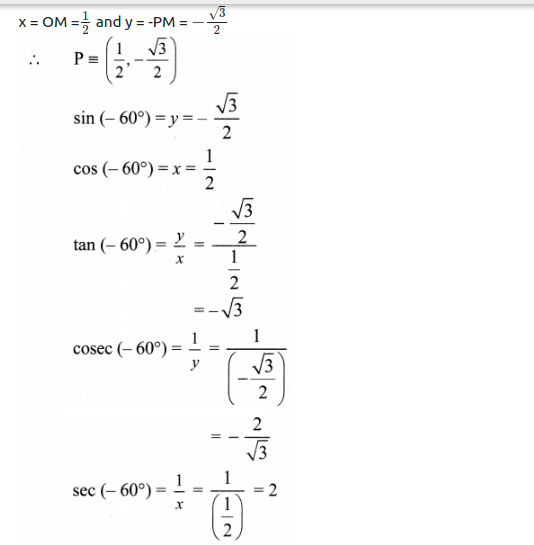
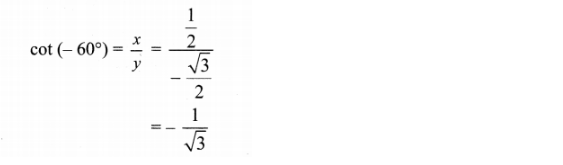
Angle of measure (-60°):
Let m∠XOA = -60°
Its terminal arm (ray OA) intersects the standard
unit circle at P(x, y).
Draw seg PM perpendicular to the X-axis.
ΔOMP is a 30° – 60° – 90° triangle.
OP = 1,
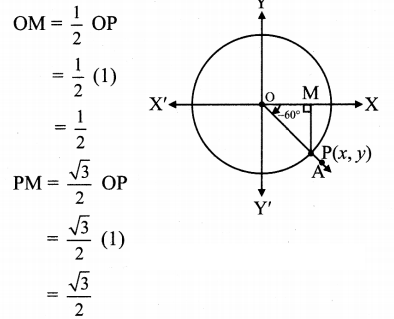
Since point P lies in the 4’ quadrant,
x > 0, y < 0
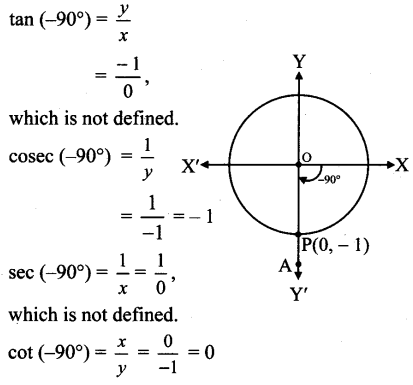
Angle of measure (-90°):
Let m∠XOA = -90°
It terminal arm (ray OA) intersects the standard unit circle at P(0, -1)
∴ x = 0 and y = -1
sin (-90°) = y = -1
cos (-90°) = s = 0
Angle of measure (-120°):
Let m∠XOA = – 120°
Its terminal arm (ray OA) intersects the standard unit circle at P(x, y).
Draw seg PM perpendicular to the X-axis.
∴ ΔOMP is a 30° – 60° – 90° triangle.
OP = 1,
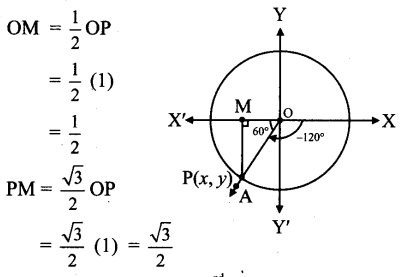
Since point P lies in the 3rd quadrant, x < 0, y < 0
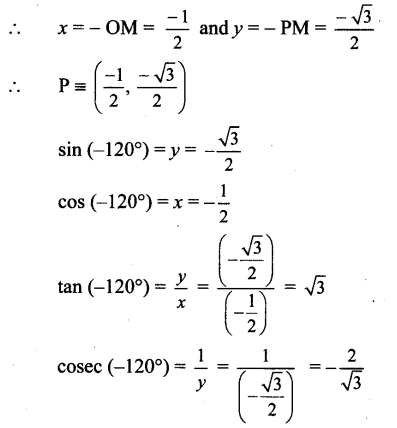
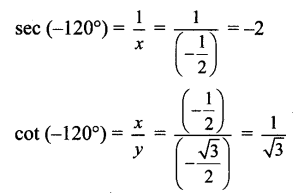
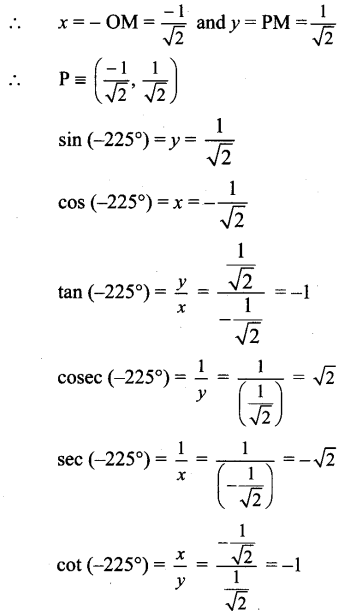
Angle of measure (- 225°):
Let m∠XOA = – 225°
Its terminal arm (ray OA) intersects the standard unit circle at P(x, y).
Draw seg PM perpendicular to the X-axis.
ΔOMP is a 45° – 45° – 90° triangle.
OP = 1,
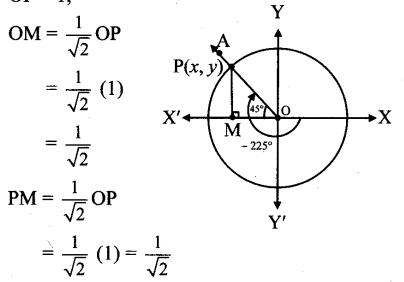
Since point P lies in the 2nd quadrant, x < 0, y > 0
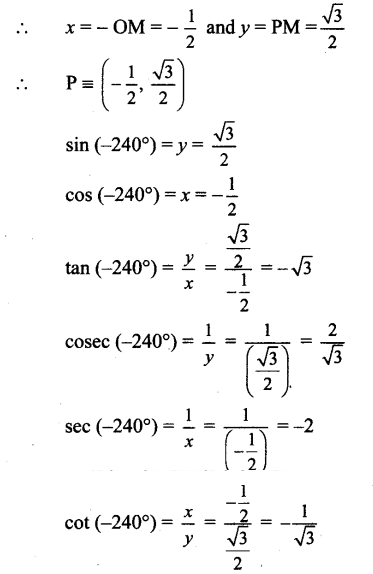
Angle of measure 2400):
Let m∠XOA = 240°
Its terminal arm (ray OA) intersects the standard
unit circle at P(x, y).
Draw seg PM perpendicular to the X-axis.
∴ ΔOMP is a 30° – 60° – 900 triangle.
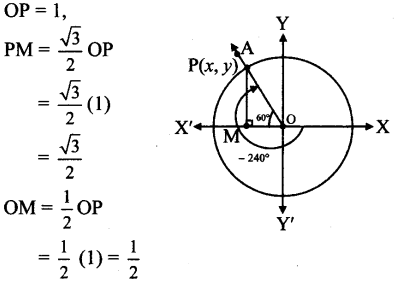
Since point P lies in the 2nd quadrant, x<0, y>0
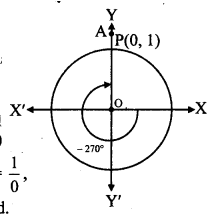
Angle of measure (- 270°):
Let m∠XOA = – 270°
Its terminal arm (ray OA)
intersects the standard unit,
circle at P(0, 1).
∴ x = 0 and y = 1
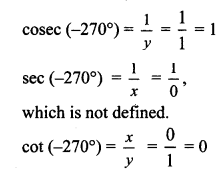
sin (- 270°) = y = 1
cos (- 270°) = x = 0
tan(-270°)= yx=10
which is not defined.
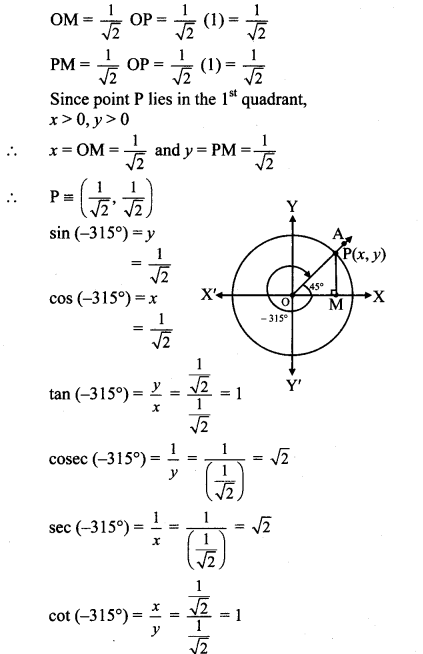
Angle of measure ( 315°):
Let m∠XOA 315°
Its terminal arm (ray OA) intersects the standard unit circle at P(x,y).
Draw seg PM perpendicular to the X-axis.
ΔOMP is a 45° – 45° – 90° triangle.
OP = 1,
Question 2.
State the signs of:
i. tan 380°
ii. cot 230°
iii 468°
Solution:
1. 380° = 360° + 20°
∴ 380° and 20° are co-terminal angles.
Since 0° < 20° <90°0,
20° lies in the l quadrant.
∴ 380° lies in the 1st quadrant,
∴ tan 380° is positive.
ii. Since, 180° <230° <270°
∴ 230° lies in the 3rd quadrant.
∴ cot 230° is positive.
iii. 468° = 360°+108°
∴ 468° and 108° are co-terminal angles.
Since 90° < 108° < 180°,
108° lies in the 2nd quadrant.
∴ 468° lies in the 2nd quadrant.
∴ sec 468° is negative.
Question 3.
State the signs of cos 4c and cos 4°. Which of these two functions is greater?
Solution:
Since 0° < 4° < 90°, 4° lies in the first quadrant. ∴ cos4° >0 …(i)
Since 1c = 57° nearly,
180° < 4c < 270°
∴ 4c lies in the third quadrant.
∴ cos 4c < 0 ………(ii)
From (i) and (ii),
cos 4° is greater.
Question 4.
State the quadrant in which 6 lies if
i. sin θ < 0 and tan θ > 0
ii. cos θ < 0 and tan θ > 0
Solution:
i. sin θ < 0 sin θ is negative in 3rd and 4th quadrants, tan 0 > 0
tan θ is positive in 1st and 3rd quadrants.
∴ θ lies in the 3rd quadrant.
ii. cos θ < 0 cos θ is negative in 2nd and 3rd quadrants, tan 0 > 0
tan θ is positive in 1st and 3rd quadrants.
∴ θ lies in the 3rd quadrant.
Question 5.
Evaluate each of the following:
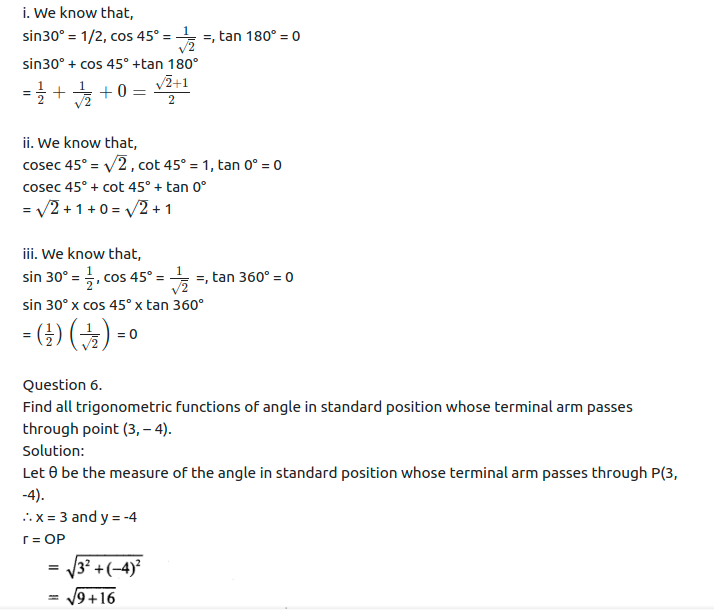
i. sin 30° + cos 45° + tan 180°
ii. cosec 45° + cot 45° + tan 0°
iii. sin 30° x cos 45° x lies tan 360°
Solution:
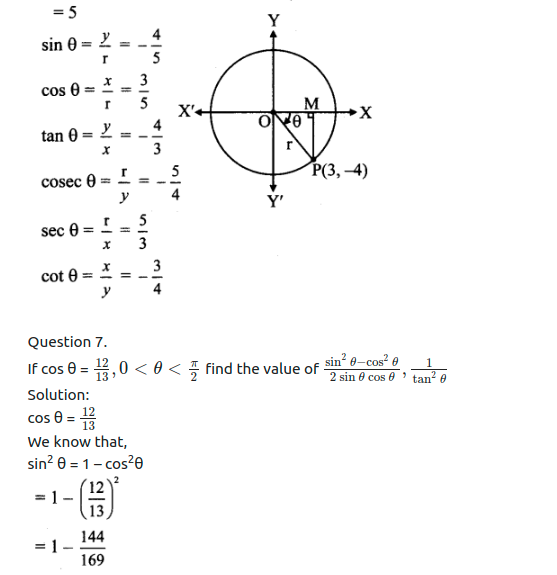
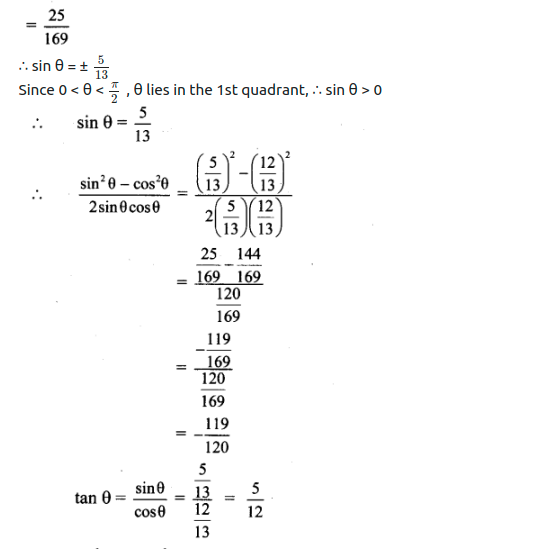
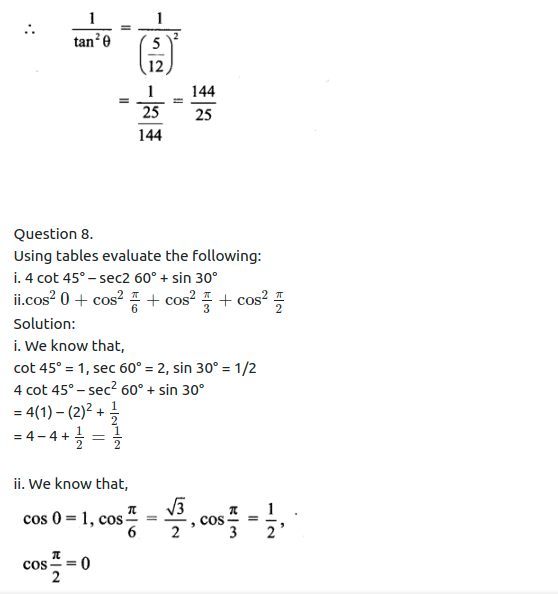
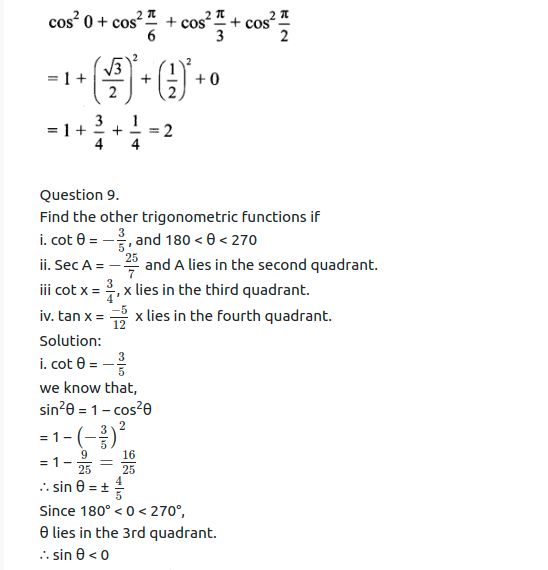
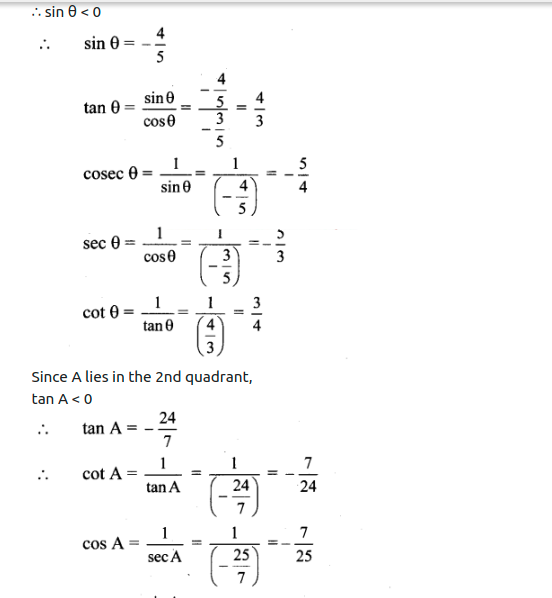
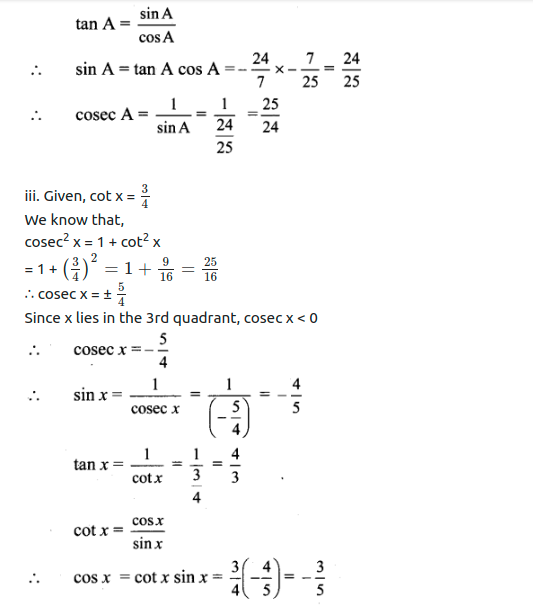
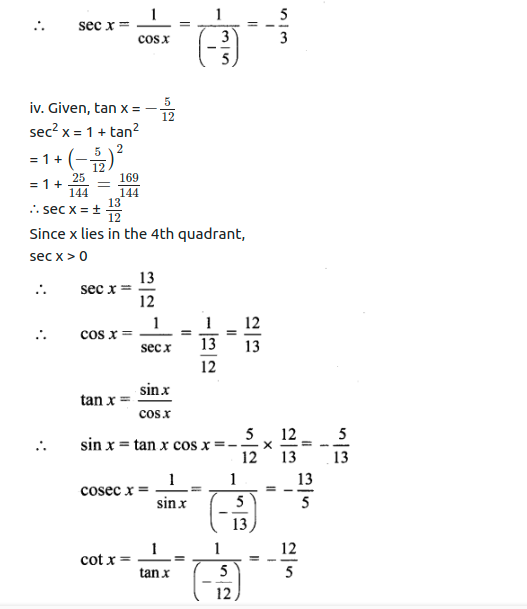
Ex 2.2
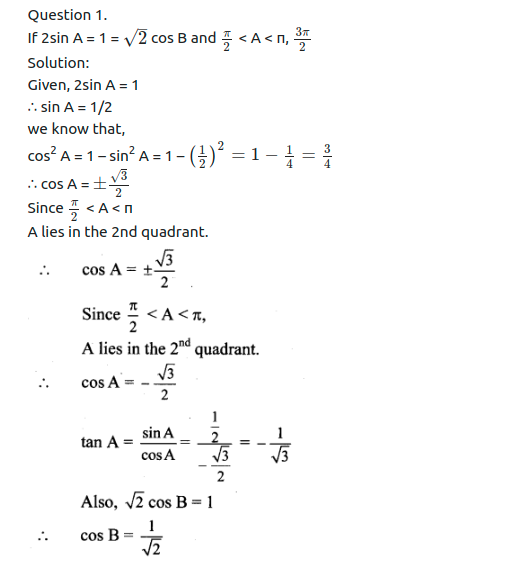
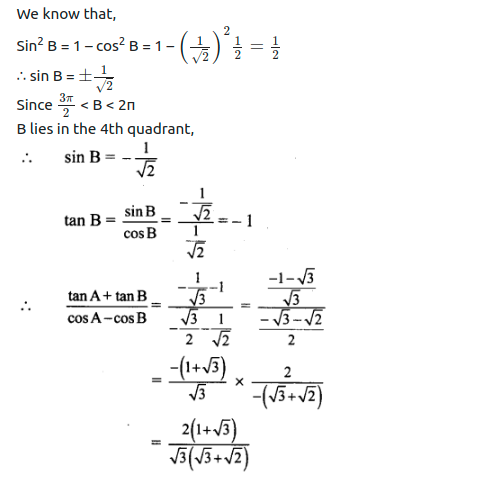
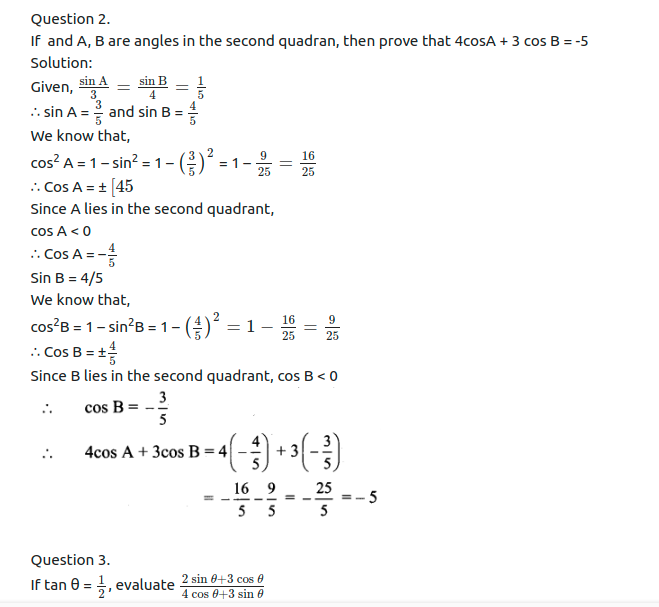
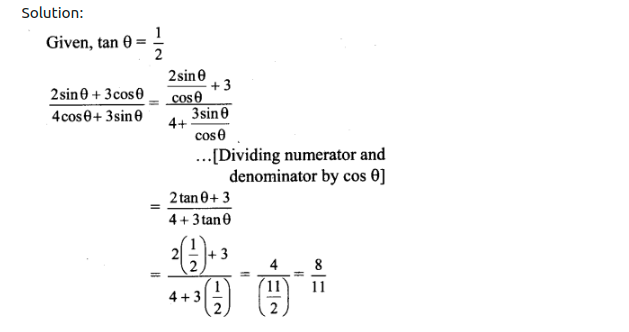
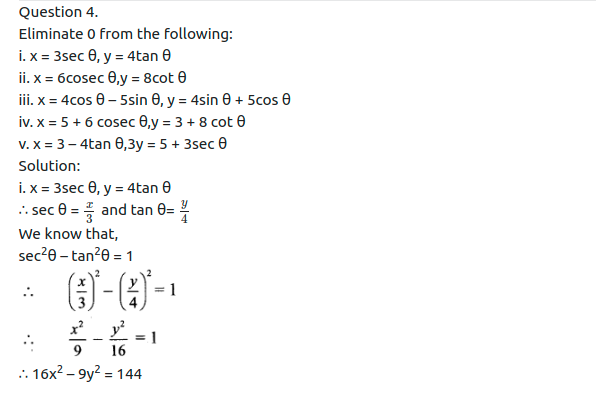
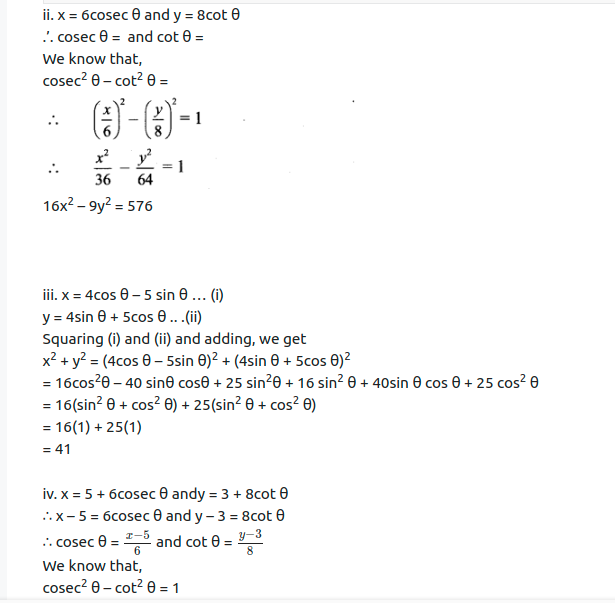

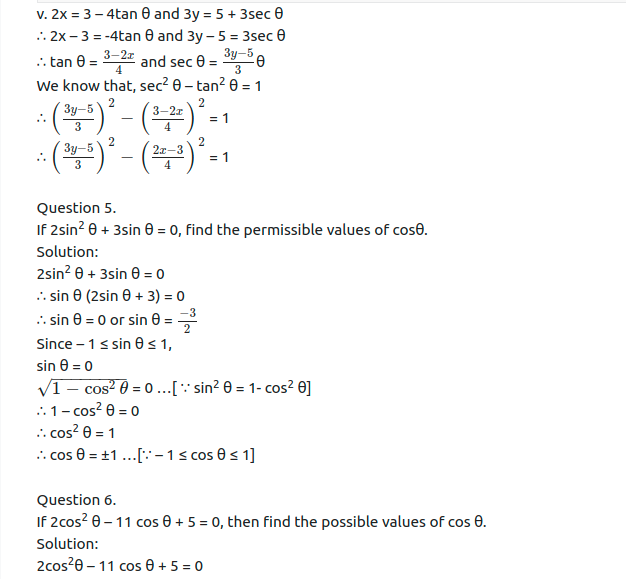
∴ 2cos2 θ – 10 cos θ – cos θ + 5 = 0
∴ 2cos θ(cos θ – 5) – 1 (cos θ – 5) = 0
∴ (cos θ – 5) (2cos θ – 1) = 0
cos θ – 5 = 0 or 2cos θ – 1 = 0
∴ cos θ = 5 or cos θ = 1/2
Since, -1 ≤ cos θ ≤ 1
∴ cos θ = 1/2
Question 7.
Find the acute angle θ such 2cos2 θ = 3sin θ.
Solution:
2cos20 = 3sin θ
∴ 2(1 – sin2 θ) = 3sin θ
∴ 2 – 2sin2 θ = 3sin θ
∴ 2sin2 θ + 3sin 9-2 = θ
∴ 2sin2 θ + 4sin θ – sin θ – 2 = θ
∴ 2sin θ(sin θ + 2) -1 (sin θ + 2) = θ
∴ (sin θ + 2) (2sin θ – 1) = 0
∴ sin θ + 2 = 0 or 2sin θ – 1 = 0
∴ sin θ = -2 or sin θ = 1/2
Since, -1 ≤ sin θ ≤ 1
∴ Sin θ = 1/2
∴ θ = 30° …[ ∵ sin 30 = 1/2]
Question 8.
Find the acute angle 0 such that 5tan2 0 + 3 = 9sec 0.
Solution:
5tan2 θ + 3 = 9sec θ
∴ 5(sec2 θ – 1) + 3 = 9sec θ
∴ 5sec2 θ – 5 + 3 = 9sec θ
∴ 5sec2 θ – 9sec θ – 2 = 0
∴ 5sec2 θ – 10 sec θ + sec θ – 2 = 0
∴ 5sec θ(sec θ – 2) + 1(sec θ – 2) = 0
∴ (sec θ – 2) (5sec θ + 1) = 0
∴ sec θ – 2 = 0 or 5sec θ + 1 = 0
∴ sec θ = 2 or sec θ = -1/5
Since sec θ ≥ 1 or sec θ ≤ -1,
sec θ = 2
∴ θ = 60° … [ ∵ sec 60° = 2]
Question 9.
Find sin θ such that 3cos θ + 4sin θ = 4.
Solution:
3cos θ + 4sin θ = 4
∴ 3cos θ = 4(1 – sin θ)
Squaring both the sides, we get .
9cos2θ = 16(1 – sin θ)2
∴ 9(1 – sin2 θ) = 16(1 + sin2 θ – 2sin θ)
∴ 9 – 9sin2 θ = 16 + 16sin2 θ – 32sin θ
∴ 25sin2 θ – 32sin θ + 7 = 0
∴ 25sin2 θ – 25sin θ – 7sin θ + 7 = 0
25sin θ (sin θ – 1) – 7 (sin θ – 1) = 0
∴ (sin θ – 1) (25sin θ – 7) = 0
∴ sin θ – 1 = 0 or 25 sin θ – 7 = 0

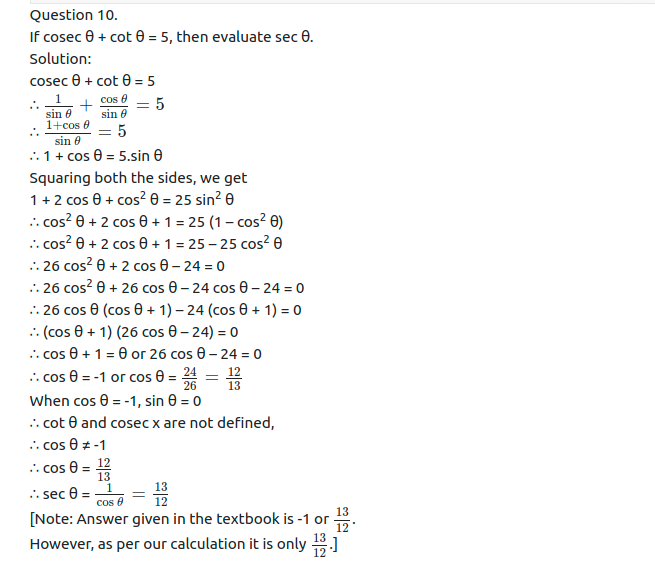
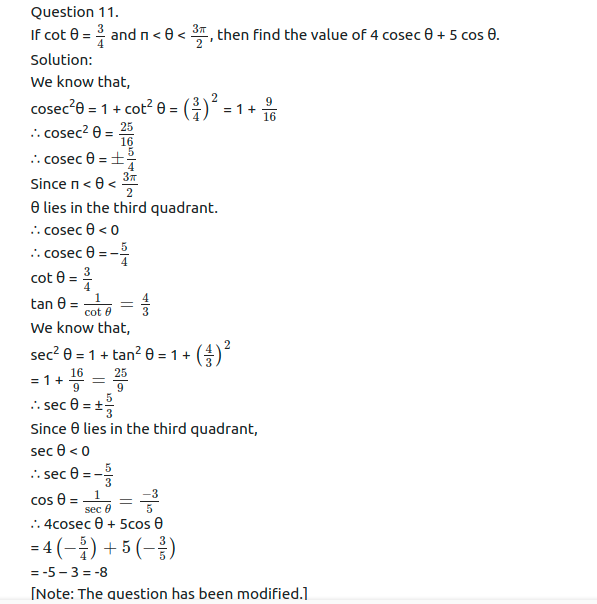
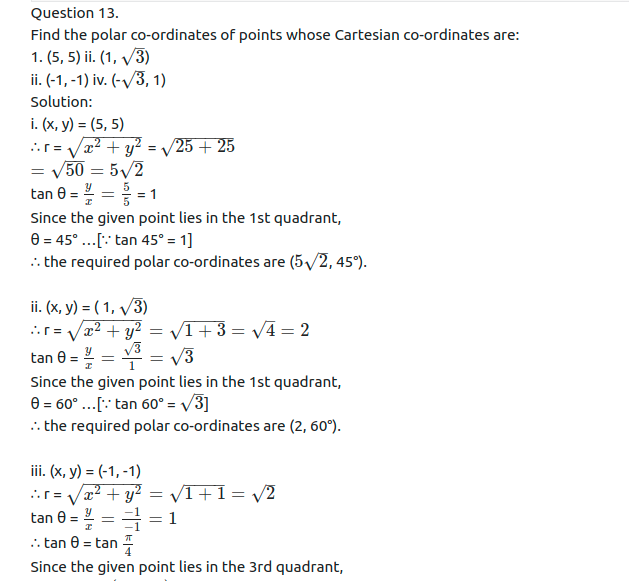
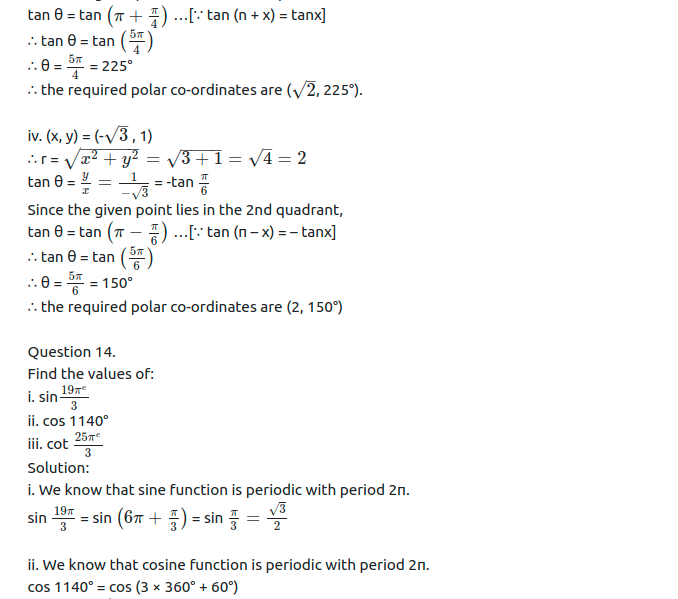
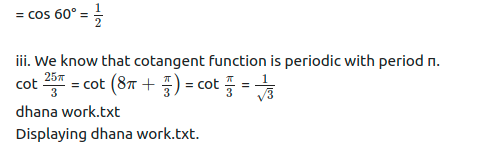
Question 12.
Find the Cartesian co-ordinates of points whose polar co-ordinates are:
i. (3, 90°) ii. (1, 180°)
Solution:
i. (r, θ) = (3, 90°)
Using x = r cos θ and y = r sin θ, where (x, y) are the required cartesian co-ordinates, we get
x = 3cos 90° and y = 3sin 90°
∴ x = 3(0) = 0 and y = 3(1) = 3
∴ the required cartesian co-ordinates are (0, 3).
ii. (r, θ) = (1, 180°)
Using x = r cos θ and y = r sin θ, where (x, y) are the required cartesian co-ordinates, we get
x = 1(cos 180°) and y = 1(sin 180°)
∴ x = -1 and y = 0
∴ the required cartesian co-ordinates are (-1, 0).
Download PDF
Maharashtra Board Solutions Class 11-Arts & Science Maths (Part 1): Chapter 2- Trigonometry – I
Chapterwise Maharashtra Board Solutions Class 11 Arts & Science Maths (Part 1) :
- Chapter 1- Angle and its Measurement
- Chapter 2- Trigonometry – I
- Chapter 3- Trigonometry – II
- Chapter 4- Determinants and Matrices
- Chapter 5- Straight Line
- Chapter 6- Circle
- Chapter 7- Conic Sections
- Chapter 8- Measures of Dispersion
- Chapter 9- Probability