
Class 11: Maths Chapter 9 solutions. Complete Class 11 Maths Chapter 9 Notes.
Maharashtra Board Solutions Class 11-Arts & Science Maths (Part 1): Chapter 9- Probability
Maharashtra Board 11th Maths Chapter 9, Class 11 Maths Chapter 9 solutions
Ex 9.1
Question 1.
There are four pens: Red, Green, Blue, and Purple in a desk drawer of which two pens are selected at random one after the other with replacement. State the sample space and the following events.
(a) A : Select at least one red pen.
(b) B : Two pens of the same colour are not selected.
Solution:
The drawer contains 4 pens out of which one is red (R), one is green (G), one is blue (B) and the other one is purple (P).
From this drawer, two pens are selected one after the other with replacement.
∴ The sample space S is given by
S = {RR, RG, RB, RP, GR, GG, GB, GP, BR, BG, BB, BP, PR, PG, PB, PP}
(a) A : Select at least one red pen.
At least one means one or more than one.
∴ A = {RR, RG, RB, RP, GR, BR, PR}
(b) B : Two pens of the same colour are not selected.
B = {RG, RB, RP, GR, GB, GP, BR, BG, BP, PR, PG, PB}
Question 2.
A coin and a die are tossed simultaneously. Enumerate the sample space and the following events.
(a) A : Getting a tail and an odd number.
(b) B : Getting a prime number.
(c) C : Getting head and a perfect square.
Solution:
When a coin and a die are tossed simultaneously, the sample space S is given by
S = {(H, 1), (H, 2), (H, 3), (H, 4), (H, 5), (H, 6), (T, 1), (T, 2), (T, 3), (T, 4), (T, 5), (T, 6)}
(a) A : Getting a tail and an odd number.
∴ A = {(T, 1), (T, 3), (T, 5)}
(b) B : Getting a prime number.
∴ B = {(H, 2), (H, 3), (H, 5), (T, 2), (T, 3), (T, 5)}
(c) C : Getting a head and a perfect square.
∴ C = {(H, 1), (H, 4)}
Question 3.
Find n(S) for each of the following random experiments.
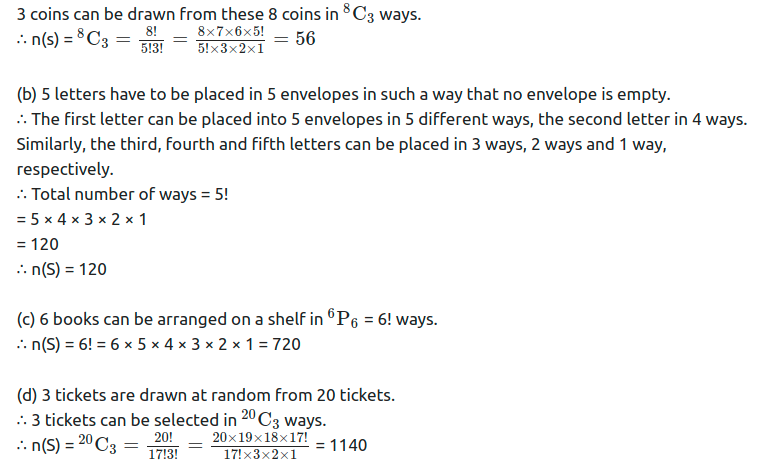
(a) From an urn containing 5 gold and 3 silver coins, 3 coins are drawn at random.
(b) 5 letters are to be placed into 5 envelopes such that no envelope is empty.
(c) 6 books of different subjects are arranged on a shelf.
(d) 3 tickets are drawn from a box containing 20 lottery tickets.
Solution:
(a) There are 5 gold and 3 silver coins, i.e., 8 coins.
Question 4.
Two fair dice are thrown. State the sample space and write the favourable outcomes for the following events.
(a) A : Sum of numbers on two dice is divisible by 3 or 4.
(b) B : The sum of numbers on two dice is 7.
(c) C : Odd number on the first die.
(d) D : Even number on the first die.
(e) Check whether events A and B are mutually exclusive and exhaustive.
(f) Check whether events C and D are mutually exclusive and exhaustive.
Solution:
When two dice are thrown, the sample space is
S = {(1, 1), (1, 2), (1, 3), (1, 4), (1, 5), (1, 6),
(2, 1), (2, 2), (2, 3), (2, 4), (2, 5), (2, 6),
(3, 1), (3, 2), (3, 3), (3, 4), (3, 5), (3, 6),
(4, 1), (4, 2), (4, 3), (4, 4), (4, 5), (4, 6),
(5, 1), (5, 2), (5, 3), (5, 4), (5, 5), (5, 6),
(6, 1), (6, 2), (6, 3), (6,4), (6, 5), (6, 6)}
∴ n(S) = 36
(a) A: Sum of the numbers on two dice is divisible by 3 or 4.
∴ A = {(1, 2), (1, 3), (1, 5), (2, 1), (2, 2), (2, 4), (2, 6), (3, 1), (3, 3), (3, 5), (3, 6), (4, 2), (4, 4), (4, 5), (5, 1), (5, 3), (5, 4), (6, 2), (6, 3), (6, 6)}
(b) B: Sum of the numbers on two dice is 7.
∴ B = {(1, 6), (2, 5), (3, 4), (4, 3), (5, 2), (6, 1)}
(c) C: Odd number on the first die.
∴ C = {(1, 1), (1, 2), (1, 3), (1, 4), (1, 5), (1, 6), (3, 1), (3, 2), (3, 3), (3, 4), (3, 5), (3, 6), (5, 1), (5, 2), (5, 3), (5, 4), (5, 5), (5, 6)}
(d) D: Even number on the first die.
∴ D = {(2, 1), (2, 2), (2, 3), (2, 4), (2, 5), (2, 6), (4, 1), (4, 2), (4, 3), (4, 4), (4, 5), (4, 6), (6, 1), (6, 2), (6, 3), (6, 4), (6, 5), (6, 6)}
(e) A and B are mutually exclusive events as A ∩ B = Φ.
A ∪ B = {(1, 2), (1, 3), (1, 5), (1, 6), (2, 1), (2, 2), (2, 4), (2, 5), (2, 6), (3, 1), (3, 3), (3, 4), (3, 5), (3, 6), (4, 2), (4, 3), (4, 4), (4, 5), (5, 1), (5, 2), (5, 3), (5, 4), (6, 1), (6, 2), (6, 3), (6, 6)} ≠ S
∴ A and B are not exhaustive events as A ∪ B ≠ S.
(f) C and D are mutually exclusive events as C ∩ D = Φ.
C ∪ D = {(1, 1), (1, 2), (1, 3), (1, 4), (1, 5), (1, 6), (2, 1), (2, 2), (2, 3), (2, 4), (2, 5), (2, 6), (3, 1), (3, 2), (3, 3), (3, 4), (3, 5), (3, 6), (4, 1), (4, 2), (4, 3), (4, 4), (4, 5), (4, 6), (5, 1), (5, 2), (5, 3), (5, 4), (5, 5), (5, 6), (6, 1), (6, 2), (6, 3), (6, 4), (6, 5), (6, 6)} = S
∴ C and D are exhaustive events.
Question 5.
A bag contains four cards marked as 5, 6, 7, and 8. Find the sample space if two cards are drawn at random
(a) with replacement.
(b) without replacement.
Solution:
The bag contains 4 cards marked 5, 6, 7, and 8. Two cards are to be drawn from this bag.
(a) If the two cards are drawn with replacement, then the sample space is
S = {(5, 5), (5, 6), (5, 7), (5, 8), (6, 5), (6, 6), (6, 7), (6, 8), (7, 5), (7, 6), (7, 7), (7, 8), (8, 5), (8, 6), (8, 7), (8, 8)}
(b) If the two cards are drawn without replacement, then the sample space is
S = {(5, 6), (5, 7), (5, 8), (6, 5), (6, 7), (6, 8), (7, 5), (7, 6), (7, 8), (8, 5), (8, 6), (8, 7)}
Question 6.
A fair die is thrown two times. Find the probability that
(a) the sum of the numbers on them is 5.
(b) the sum of the numbers on them is at least 8.
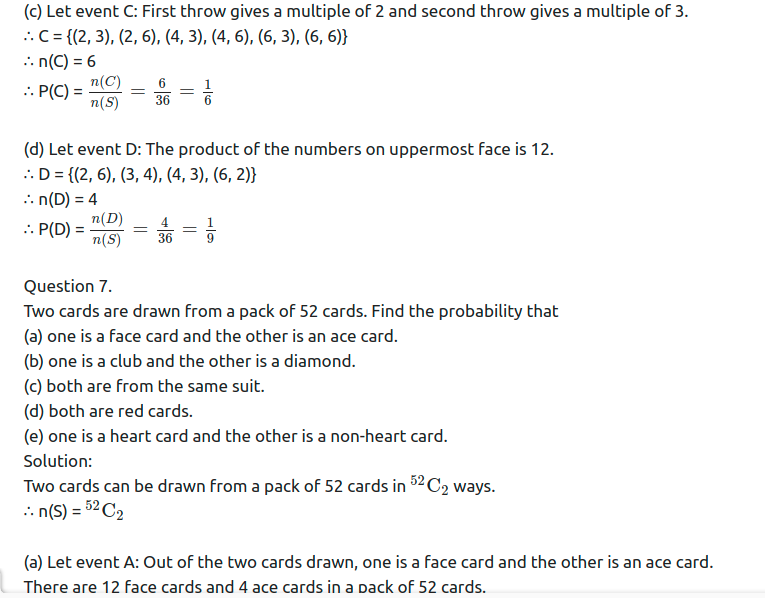
(c) the first throw gives a multiple of 2 and the second throw gives a multiple of 3.
(d) product of numbers on them is 12.
Solution:
When two dice are thrown, the sample space is
S = {(1, 1), (1, 2), (1, 3), (1, 4), (1, 5), (1, 6), (2, 1), (2, 2), (2, 3), (2, 4), (2, 5), (2, 6), (3, 1), (3, 2), (3, 3), (3, 4), (3, 5), (3, 6), (4, 1), (4, 2), (4, 3), (4, 4), (4, 5), (4, 6), (5, 1), (5, 2), (5, 3), (5, 4), (5, 5), (5, 6), (6, 1), (6, 2), (6, 3), (6,4), (6, 5), (6, 6)}
∴ n(S) = 36
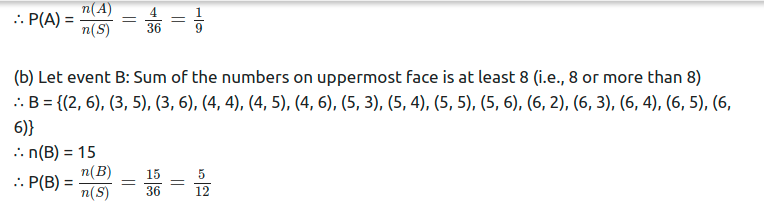
(a) Let event A: Sum of the numbers on uppermost face is 5.
∴ A = {(1, 4), (2, 3), (3, 2), (4, 1)}
∴ n(A) = 4
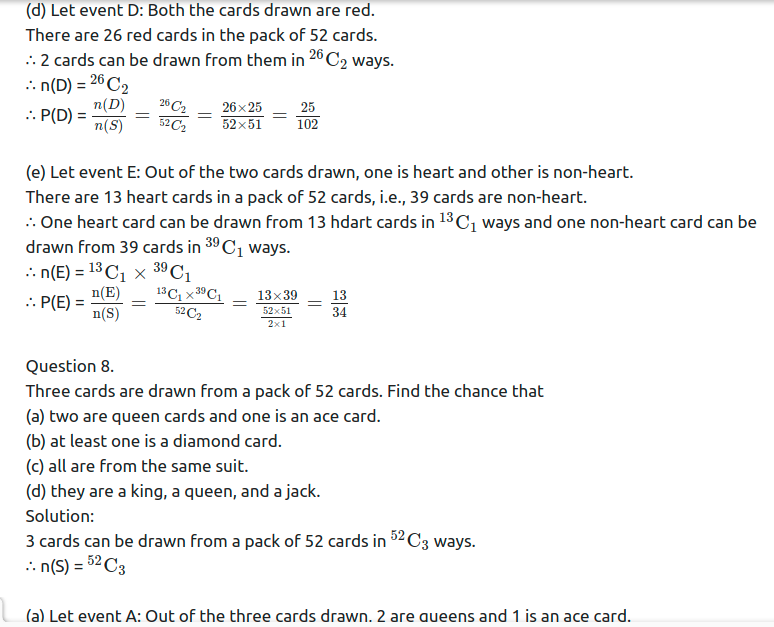

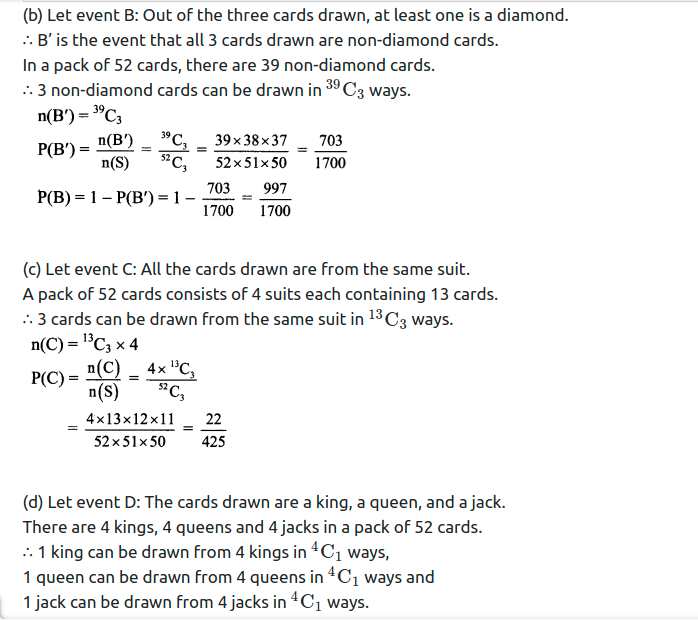
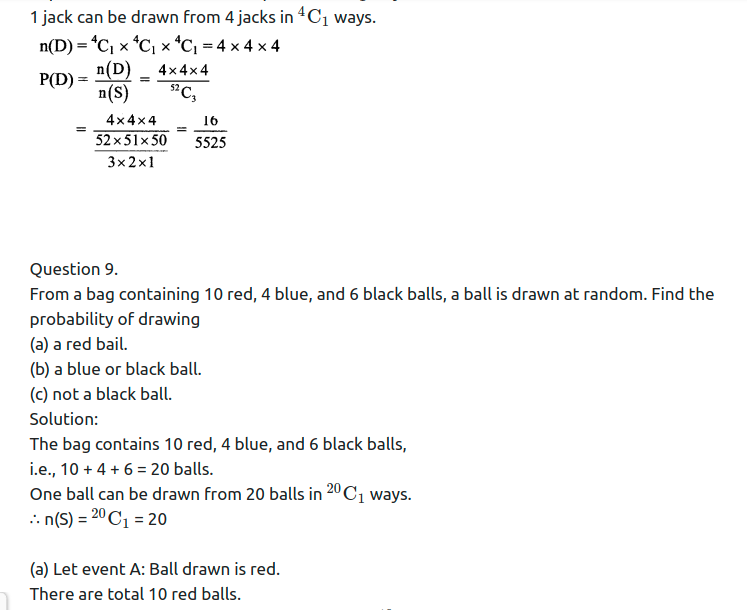

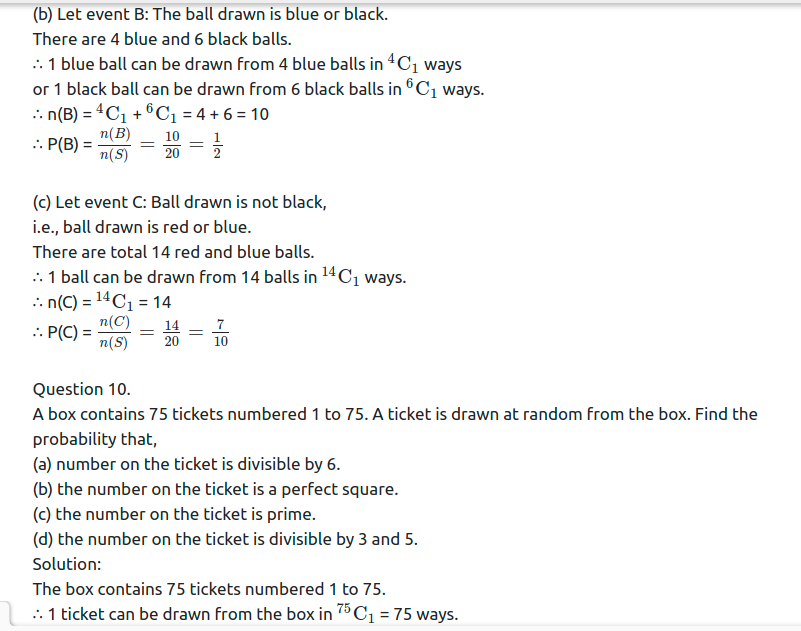
Ex 9.2
Question 1.
First, 6 faced die which is numbered 1 to 6 is thrown, then a 5 faced die which is numbered 1 to 5 is thrown. What is the probability that sum of the numbers on the upper faces of the dice is divisible by 2 or 3?
Solution:
When a 6 faced die and a 5 faced die are thrown, the sample space is
S = {(1, 1), (1, 2), (1, 3), (1, 4), (1, 5), (2, 1), (2, 2), (2, 3), (2, 4), (2, 5), (3, 1), (3, 2), (3, 3), (3, 4), (3, 5), (4, 1), (4, 2), (4, 3), (4,4), (4, 5), (5, 1), (5, 2), (5, 3), (5, 4), (5, 5), (6, 1), (6, 2), (6, 3), (6, 4), (6, 5)}
∴ n(S) = 30
Let event A: The sum of the numbers on the upper faces of the dice is divisible by 2.
A = {(1, 1), (1, 3), (1, 5), (2, 2), (2, 4), (3, 1), (3, 3), (3, 5), (4, 2), (4, 4), (5, 1), (5, 3), (5, 5), (6, 2), (6, 4)}
∴ n(A) = 15

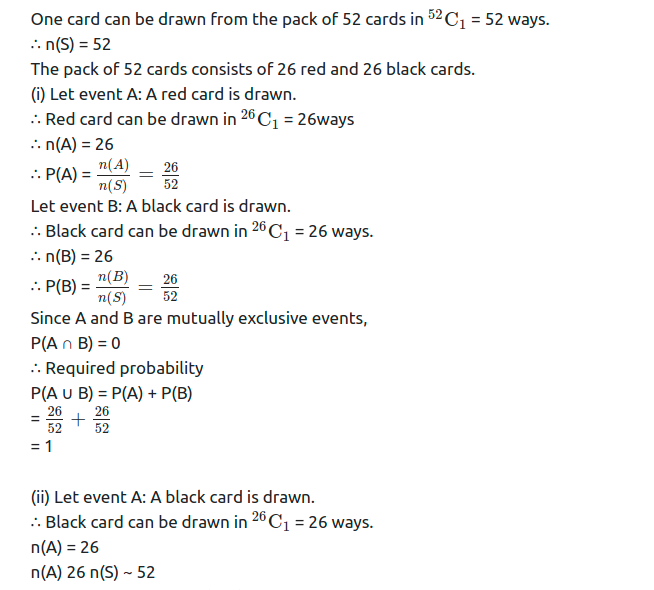
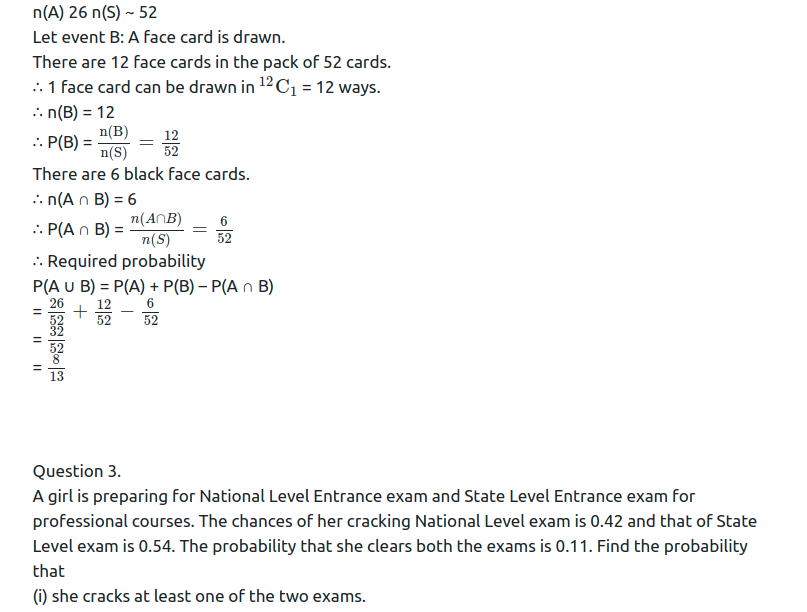
(ii) she cracks only one of the two.
(iii) she cracks none.
Solution:
Let event A: The girl cracks the National Level exam.
∴ P(A) = 0.42
Let event B: The girl cracks the State Level exam.
∴ P(B) = 0.54
Also, P(A ∩ B) = 0.11
(i) P(the girl cracks at least one of the two exams)
P(A ∪ B) = P(A) + P(B) – P(A ∩ B)
= 0.42 + 0.54 – 0.11
= 0.85
(ii) P(the girl cracks only one of the two exams)
= P(A) – P(B) – 2P(A ∩ B)
= 0.42 + 0.54 – 2(0.11)
= 0.74
(iii) P(the girl cracks none of the exams)
= P(A’ ∩ B’)
= P(A ∪ B)’
= 1 – P(A ∪ B)
= 1 – 0.85
= 0.15
Question 4.
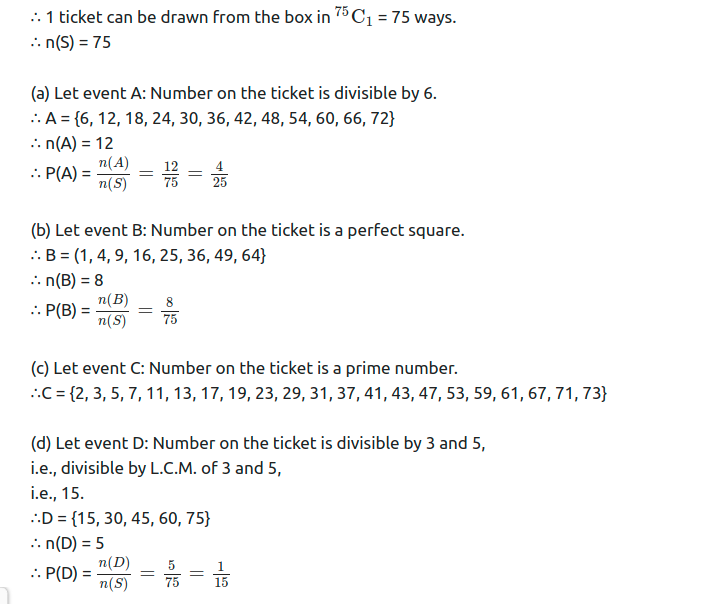
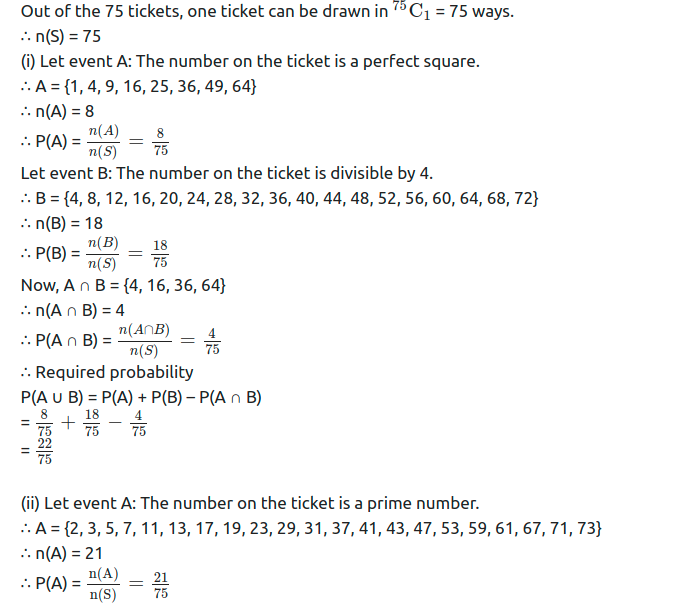
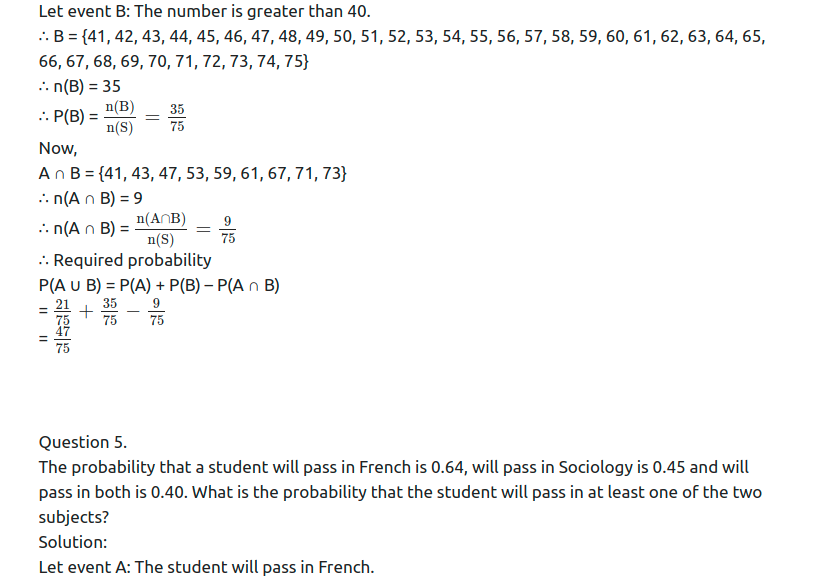
A bag contains 75 tickets numbered from 1 to 75. One ticket is drawn at random. Find the probability that,
(i) number on the ticket is a perfect square or divisible by 4.
(ii) number on the ticket is a prime number or greater than 40.
Solution:
∴ P(A) = 0.64
Let event B: The student will pass in Sociology.
∴ P(B) = 0.45
Also, P(A ∩ B) = 0.40
∴ Required probability
P(A ∪ B) = P(A) + P(B) – P(A ∩ B)
= 0.64 + 0.45 – 0.40
= 0.69
Question 6.
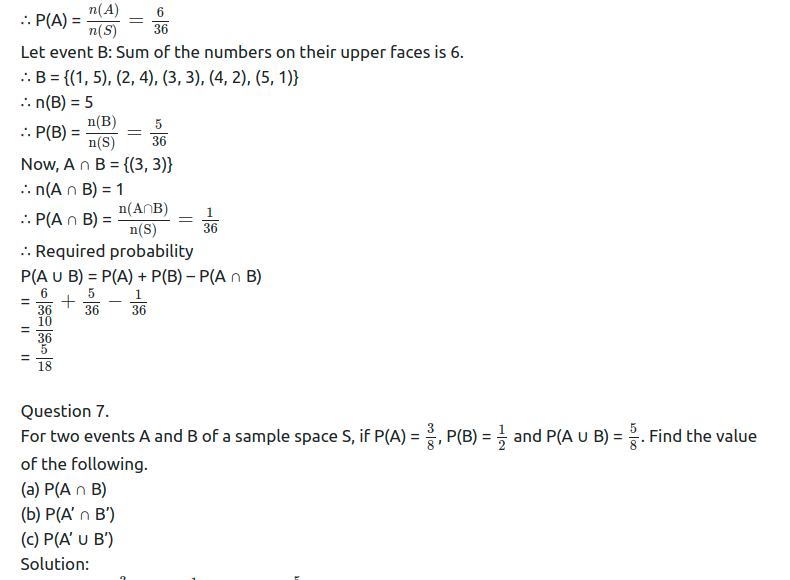
Two fair dice are thrown. Find the probability that the number on the upper face of the first die is 3 or sum of the numbers on their upper faces is 6.
Solution:
When two dice are thrown, the sample space is
S = {(1, 1), (1, 2), (1, 3), (1, 4), (1, 5), (1, 6), (2, 1), (2, 2), (2, 3), (2, 4), (2, 5), (2, 6), (3, 1), (3, 2), (3, 3), (3, 4), (3, 5), (3, 6), (4, 1), (4, 2), (4, 3), (4, 4), (4, 5), (4, 6), (5, 1), (5, 2), (5, 3), (5, 4), (5, 5), (5, 6), (6, 1), (6, 2), (6, 3), (6, 4), (6, 5), (6, 6)}
∴ n(S) = 36
Let event A: The number on the upper face of the first die is 3.
∴ A = {(3, 1), (3, 2), (3, 3), (3, 4), (3, 5), (3, 6)}
∴ n(A) = 6
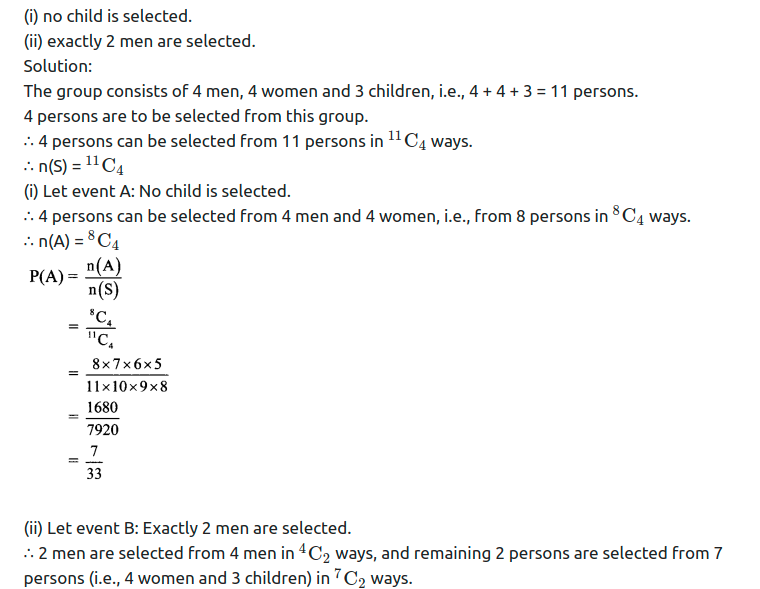

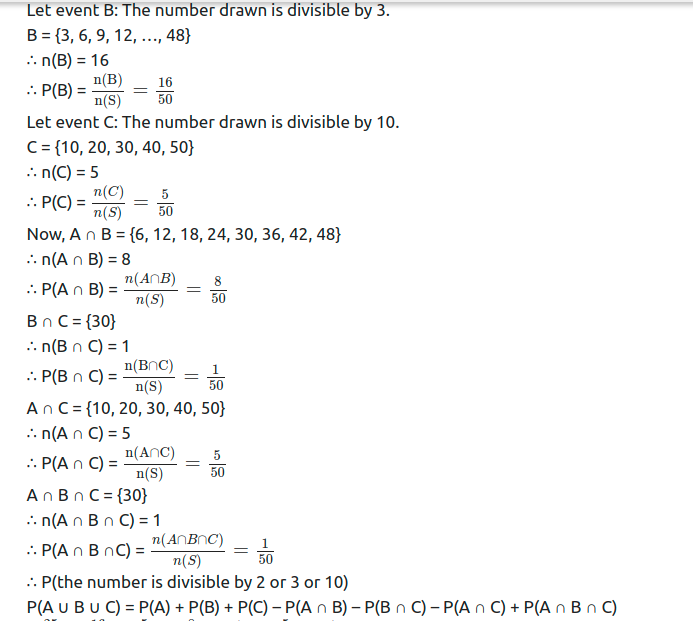

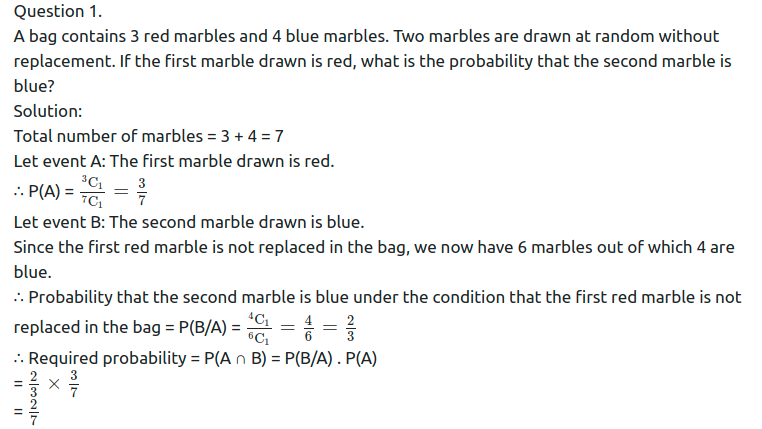
Ex 9.3
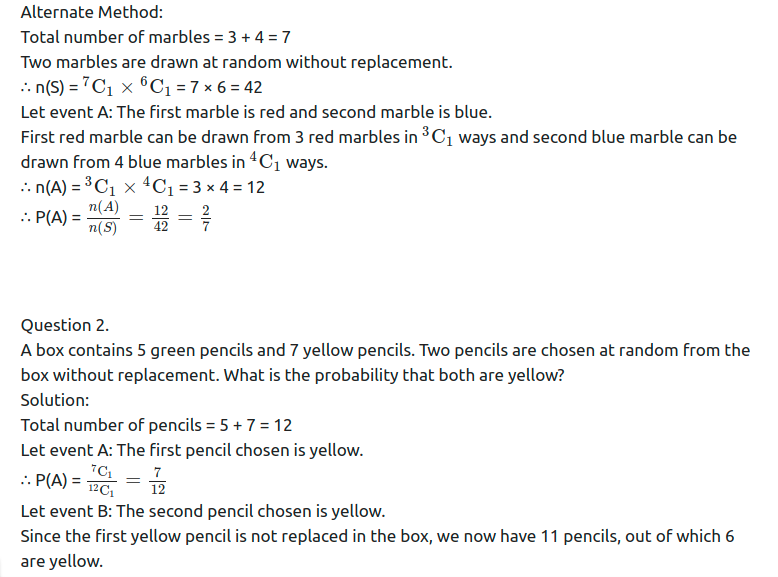

Ex 9.4



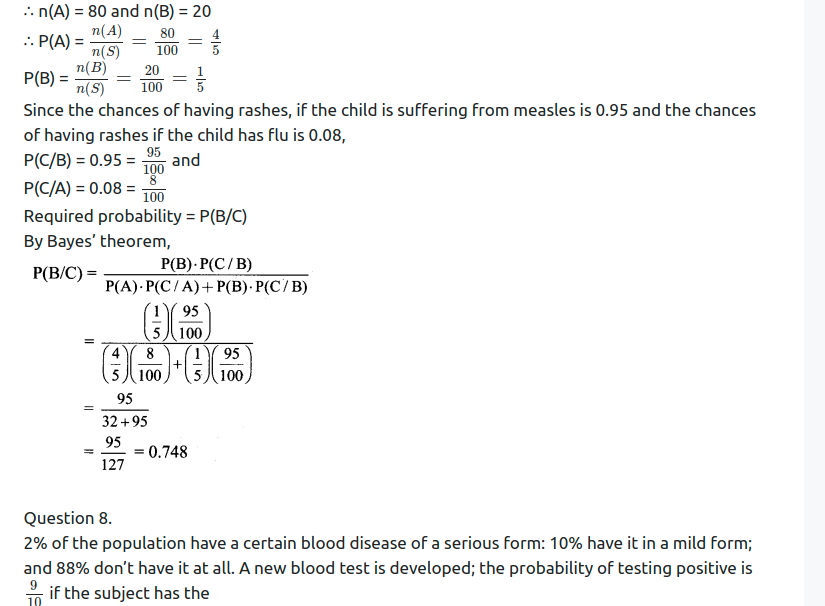
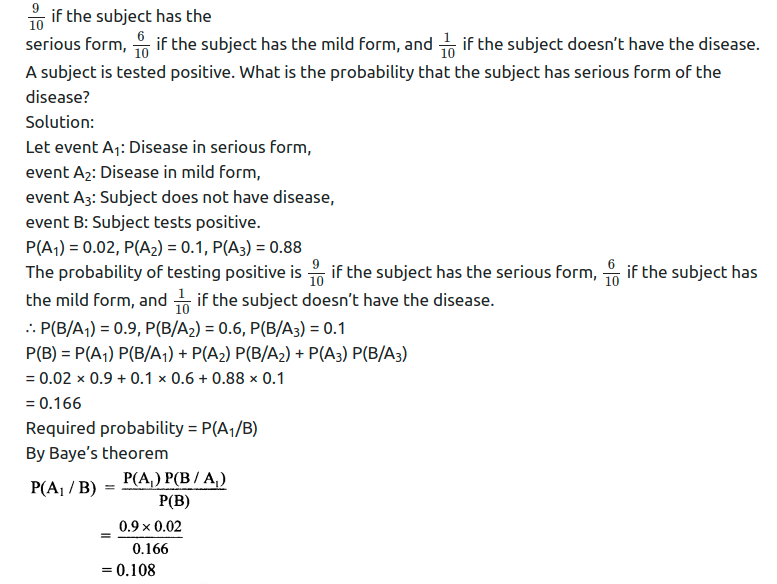
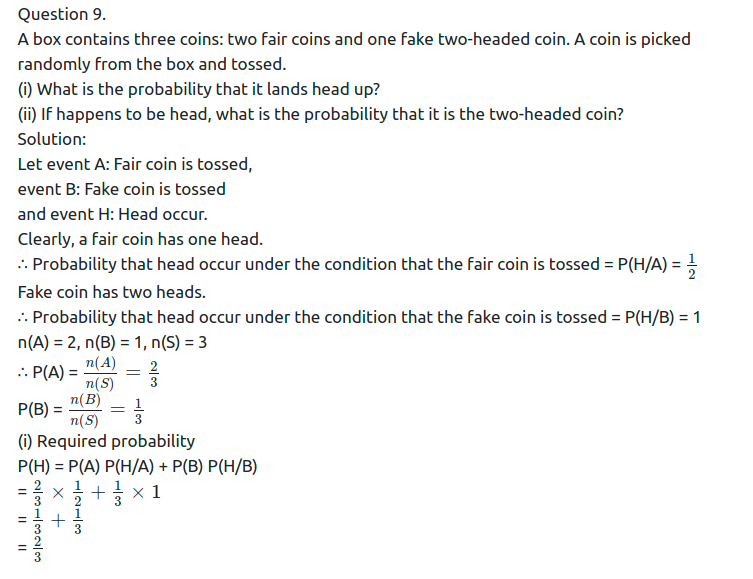
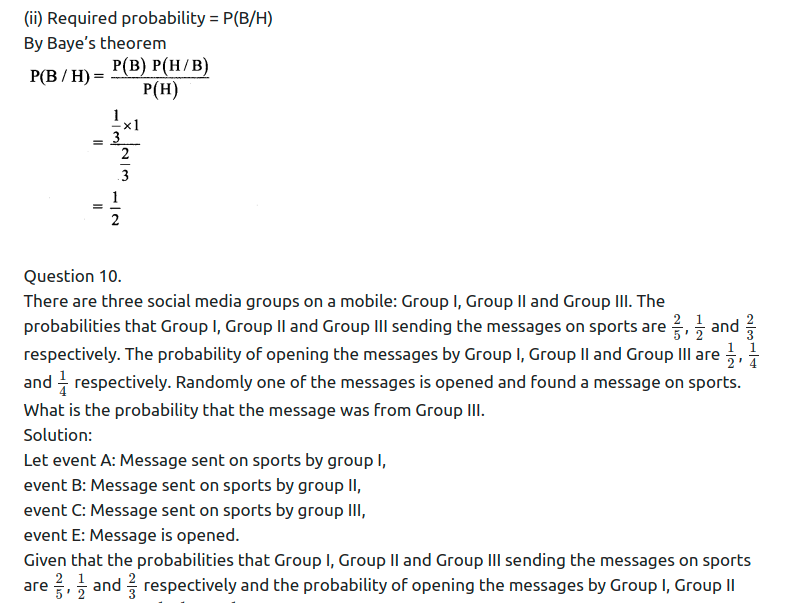
Ex 9.5


Download PDF
Maharashtra Board Solutions Class 11-Arts & Science Maths (Part 1): Chapter 9- Probability
Chapterwise Maharashtra Board Solutions Class 11 Arts & Science Maths (Part 1) :
- Chapter 1- Angle and its Measurement
- Chapter 2- Trigonometry – I
- Chapter 3- Trigonometry – II
- Chapter 4- Determinants and Matrices
- Chapter 5- Straight Line
- Chapter 6- Circle
- Chapter 7- Conic Sections
- Chapter 8- Measures of Dispersion
- Chapter 9- Probability