
Class 11: Maths Chapter 5 solutions. Complete Class 11 Maths Chapter 5 Notes.
Maharashtra Board Solutions Class 11-Arts & Science Maths (Part 2): Chapter 6- Functions
Maharashtra Board 11th Maths Chapter 5, Class 11 Maths Chapter 5 solutions
Ex 6.1
Question 1.
Check if the following relations are functions.
(a)
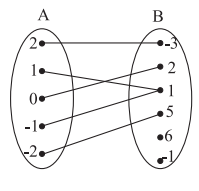
Solution:
Yes.
Reason: Every element of set A has been assigned a unique element in set B.
(b)
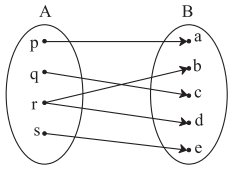
Solution:
No.
Reason: An element of set A has been assigned more than one element from set B.
(c)
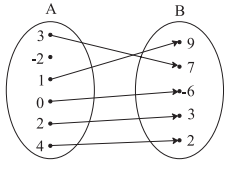
Solution:
No.
Reason:
Not every element of set A has been assigned an image from set B.
Question 2.
Which sets of ordered pairs represent functions from A = {1, 2, 3, 4} to B = {-1, 0, 1, 2, 3}? Justify.
(i) {(1, 0), (3, 3), (2, -1), (4, 1), (2, 2)}
(ii) {(1, 2), (2, -1), (3, 1), (4, 3)}
(iii) {(1, 3), (4, 1), (2, 2)}
(iv) {(1, 1), (2, 1), (3, 1), (4, 1)}
Solution:
(i) {(1, 0), (3, 3), (2, -1), (4, 1), (2, 2)} does not represent a function.
Reason: (2, -1), (2, 2), show that element 2 ∈ A has been assigned two images -1 and 2 from set B.
(ii) {(1, 2), (2, -1), (3, 1), (4, 3)} represents a function.
Reason: Every element of set A has been assigned a unique image in set B.
(iii) {(1, 3), (4, 1), (2, 2)} does not represent a function.
Reason:
3 ∈ A does not have an image in set B.
(iv) {(1, 1), (2, 1), (3, 1), (4, 1)} represents a function
Reason: Every element of set A has been assigned a unique image in set B.
Question 3.
Check if the relation given by the equation represents y as function of x.
(i) 2x + 3y = 12
(ii) x + y2 = 9
(iii) x2 – y = 25
(iv) 2y + 10 = 0
(v) 3x – 6 = 21
Solution:
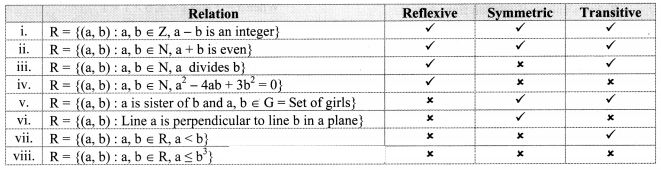
(iii) x2 – y = 25
∴ y = x2 – 25
∴ For every value of x, there is a unique value of y.
∴ y is a function of x.
(iv) 2y + 10 = 0
∴ y = -5
∴ For every value of x, there is a unique value of y.
∴ y is a function of x.
(v) 3x – 6 = 21
∴ x = 9
∴ x = 9 represents a point on the X-axis.
There is no y involved in the equation.
So the given equation does not represent a function.
Question 6.
Find x, if f(x) = g(x) where
(i) f(x) = x4 + 2x2, g(x) = 11x2
(ii) f(x) = √x – 3, g(x) = 5 – x
Solution:
(i) f(x) = x4 + 2x2, g(x) = 11x2
f(x) = g(x)
∴ x4 + 2x2 = 11x2
∴ x4 – 9x2 = 0
∴ x2 (x2 – 9) = 0
∴ x2 = 0 or x2 – 9 = 0
∴ x = 0 or x2 = 9
∴ x = 0, ±3
(ii) f(x) = √x – 3, g(x) = 5 – x
f(x) = g(x)
∴ √x – 3 = 5 – x
∴ √x = 5 – x + 3
∴ √x = 8 – x
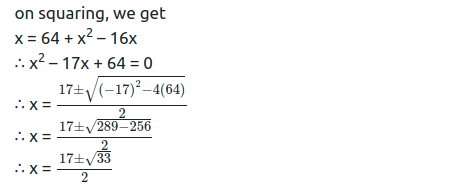
on squaring, we get
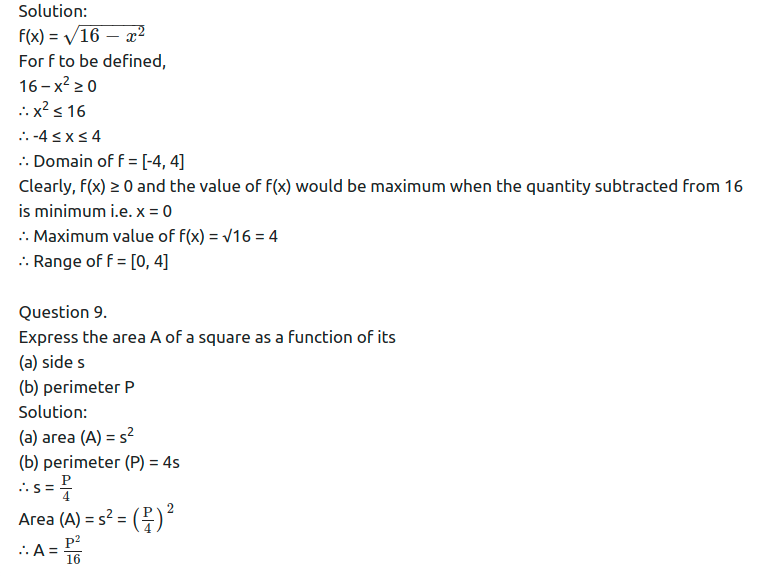
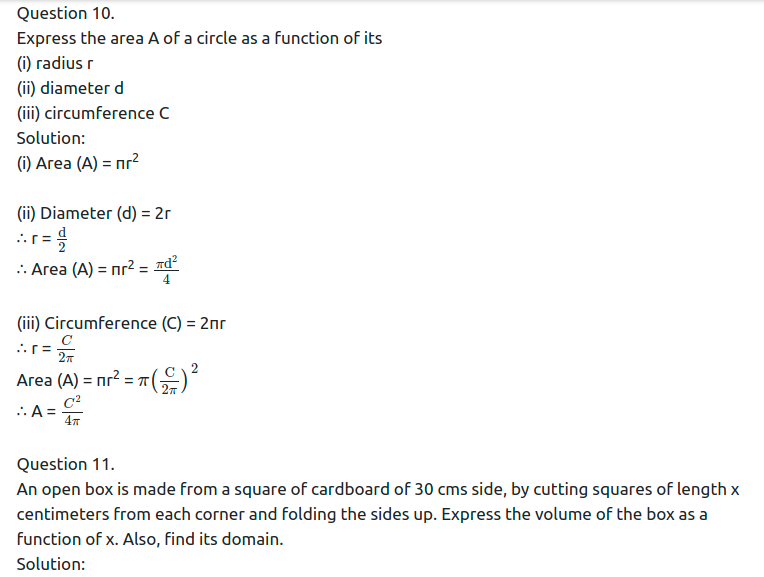
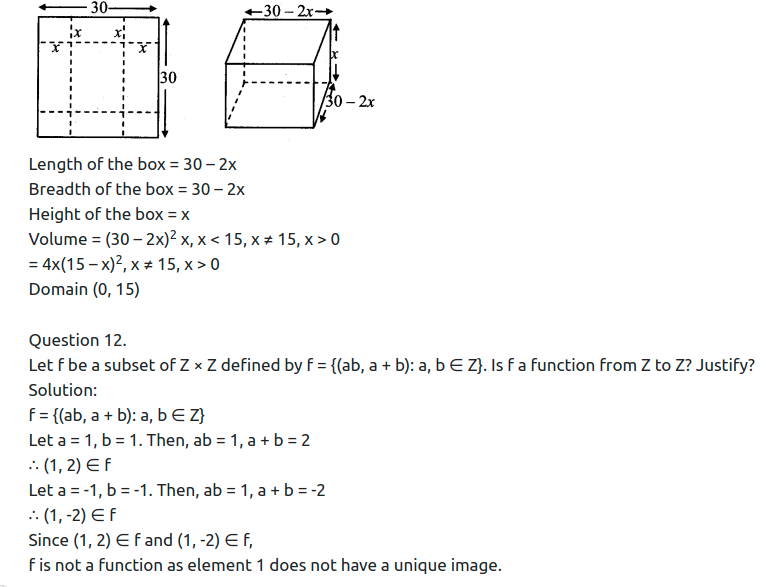
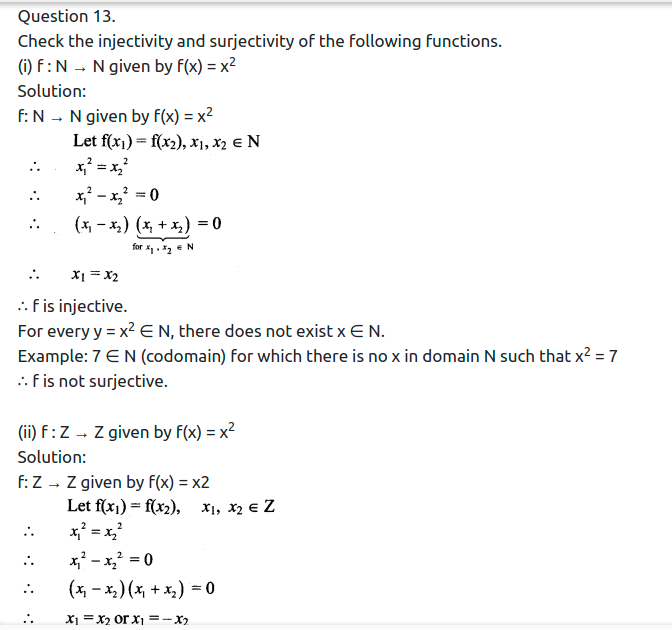
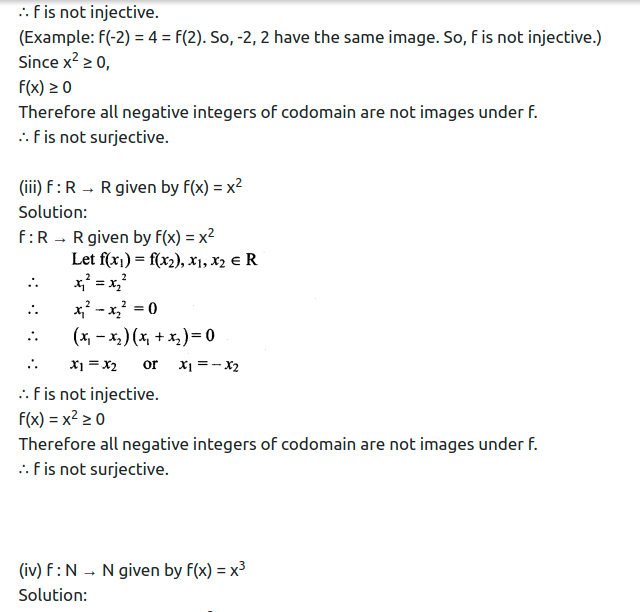
f: N → N given by f(x) = x3
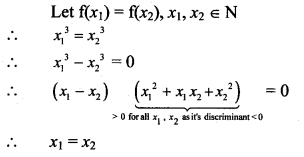
∴ f is injective.
Numbers from codomain which are not cubes of natural numbers are not images under f.
∴ f is not surjective.
(v) f : R → R given by f(x) = x3
Solution:
f: R → R given by f(x) = x3
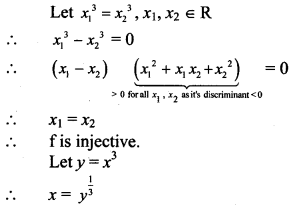
∴ For every y ∈ R, there is some x ∈ R.
∴ f is surjective.
Question 14.
Show that if f : A → B and g : B → C are one-one, then gof is also one-one.
Solution:
f is a one-one function.
Let f(x1) = f(x2)
Then, x1 = x2 for all x1, x2 …..(i)
g is a one-one function.
Let g(y1) = g(y2)
Then, y1 = y2 for all y1, y2 …..(ii)
Let (gof) (x1) = (gof) (x2)
∴ g(f(x1)) = g(f(x2))
∴ g(y1) = g(y2),
where y1 = f(x1), y2 = f(x2) ∈ B
∴ y1 = y2 …..[From (ii)]
i.e., f(x1) = f(x2)
∴ x1 = x2 ….[From (i)]
∴ gof is one-one.
Question 15.
Show that if f : A → B and g : B → C are onto, then gof is also onto.
Solution:
Since g is surjective (onto),
there exists y ∈ B for every z ∈ C such that
g(y) = z …….(i)
Since f is surjective,
there exists x ∈ A for every y ∈ B such that
f(x) = y …….(ii)
(gof) x = g(f(x))
= g(y) ……[From (ii)]
= z …..[From(i)]
i.e., for every z ∈ C, there is x in A such that (gof) x = z
∴ gof is surjective (onto).
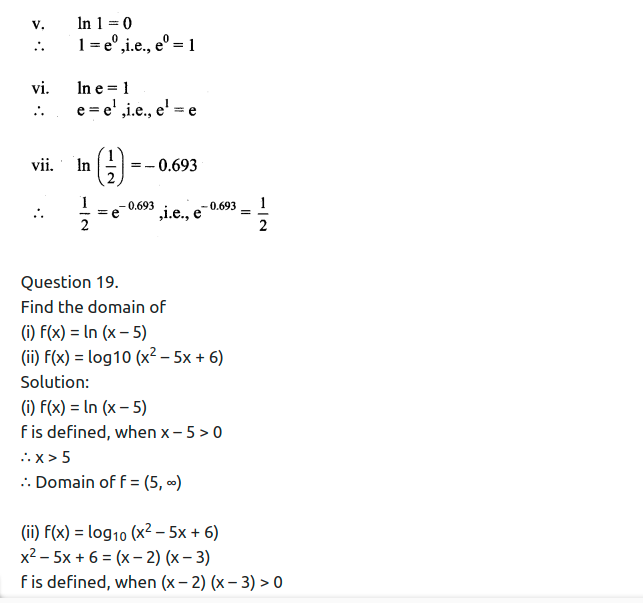
∴ x < 2 or x > 3
Solution of (x – a) (x – b) > 0 is x < a or x > b where a < b
∴ Domain of f = (-∞, 2) ∪ (3, ∞)
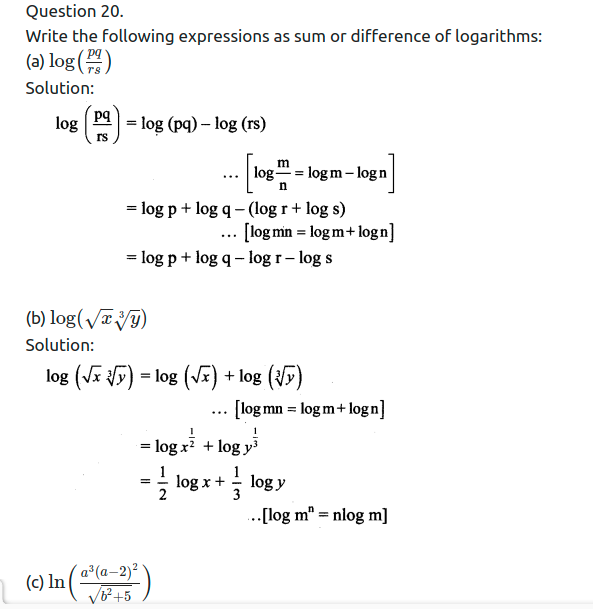
Solution:
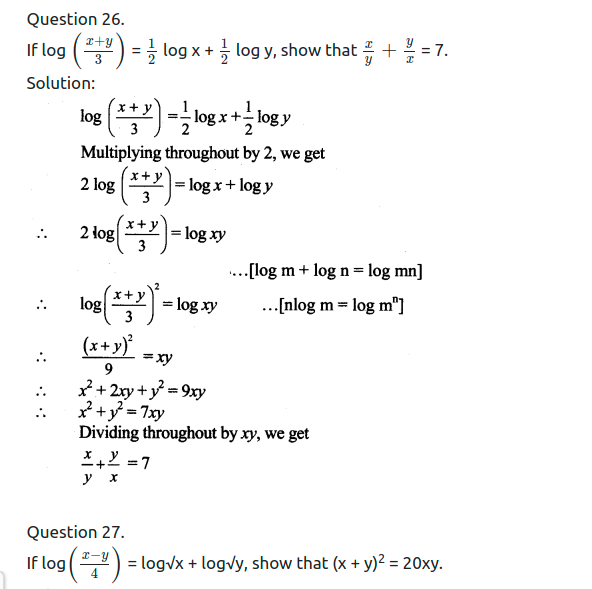
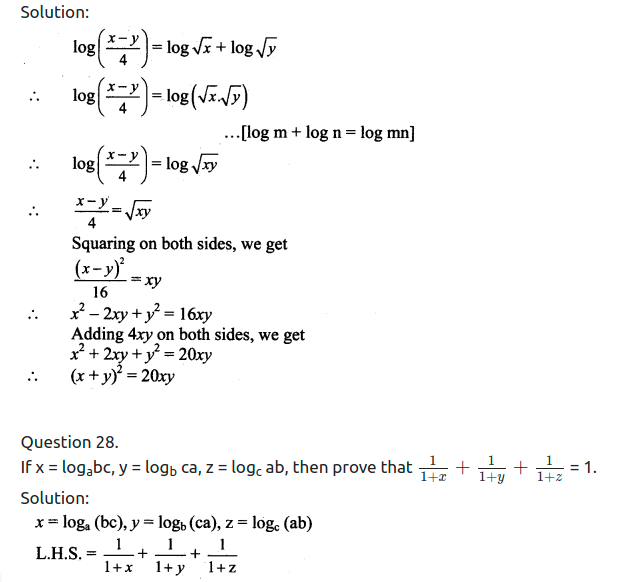
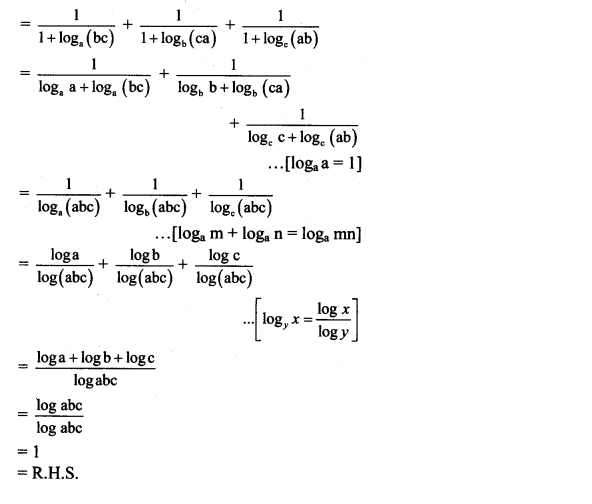
Download PDF
Maharashtra Board Solutions Class 11-Arts & Science Maths (Part 2): Chapter 6- Functions
Chapterwise Maharashtra Board Solutions Class 11 Arts & Science Maths (Part 2) :
- Chapter 1- Complex Numbers
- Chapter 2- Sequences and Series
- Chapter 3- Permutations and Combination
- Chapter 4- Methods of Induction and Binomial Theorem
- Chapter 5- Sets and Relations
- Chapter 6- Functions
- Chapter 7- Limits
- Chapter 8- Continuity
- Chapter 9- Differentiation