
Class 11: Maths Chapter 1 solutions. Complete Class 11 Maths Chapter 1 Notes.
Maharashtra Board Solutions Class 11-Arts & Science Maths (Part 2): Chapter 1- Complex Numbers
Maharashtra Board 11th Maths Chapter 1, Class 11 Maths Chapter 1 solutions
Ex 1.1
Question 1.
Simplify:
(i) √-16 + 3√-25 + √-36 – √-625
Solution:
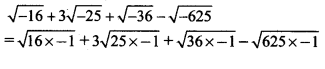
= 4i + 3(5i) + 6i – 25i
= 25i – 25i
= 0
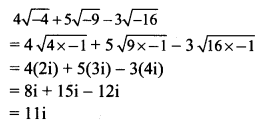
(ii) 4√-4 + 5√-9 – 3√-16
Solution:
Question 2.
Write the conjugates of the following complex numbers
(i) 3 + i
Solution:
Conjugate of (3 + i) is (3 – i).
(ii) 3 – i
Solution:
Conjugate of (3 – i) is (3 + i).
(iii) √-5 – √7 i
Solution:
Conjugate of (√-5 – √7 i) is (√-5 + √7 i).
(iv) -√-5
Solution:
-√-5 = -√5 × √-1 = -√5 i
Conjugate of (-√-5) is √5 i
(v) 5i
Solution:
Conjugate of (5i) is (-5i).
(vi) √5 – i
Solution:
Conjugate of (√5 – i) is (√5 + i).
(vii) √2 + √3 i
Solution:
Conjugate of (√2 + √3 i) is (√2 – √3 i)
(viii) cos θ + i sin θ
Solution:
Conjugate of (cos θ + i sin θ) is (cos θ – i sin θ)
Question 3.
Find a and b if
(i) a + 2b + 2ai = 4 + 6i
Solution:
a + 2b + 2ai = 4 + 6i
Equating real and imaginary parts, we get
a + 2b = 4 …..(i)
2a = 6 ……(ii)
∴ a = 3
Substituting, a = 3 in (i), we get
3 + 2b = 4
∴ b = 12
∴ a = 3 and b = 12
Check:
For a = 3 and b = 12
Consider, L.H.S. = a + 2b + 2ai
= 3 + 2(12) + 2(3)i
= 4 + 6i
= R.H.S.
(ii) (a – b) + (a + b)i = a + 5i
Solution:
(a – b) + (a + b)i = a + 5i
Equating real and imaginary parts, we get
a – b = a ……(i)
a + b = 5 ……(ii)
From (i), b = 0
Substituting b = 0 in (ii), we get
a + 0 = 5
∴ a = 5
∴ a = 5 and b = 0
(iii) (a + b) (2 + i) = b + 1 + (10 + 2a)i
Solution:
(a + b) (2 + i) = b + 1 + (10 + 2a)i
2(a + b) + (a + b)i = (b + 1) + (10 + 2a)i
Equating real and imaginary parts, we get
2(a + b) = b + 1
∴ 2a + b = 1 ……(i)
and a + b = 10 + 2a
-a + b = 10 …….(ii)
Subtracting equation (ii) from (i), we get
3a = -9
∴ a = -3
Substituting a = – 3 in (ii), we get
-(-3) + b = 10
∴ b = 7
∴ a = -3 and b = 7
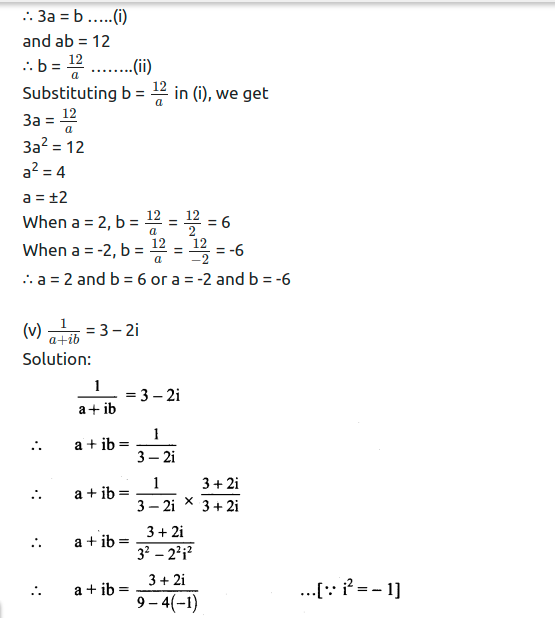
(iv) abi = 3a – b + 12i
Solution:
abi = 3a – b + 12i
∴ 0 + abi = (3a – b) + 12i
Equating real and imaginary parts, we get
3a – b = 0
∴ 3a = b …..(i)
and ab = 12
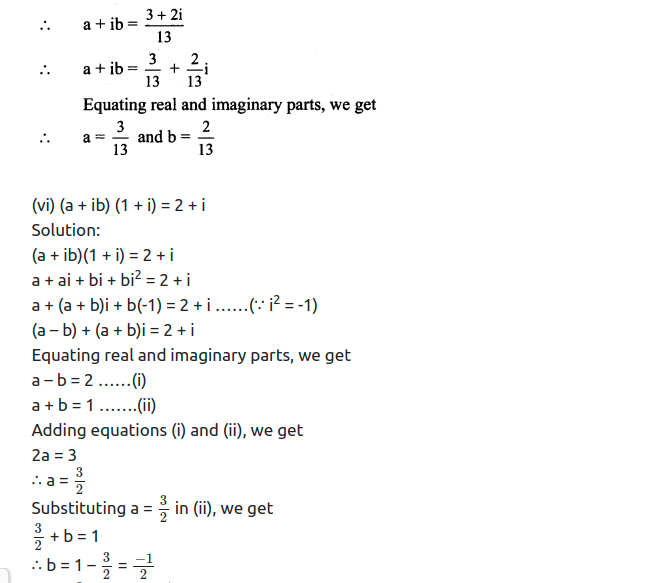
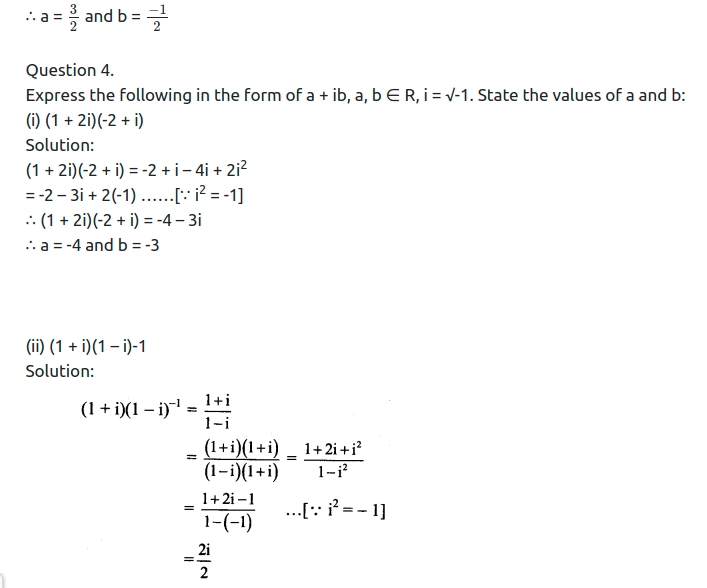
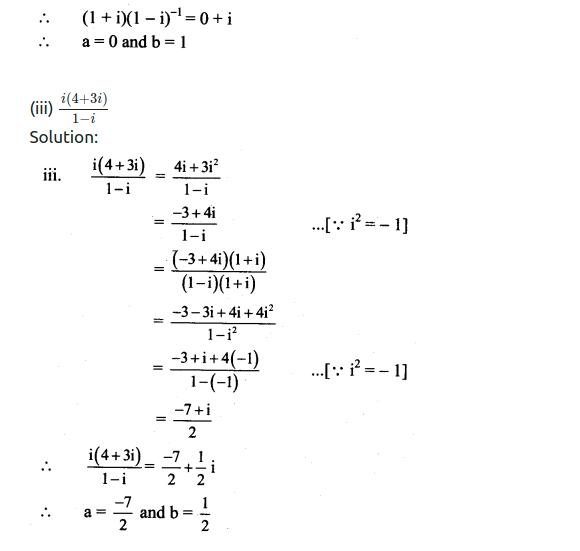
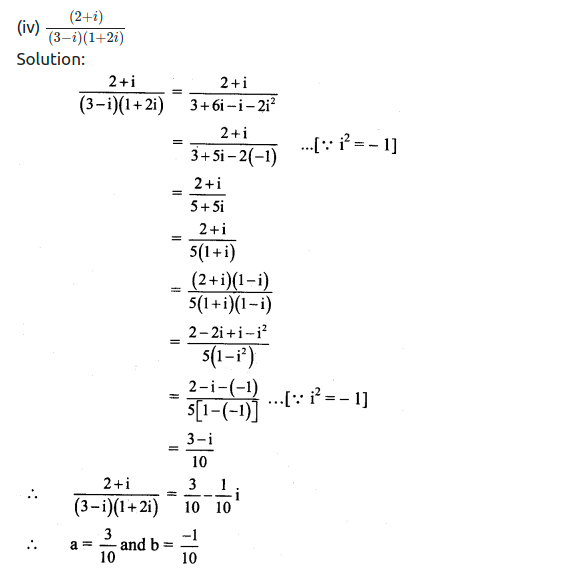
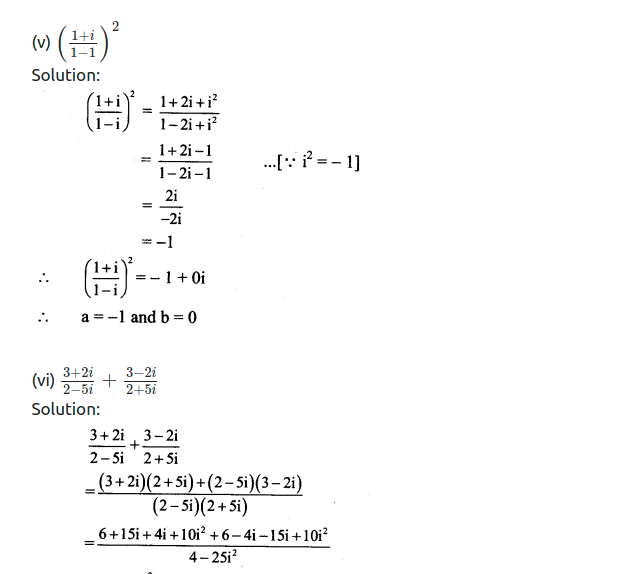
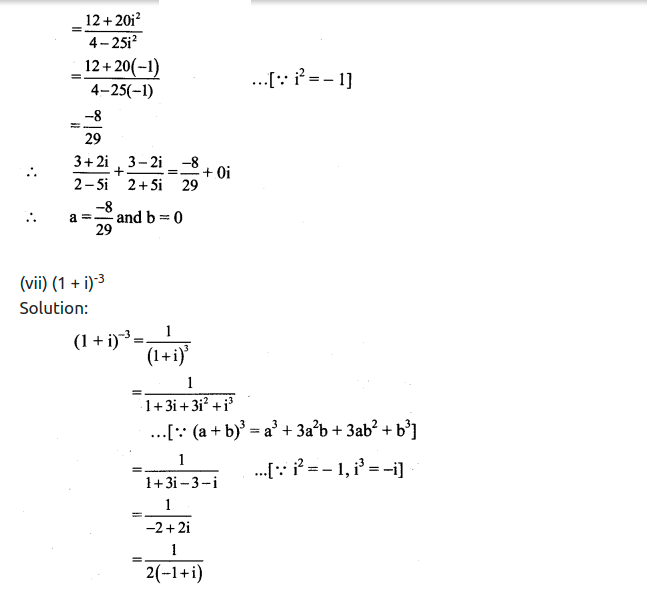
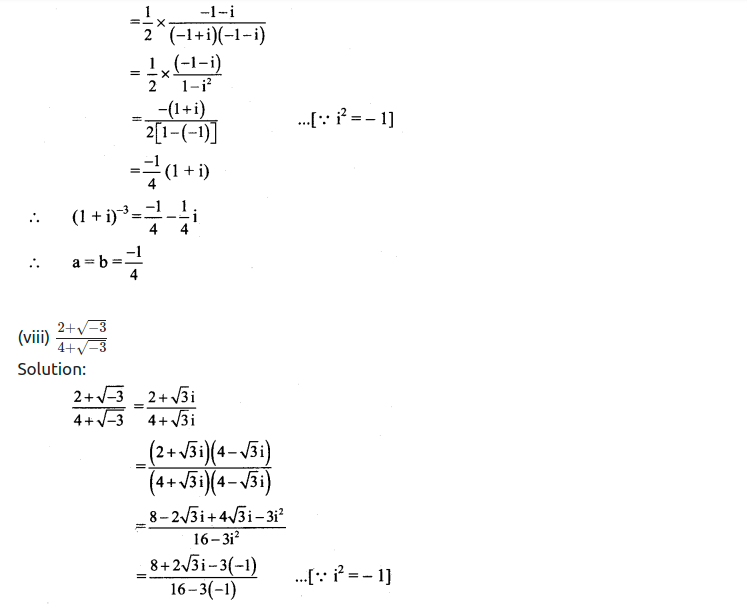
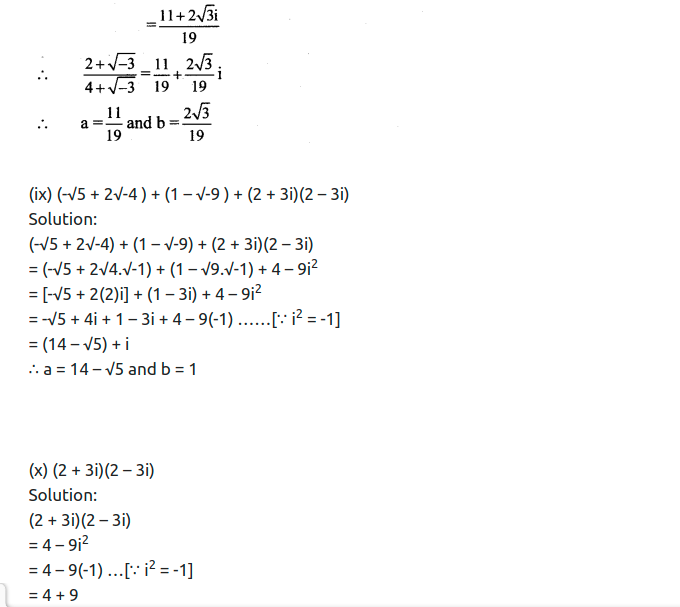
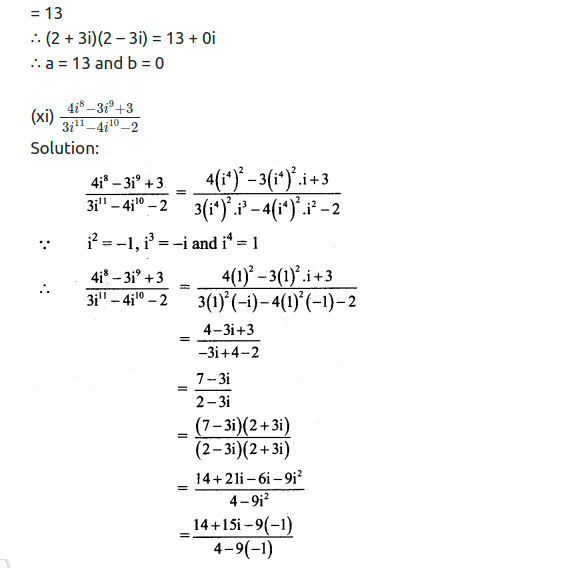
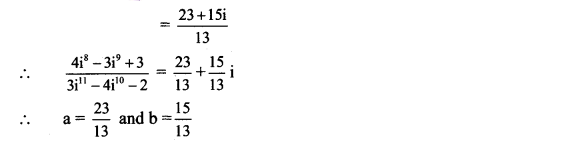
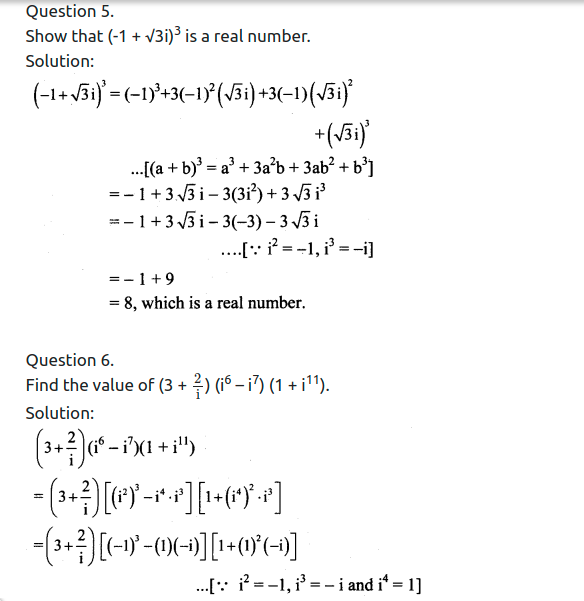
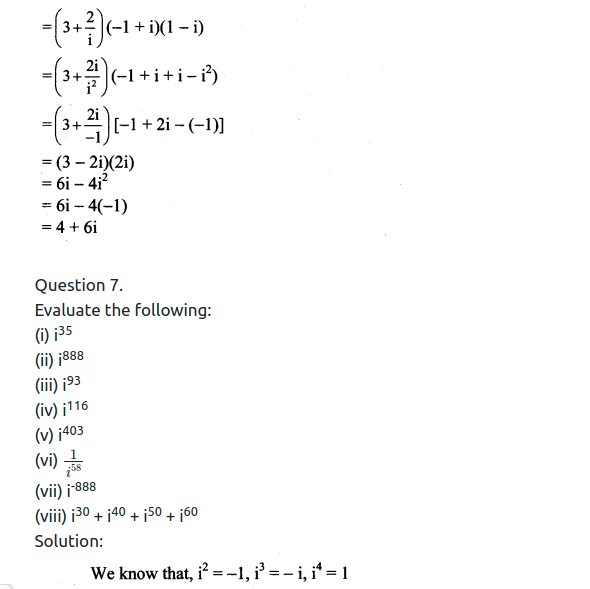
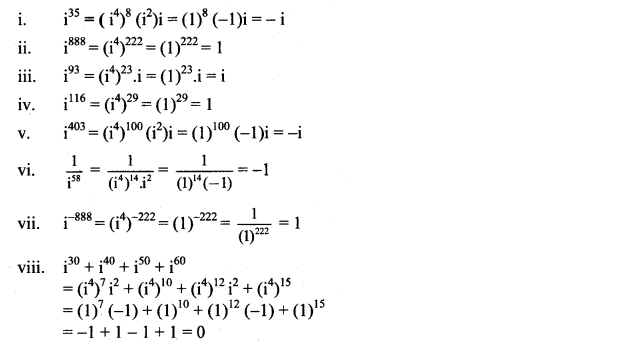
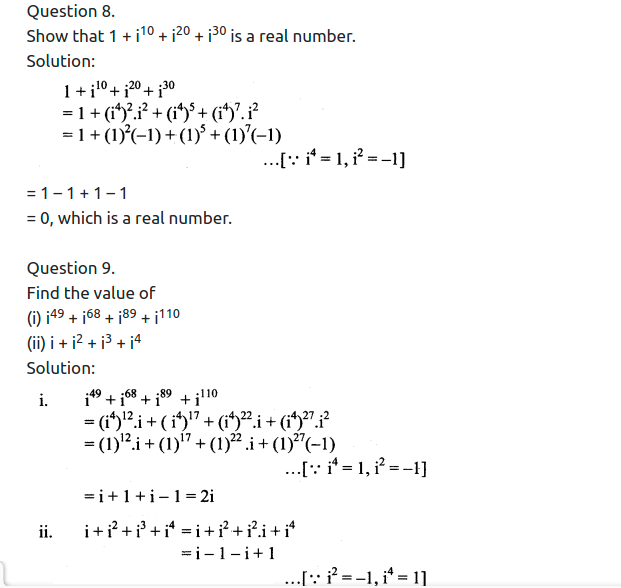
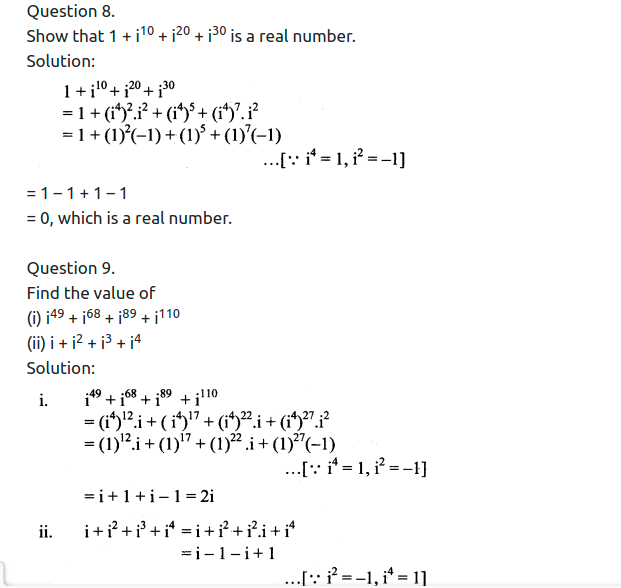
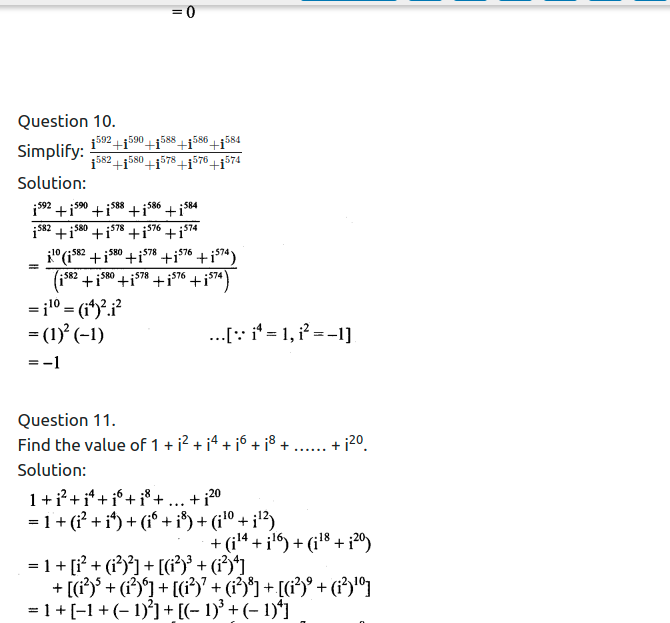
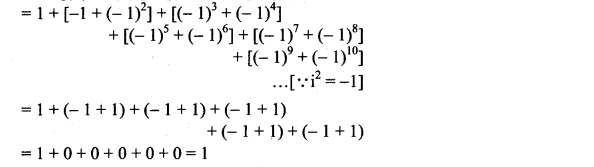
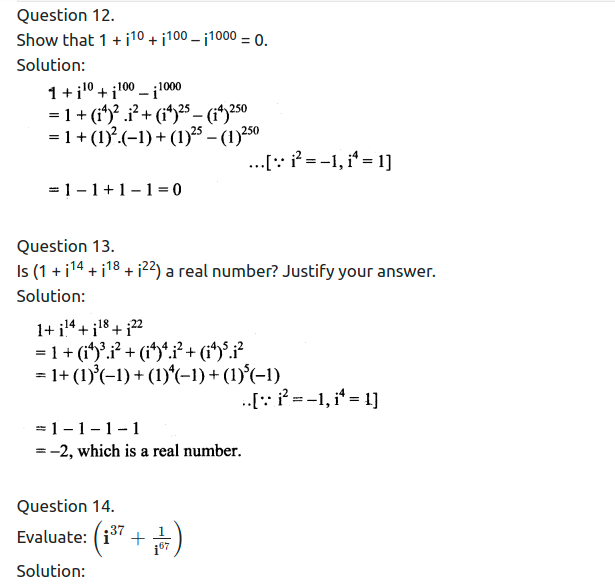
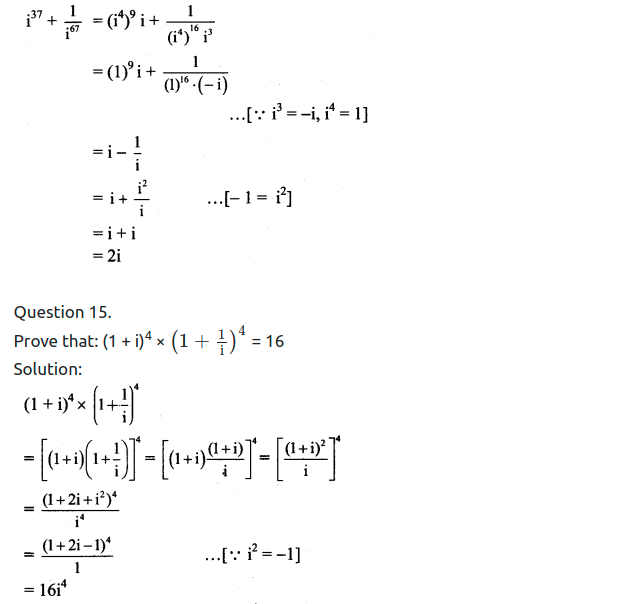
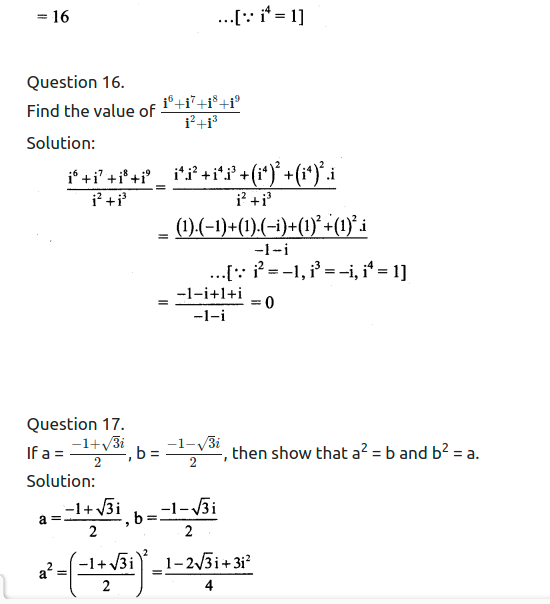
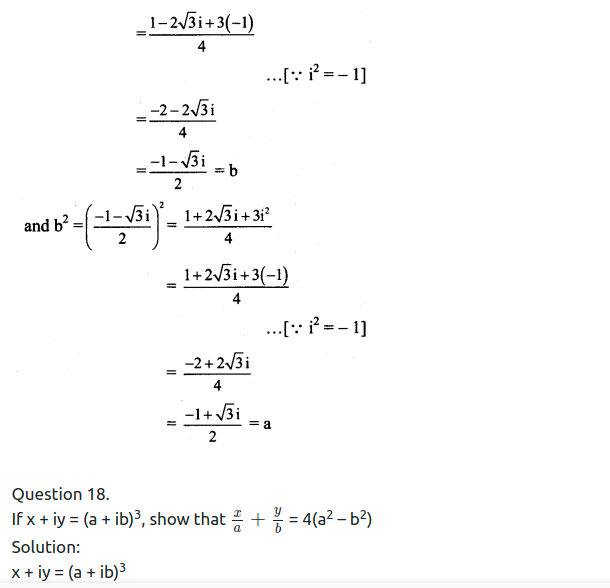
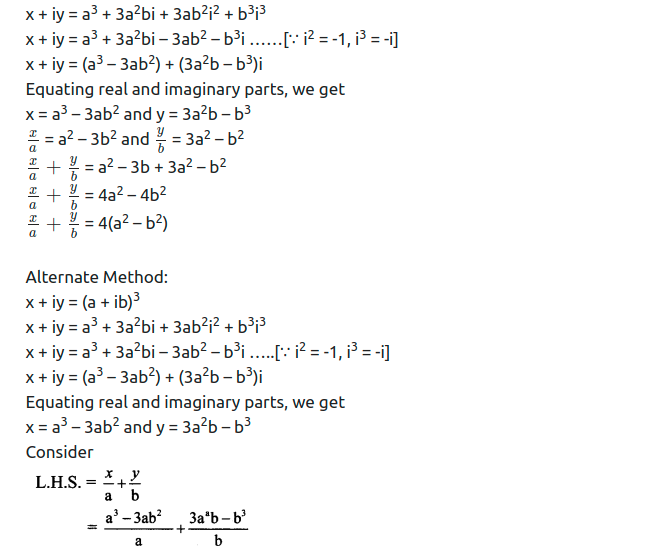
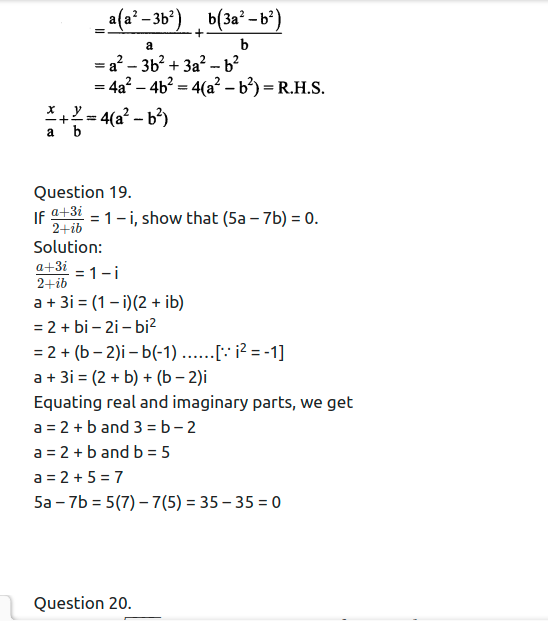
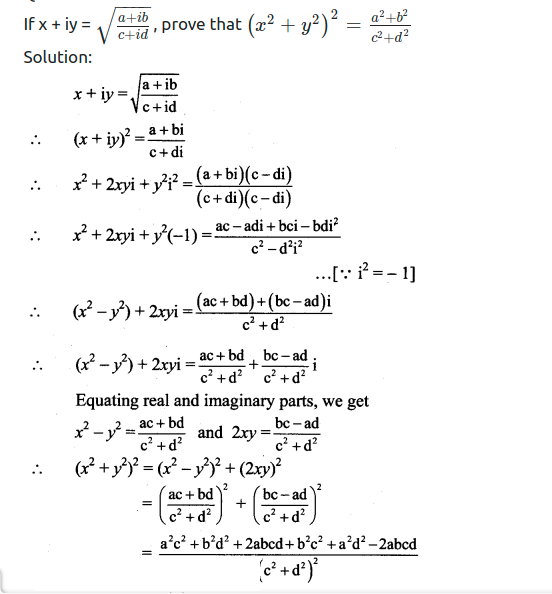
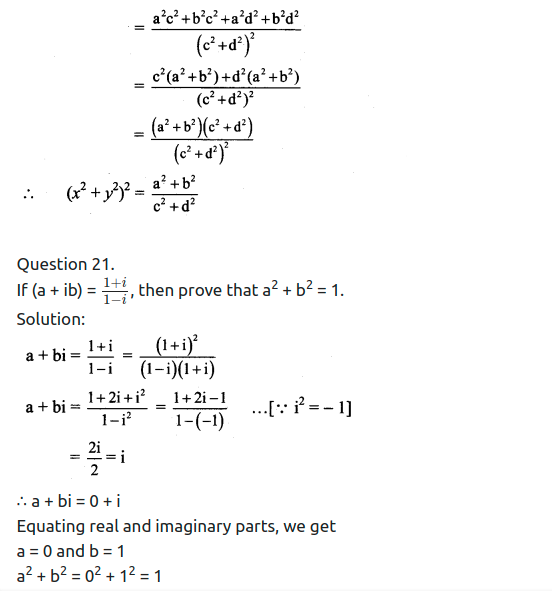
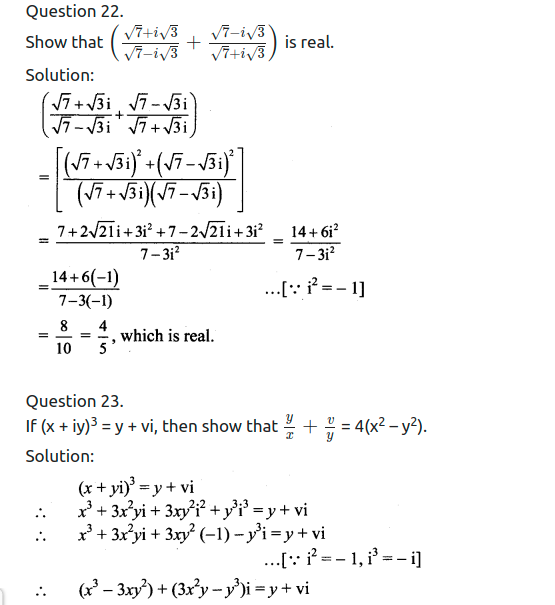
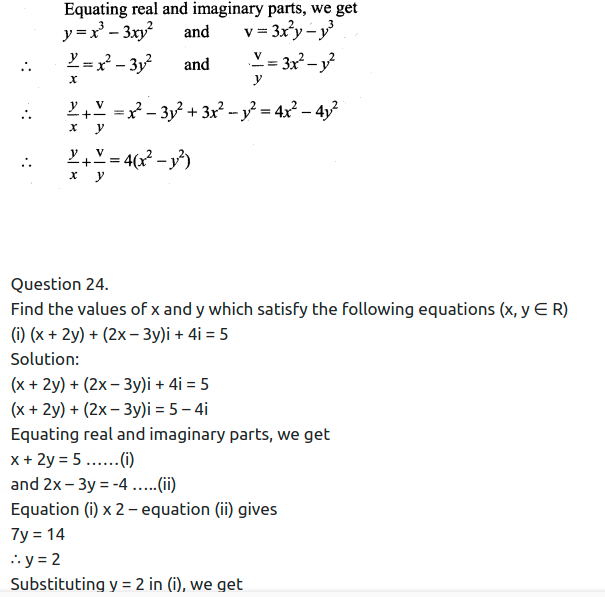
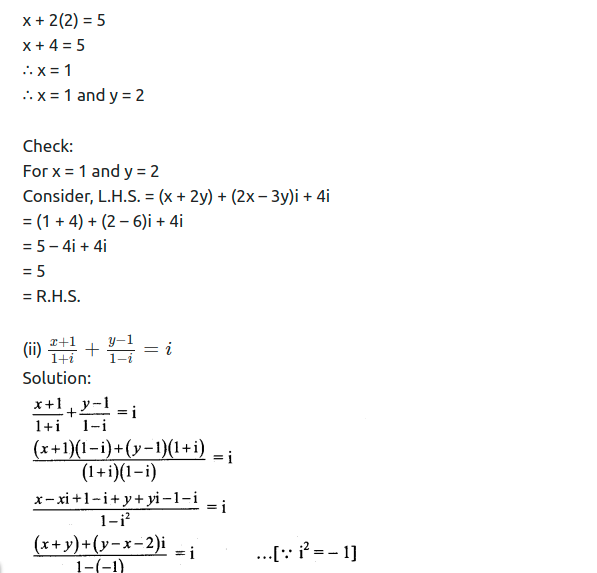
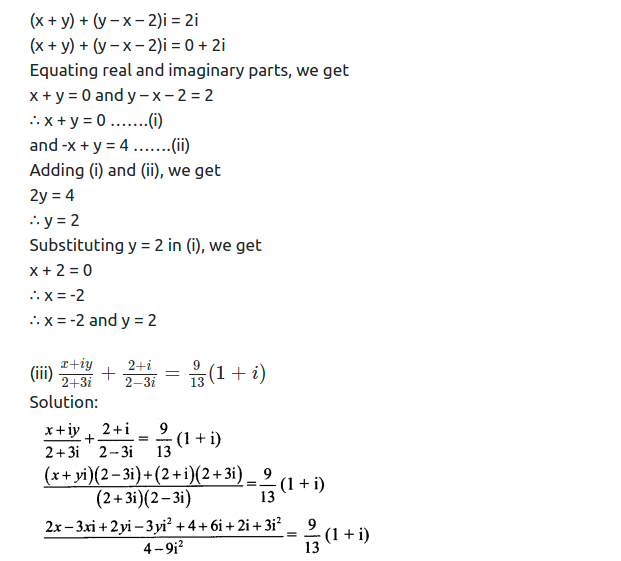
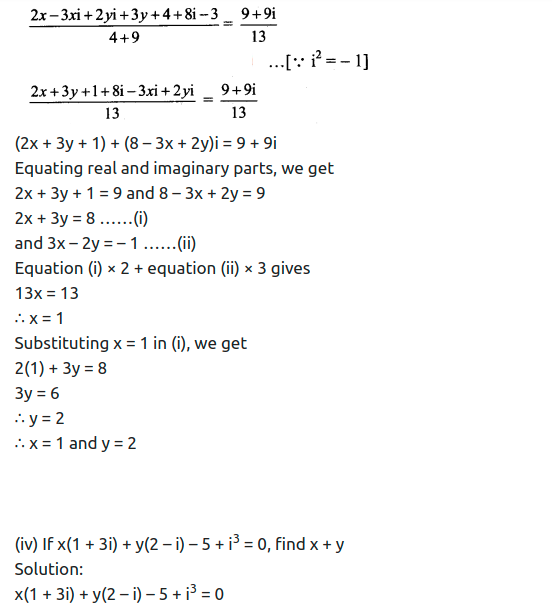
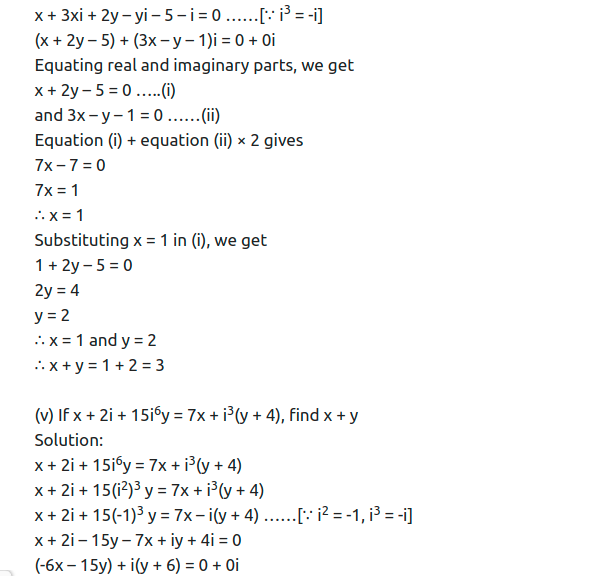
Equating real and imaginary parts, we get
-6x – 15y = 0 and y + 6 = 0
-6x – 15y = 0 and y = -6
-6x – 15(-6) = 0
-6x + 90 = 0
∴ x = 15
∴ x + y = 15 – 6 = 9
Ex 1.2
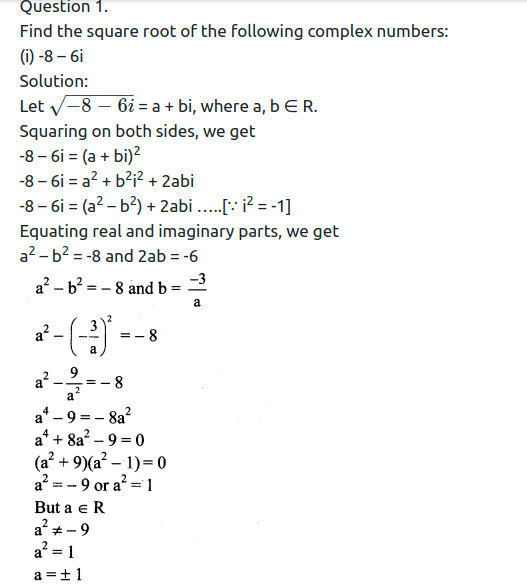
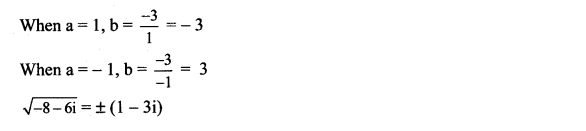
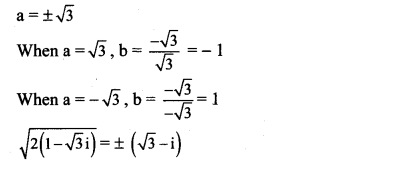
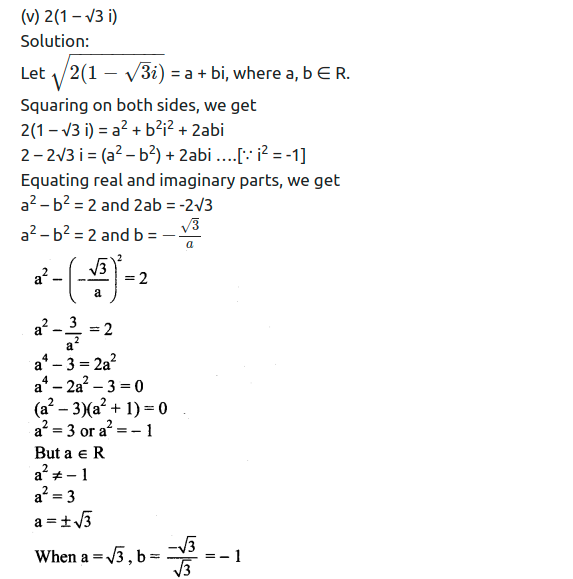
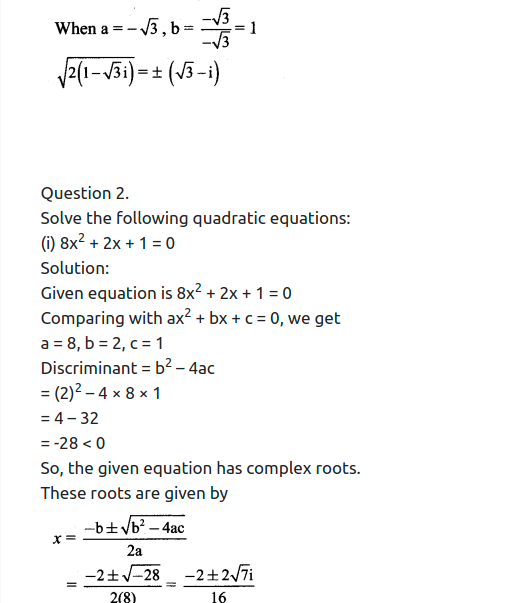
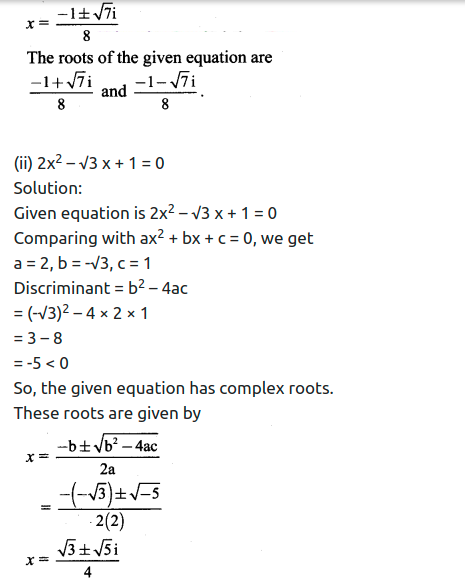
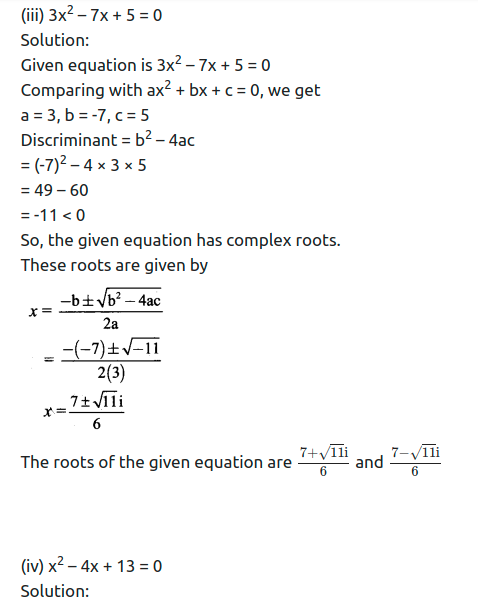
Given equation is x2 – 4x + 13 = 0
Comparing with ax2 + bx + c = 0, we get
a = 1, b = -4, c = 13
Discriminant = b2 – 4ac
= (-4)2 – 4 × 1 × 13
= 16 – 52
= -36 < 0
So, the given equation has complex roots.
These roots are given by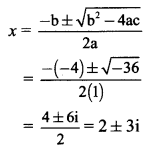
∴ The roots of the given equation are 2 + 3i and 2 – 3i.
Question 3.
Solve the following quadratic equations:
(i) x2 + 3ix + 10 = 0
Solution:
Given equation is x2 + 3ix + 10 = 0
Comparing with ax2 + bx + c = 0, we get
a = 1, b = 3i, c = 10
Discriminant = b2 – 4ac
= (3i)2 – 4 × 1 × 10
= 9i2 – 40
= -9 – 40 ……[∵ i2 = -1]
= -49 < 0
So, the given equation has complex roots.
These roots are given by
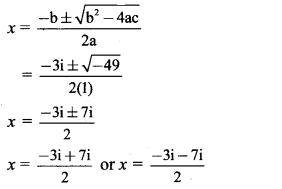
∴ x = 2i or x = -5i
∴ The roots of the given equation are 2i and -5i.
(ii) 2x2 + 3ix + 2 = 0
Solution:
Given equation is 2x2 + 3ix + 2 = 0
Comparing with ax + bx + c = 0, we get
a = 2, b = 3i, c = 2
Discriminant = b2 – 4ac
= (3i)2 – 4 × 2 × 2
= 9i2 – 16
= -9 – 16 …..[∵ i2 = -1]
= -25 < 0
So, the given equation has complex roots.
These roots are given by
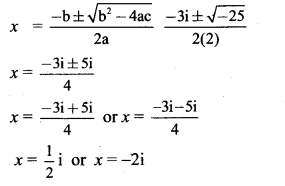
∴ The roots of the given equation are 12i and -2i.
(iii) x2 + 4ix – 4 = 0
Solution:
Given equation is x2 + 4ix – 4 = 0
Comparing with ax2 + bx + c = 0, we get
a = 1, b = 4i, c = -4
Discriminant = b2 – 4ac
= (4i)2 – 4 × 1 × (-4)
= 16i2 + 16
= -16 + 16 …..[∵ i2 = -1]
= 0
So, the given equation has equal roots.
These roots are given by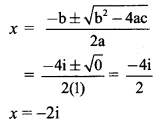
∴ x = -2i
∴ The root of the given equation is -2i.
(iv) ix2 – 4x – 4i = 0
Solution:
ix2 – 4x – 4i = 0
Multiplying throughout by i, we get
i2x2 – 4ix – 4i2 = 0
-x2 – 4ix + 4 = 0 …[∵ i2 = -1]
x2 + 4ix – 4 = 0
Comparing with ax2 + bx + c = 0, we get
a = 1, b = 4i, c = -4
Discriminant = b2 – 4ac
= (4i)2 – 4 × 1 × (-4)
= 16i2 + 16
= -16 + 16
= 0
So, the given equation has equal roots.
These roots are given by
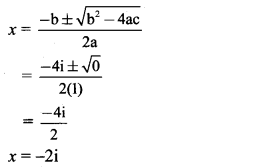
∴ The root of the given equation is -2i
Question 4.
Solve the following quadratic equations:
(i) x2 – (2 + i) x – (1 – 7i) = 0
Solution:
Given equation is x2 – (2 + i)x – (1 – 7i) = 0
Comparing with ax2 + bx + c = 0, we get
a = 1, b = -(2 + i), c = -(1 – 7i)
Discriminant = b2 – 4ac
= [-(2 + i)]2 – 4 × 1 × -(1 – 7i)
= 4 + 4i + i2 + 4 – 28i
= 4 + 4i – 1 + 4 – 28i …..[∵ i2 = – 1]
= 7 – 24i
So, the given equation has complex roots.
These roots are given by
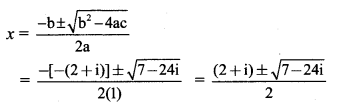
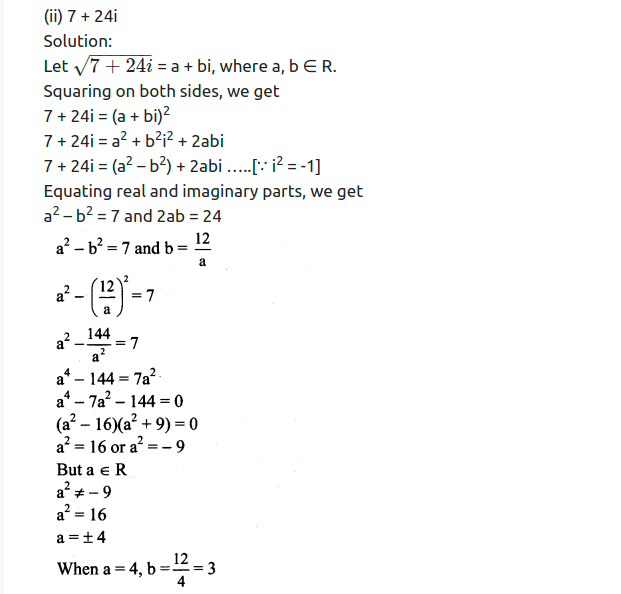
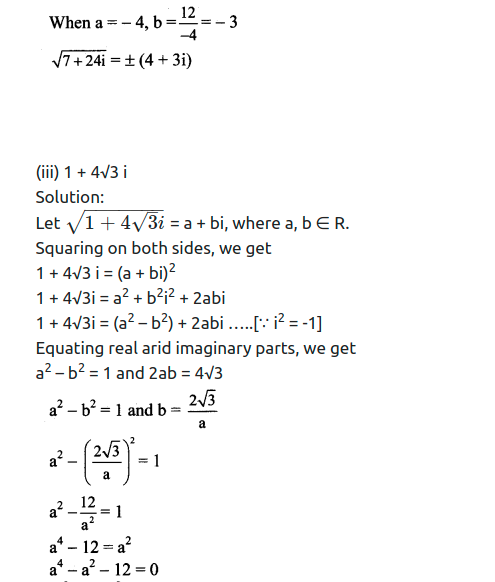
Let 7−24i−−−−−−√ = a + bi, where a, b ∈ R
Squaring on both sides, we get
7 – 24i = a2 + i2b2 + 2abi
7 – 24i = a2 – b2 + 2abi
Equating real and imaginary parts, we get
a2 – b2 = 7 and 2ab = -24
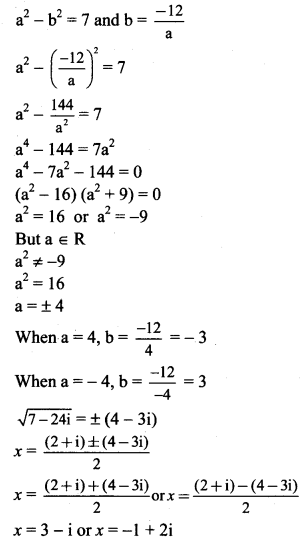
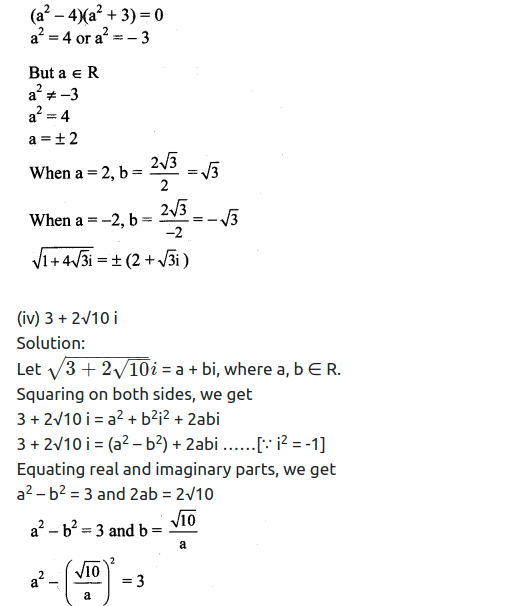
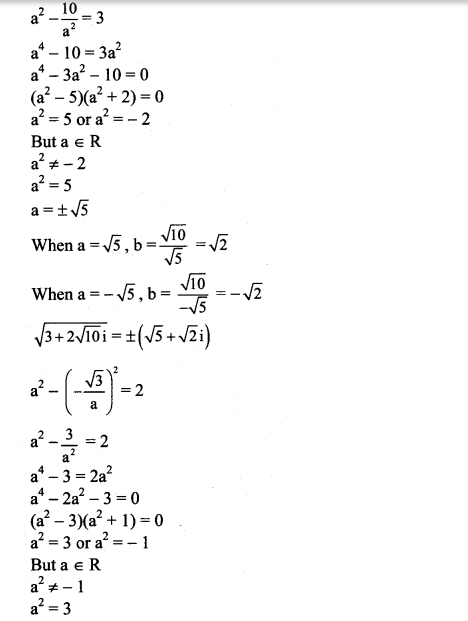
(ii) x2 – (3√2 + 2i) x + 6√2 i = 0
Solution:
Given equation is x2 – (3√2 + 2i) x + 6√2 i = 0
Comparing with ax2 + bx + c = 0, we get
a = 1, b = -(3√2 + 2i), c = 6√2i
Discriminant = b2 – 4ac
= [-(3√2 + 2i)]2 – 4 × 1 × 6√2 i
= 18 + 12√2i + 4i2 – 24√2 i
= 18 – 12√2 i – 4 ……[∵ i2 = -1]
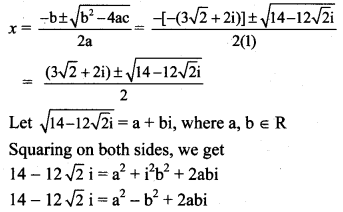
= 14 – 12√2 i
So, the given equation has complex roots.
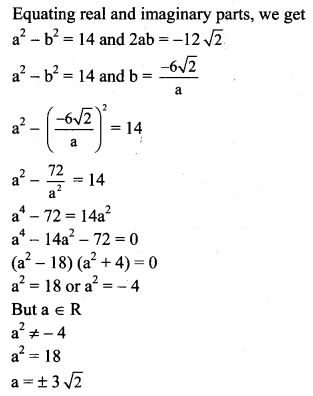
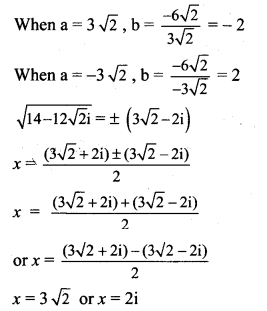
These roots are given by
(iii) x2 – (5 – i) x + (18 + i) = 0
Solution:
Given equation is x2 – (5 – i)x + (18 + i) = 0
Comparing with ax2 + bx + c = 0, we get
a = 1, b = -(5 – i), c = 18 + i
Discriminant = b2 – 4ac
= [-(5 – i)]2 – 4 × 1 × (18 + i)
= 25 – 10i + i2 – 72 – 4i
= 25 – 10i – 1 – 72 – 4i ……[∵ i2 = -1]
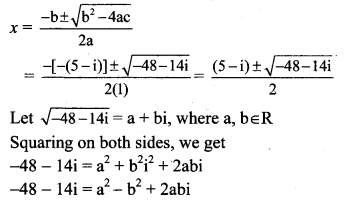
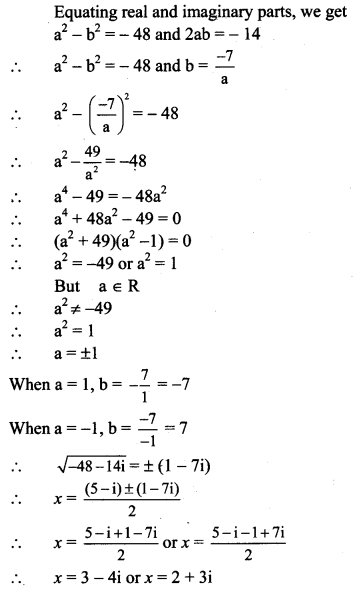
= -48 – 14i
So, the given equation has complex roots.
These roots are given by
(iv) (2 + i) x2 – (5 – i) x + 2(1 – i) = 0
Solution:
Given equation is (2 + i) x2 – (5 – i) x + 2(1 – i) = 0
Comparing with ax2 + bx + c = 0, we get
a = 2 + i, b = -(5 – i), c = 2(1 – i)
Discriminant = b2 – 4ac
= [-(5 – i)]2 – 4 × (2 + i) × 2(1 – i)
= 25 – 10i + i2 – 8(2 + i) (1 – i)
= 25 – 10i + i2 – 8(2 – 2i + i – i2)
= 25 – 10i – 1 – 8(2 – i + 1) …..[∵ i2 = -1]
= 25 – 10i – 1 – 16 + 8i – 8
= -2i
So, the given equation has complex roots.
These roots are given by
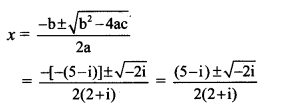
Let −2i−−−√ = a + bi, where a, b ∈ R
Squaring on both sides, we get
-2i = a2 + b2i2 + 2abi
-2i = a2 – b2 + 2abi
Equating real and imaginary parts, we get
a2 – b2 = 0 and 2ab = -2
a2 – b2 = 0 and b = −1a
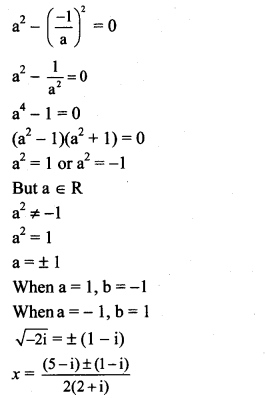
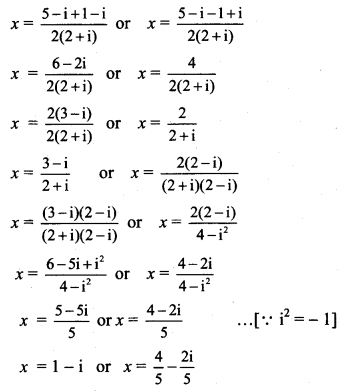
Question 5.
Find the value of
(i) x3 – x2 + x + 46, if x = 2 + 3i
Solution:
x = 2 + 3i
x – 2 = 3i
(x – 2)2 = 9i2
x2 – 4x + 4 = 9(-1) …..[∵ i2 = -1]
x2 – 4x + 13 = 0 …..(i)
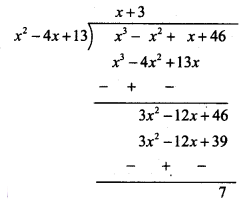
Dividend = Divisor × Quotient + Remainder
∴ x3 – x2 + x + 46 = (x2 – 4x + 13) (x + 3) + 7
= 0(x + 3) + 7 …..[from(i)]
= 7
Alternate Method:
x = 2 + 3i
α = 2 + 3i, α¯ = 2 – 3i
αα¯ = (2 + 3i)(2 – 3i)
= 4 – 6i + 6i – 9i2
= 4 – 9(-1)
= 4 + 9
= 13
α + α¯ = 2 + 3i + 2 – 3i = 4
∴ Standard form of quadratic equation,
x2 – (Sum of roots) x + Product of roots = 0
x2 – 4x + 13 = 0
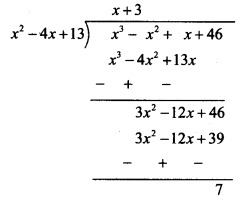
Dividend = Divisor × Quotient + Remainder
∴ x3 – x2 + x + 46 = (x2 – 4x + 13).(x + 3) + 7
= 0(x + 3) + 7 …..[From (i)]
= 7
(ii) 2x3 – 11x2 + 44x + 27, if x = 253−4i
Solution:
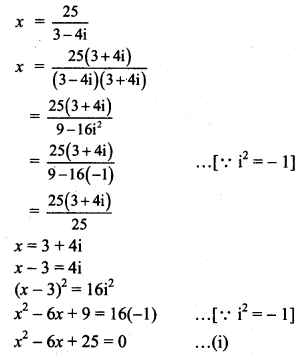
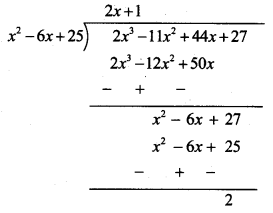
Dividend = Divisor × Quotient + Remainder
2x3 – 11x2 + 44x + 27 = (x2 – 6x + 25)(2x + 1) + 2
= 0.(2x + 1) + 2 …..[From (i)]
= 0 + 2
= 2
(iii) x3 + x2 – x + 22, if x = 51−2i
Solution:
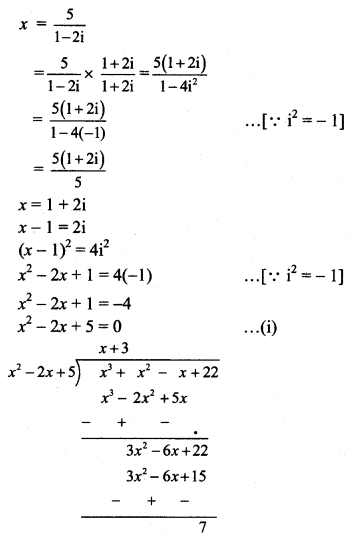
Dividend = Divisor × Quotient + Remainder
x3 + x2 – x + 22 = (x2 – 2x + 5)(x + 3) + 7
= 0.(x + 3) + 7 …..[From (i)]
= 0 + 7
= 7
(iv) x4 + 9x3 + 35x2 – x + 4, if x = -5 + √-4
Solution:
x = -5 + √-4
x + 5 = √-4
x + 5 = √4 √-1
x + 5 = 2i
(x + 5)2 = 4i2
x2 + 10x + 25 = 4(-1) ….[∵ i2 = -1]
x2 + 10x + 29 = 0 …..(i)
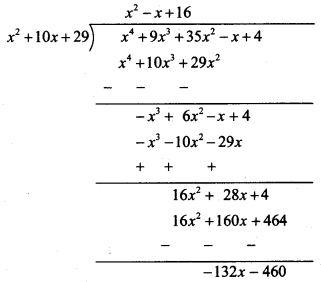
Dividend = Divisor × Quotient + Remainder
x4 + 9x3 + 35x2 – x + 4 = (x2 + 10x + 29) (x2 – x + 16) – 132x – 460
= 0.(x2 – x + 16) – 132x – 460 …..[From (i)]
= -132 (-5 + 2i) – 460
= 660 – 264i – 460
= 200 – 264i
(v) 2x4 + 5x3 + 7x2 – x + 41, if x = -2 – √3i
Solution:
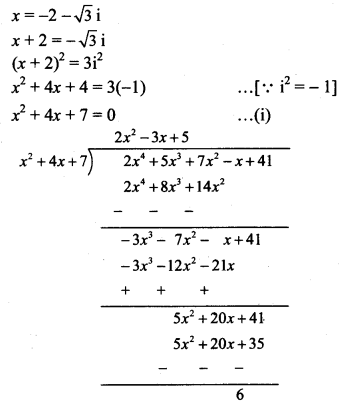
Dividend = Divisor × Quotient + Remainder
2x4 + 5x3 + 7x2 – x + 41 = (x2 + 4x + 7) (2x2 – 3x + 5) + 6
= 0(2x2 – 3x + 5) + 6 ……[From (i)]
= 0 + 6
= 6
Ex 1.3
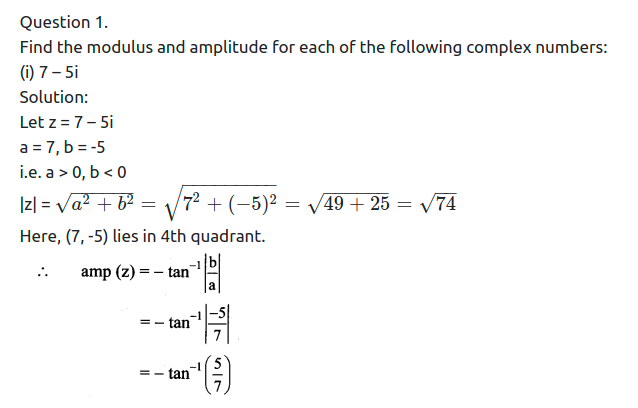
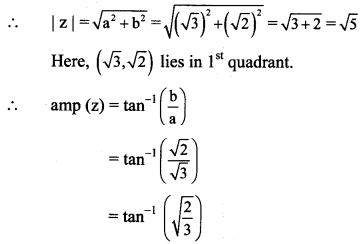
(ii) √3 + √2 i
Solution:
Let z = √3 + √2 i
a = √3, b = √2,
i.e. a > 0, b > 0
(iii) -8 + 15i
Solution:
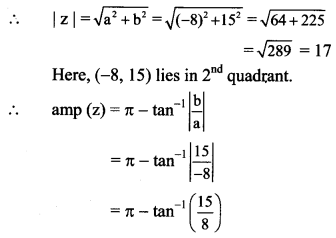
Let z = -8 + 15i
a = -8, b = 15 , i.e. a < 0, b > 0
(iv) -3(1 – i)
Solution:
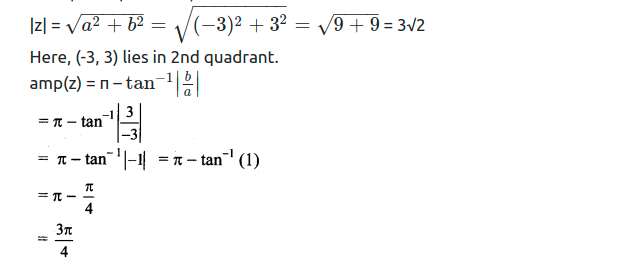
Let z = -3(1 – i) = -3 + 3i
a = -3, b = 3 , i.e. a < 0, b > 0
(v) -4 – 4i
Solution:
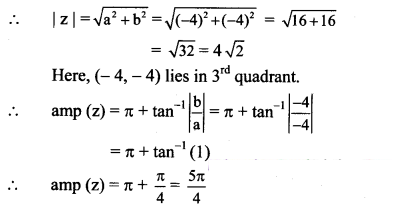
Let z = -4 – 4i
a = -4, b = -4 , i.e. a < 0, b < 0
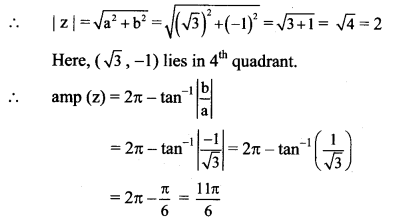
(vi) √3 – i
Solution:
Let z = √3 – i
a = √3, b = -1, i.e. a > 0, b < 0

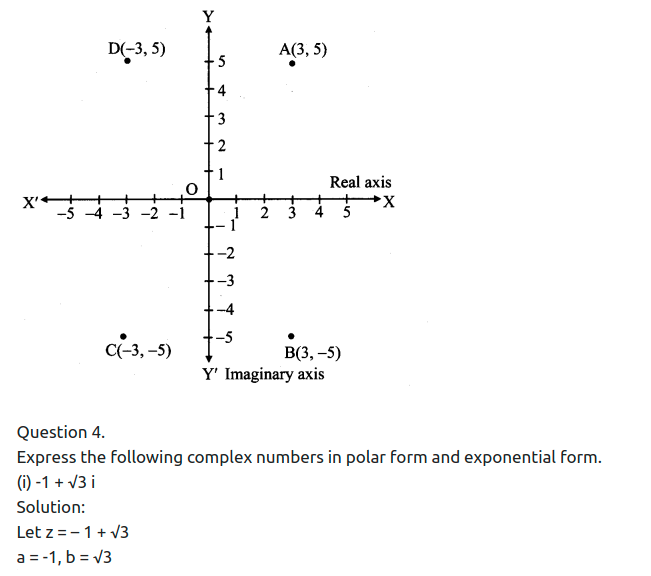
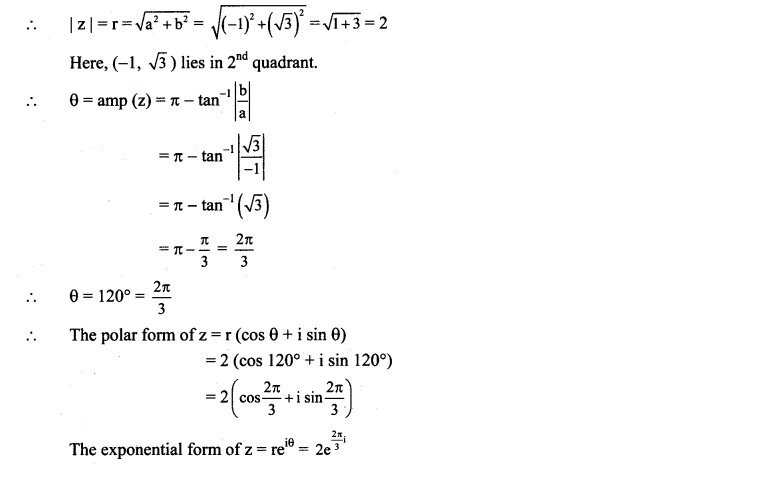
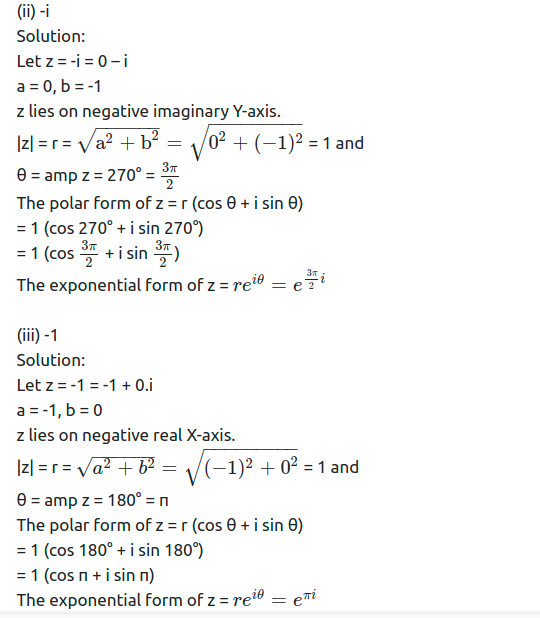
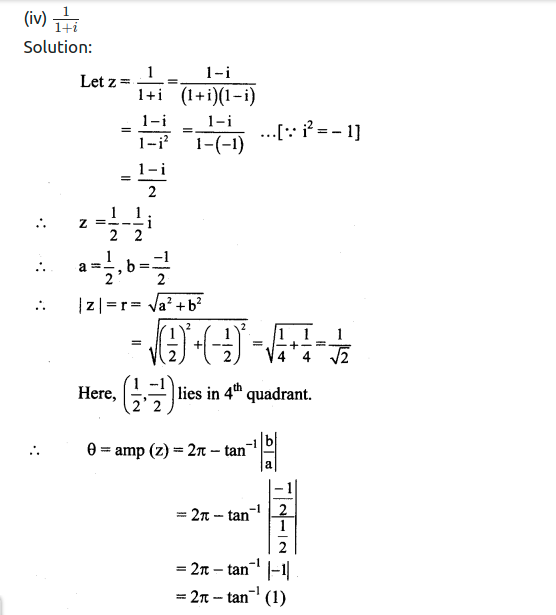
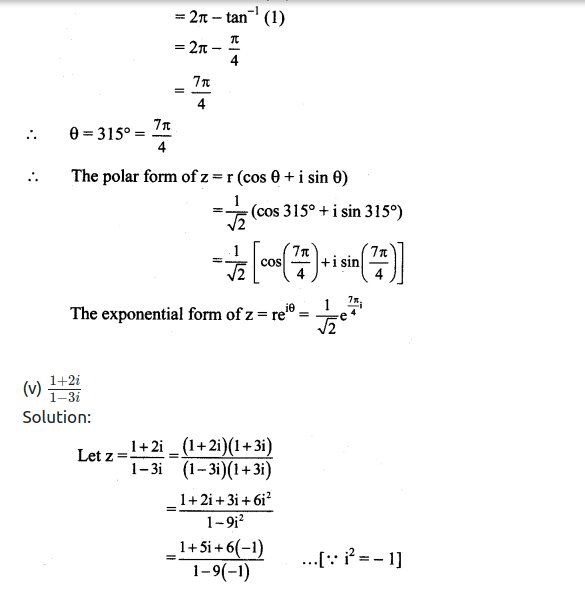
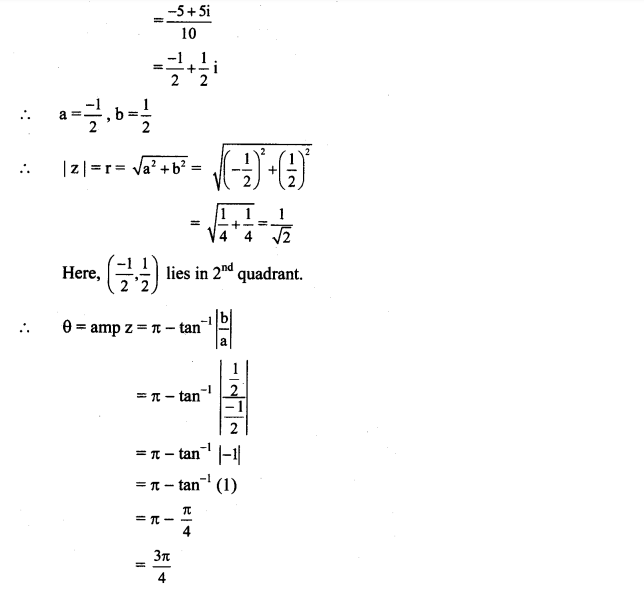
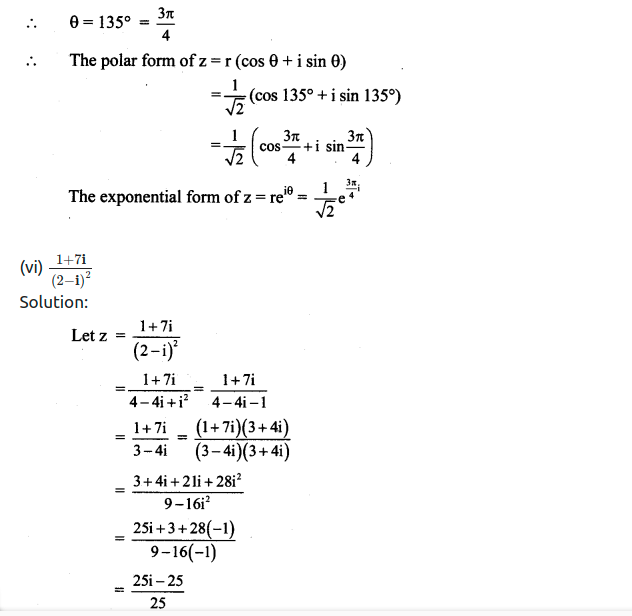
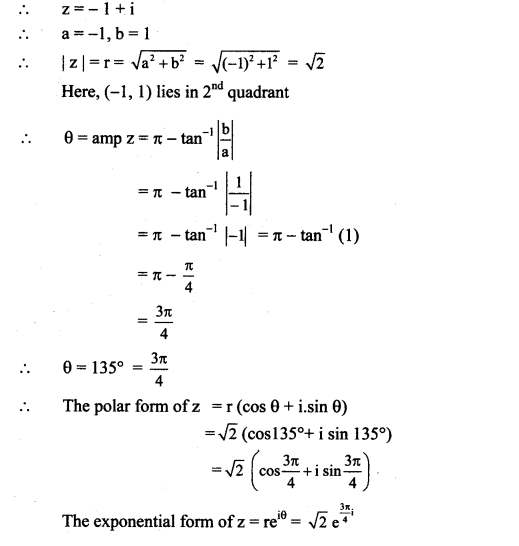
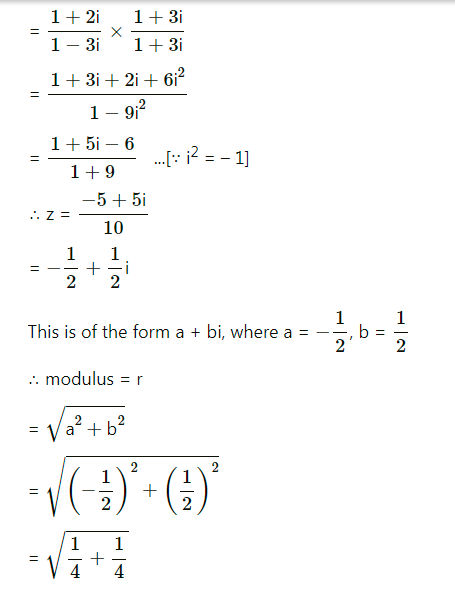
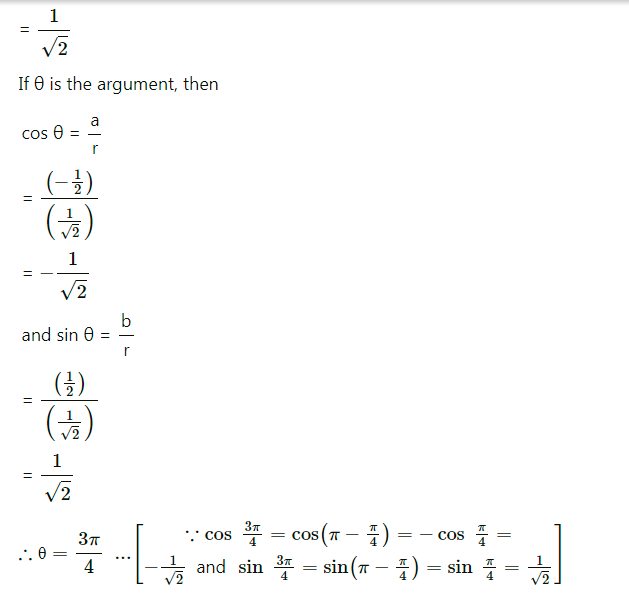
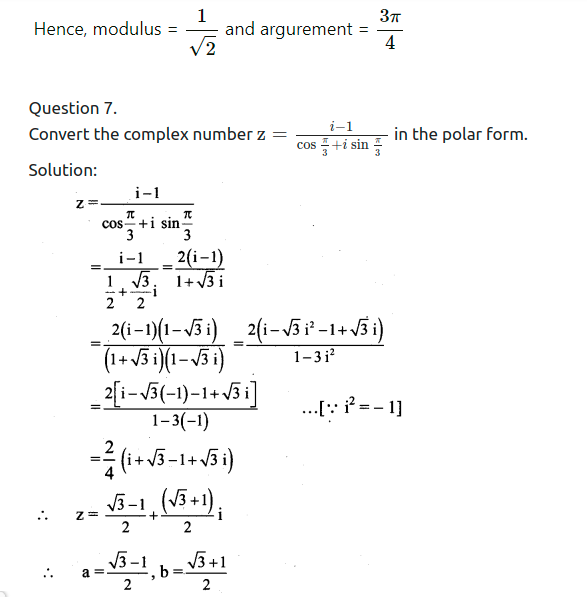
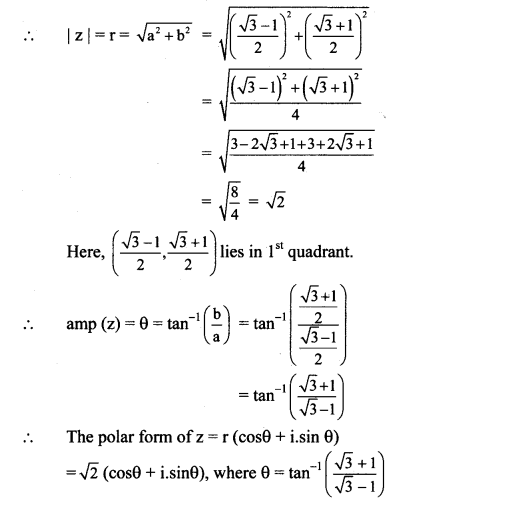
Ex 1.4
Question 1.
Find the value of
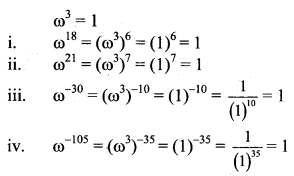
(i) ω18
(ii) ω21
(iii) ω-30
(iv) ω-105
Solution:
Question 2.
If ω is the complex cube root of unity, show that
(i) (2 – ω)(2 – ω2) = 7
Solution:
ω is the complex cube root of unity.
ω3 = 1 and 1 + ω + ω2 = 0
Also, 1 + ω2 = -ω, 1 + ω = -ω2 and ω + ω2 = -1
L.H.S. = (2 – ω)(2 – ω2)
= 4 – 2ω2 – 2ω + ω3
= 4 – 2(ω2 + ω) + 1
= 4 – 2(-1) + 1
= 4 + 2 + 1
= 7
= R.H.S.
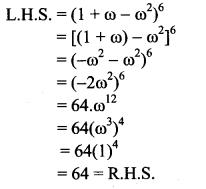
(ii) (1 + ω – ω2)6 = 64
Solution:
ω is the complex cube root of unity.
ω3 = 1 and 1 + ω + ω2 = 0
Also, 1 + ω2 = -ω, 1 + ω = -ω2 and ω + ω2 = -1
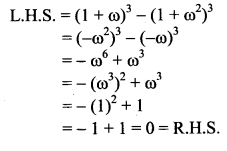
(iii) (1 + ω)3 – (1 + ω2)3 = 0
Solution:
ω is the complex cube root of unity.
ω3 = 1 and 1 + ω + ω2 = 0
Also, 1 + ω2 = -ω, 1 + ω = -ω2 and ω + ω2 = -1
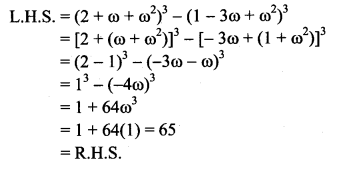
(iv) (2 + ω + ω2)3 – (1 – 3ω + ω2)3 = 65
Solution:
ω is the complex cube root of unity.
ω3 = 1 and 1 + ω + ω2 = 0
Also, 1 + ω2 = -ω, 1 + ω = -ω2 and ω + ω2 = -1
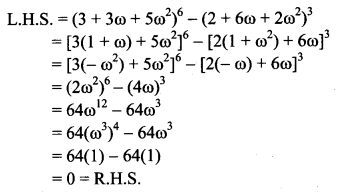
(v) (3 + 3ω + 5ω2)6 – (2 + 6ω + 2ω2)3 = 0
Solution:
ω is the complex cube root of unity.
ω3 = 1 and 1 + ω + ω2 = 0
Also, 1 + ω2 = -ω, 1 + ω = -ω2 and ω + ω2 = -1
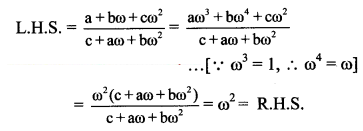
(vi) a+bω+cω2c+aω+bω2 = ω2
Solution:
ω is the complex cube root of unity.
ω3 = 1 and 1 + ω + ω2 = 0
Also, 1 + ω2 = -ω, 1 + ω = -ω2 and ω + ω2 = -1
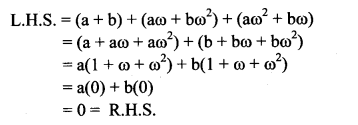
(vii) (a + b) + (aω + bω2) + (aω2 + bω) = 0
Solution:
ω is the complex cube root of unity.
ω3 = 1 and 1 + ω + ω2 = 0
Also, 1 + ω2 = -ω, 1 + ω = -ω2 and ω + ω2 = -1
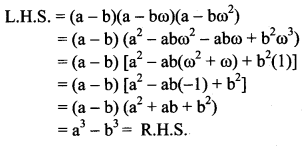
(viii) (a – b)(a – bω)(a – bω2) = a3 – b3
Solution:
ω is the complex cube root of unity.
ω3 = 1 and 1 + ω + ω2 = 0
Also, 1 + ω2 = -ω, 1 + ω = -ω2 and ω + ω2 = -1
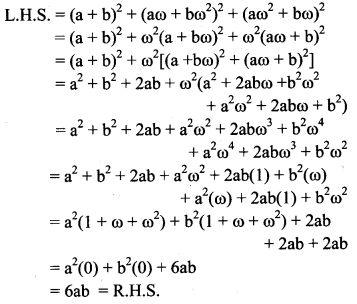
(ix) (a + b)2 + (aω + bω2)2 + (aω2+ bω)2 = 6ab
Solution:
ω is the complex cube root of unity.
ω3 = 1 and 1 + ω + ω2 = 0
Also, 1 + ω2 = -ω, 1 + ω = -ω2 and ω + ω2 = -1
Question 3.
If ω is the complex cube root of unity, find the value of
(i) ω + 1ω
Solution:
ω is the complex cube root of unity.
ω3 = 1 and 1 + ω + ω2 = 0
Also, 1 + ω2 = -ω, 1 + ω = -ω2 and ω + ω2 = -1
ω+1ω=ω2+1ω=−ωω=−1
(ii) ω2 + ω3 + ω4
Solution:
ω is the complex cube root of unity.
ω3 = 1 and 1 + ω + ω2 = 0
Also, 1 + ω2 = -ω, 1 + ω = -ω2 and ω + ω2 = -1
ω2 + ω3 + ω4
= ω2(1 + ω + ω2)
= ω2(0)
= 0
(iii) (1 + ω2)3
Solution:
ω is the complex cube root of unity.
ω3 = 1 and 1 + ω + ω2 = 0
Also, 1 + ω2 = -ω, 1 + ω = -ω2 and ω + ω2 = -1
(1 + ω2)3
= (-ω)3
= -ω3
= -1
(iv) (1 – ω – ω2)3 + (1 – ω + ω2)3
Solution:
ω is the complex cube root of unity.
ω3 = 1 and 1 + ω + ω2 = 0
Also, 1 + ω2 = -ω, 1 + ω = -ω2 and ω + ω2 = -1
(1 – ω – ω2)3 + (1 – ω + ω2)3
= [1 – (ω + ω2)]3 + [(1 + ω2) – ω]3
= [1 – (-1)]2 + (-ω – ω)3
= 23 + (-2ω)3
= 8 – 8ω3
= 8 – 8(1)
= 0
(v) (1 + ω)(1 + ω2)(1 + ω4)(1 + ω8)
Solution:
ω is the complex cube root of unity.
ω3 = 1 and 1 + ω + ω2 = 0
Also, 1 + ω2 = -ω, 1 + ω = -ω2 and ω + ω2 = -1
(1 + ω)(1 + ω2)(1 + ω4)(1 + ω8)
= (1 + ω)(1 + ω2)(1 + ω)(1 + ω2) …..[∵ ω3 = 1, ω4 = ω]
= (-ω2)(-ω)(-ω2)(-ω)
= ω6
= (ω3)2
= (1)2
= 1
Question 4.
If α and β are the complex cube roots of unity, show that
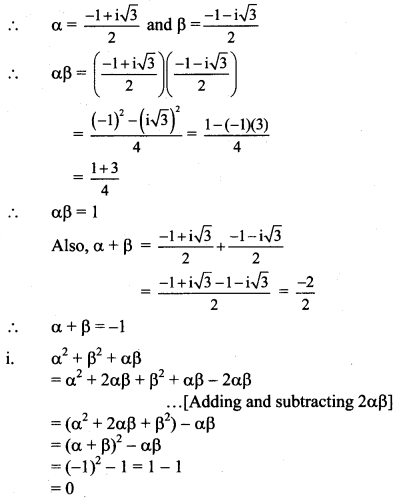
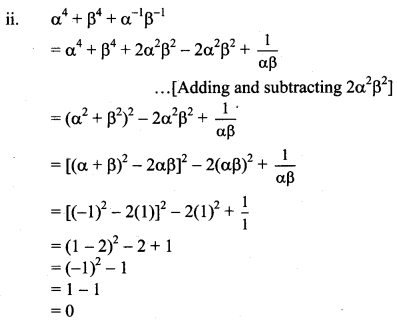
(i) α2 + β2 + αβ = 0
(ii) α4 + β4 + α-1β-1 = 0
Solution:
α and β are the complex cube roots of unity.
Question 5.
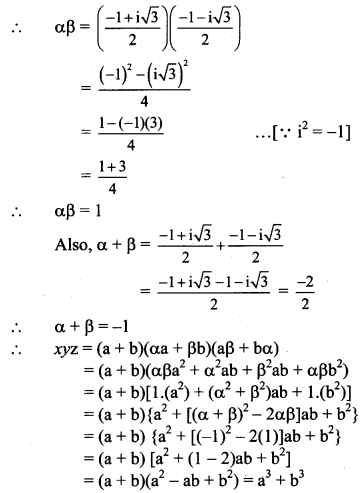
If x = a + b, y = αa + βb and z = aβ + bα, where α and β are complex cube roots of unity, show that xyz = a3 + b3.
Solution:
x = a + b, y = αa + βb, z = aβ + bα
α and β are the complex cube roots of unity.
∴ α = −1+i3√2 and β = −1−i3√2
Question 6.
Find the equation in cartesian coordinates of the locus of z if
(i) |z| = 10
Solution:
Let z = x + iy
|z| = 10
|x + iy| = 10
x2+y2−−−−−−√ = 10
∴ x2 + y2 = 100
(ii) |z – 3| = 2
Solution:
Let z = x + iy
|z – 3| = 2
|x + iy – 3| = 2
|(x – 3) + iy| = 2
(x−3)2+y2−−−−−−−−−−−√ = 2
∴ (x – 3)2 + y2 = 4
(iii) |z – 5 + 6i| = 5
Solution:
Let z = x + iy
|z – 5 + 6i| = 5
|x + iy – 5 + 6i| = 5
|(x – 5) + i(y + 6)| = 5
(x−5)2+(y+6)2−−−−−−−−−−−−−−−√ = 5
∴ (x – 5)2 + (y + 6)2 = 25
(iv) |z + 8| = |z – 4|
Solution:
Let z = x + iy
|z + 8| = |z – 4|
|x + iy + 8| = |x + iy – 4|
|(x + 8) + iy | = |(x – 4) + iy|
(x+8)2+y2−−−−−−−−−−−√=(x−4)2+y2−−−−−−−−−−−√
(x + 8)2 + y2 = (x – 4)2 + y2
x2 + 16x + 64 + y2 = x2 – 8x + 16 + y2
16x + 64 = -8x + 16
24x + 48 = 0
∴ x + 2 = 0
(v) |z – 2 – 2i | = |z + 2 + 2i|
Solution:
Let z = x + iy
|z – 2 – 2i| = |z + 2 + 2i|
|x + iy – 2 – 2i | = |x + iy + 2 + 2i |
|(x – 2) + i(y – 2)| = |(x + 2) + i(y + 2)|
(x−2)2+(y−2)2−−−−−−−−−−−−−−−√=(x+2)2+(y+2)2−−−−−−−−−−−−−−−√
(x – 2)2 + (y – 2)2 = (x + 2)2 + (y + 2)2
x2– 4x + 4 + y2 – 4y + 4 = x2 + 4x + 4 + y2 + 4y + 4
-4x – 4y = 4x + 4y
8x + 8y = 0
x + y = 0
y = -x
(vi) |z+3i||z−6i|=1
Solution:
Let z = x + iy
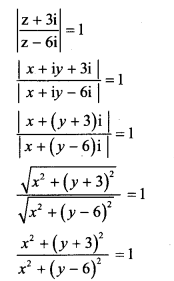
x2 + (y + 3)2 = x2 + (y – 6)2
y2 + 6y + 9 = y2 – 12y + 36
18y – 27 = 0
2y – 3 = 0
Question 7.
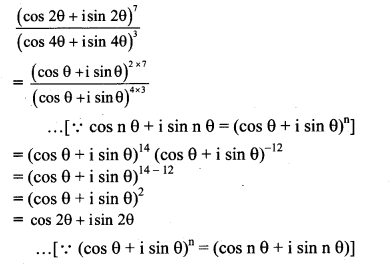
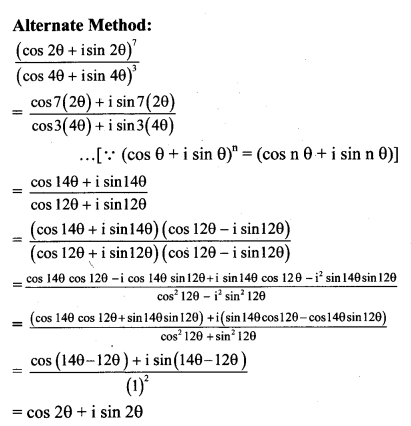
Use De Moivre’s theorem and simplify the following:
(i) (cos2θ+isin2θ)7(cos4θ+isin4θ)3
Solution:
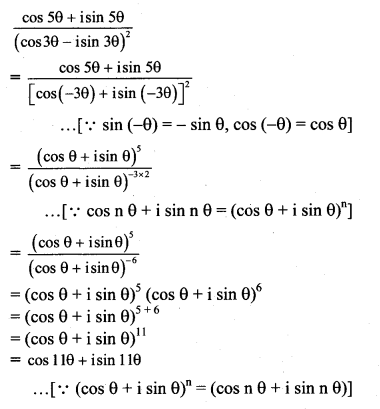
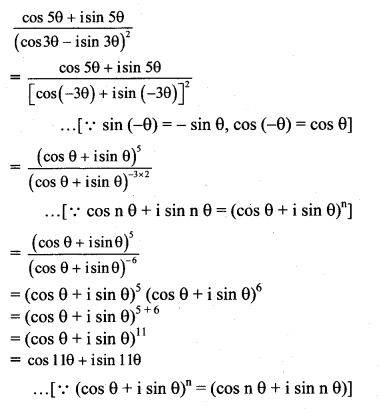
(ii) cos5θ+isin5θ(cos3θ−isin3θ)2
Solution:
(iii) (cos7π13+isin7π13)4(cos4π13−isin4π13)6
Solution:
Question 8.
Express the following in the form a + ib, a, b ∈ R, using De Moivre’s theorem.
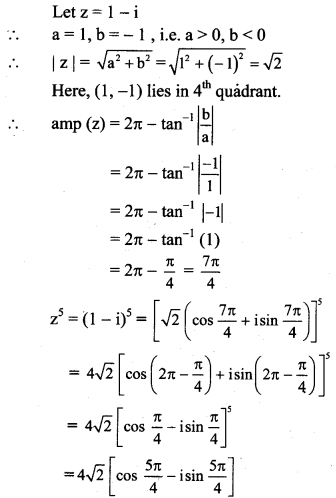
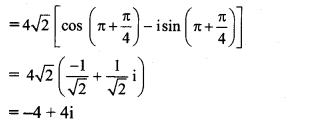
(i) (1 – i)5
Solution:
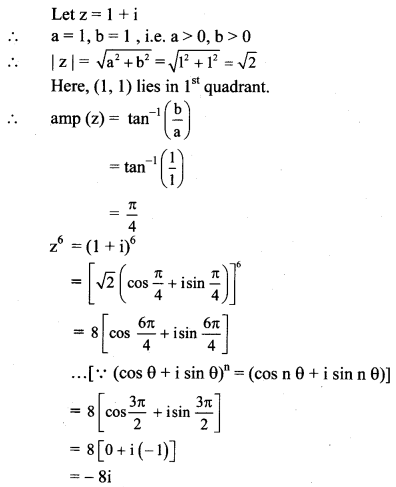
(ii) (1 + i)6
Solution:
(iii) (1 – √3 i)4
Solution:
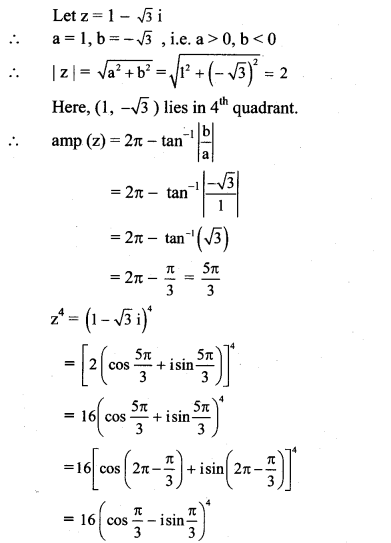
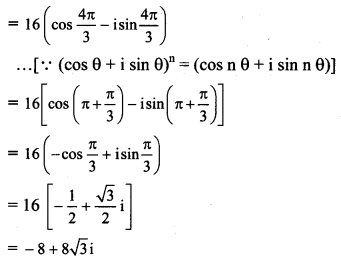
(iv) (-2√3 – 2i)5
Solution:
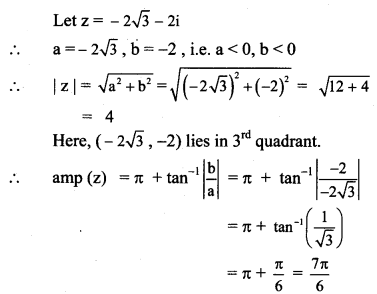
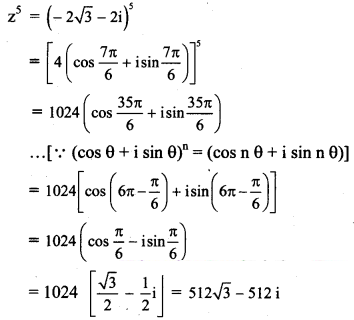
Download PDF
Maharashtra Board Solutions Class 11-Arts & Science Maths (Part 2): Chapter 1- Complex Numbers
Chapterwise Maharashtra Board Solutions Class 11 Arts & Science Maths (Part 2) :
- Chapter 1- Complex Numbers
- Chapter 2- Sequences and Series
- Chapter 3- Permutations and Combination
- Chapter 4- Methods of Induction and Binomial Theorem
- Chapter 5- Sets and Relations
- Chapter 6- Functions
- Chapter 7- Limits
- Chapter 8- Continuity
- Chapter 9- Differentiation