
Class 11: Political Science Chapter 5 solutions. Complete Class 11 Political Science Chapter 5 Notes.
Maharashtra Board Solutions Class 11-Political Science: Chapter 5- Concept of Representation
Class 11: Political Science Chapter 5 solutions. Complete Class 11 Political Science Chapter 5 Notes.
1A. Choose the correct alternative and complete the following statements.
Question 1.
Ancient Greece had ___________ (dictatorship, direct democracy, indirect democracy, monarchy)
Answer:
Direct democracy
Question 2.
The oldest representative assembly in the world is ___________ (House of Commons, House of Lords, Senate, House of Representative)
Answer:
House of Commons
1B. State the appropriate concept for the given statements.
Question 1.
The political system is where people elect representatives to govern themselves.
Answer:
Representative Democracy
1C. Find the odd word in the given set.
Question 1.
The Indian National Trade Union Congress, All India Kisan Sabha, National Students Union of India, Indian National Congress
Answer:
Indian National Congress (it is a political party)
2. Complete the concept maps.
Question 1.
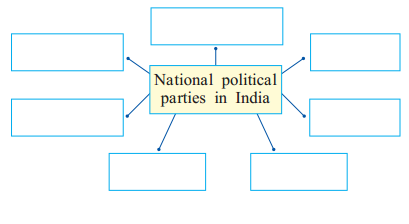
Answer:

3. Explain the correlation between the following.
Question 1.
Governmental and Non-Governmental Organizations.
Answer:
Governmental organizations are public organizations that have a formalized structure. They are formed by election or nomination. They have legal status in terms of their jurisdiction. They are more concerned with political and administrative aspects.
However, such organizations due to their structure and scope may not be able to satisfy the concerns of different sections of the population or to represent various interests and causes. This leads to people who are devoted to the cause coming together as non-profit groups and further their cause. NGO’s work in the field of political and environmental awareness, the welfare of the elderly/women/children/disabled, etc., for e.g., Green Peace (environment), Help Age (senior citizens), CRY (children), AGNI (Political awareness), PFA (animals).
4. Express your opinion of the following.
Question 1.
Pressure groups are different from political parties.
Answer:
I agree with the statement.
- The political parties are part of the governmental system. They seek to influence government policy from the inside. A pressure group tries to influence the government from the outside. They do not stand for elections or aim to become members of the legislature/ government.
- Political parties have a broad agenda. They seek to represent the people for political, social, economic, cultural, and other concerns. Pressure groups usually have a narrow focus. They focus on specific issues or agitations for a specific cause e.g., the environment.
5. Answer the following in detail with reference to the given points.
Question 1.
What is meant by representation? Explain the various methods of representation?
(a) Meaning
(b) Electoral
(c) Non-electoral
(d) Non-official
Answer:
(a) Meaning: The concept of representation is important in any democracy.
Today, most countries have large territories and populations. Hence, direct democracy is not possible. The form of democracy today is indirect democracy or representative democracy. People elect representatives among themselves to govern the country for e.g., in India, Members of Parliament (MP’s), Members of State Legislative Assemblies/ Councils (MLA’s, MLC’s), of corporations, etc., are all our representatives.
(b) Electoral Method: Persons are directly or indirectly elected by the citizens to govern them as members of representative assemblies e.g., General elections to Lok Sabha, Assembly elections.
(c) Non-electoral Method: Representatives occupy their position through nomination or appointment for e.g., President of India appoints 12 Members to the Rajya Sabha.
(d) Non-official Method: Civil society represents the people through various pressure groups like trade unions, student groups, peasant organizations.
6. Suggest ways by which you can encourage people to vote in elections.
Answer:
- NGO’s such as AGNI have special programmes designed to encourage people to exercise their franchise.
- Street plays, flash mobs at railway stations, talks in colleges about the importance of voting.
- Voter enrollment drives to encourage youngsters to vote.
- Advertisements, especially involving celebrities as ‘ambassadors’ for the franchise.
- In some countries of the world, the franchise is compulsory.
Activity (Text Book Page No. 44)
Question 1.
Write the history of anyone national political party in India.
Answer:
Indian National Congress
Indian National Congress was founded on 28th December 1885 due to the efforts of A.O. Hume, to act as a platform for civil and political dialogue among educated Indians. The first session, held in Bombay with 72 delegates in attendance, elected W.C. Banerjee as its first President. Members were mainly from the Bombay and Madras Presidencies such as Dadabhai Naoroji, Dinshaw Wacha, Pherozshah Mehta, and others. During its early phase, the Congress was led by the Moderates.
The party first split at the Surat session (1907) into two groups i.e., Moderates and Extremists (led by Bal Gangadhar Tilak). The party began to endorse the policy of “Swaraj” (Self-rule) and “Swadeshi” (of our own country), After the death of Lokmanya Tilak, the leadership of the Congress passed into the hands of Mahatma Gandhi. His philosophy was based on the ideals of Satyagraha and Ahimsa. Various movements were organized by Gandhiji such as Non-Cooperation Movement (1920’s), Civil Disobedience (1930’s), and Quit India Movement (1942).
The INC has dominated most of India’s political landscape since Independence. The period 1947-1967 is described as the One-Party Dominant System (OPDS) of the INC. However, Congress dominance has declined. In the UPA government (2004 – 2014) the INC was one of the major parties. At present, it is the main opposition party (2019).
Download PDF
Maharashtra Board Solutions Class 11-Political Science: Chapter 5- Concept of Representation
Chapterwise Maharashtra Board Solutions Class 11 Political Science :
- Chapter 1- The State
- Chapter 2- Liberty and Rights
- Chapter 3- Equality and Justice
- Chapter 4- Constitutional Government
- Chapter 5- Concept of Representation
- Chapter 6- Role of the Judiciary
- Chapter 7- Public Administration
- Chapter 8- Development Administration
- Chapter 9- The World Since 1945 – I
- Chapter 10- The World Since 1945 – II
Download PDF
Maharashtra Board Solutions Class 11-Political Science: Chapter 5- Concept of Representation
Download PDF: Maharashtra Board Solutions Class 11-Political Science: Chapter 5- Concept of Representation PDF