
Class 11: Political Science Chapter 9 solutions. Complete Class 11 Political Science Chapter 9 Notes.
Maharashtra Board Solutions Class 11-Political Science: Chapter 9- The World Since 1945 – I
Class 11: Political Science Chapter 9 solutions. Complete Class 11 Political Science Chapter 9 Notes.
1A. Choose the correct alternative and complete the following statements.
Question 1.
In 1949, China became a communist country under the leadership of ___________ (Khrushchev, Mao Zedong, Joseph Stalin, Ho Chi Minh)
Answer:
Mao Zedong
Question 2.
The principle of peaceful co-existence was put forth by ___________ (Eisenhower, Joseph Stalin, Khrushchev, Jawaharlal Nehru)
Answer:
Khrushchev
1B. State the appropriate concept for the given statement.
Question 1.
Period of the dominance of European powers.
Answer:
Eurocentric
Question 2.
The conflict between America and the Soviet Union.
Answer:
Cold War
1C. Find the odd word in the given set.
Question 1.
Hungary, Romania, Bulgaria, France.
Answer:
France (not from the soviet bloc)
Question 2.
Italy, Poland, Spain, Greece.
Answer:
Poland (Not from the capitalist bloc nations)
2A. Complete the concept maps.
Question 1.
Answer:
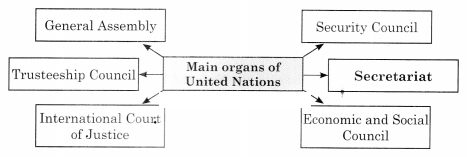
2B. Observe the given map and answer the following questions.
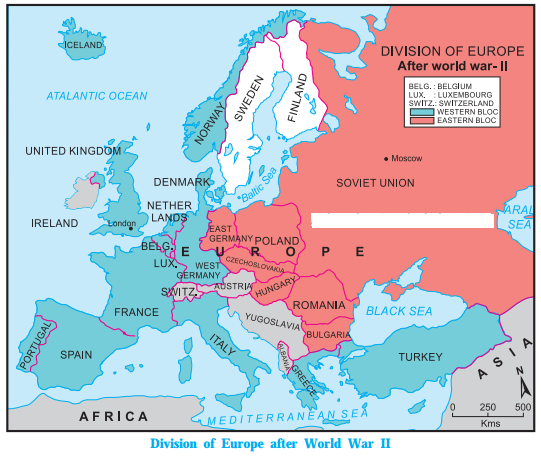
See a map of the Division of Europe after World War II.
Question i.
Name two East European countries under influence of the Soviet Union.
Answer:
Poland, Hungary, Czechoslovakia, Bulgaria, Romania.
Question 2.
Name two West European countries under the influence of the United States.
Answer:
France, Spain, Italy, Belgium, England.
3. State whether the following statements are true or false with reasons.
Question 1.
After the Bolshevik Revolution, Soviet Russia became a capitalist nation.
Answer:
This statement is False.
- After the 1917 Bolshevik Revolution. Vladimir Lenin established Socialism based on Marxist doctrine in Russia.
- Thus, Russia became the first communist nation in the world. The USA is an example of a capitalist nation.
Question 2.
The Bandung Conference brought Cold War in Asia.
Answer:
This statement is False.
- In 1955, the Bandung conference had 24 participating countries and sought to broad base the concept of regionalism to Asia and Africa.
- The Bandung conference tried to bring cooperation and stability to the regions.
4. Answer the following.
Question 1.
Explain the term regionalism.
Answer:
Regional organisations are created by countries from a particular geographic region. They form groups to promote their national interest in a cooperative manner. They try to establish their independent identity. This process of regional level cooperation is also called regionalism.
While geographic linkages are important, sometimes some functional issues become the basis of regional cooperation. These can be in areas like transport and communication, energy, health, etc.
The process of regionalism usually begins with a political dialogue amongst the participants. Such a dialogue may lead to the creation of an organisation. Organisations like the European Union (EU), Association of South-East Asian Nations (ASEAN), or South Asian Association for Regional Cooperation (SAARC) are examples of such regional groupings.
Question 2.
Discuss the role of the United Nations (UNO).
Answer:
The UNO was established in 1945. Its main functions include to
(i) Maintain International Peace and Security: The United Nations came into being with one main purpose i.e., the maintenance of international peace and security. The UN does this by working to prevent conflict, helping parties in conflict to make peace, peacekeeping activities, and creating the conditions to allow peace to hold and flourish.
(ii) Protect Human Rights: The promotion and protection of human rights is a key purpose and guiding principle of the UN. On 10th December 1948, the Universal Declaration of Human Rights was adopted.
(iii) Deliver Humanitarian Aid: One of the purposes of the United Nations is “to achieve international cooperation in solving international problems of an economic, social, cultural or humanitarian character.” The international community relies on the UN to coordinate humanitarian relief operations in times of natural and man-made disasters.
(iv) Promote Sustainable Development: The global understanding of development has changed over the years. The UN seeks to promote sustainable development, that is, a development that promotes prosperity and economic opportunity, greater social well-being, and protection of the environment.
(v) Uphold International Law: The development of and respect for international law has been a key part of the work of the UNO. This work is carried out in many ways – by courts, tribunals, multilateral treaties, and by the Security Council and ICJ.
5. Answer the following in detail with reference to the given points.
Question 1.
Elaborate on the dimensions of the Cold War.
(a) political
(b) ideological
(c) economic
(d) security
Answer:
The hostile relations between the USA and its’ allies and the USSR and its allies along with ideological conflict between them is called the ‘Cold War’ or Bipolarity. Its dimensions are
(a) Political dimension: was the aspect of the struggle for political influence over the areas under the control of the two countries. Areas under Soviet influence included East Germany, Poland, Czechoslovakia, Hungary, Romania, Bulgaria, and Albania. Areas under the United States’ influence included Netherlands, Denmark, Belgium, West Germany, France, Italy, Spain, Greece, and United Kingdom. Finland was forced to opt for neutrality to ensure that both the United States and the Soviet Union did not clash in the region.
(b) Ideological dimension: Eastern Europe adopted Socialist ideology under the influence of the Soviet Union and followed a Socialist form of government. Western Europe adopted capitalist ideology under the leadership of the United States. These countries had democratic governments.
(c) Economic dimension: East European countries with socialist governments followed the socialist economic system. This meant that the government or the public sector would play a dominant role in the economic system. West European countries that followed the democratic system of government had a capitalist form of economy. Here the private sector played a dominant role in the economic system.
(d) Security dimension: Military alliances were created in Europe to protect these countries. The North Atlantic Treaty Organisation (NATO) was created in 1949 as a military alliance to defend West European countries and the United States from the threat of invasion from the Soviet Union and East Europe. Warsaw Pact was created in 1955 to defend East European countries and the Soviet Union from the threat from Western Europe and the United States.
Download PDF
Maharashtra Board Solutions Class 11-Political Science: Chapter 9- The World Since 1945 – I
Chapterwise Maharashtra Board Solutions Class 11 Political Science :
- Chapter 1- The State
- Chapter 2- Liberty and Rights
- Chapter 3- Equality and Justice
- Chapter 4- Constitutional Government
- Chapter 5- Concept of Representation
- Chapter 6- Role of the Judiciary
- Chapter 7- Public Administration
- Chapter 8- Development Administration
- Chapter 9- The World Since 1945 – I
- Chapter 10- The World Since 1945 – II