
Class 10: Maths Chapter 4 solutions. Complete Class 10 Maths Chapter 4 Notes.
Maharashtra Board Solutions for Class 10-Maths (Part 1): Chapter 4- Financial Planning
Maharashtra Board 10th Maths Chapter 4, Class 10 Maths Chapter 4 solutions
Practice Set 4.1
Financial Planning Class 10 Practice Set 4.1 Question 1.
‘Pawan Medical’ supplies medicines. On some medicines the rate of GST is 12%, then what is the rate of CGST and SGST?
Solution: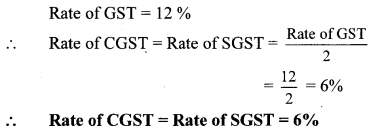
Question 2.
On certain article if rate of CGST is 9% then what is the rate of SGST? and what is the rate of GST?
Solution:
Rate of CGST = 9%
But, rate of SGST = rate of CGST
∴ Rate of SGST = 9%
Rate of GST = Rate of SGST + Rate of CGST = 9% + 9%
∴ Rate of GST = 18%
Financial Planning Class 10 Question 3.
‘M/s. Real Paint’ sold 2 tins of lustre paint and taxable value of each tin is ₹ 2800. If the rate of GST is 28%, then find the amount of CGST and SGST charged in the tax invoice.
Solution:
Taxable value of 1 tin = ₹ 2800
∴ Taxable value of 2 tins = 2 × 2800
= ₹ 5600
Rate of GST = 28 %
∴ Rate of CGST = Rate of SGST = 14 %
CGST = 14% of taxable value 14
= 14100 × 5600
∴ CGST = ₹ 784
∴ SGST = CGST = ₹ 784
∴ The amount of CGST and SGST charged in the tax invoice is ₹ 784 each.
Question 4.
The taxable value of a wrist watch belt is 7 586. Rate of GST is 18%. Then what is price of the belt for the customer?
Solution:
Taxable value of wrist watch belt = ₹ 586
Rate of GST = 18%
∴ GST = 18% of taxable value
= 18100 × 586
∴ GST = ₹ 105.48
∴ Amount paid by customer = Taxable value of wrist watch belt + GST
= 586+ 105.48
= ₹ 691.48
∴ The price of the belt for the customer is ₹ 691.48.
Question 5.
The total value (with GST) of a remote-controlled toy car is ₹ 1770. Rate of GST is 18% on toys. Find the taxable value, CGST and SGST for this toy-car.
Solution:
Let the amount of GST be ₹ x.
Total value of remote controlled toy car = ₹ 1770
∴ Taxable value of remote controlled toy car = ₹ (1770 – x)
Now, GST = 18% of taxable value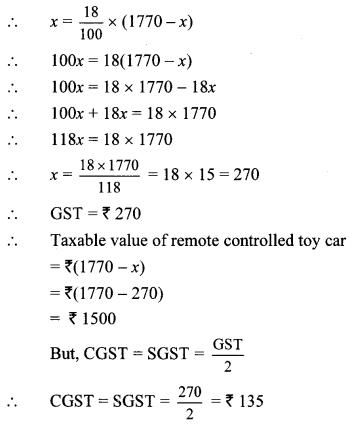
∴ Taxable value of toy car is ₹ 1500 and CGST and SGST for it is ₹ 135 each.
Question 6.
‘Tiptop Electronics’ supplied an AC of 1.5 ton to a company. Cost of the AC supplied is ₹ 51,200 (with GST). Rate of CGST on AC is 14%. Then find the following amounts as shown in the tax invoice of Tiptop Electronics.
i. Rate of SGST
ii. Rate of GST on AC
iii. Taxable value of AC
iv. Total amount of GST
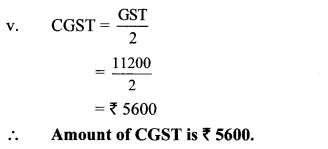
v. Amount of CGST
vi. Amount of SGST
Solution:
i. Rate of CGST = 14%
But, Rate of SGST = Rate of CGST
∴ Rate of SGST = 14%
ii. Rate of GST on AC
= Rate of SGST + Rate of CGST
= 14% + 14% = 28%
∴ Rate of GST on AC is 28%.
iii. Let the cost (Taxable value) of AC be ₹ 100.
Given, GST = 28%
∴ The cost of AC with GST is ₹ 128.
For the total value of ₹ 128, the taxable value is ₹ 100.
For the total value of ₹ 51200, let the taxable value be ₹ x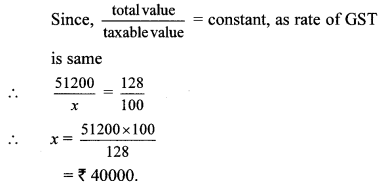
∴ Taxable value of AC is ₹ 40,000.
iv. Total amount of GST = 28% of taxable value
= 28100 × 40000
= ₹ 11,200
∴ Total amount of GST is ₹ 11,200.
∴ Amount of CGST is ₹ 5600.
vi. Amount of SGST = Amount of CGST
= ₹ 5600
Amount of SGST is ₹ 5600.
Question 7.
Prasad purchased a washing-machine from ‘Maharashtra Electronic Goods’. The discount of 5% was given on the printed price of ₹ 40,000. Rate of GST charged was 28%. Find the purchase price of washing machine. Also find the amount of CGST and SGST shown in the tax invoice.
Solution:
Printed price of washing machine = ₹ 40,000
Rate of discount = 5%
Amount of discount = 5% of printed price
= 5100 × 40000 = ₹ 2000
∴ Taxable value = Printed price – Discount
= 40000 – 2000 = ₹ 38000
Rate of GST = 28%
∴ Rate of CGST = 14% and
Rate of SGST = 14%
CGST = 14% of taxable value
= 14100 × 38000
∴ CGST = ₹ 5320
∴ CGST = SGST = ₹ 5320
Purchase price of washing machine
= Taxable value + CGST + SGST
= 38000 + 5320 + 5320
= ₹ 48,640
∴ Purchase price of washing machine is ₹ 48640. Amount of CGST and SGST in tax invoice is ₹ 5320 each.
Question 1.
Observe the given bill and fill in the boxes with the appropriate number. (Textbook pg. no. 82 and 83)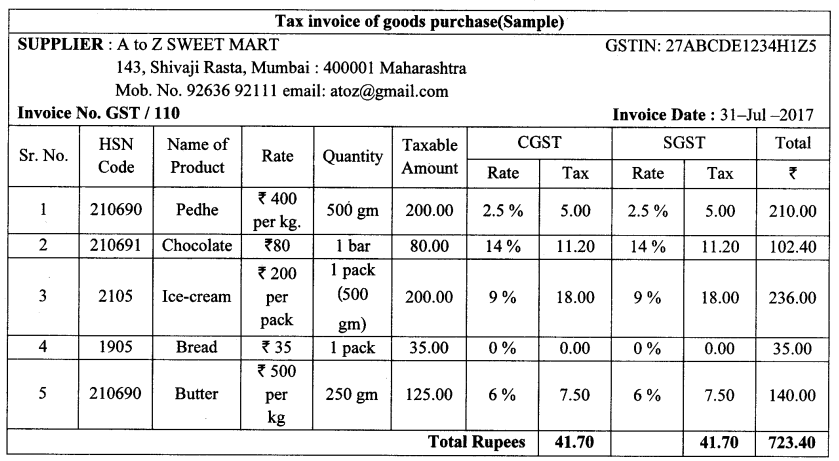
Solution:
i. Price of 1 kg of Pedhe is ₹ 400, therefore cost of 500 gm. of Pedhe is ₹ 200.
CGST for pedhe at the rate of 2.5% is ₹ [5] and SGST at the rate of [2.5| % is ₹ 5.00. It means that the rate of GST on Pedhe is 2.5% + 2.5% = 5% and hence the total GST is ₹ 10.
ii. The rate of GST on chocolate is [28] % and hence the total GST is ₹ [22.40]
iii. Rate of GST on Ice-cream is [18] %, hence the total cost of ice-cream is ₹ 236
iv. On butter CGST rate is [6] % and SGST rate is also [6] %. So GST rate on butter is [12]%.
Question 2.
Fill in the blanks with the help of given information for the table given below. (Textbook pg. no. 83)
Solution: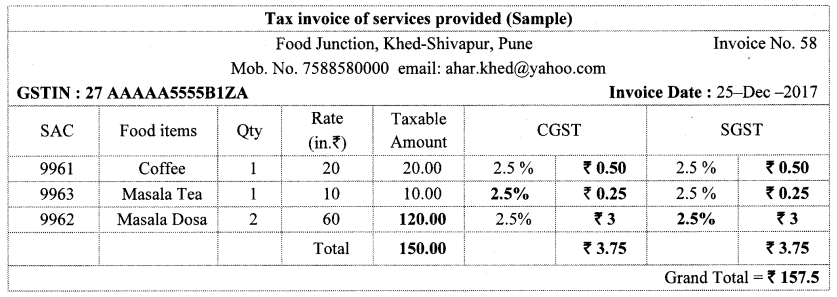
Question 3.
Make a list of ten things you need in your daily life. Find the GST rates with the help of GST rate chart given in the textbook, news papers or books, internet, or the bills of purchases. Verify these rates with the list prepared by your friends. (Textbook pg. no. 85)
Solution: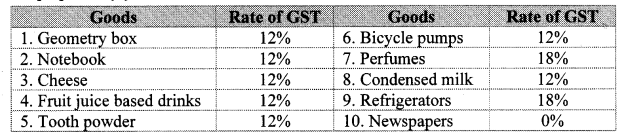
Question 4.
Make a list of ten services and their GST rates as per activity 1. (e.g. Railway and ST bus booking services etc.) You can also collect service bills and complete the given information (Textbook pg. no. 85)
Solution: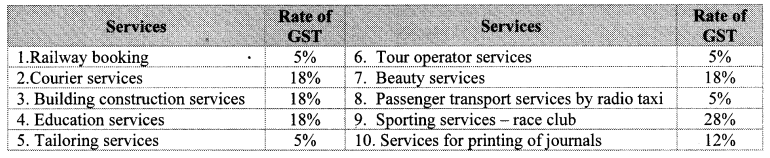
Question 5.
Complete the given table by writing remaining SAC and HSN codes with rates and add some more items in the list. (Textbook pg, no. 85)
Solution: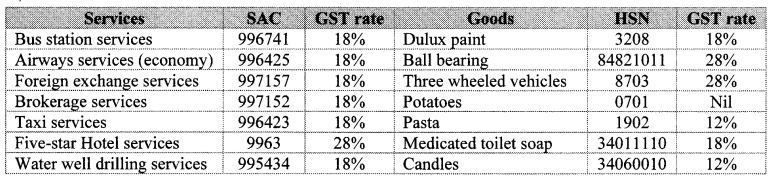
[Note : The above Activities has many answers students may write answers other than the ones given]
Practice Set 4.2
Question 1. ‘Chetana Store’ paid total GST of ₹ 1,00,500 at the time of purchase and collected GST ₹ 1,22,500 at the time of sale during 1st of July 2017 to 31st July 2017. Find the GST payable by Chetana Stores.
Answer:
Output tax (Tax collected at the time of sale)
= ₹ 1,22,500
Input tax (Tax paid at the time of purchase)
= ₹ 1,00,500
ITC (Input Tax credit) = ₹ 1,00,500.
GST payable = Output tax – ITC
= 1,22,500 – 1,00,500
= ₹ 22,000
GST payable by Chetana stores is ₹ 22,000.
Question 2. Nazama is a proprietor of a firm, registered under GST. She has paid GST of ₹ 12,500 on purchase and collected ₹ 14,750 on sale. What is the amount of ITC to be claimed? What is the amount of GST payable?
Solution:
Output tax = ₹ 14,750
Input tax = ₹ 12,500
∴ ITC for Nazama = ₹ 12,500.
∴ GST payable = Output tax – ITC
= 14750 – 12500
= ₹ 2250
∴ Amount of ITC to be claimed is ₹ 12,500 and amount of GST payable is ₹ 2250.
Question 3. Amir Enterprise purchased chocolate sauce bottles and paid GST of ₹ 3800. He sold those bottles to Akbari Bros, and collected GST of ₹ 4100. Mayank Food Corner purchased these bottles from Akbari Bros, and paid GST of ₹ 4500. Find the amount of GST payable at every stage of trading and hence find payable CGST and SGST.
Solution:
For Amir Enterprise:
Output tax = ₹ 4100
Input tax = ₹ 3800
ITC for Amir enterprise = ₹ 3800.
∴ GST payable = Output tax – ITC
= 4100 – 3800
= ₹ 300
For Akbari Bros.:
Output tax = ₹ 4500
Input tax = ₹ 4100
ITC for Akbari Bros = ₹ 4100.
GST payable = Output tax – ITC
= 4500 – 4100 = ₹ 400
∴ Statement of GST payable at every stage of trading: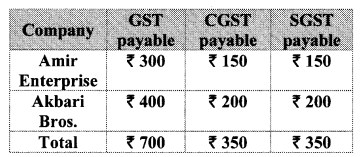
Question 4. Malik Gas Agency (Chandigarh Union Territory) purchased some gas cylinders for industrial use for ₹ 24,500, and sold them to the local customers for ₹ 26,500. Find the GST to be paid at the rate of 5% and hence the CGST and UTGST to be paid for this transaction, (for Union Territories there is UTGST instead of SGST.)
Solution:
For Malik Gas Agency:
Output tax = 5% of 26500
= 5100 × 26500
= ₹ 1325
Input tax = 5% of 24500
= 5100 × 24500
= ₹ 1225
ITC for Malik Gas Agency = ₹ 1225.
∴ GST payable = Output tax – ITC
= 1325 – 1225
= ₹ 100
∴ CGST = UTGST = ₹ 50
∴ The GST to be paid at the rate of 5% is ₹ 100 and hence, CGST and UTGST paid for the transaction is ₹ 50 each.
Question 5.
M/s Beauty Products paid 18% GST on cosmetics worth ₹ 6000 and sold to a customer for ₹ 10,000. What are the amounts of CGST and SGST shown in the tax invoice issued?
Solution:
Output tax = 18% of 10,000
= 18100 × 10,000
= ₹ 1800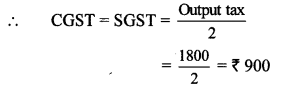
∴ Amount of CGST and SGST shown in the tax invoice issued is ₹ 900 each.
Question 6.
Prepare Business to Consumer (B2C) tax invoice using given information. Write the name of the supplier, address, state, Date, Invoice number, GSTIN etc. as per your choice.
Supplier: M/s ______ Address _______ State _______ Date _______ Invoice No. _______ GSTIN _______
Particulars
Rate of Mobile Battery ₹ 200 Rate of GST 12% HSN 8507 1 PC
Rate of Headphone ₹750 Rate of GST 18% HSN 8518 1 Pc
Solution:
Rate of Mobile Battery = ₹200
CGST = 6% of 200
= 6100 × 200
= ₹ 12
∴ CGST = SGST = ₹ 12
Rate of Headphone = ₹ 750
COST = 9% of 750
= 9100 × 750
= ₹ 67.5
∴ CGST = SGST = ₹ 67.5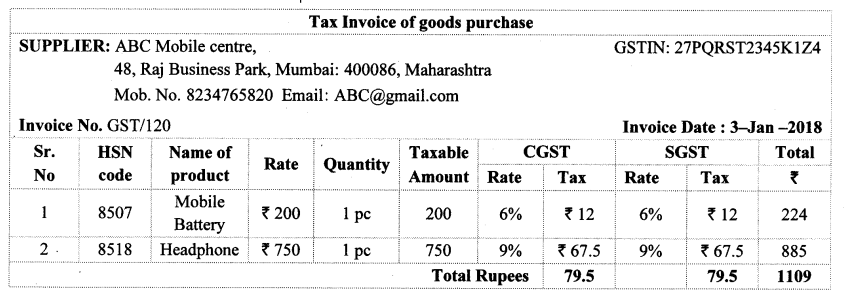
Question 7.
Prepare Business to Business (B2B) Tax Invoice as per the details given below, name of the supplier, address, Date etc. as per your choice.
Supplier – Name, Address, State, GSTIN, Invoice No., Date
Recipient – Name, Address, State, GSTIN,
Items:
i. Pencil boxes 100, HSN – 3924, Rate – ₹ 20, GST 12%
ii. Jigsaw Puzzles 50, HSN 9503, Rate – ₹ 100 GST 12%.
Solution:
Cost of 100 Pencil boxes
= 20 × 1oo
= ₹ 2000
CGST = 6% of 2000
= 6100 × 2000
= ₹ 120
∴ CGST = SGST = ₹ 120
Cost of 50 Jigsaw Puzzles = 100 × 50
= ₹ 5000
CGST = 6% of 5000
= 6100 × 5000
= ₹ 300
CGST – SGST = ₹ 300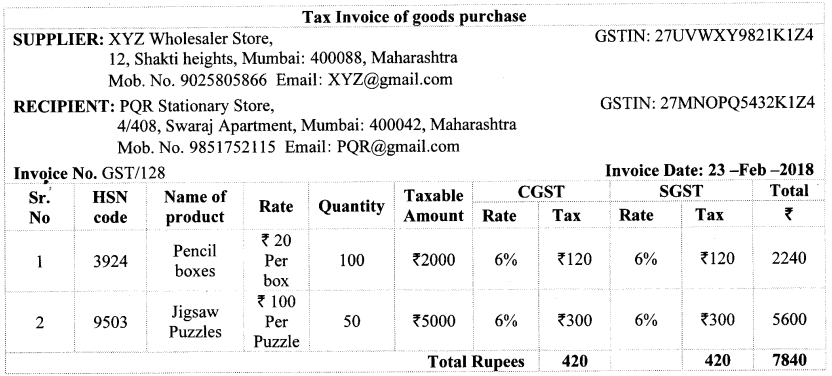
Question 1.
Suppose a manufacturer sold a cycle for a taxable value of ₹ 4000 to the wholesaler. Wholesaler sold it to the retailer for ₹ 4800 (taxable value). Retailer sold it to a customer for ₹ 5200 (taxable value). Rate of GST is 12%. Complete the following activity to find the payable CGST and SGST at each stage of trading. (Textbook pg. no. 92)
Solution: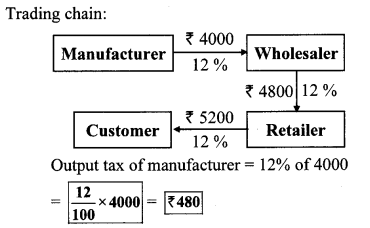
GST payable by manufacturer = ₹ 480
Output tax of wholesaler
= 12% of 4800 = 12100 × 4800 = ₹ 576
∴ GST payable by wholesaler
= Output tax – Input tax
= 576 – 480
= ₹ 96
Output tax of retailer = 12% of 5200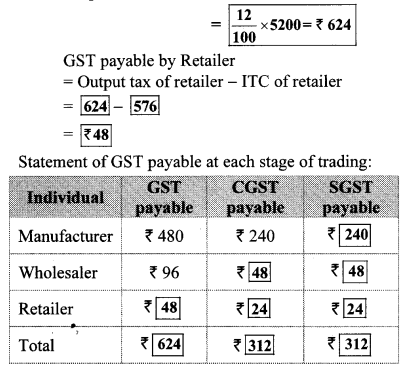
Question 2. Suppose in the month of July the output tax of a trader is equal to the input tax, then what is his payable GST?(Textbook pg. no. 93)
Answer:
Here, output tax is same as input tax.
∴ Trader payable GST will be zero.
Question 3.
Suppose in the month of July output tax of a trader is less than the input tax then how to compute his GST? (Textbook pg. no. 93)
Answer:
If output tax of a trader in a particular month is less than his input tax, then he won’t be able to get entire credit for his input tax. In such a case his balance credit will be carried forward and adjusted against the subsequent transactions.
Practice Set 4.3
Practice Set 4.3 Financial Planning Question 1. Complete the following table by writing suitable numbers and words.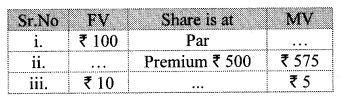
Solution:
i. Here, share is at par.
∴ MV = FV
∴ MV = ₹ 100
ii. Here, Premium = ₹ 500, MV = ₹ 575
∴ FV + Premium = MV
∴ FV + 500 = 575
∴ FV = 575 – 500
∴ FV = ₹ 75
iii. Here, FV = ₹ 10, MV = ₹ 5
∴ FV > MV
Share is at discount.
FV – Discount = MV
∴ 10 – Discount = 5
∴ 10 – 5 = Discount
₹ Discount = ₹ 5
Practice Set 4.3 Question 2. Mr. Amol purchased 50 shares of Face value ₹ 100 when the Market value of the share was ₹ 80. Company had given 20% dividend. Find the rate of return on investment.
Solution:
Here, MV = ₹ 80, FV = ₹ 100,
Number of shares = 50, Rate of dividend = 20%
∴ Sum invested = Number of shares × MV
= 50 × 80
= ₹ 4000
Dividend per share = 20% of FV
= 20100 × 100 = ₹ 20
∴ Total dividend of 50 shares = 50 × 20
= ₹ 1000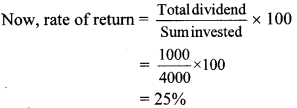
∴ Rate of return on investment is 25%.
Practice Set 4.3 Question 3.
Joseph purchased following shares, Find his total investment.
Company A : 200 shares, FV = ₹ 2, Premium = ₹ 18.
Company B : 45 shares, MV = ₹ 500
Company C : 1 share, MV = ₹ 10,540
Solution:
For company A:
FV = ₹ 2, premium = ₹ 18,
Number of shares = 200
∴ MV = FV+ Premium
= 2 + 18
= ₹ 20
Sum invested = Number of shares × MV
= 200 × 20
= ₹ 14000
For company B:
MV = ₹ 500, Number of shares = 45
Sum invested = Number of shares × MV
= 45 × 500 = ₹ 22,500
For company C:
MV = ₹ 10,540, Number of shares = 1
∴ Sum invested = Number of shares × MV
= 1 × 10540
= ₹ 10,540
∴ Total investment of Joseph
= Investment for company A + Investment for company B + Investment for company C
= 4000 + 22,500 + 10,540
= ₹ 37040
∴ Total investment done by Joseph is ₹ 37,040.
Practice Set 4.3 Class 7th Question 4.
Smt. Deshpande purchased shares of FV ₹ 5 at a premium of ₹ 20. How many shares will she get for ₹ 20,000?
Solution:
Here, FV = ₹ 5, Premium = ₹ 20,
Sum invested = ₹ 20,000
∴ MV = FV + Premium
= 5 + 20
∴ MV = ₹ 25
Now, sum invested = Number of shares × MV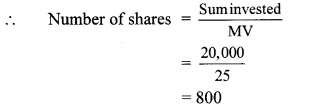
∴ Smt. Deshpande got 800 shares for ₹ 20,000.
Question 5.
Shri Shantilal has purchased 150 shares of FV ₹ 100, for MV of ₹ 120. Company has paid dividend at 7%. Find the rate of return on his investment.
Solution:
Here, FV = ₹ 100, MV = ₹ 120
Dividend = 7%, Number of shares = 150
∴ Sum invested = Number of shares × MV
= 150 × 120 = ₹ 18000
Dividend per share = 7% of FV
= 7100 × 100 = ₹ 7
∴ Total dividend of 150 shares
= 150 × 7 = ₹ 1050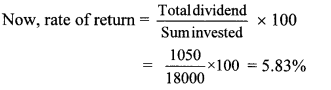
∴ Rate of return on investment is 5.83%.
4.3 Class 10 Question 6. If the face value of both the shares is same, then which investment out of the following is more profitable?
Company A : dividend 16%, MV = ₹ 80,
Company B : dividend 20%, MV = ₹ 120.
Solution:
Let the face value of share be ₹ x.
For company A:
MV = ₹ 80, Dividend = 16%
Dividend = 16% of FV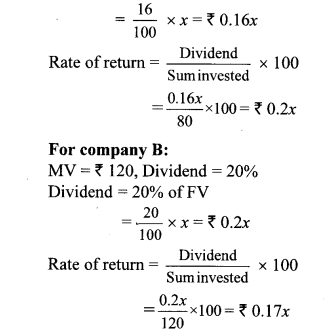
∴ Rate of return of company A is more.
∴ Investment in company A is profitable.
Question 1.
Smita has invested ₹ 12,000 and purchased shares of FV ₹ 10 at a premium of ₹ 2. Find the number of shares she purchased. Complete the given activity to get the answer. (Textbook pg. no. 101.)
Solution: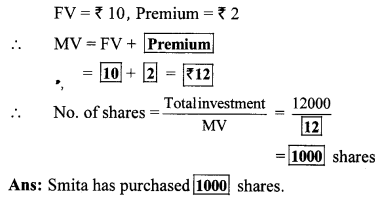
Practice Set 4.4
Question 1.
Market value of a share is ₹ 200. If the brokerage rate is 0.3% then find the purchase value of the share.
Solution:
Here, MV = ₹ 200, Brokerage = 0.3%
Brokerage = 0.3% of MV
= 0.3100 × 200
= ₹ 0.6
∴ Purchase value of the share = MV + Brokerage
= 200 + 0.6
= ₹ 200.60
∴ Purchase value of the share is ₹ 200.60.
Question 2.
A share is sold for the market value of ₹ 1000. Brokerage is paid at the rate of 0.1%. What is the amount received after the sale?
Solution:
Here, MV = ₹ 1000, Brokerage = 0.1%
∴ Brokerage = 0.1 % of MV
= 0.1100 × 1000
∴ Brokerage = ₹ 1
∴ Selling value of the share = MV – Brokerage
= 1000 – 1
= ₹ 999
∴ Amount received after the sale is ₹ 999.
Question 3.
Fill in the blanks given in the contract note of sale-purchase of shares.
(B – buy S – sell)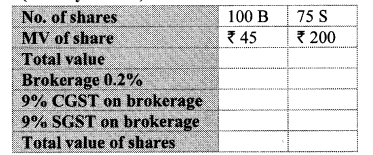
Solution:
For buying shares:
Here, Number of shares = 100,
MV of one share = ₹ 45
∴ Total value = 100 × 45
= ₹ 4500
Brokerage= 0.2% of total value 0.2
= 0.2100 × 4500
CGST = 9% of brokerage
= 9100 × 9 = ₹ 0.81
But, SGST = CGST
∴ SGST = ₹ 0.81
∴ Purchase value of shares
= Total value + Brokerage
= 4500 + 9 + 0.81 + 0.81
= ₹ 4510.62
ii. For selling shares:
Here, Number of shares = 75,
MV of one share = ₹ 200
∴ Total value = 75 × 200
= ₹ 15000
Brokerage = 0.2% of total value
= 0.2100 × 15000
= ₹ 30
CGST = 9% of brokerage
= 9100 × 30 = ₹ 2.70
But, SGST = CGST
∴ SGST = ₹ 2.70
∴ Selling value of shares = Total value – (Brokerage + CGST + SGST)
= 15000 – (30 + 2.70 + 2.70)
= 15000 – 35.40
= ₹ 14964.60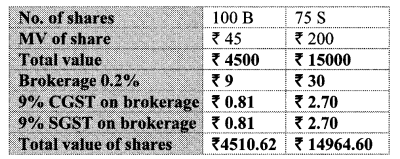
Question 4.
Smt. Desai sold shares of face value ₹ 100 when the market value was ₹ 50 and received ₹ 4988.20. She paid brokerage 0.2% and GST on brokerage 18%, then how many shares did she sell?
Solution:
Here, face value of share = ₹ 100,
MV = ₹ 50,
Selling price of shares = ₹ 4988.20,
Rate of brokerage = 0.2%, Rate of GST = 18%
Brokerage = 0.2% of MV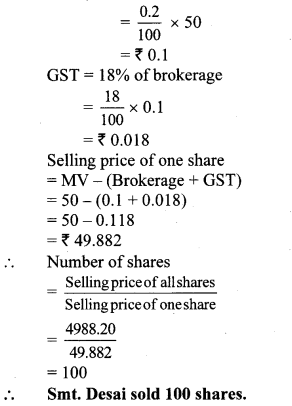
Question 5.
Mr. D’souza purchased 200 shares of FV ₹ 50 at a premium of ₹ 100. He received 50% dividend on the shares. After receiving the dividend he sold 100 shares at a discount of ₹ 10 and remaining shares were sold at a premium of ₹ 75. For each trade he paid the brokerage of ₹ 20. Find whether Mr. D’souza gained or incurred a loss? By how much?
Solution:
For purchasing shares:
Here, FV = ₹ 50, Number of shares = 200,
premium = ₹ 100
MV of 1 share = FV + premium
= 50 + 100
= ₹ 150
∴ MV of 200 shares = 200 × 150 = ₹ 30,000
∴ Mr. D’souza invested amount
= MV of 200 shares + brokerage
= 30,000 + 20
= ₹ 30,020
For selling shares:
Rate of dividend = 50 %, FV = ₹ 50,
brokerage = ₹ 20
Number of shares = 200
Dividend per share = 50% of FV
= 50100 × 50
= ₹ 25
∴ Dividend of 200 shares = 200 × 25 = ₹ 5,000
Now, 100 shares are sold at a discount of ₹ 10.
∴ Selling price of 1 share = FV – discount
= 50 – 10
= ₹ 40
∴ Selling price of 100 shares = 100 × 40
= ₹ 4000
∴ Amount obtained by selling 100 shares
= selling price – brokerage
= 4000 – 20
= ₹ 3980
Also, remaining 100 shares are sold at premium of ₹ 75.
∴ selling price of 1 share = FV + premium
= 50 + 75
= ₹ 125
∴ selling price of 100 shares = 100 × 125
= ₹ 12,500
∴ Amount obtained by selling 100 shares
= selling price – brokerage
= 12,500 – 20
= ₹ 12,480
∴ Mr D’souza income = 5000 + 3980 + 12480
= ₹ 21460
Now, Mr D’souza invested amount > income
∴ Mr D’souza incurred a loss.
∴ Loss = amount invested – income
= 30020 – 21460
= ₹ 8560
∴ Mr. D’souza incurred a loss of ₹ 8560.
Question 1.
Nalinitai invested ₹ 6024 in the shares of FV ₹ 10 when the Market Value was ₹ 60. She sold all the shares at MV of ₹ 50 after taking 60% dividend. She paid 0.4% brokerage at each stage of transactions. What was the total gain or loss in this transaction? (Textbook pg. no. 106)
Solution:
Rate of GST is not given in the example, so it is not considered.
For Purchased Shares:
FV = ₹ 10, MV = ₹ 60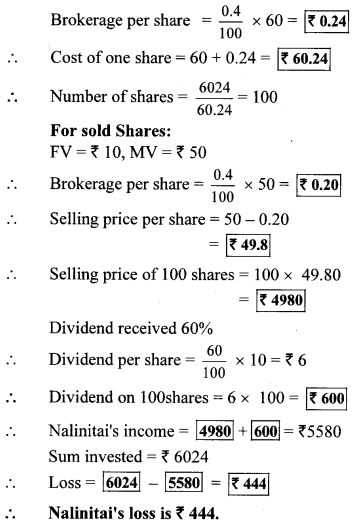
Question 2.
In the above example if GST was paid at 18% on brokerage, then the loss is ₹ 451.92. Verify whether you get the same answer. (Textbook pg, no. 107)
Solution:
For Purchased Shares:
FV = ₹ 10, MV = ₹ 60, sum invested = ₹ 6024, brokerage = 0.4 %, GST = 18%
Brokerage per share = 0.4100 × 60 = ₹ 0.24 100
GST per share = 18100 × 0.24 = ₹ 0.0432
∴ Cost of one share = 60 + 0.24 + 0.0432
= ₹ 60.2832
∴ Cost of 100 shares = 100 × 60.2832 = ₹ 6028.32
For sold shares:
FV = ₹ 10, MV = ₹ 50, brokerage = 0.4 %,
GST = 18%, Number of shares = 100
Brokerage per share = 0.4100 × 50 = ₹ 0.20
GST per share = 18100 × 0.20 = ₹ 0.036
Selling price per share = 50 – 0.2 – 0.036
= ₹ 49.764
Selling price of 100 shares = 100 × 49.764
= ₹ 4976.4
Dividend received 60 %
∴ Dividend per share = 60100 × 10 = ₹ 6
Dividend on 100 shares = 6 × 100 = ₹ 600
∴ Nalinitai’s income = 4976.4 + 600 = ₹ 5576.4
∴ Cost of 100 shares = ₹ 6028.32
∴ Loss = 6028.32 – 5576.4 = ₹ 451.92
∴ Nalinitai’s loss is ₹ 451.92.
Download PDF
Maharashtra Board Solutions for Class 10-Maths (Part 1): Chapter 4- Financial Planning
Chapterwise Maharashtra Board Solutions Class 10 Maths (Part 1) :
- Chapter 1- Linear Equations in Two Variables
- Chapter 2- Quadratic Equations
- Chapter 3- Arithmetic Progression
- Chapter 4- Financial Planning
- Chapter 5- Probability
- Chapter 6- Statistics