
Class 10: Maths Chapter 11 solutions. Complete Class 10 Maths Chapter 11 Notes.
RD Sharma Solutions for Class 10 Maths Chapter 11–Constructions
RD Sharma 10th Maths Chapter 11, Class 10 Maths Chapter 11 solutions
Exercise 11.1 Page No: 11.4
1. Determine a point which divides a line segment of length 12 cm internally in the ratio of 2: 3. Also, justify your construction.
Solution:

Steps of construction:
1. Draw a line segment AB = 12 cm by using a ruler.
2. Through the points A and B draw two parallel line on the opposite side of AB and making the same acute angles with the line segment.
3. Cut 2 equal parts on AX and 3 equal parts on BY such that AX1 = X1X2 and BY1 = Y1Y2 = Y2Y3.
4. Join X2Y3 which intersects AB at P
Hence, AP/PB = 2/3.
Justification:
In ΔAX2P and ΔBY3P, we have
∠APX2 = ∠BPY3 [vertically opposite angle]
∠X2AP = ∠Y3BP [alternate interior angles}
ΔAX2P = ΔBY3P [Because AA similarity]
∴ AP/BP = AX2/BY3 = 2/3 [From C.P.C.T]
Exercise 11.2 Page No: 11.9
1. Construct a triangle of sides 4 cm, 5 cm and 6 cm and then a triangle similar to it whose sides are (2/3) of the corresponding sides of it.
Solution:

Steps of construction:
1. Draw a line segment BC = 5 cm.
2. With centre as B and radius 4 cm and with centre C and radius 6 cm, draw arcs from both points to intersect each other at A.
3. Now, join AB and AC. Then ABC is the triangle.
4. Draw a ray BX making an acute angle with BC and cut off 3 equal parts making BB1 = B1B2= B2B3.
5. Join B3C.
6. Draw B2 C’ parallel to B3C and C’A’ parallel to CA.
Then, ΔA’BC’ is the required triangle.
2. Construct a triangle similar to a given ΔABC such that each of its sides is (5/7)th of the corresponding sides of ΔABC. It is given that AB = 5 cm, BC = 7 cm and ∠ABC = 50°.
Solution:

Steps of construction:
1. Draw a line segment BC = 7 cm.
2. Draw a ray BX making an angle of 50° and cut off BA = 5 cm.
3. Join AC. Then ABC is the triangle.
4. Draw a ray BY making an acute angle with BC and cut off 7 equal parts making BB1 = B1B2 = B2B3 = B3B4 = B4Bs = B5B6 = B6B7
5. Now, join B7 and C
6. Draw B5C’ parallel to B7C and C’A’ parallel to CA.
Then, ΔA’BC’ is the required triangle.
3. Construct a triangle similar to a given ΔABC such that each of its sides is (2/3)rd of the corresponding sides of ΔABC. It is given that BC = 6 cm, ∠B = 50° and ∠C = 60°.
Solution:
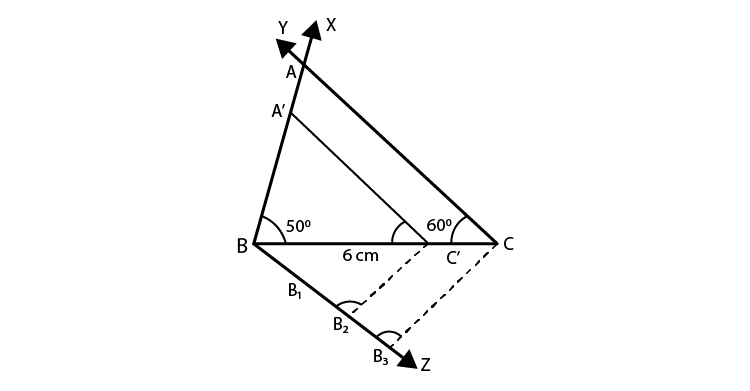
Steps of construction:
1. Draw a line segment BC = 6 cm.
2. Draw a ray BX making an angle of 50° and CY making 60° with BC which intersect each other at A. Then, ABC is the triangle.
3. From B, draw another ray BZ making an acute angle below BC and then cut off 3 equal parts making BB1 = B1B2 = B2B3
4. Now, join B3C.
5. From B2, draw B2C’ parallel to B3C and C’A’ parallel to CA.
Then ΔA’BC’ is the required triangle.
4. Draw a ΔABC in which BC = 6 cm, AB = 4 cm and AC = 5 cm. Draw a triangle similar to ΔABC with its sides equal to (3/4)th of the corresponding sides of ΔABC.
Solution:
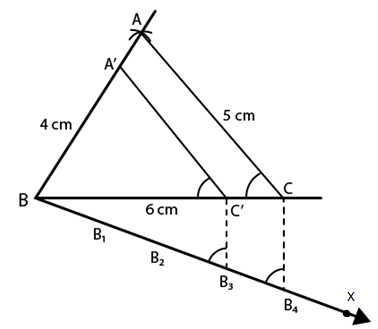
Steps of construction:
1. Draw a line segment BC = 6 cm.
2. With centre as B and radius 4 cm and with C as centre and radius 5 cm, draw arcs intersecting each other at A.
3. Join AB and AC. Then, ABC is the triangle.
4. Draw a ray BX making an acute angle with BC and cut off 4 equal parts making BB1 = B1B2 = B2B3 = B3B4.
5. Join B4 and C.
6. From B3 draw C’ parallel to B4C and from C’, draw C’A’ parallel to CA.
Then ΔA’BC’ is the required triangle.
5. Construct a triangle with sides 5 cm, 6 cm and 7 cm and then another triangle whose sides are (7/5)th of the corresponding sides of the first triangle.
Solution:

Steps of construction:
1. Draw a line segment BC = 5 cm.
2. With B as centre and radius 6 cm and with C as centre and radius 7 cm, draw arcs intersecting each other at A.
3. Now, join AB and AC. Then, ABC is the triangle.
4. Draw a ray BX making an acute angle with BC and cut off 7 equal parts making BB1 = B1B2 = B2B3 = B3B4 = B4B5 = B5B6 = B6B7.
5. Join B5 and C.
6. From B7, draw B7C’ parallel to B5C and C’A’ parallel CA.
Then, ΔA’BC’ is the required triangle.
6. Draw a right triangle ABC in which AC = AB = 4.5 cm and ∠A = 90°. Draw a triangle similar to ΔABC with its sides equal to (5/4)th of the corresponding sides of ΔABC.
Solution:
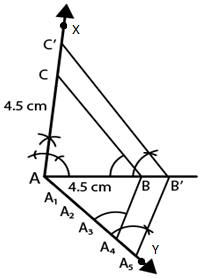
Steps of construction:
1. Draw a line segment AB = 4.5 cm.
2. At A, draw a ray AX perpendicular to AB and cut off AC = AB = 4.5 cm.
3. Now, join BC. Then, ABC is the triangle.
4. Draw a ray AY making an acute angle with AB and cut off 5 equal parts making AA1 = A1A2 = A2A3 = A3A4 = A4A5
5. Join A4 and B.
6. From A5, draw A5B’ parallel to A4B and B’C’ parallel to BC.
Then, ΔAB’C’ is the required triangle.
7. Draw a right triangle in which the sides (other than hypotenuse) are of lengths 5 cm and 4 cm. Then construct another triangle whose sides are 5/3 times the corresponding sides of the given triangle.
Solution:

Steps of construction:
1. Draw a line segment BC = 5 cm.
2. At B, draw perpendicular BX and cut off BA = 4 cm.
3. Now, join AC. Then, ABC is the triangle
4. Draw a ray BY making an acute angle with BC and cut off 5 equal parts making BB1 = B1B2 = B2B3 = B3B4 = B4B5
5. Join B3 and C.
6. From B5, draw B5C’ parallel to B3C and C’A’ parallel to CA.
Then, ΔA’BC’ is the required triangle.
Exercise 11.3 Page No: 11.17
1. Draw a circle of radius 6 cm. From a point 10 cm away from its centre, construct a pair of tangents to the circle and measure their lengths.
Solution:

Steps of construction:
1. Firstly, we draw a circle with centre O and radius 6 cm.
2. Mark a point P at a distance of OP = 10 cm, and join OP.
3. Draw a right bisector of OP, intersecting OP at Q.
4. Now, taking Q as centre and radius OQ = PQ, draw a circle to intersect the given circle at T and T’.
5. Join PT and PT’ to obtain the required tangents.
Thus, PT and PT’ are the required tangents.
To find the length of the tangents.
We know that OT ⊥ PT and ΔOTP is the right triangle.
Therefore, OT = 6 cm (radius) and PO = 10 cm.
So, in ΔOTP,
PT2 = OP2 − OT2 [By Pythagoras theorem]
= (10)2 − (6)2
= 100 – 36
= 64
= 8 cm
Therefore, the length of tangents is 8 cm each.
2. Draw a circle of radius 3 cm. Take two points P and Q on one of its extended diameter each at a distance of 7 cm from its centre. Draw tangents to the circle from these points P and Q.
Solution:

Steps of construction:
1. Draw a line segment PQ of 14 cm.
2. Now, mark the midpoint O of PQ.
3. Draw the perpendicular bisectors of PO and OQ which intersects at points R and S on PQ.
4. With centre R and radius RP draw a circle.
5. With centre S and radius, SQ draw a circle.
6. And now, with centre O and radius 3 cm draw another circle which intersects the previous circles at the points A, B, C, and D.
7. Finally, join PA, PB, QC and QD. Thus, PA, PB, QC, and QD are the required tangents.
3. Draw a line segment AB of length 8 cm. Taking A as centre, draw a circle of radius 4 cm and taking B as the centre, draw another circle of radius 3 cm. Construct tangents to each circle from the centre of the other circle.
Solution:

Steps of construction:
1. Draw a line segment AB = 8 cm.
2. Draw the perpendicular of AB which intersects it at C.
3. With the centre, C and radius CA draw a circle.
4. Now, with A & B as centres and radii 4 cm and 3 cm respectively, draw two circles which intersects the previous circles at the points P, Q, R and S.
5. Finally, join AR, AS, BP and BQ.
Thus, AR, AS, BP and BQ are the required tangents.
RD Sharma Solutions for Class 10 Maths Chapter 11: Download PDF
RD Sharma Solutions for Class 10 Maths Chapter 11–Constructions
Download PDF: RD Sharma Solutions for Class 10 Maths Chapter 11–Constructions PDF
Chapterwise RD Sharma Solutions for Class 10 Maths :
- Chapter 1–Real Numbers
- Chapter 2–Polynomials
- Chapter 3–Pair of Linear Equations In Two Variables
- Chapter 4–Triangles
- Chapter 5–Trigonometric Ratios
- Chapter 6–Trigonometric Identities
- Chapter 7–Statistics
- Chapter 8–Quadratic Equations
- Chapter 9–Arithmetic Progressions
- Chapter 10–Circles
- Chapter 11–Constructions
- Chapter 12–Some Applications of Trigonometry
- Chapter 13–Probability
- Chapter 14–Co-ordinate Geometry
- Chapter 15–Areas Related To Circles
- Chapter 16–Surface Areas And Volumes
About RD Sharma
RD Sharma isn't the kind of author you'd bump into at lit fests. But his bestselling books have helped many CBSE students lose their dread of maths. Sunday Times profiles the tutor turned internet star
He dreams of algorithms that would give most people nightmares. And, spends every waking hour thinking of ways to explain concepts like 'series solution of linear differential equations'. Meet Dr Ravi Dutt Sharma — mathematics teacher and author of 25 reference books — whose name evokes as much awe as the subject he teaches. And though students have used his thick tomes for the last 31 years to ace the dreaded maths exam, it's only recently that a spoof video turned the tutor into a YouTube star.
R D Sharma had a good laugh but said he shared little with his on-screen persona except for the love for maths. "I like to spend all my time thinking and writing about maths problems. I find it relaxing," he says. When he is not writing books explaining mathematical concepts for classes 6 to 12 and engineering students, Sharma is busy dispensing his duty as vice-principal and head of department of science and humanities at Delhi government's Guru Nanak Dev Institute of Technology.