
Class 10: Maths Chapter 2 solutions. Complete Class 10 Maths Chapter 2 Notes.
RD Sharma Solutions for Class 10 Maths Chapter 2–Polynomials
RD Sharma 10th Maths Chapter 2, Class 10 Maths Chapter 2 solutions
Exercise 2.1 Page No: 2.33
1. Find the zeros of each of the following quadratic polynomials and verify the relationship between the zeros and their coefficients:
(i) f(x) = x2 – 2x – 8
Solution:
Given,
f(x) = x2 – 2x – 8
To find the zeros, we put f(x) = 0
⇒ x2 – 2x – 8 = 0
⇒ x2 – 4x + 2x – 8 = 0
⇒ x(x – 4) + 2(x – 4) = 0
⇒ (x – 4)(x + 2) = 0
This gives us 2 zeros, for
x = 4 and x = -2
Hence, the zeros of the quadratic equation are 4 and -2.
Now, for verification
Sum of zeros = – coefficient of x / coefficient of x2
4 + (-2)= – (-2) / 1
2 = 2
Product of roots = constant / coefficient of x2
4 x (-2) = (-8) / 1
-8 = -8
Therefore, the relationship between zeros and their coefficients is verified.
(ii) g(s) = 4s2 – 4s + 1
Solution:
Given,
g(s) = 4s2 – 4s + 1
To find the zeros, we put g(s) = 0
⇒ 4s2 – 4s + 1 = 0
⇒ 4s2 – 2s – 2s + 1= 0
⇒ 2s(2s – 1) – (2s – 1) = 0
⇒ (2s – 1)(2s – 1) = 0
This gives us 2 zeros, for
s = 1/2 and s = 1/2
Hence, the zeros of the quadratic equation are 1/2 and 1/2.
Now, for verification
Sum of zeros = – coefficient of s / coefficient of s2
1/2 + 1/2 = – (-4) / 4
1 = 1
Product of roots = constant / coefficient of s2
1/2 x 1/2 = 1/4
1/4 = 1/4
Therefore, the relationship between zeros and their coefficients is verified.
(iii) h(t)=t2 – 15
Solution:
Given,
h(t) = t2 – 15 = t2 +(0)t – 15
To find the zeros, we put h(t) = 0
⇒ t2 – 15 = 0
⇒ (t + √15)(t – √15)= 0
This gives us 2 zeros, for
t = √15 and t = -√15
Hence, the zeros of the quadratic equation are √15 and -√15.
Now, for verification
Sum of zeros = – coefficient of t / coefficient of t2
√15 + (-√15) = – (0) / 1
0 = 0
Product of roots = constant / coefficient of t2
√15 x (-√15) = -15/1
-15 = -15
Therefore, the relationship between zeros and their coefficients is verified.
(iv) f(x) = 6x2 – 3 – 7x
Solution:
Given,
f(x) = 6x2 – 3 – 7x
To find the zeros, we put f(x) = 0
⇒ 6x2 – 3 – 7x = 0
⇒ 6x2 – 9x + 2x – 3 = 0
⇒ 3x(2x – 3) + 1(2x – 3) = 0
⇒ (2x – 3)(3x + 1) = 0
This gives us 2 zeros, for
x = 3/2 and x = -1/3
Hence, the zeros of the quadratic equation are 3/2 and -1/3.
Now, for verification
Sum of zeros = – coefficient of x / coefficient of x2
3/2 + (-1/3) = – (-7) / 6
7/6 = 7/6
Product of roots = constant / coefficient of x2
3/2 x (-1/3) = (-3) / 6
-1/2 = -1/2
Therefore, the relationship between zeros and their coefficients is verified.
(v) p(x) = x2 + 2√2x – 6
Solution:
Given,
p(x) = x2 + 2√2x – 6
To find the zeros, we put p(x) = 0
⇒ x2 + 2√2x – 6 = 0
⇒ x2 + 3√2x – √2x – 6 = 0
⇒ x(x + 3√2) – √2 (x + 3√2) = 0
⇒ (x – √2)(x + 3√2) = 0
This gives us 2 zeros, for
x = √2 and x = -3√2
Hence, the zeros of the quadratic equation are √2 and -3√2.
Now, for verification
Sum of zeros = – coefficient of x / coefficient of x2
√2 + (-3√2) = – (2√2) / 1
-2√2 = -2√2
Product of roots = constant / coefficient of x2
√2 x (-3√2) = (-6) / 2√2
-3 x 2 = -6/1
-6 = -6
Therefore, the relationship between zeros and their coefficients is verified.
(vi) q(x)=√3x2 + 10x + 7√3
Solution:
Given,
q(x) = √3x2 + 10x + 7√3
To find the zeros, we put q(x) = 0
⇒ √3x2 + 10x + 7√3 = 0
⇒ √3x2 + 3x +7x + 7√3x = 0
⇒ √3x(x + √3) + 7 (x + √3) = 0
⇒ (x + √3)(√3x + 7) = 0
This gives us 2 zeros, for
x = -√3 and x = -7/√3
Hence, the zeros of the quadratic equation are -√3 and -7/√3.
Now, for verification
Sum of zeros = – coefficient of x / coefficient of x2
-√3 + (-7/√3) = – (10) /√3
(-3-7)/ √3 = -10/√3
-10/ √3 = -10/√3
Product of roots = constant / coefficient of x2
(-√3) x (-7/√3) = (7√3) / √3
7 = 7
Therefore, the relationship between zeros and their coefficients is verified.
(vii) f(x) = x2 – (√3 + 1)x + √3
Solution:
Given,
f(x) = x2 – (√3 + 1)x + √3
To find the zeros, we put f(x) = 0
⇒ x2 – (√3 + 1)x + √3 = 0
⇒ x2 – √3x – x + √3 = 0
⇒ x(x – √3) – 1 (x – √3) = 0
⇒ (x – √3)(x – 1) = 0
This gives us 2 zeros, for
x = √3 and x = 1
Hence, the zeros of the quadratic equation are √3 and 1.
Now, for verification
Sum of zeros = – coefficient of x / coefficient of x2
√3 + 1 = – (-(√3 +1)) / 1
√3 + 1 = √3 +1
Product of roots = constant / coefficient of x2
1 x √3 = √3 / 1
√3 = √3
Therefore, the relationship between zeros and their coefficients is verified.
(viii) g(x)=a(x2+1)–x(a2+1)
Solution:
Given,
g(x) = a(x2+1)–x(a2+1)
To find the zeros, we put g(x) = 0
⇒ a(x2+1)–x(a2+1) = 0
⇒ ax2 + a − a2x – x = 0
⇒ ax2 − a2x – x + a = 0
⇒ ax(x − a) − 1(x – a) = 0
⇒ (x – a)(ax – 1) = 0
This gives us 2 zeros, for
x = a and x = 1/a
Hence, the zeros of the quadratic equation are a and 1/a.
Now, for verification
Sum of zeros = – coefficient of x / coefficient of x2
a + 1/a = – (-(a2 + 1)) / a
(a2 + 1)/a = (a2 + 1)/a
Product of roots = constant / coefficient of x2
a x 1/a = a / a
1 = 1
Therefore, the relationship between zeros and their coefficients is verified.
(ix) h(s) = 2s2 – (1 + 2√2)s + √2
Solution:
Given,
h(s) = 2s2 – (1 + 2√2)s + √2
To find the zeros, we put h(s) = 0
⇒ 2s2 – (1 + 2√2)s + √2 = 0
⇒ 2s2 – 2√2s – s + √2 = 0
⇒ 2s(s – √2) -1(s – √2) = 0
⇒ (2s – 1)(s – √2) = 0
This gives us 2 zeros, for
x = √2 and x = 1/2
Hence, the zeros of the quadratic equation are √3 and 1.
Now, for verification
Sum of zeros = – coefficient of s / coefficient of s2
√2 + 1/2 = – (-(1 + 2√2)) / 2
(2√2 + 1)/2 = (2√2 +1)/2
Product of roots = constant / coefficient of s2
1/2 x √2 = √2 / 2
√2 / 2 = √2 / 2
Therefore, the relationship between zeros and their coefficients is verified.
(x) f(v) = v2 + 4√3v – 15
Solution:
Given,
f(v) = v2 + 4√3v – 15
To find the zeros, we put f(v) = 0
⇒ v2 + 4√3v – 15 = 0
⇒ v2 + 5√3v – √3v – 15 = 0
⇒ v(v + 5√3) – √3 (v + 5√3) = 0
⇒ (v – √3)(v + 5√3) = 0
This gives us 2 zeros, for
v = √3 and v = -5√3
Hence, the zeros of the quadratic equation are √3 and -5√3.
Now, for verification
Sum of zeros = – coefficient of v / coefficient of v2
√3 + (-5√3) = – (4√3) / 1
-4√3 = -4√3
Product of roots = constant / coefficient of v2
√3 x (-5√3) = (-15) / 1
-5 x 3 = -15
-15 = -15
Therefore, the relationship between zeros and their coefficients is verified.
(xi) p(y) = y2 + (3√5/2)y – 5
Solution:
Given,
p(y) = y2 + (3√5/2)y – 5
To find the zeros, we put f(v) = 0
⇒ y2 + (3√5/2)y – 5 = 0
⇒ y2 – √5/2 y + 2√5y – 5 = 0
⇒ y(y – √5/2) + 2√5 (y – √5/2) = 0
⇒ (y + 2√5)(y – √5/2) = 0
This gives us 2 zeros, for
y = √5/2 and y = -2√5
Hence, the zeros of the quadratic equation are √5/2 and -2√5.
Now, for verification
Sum of zeros = – coefficient of y / coefficient of y2
√5/2 + (-2√5) = – (3√5/2) / 1
-3√5/2 = -3√5/2
Product of roots = constant / coefficient of y2
√5/2 x (-2√5) = (-5) / 1
– (√5)2 = -5
-5 = -5
Therefore, the relationship between zeros and their coefficients is verified.
(xii) q(y) = 7y2 – (11/3)y – 2/3
Solution:
Given,
q(y) = 7y2 – (11/3)y – 2/3
To find the zeros, we put q(y) = 0
⇒ 7y2 – (11/3)y – 2/3 = 0
⇒ (21y2 – 11y -2)/3 = 0
⇒ 21y2 – 11y – 2 = 0
⇒ 21y2 – 14y + 3y – 2 = 0
⇒ 7y(3y – 2) – 1(3y + 2) = 0
⇒ (3y – 2)(7y + 1) = 0
This gives us 2 zeros, for
y = 2/3 and y = -1/7
Hence, the zeros of the quadratic equation are 2/3 and -1/7.
Now, for verification
Sum of zeros = – coefficient of y / coefficient of y2
2/3 + (-1/7) = – (-11/3) / 7
-11/21 = -11/21
Product of roots = constant / coefficient of y2
2/3 x (-1/7) = (-2/3) / 7
– 2/21 = -2/21
Therefore, the relationship between zeros and their coefficients is verified.
2. For each of the following, find a quadratic polynomial whose sum and product respectively of the zeros are as given. Also, find the zeros of these polynomials by factorization.
(i) -8/3 , 4/3
Solution:
A quadratic polynomial formed for the given sum and product of zeros is given by:
f(x) = x2 + -(sum of zeros) x + (product of roots)
Here, the sum of zeros is = -8/3 and product of zero= 4/3
Thus,
The required polynomial f(x) is,
⇒ x2 – (-8/3)x + (4/3)
⇒ x2 + 8/3x + (4/3)
So, to find the zeros we put f(x) = 0
⇒ x2 + 8/3x + (4/3) = 0
⇒ 3x2 + 8x + 4 = 0
⇒ 3x2 + 6x + 2x + 4 = 0
⇒ 3x(x + 2) + 2(x + 2) = 0
⇒ (x + 2) (3x + 2) = 0
⇒ (x + 2) = 0 and, or (3x + 2) = 0
Therefore, the two zeros are -2 and -2/3.
(ii) 21/8 , 5/16
Solution:
A quadratic polynomial formed for the given sum and product of zeros is given by:
f(x) = x2 + -(sum of zeros) x + (product of roots)
Here, the sum of zeros is = 21/8 and product of zero = 5/16
Thus,
The required polynomial f(x) is,
⇒ x2 – (21/8)x + (5/16)
⇒ x2 – 21/8x + 5/16
So, to find the zeros we put f(x) = 0
⇒ x2 – 21/8x + 5/16 = 0
⇒ 16x2 – 42x + 5 = 0
⇒ 16x2 – 40x – 2x + 5 = 0
⇒ 8x(2x – 5) – 1(2x – 5) = 0
⇒ (2x – 5) (8x – 1) = 0
⇒ (2x – 5) = 0 and, or (8x – 1) = 0
Therefore, the two zeros are 5/2 and 1/8.
(iii) -2√3, -9
Solution:
A quadratic polynomial formed for the given sum and product of zeros is given by:
f(x) = x2 + -(sum of zeros) x + (product of roots)
Here, the sum of zeros is = -2√3 and product of zero = -9
Thus,
The required polynomial f(x) is,
⇒ x2 – (-2√3)x + (-9)
⇒ x2 + 2√3x – 9
So, to find the zeros we put f(x) = 0
⇒ x2 + 2√3x – 9 = 0
⇒ x2 + 3√3x – √3x – 9 = 0
⇒ x(x + 3√3) – √3(x + 3√3) = 0
⇒ (x + 3√3) (x – √3) = 0
⇒ (x + 3√3) = 0 and, or (x – √3) = 0
Therefore, the two zeros are -3√3and √3.
(iv) -3/2√5, -1/2
Solution:
A quadratic polynomial formed for the given sum and product of zeros is given by:
f(x) = x2 + -(sum of zeros) x + (product of roots)
Here, the sum of zeros is = -3/2√5 and product of zero = -1/2
Thus,
The required polynomial f(x) is,
⇒ x2 – (-3/2√5)x + (-1/2)
⇒ x2 + 3/2√5x – 1/2
So, to find the zeros we put f(x) = 0
⇒ x2 + 3/2√5x – 1/2 = 0
⇒ 2√5x2 + 3x – √5 = 0
⇒ 2√5x2 + 5x – 2x – √5 = 0
⇒ √5x(2x + √5) – 1(2x + √5) = 0
⇒ (2x + √5) (√5x – 1) = 0
⇒ (2x + √5) = 0 and, or (√5x – 1) = 0
Therefore, the two zeros are -√5/2 and 1/√5.
3. If α and β are the zeros of the quadratic polynomial f(x) = x2 – 5x + 4, find the value of 1/α + 1/β – 2αβ.
Solution:
From the question, it’s given that:
α and β are the roots of the quadratic polynomial f(x) where a = 1, b = -5 and c = 4
So, we can find
Sum of the roots = α+β = -b/a = – (-5)/1 = 5
Product of the roots = αβ = c/a = 4/1 = 4
To find, 1/α +1/β – 2αβ
⇒ [(α +β)/ αβ] – 2αβ
⇒ (5)/ 4 – 2(4) = 5/4 – 8 = -27/ 4
4. If α and β are the zeros of the quadratic polynomial p(y) = 5y2 – 7y + 1, find the value of 1/α+1/β.
Solution:
From the question, it’s given that:
α and β are the roots of the quadratic polynomial f(x) where a =5, b = -7 and c = 1
So, we can find
Sum of the roots = α+β = -b/a = – (-7)/5 = 7/5
Product of the roots = αβ = c/a = 1/5
To find, 1/α +1/β
⇒ (α +β)/ αβ
⇒ (7/5)/ (1/5) = 7
5. If α and β are the zeros of the quadratic polynomial f(x)=x2 – x – 4, find the value of 1/α+1/β–αβ.
Solution:
From the question, it’s given that:
α and β are the roots of the quadratic polynomial f(x) where a = 1, b = -1 and c = – 4
So, we can find
Sum of the roots = α+β = -b/a = – (-1)/1 = 1
Product of the roots = αβ = c/a = -4 /1 = – 4
To find, 1/α +1/β – αβ
⇒ [(α +β)/ αβ] – αβ
⇒ [(1)/ (-4)] – (-4) = -1/4 + 4 = 15/ 4
6. If α and β are the zeroes of the quadratic polynomial f(x) = x2 + x – 2, find the value of 1/α – 1/β.
Solution:
From the question, it’s given that:
α and β are the roots of the quadratic polynomial f(x) where a = 1, b = 1 and c = – 2
So, we can find
Sum of the roots = α+β = -b/a = – (1)/1 = -1
Product of the roots = αβ = c/a = -2 /1 = – 2
To find, 1/α – 1/β
⇒ [(β – α)/ αβ]

⇒
7. If one of the zero of the quadratic polynomial f(x) = 4x2 – 8kx – 9 is negative of the other, then find the value of k.
Solution:
From the question, it’s given that:
The quadratic polynomial f(x) where a = 4, b = -8k and c = – 9
And, for roots to be negative of each other, let the roots be α and – α.
So, we can find
Sum of the roots = α – α = -b/a = – (-8k)/1 = 8k = 0 [∵ α – α = 0]
⇒ k = 0
8. If the sum of the zeroes of the quadratic polynomial f(t)=kt2 + 2t + 3k is equal to their product, then find the value of k.
Solution:
Given,
The quadratic polynomial f(t)=kt2 + 2t + 3k, where a = k, b = 2 and c = 3k.
And,
Sum of the roots = Product of the roots
⇒ (-b/a) = (c/a)
⇒ (-2/k) = (3k/k)
⇒ (-2/k) = 3
∴ k = -2/3
9. If α and β are the zeros of the quadratic polynomial p(x) = 4x2 – 5x – 1, find the value of α2β+αβ2.
Solution:
From the question, it’s given that:
α and β are the roots of the quadratic polynomial p(x) where a = 4, b = -5 and c = -1
So, we can find
Sum of the roots = α+β = -b/a = – (-5)/4 = 5/4
Product of the roots = αβ = c/a = -1/4
To find, α2β+αβ2
⇒ αβ(α +β)
⇒ (-1/4)(5/4) = -5/16
10. If α and β are the zeros of the quadratic polynomial f(t)=t2– 4t + 3, find the value of α4β3+α3β4.
Solution:
From the question, it’s given that:
α and β are the roots of the quadratic polynomial f(t) where a = 1, b = -4 and c = 3
So, we can find
Sum of the roots = α+β = -b/a = – (-4)/1 = 4
Product of the roots = αβ = c/a = 3/1 = 3
To find, α4β3+α3β4
⇒ α3β3 (α +β)
⇒ (αβ)3 (α +β)
⇒ (3)3 (4) = 27 x 4 = 108
Exercise 2.2 Page No: 2.43
1. Verify that the numbers given alongside of the cubic polynomials below are their zeroes. Also, verify the relationship between the zeros and coefficients in each of the following cases:
(i) f(x) = 2x3 + x2 – 5x + 2; 1/2, 1, -2
Solution:
Given, f(x) = 2x3 + x2 – 5x + 2, where a= 2, b= 1, c= -5 and d= 2
For x = 1/2
f(1/2) = 2(1/2)3 + (1/2)2 – 5(1/2) + 2
= 1/4 + 1/4 – 5/2 + 2 = 0
⇒ f(1/2) = 0, hence x = 1/2 is a root of the given polynomial.
For x = 1
f(1) = 2(1)3 + (1)2 – 5(1) + 2
= 2 + 1 – 5 + 2 = 0
⇒ f(1) = 0, hence x = 1 is also a root of the given polynomial.
For x = -2
f(-2) = 2(-2)3 + (-2)2 – 5(-2) + 2
= -16 + 4 + 10 + 2 = 0
⇒ f(-2) = 0, hence x = -2 is also a root of the given polynomial.
Now,
Sum of zeros = -b/a
1/2 + 1 – 2 = – (1)/2
-1/2 = -1/2
Sum of the products of the zeros taken two at a time = c/a
(1/2 x 1) + (1 x -2) + (1/2 x -2) = -5/ 2
1/2 – 2 + (-1) = -5/2
-5/2 = -5/2
Product of zeros = – d/a
1/2 x 1 x (– 2) = -(2)/2
-1 = -1
Hence, the relationship between the zeros and coefficients is verified.
(ii) g(x) = x3 – 4x2 + 5x – 2; 2, 1, 1
Solution:
Given, g(x) = x3 – 4x2 + 5x – 2, where a= 1, b= -4, c= 5 and d= -2
For x = 2
g(2) = (2)3 – 4(2)2 + 5(2) – 2
= 8 – 16 + 10 – 2 = 0
⇒ f(2) = 0, hence x = 2 is a root of the given polynomial.
For x = 1
g(1) = (1)3 – 4(1)2 + 5(1) – 2
= 1 – 4 + 5 – 2 = 0
⇒ g(1) = 0, hence x = 1 is also a root of the given polynomial.
Now,
Sum of zeros = -b/a
1 + 1 + 2 = – (-4)/1
4 = 4
Sum of the products of the zeros taken two at a time = c/a
(1 x 1) + (1 x 2) + (2 x 1) = 5/ 1
1 + 2 + 2 = 5
5 = 5
Product of zeros = – d/a
1 x 1 x 2 = -(-2)/1
2 = 2
Hence, the relationship between the zeros and coefficients is verified.
2. Find a cubic polynomial with the sum, sum of the product of its zeroes taken two at a time, and product of its zeros as 3, -1 and -3 respectively.
Solution:
Generally,
A cubic polynomial say, f(x) is of the form ax3 + bx2 + cx + d.
And, can be shown w.r.t its relationship between roots as.
⇒ f(x) = k [x3 – (sum of roots)x2 + (sum of products of roots taken two at a time)x – (product of roots)]
Where, k is any non-zero real number.
Here,
f(x) = k [x3 – (3)x2 + (-1)x – (-3)]
∴ f(x) = k [x3 – 3x2 – x + 3)]
where, k is any non-zero real number.
3. If the zeros of the polynomial f(x) = 2x3 – 15x2 + 37x – 30 are in A.P., find them.
Solution:
Let the zeros of the given polynomial be α, β and γ. (3 zeros as it’s a cubic polynomial)
And given, the zeros are in A.P.
So, let’s consider the roots as
α = a – d, β = a and γ = a +d
Where, a is the first term and d is the common difference.
From given f(x), a= 2, b= -15, c= 37 and d= 30
⇒ Sum of roots = α + β + γ = (a – d) + a + (a + d) = 3a = (-b/a) = -(-15/2) = 15/2
So, calculating for a, we get 3a = 15/2 ⇒ a = 5/2
⇒ Product of roots = (a – d) x (a) x (a + d) = a(a2 –d2) = -d/a = -(30)/2 = 15
⇒ a(a2 –d2) = 15
Substituting the value of a, we get
⇒ (5/2)[(5/2)2 –d2] = 15
⇒ 5[(25/4) –d2] = 30
⇒ (25/4) – d2 = 6
⇒ 25 – 4d2 = 24
⇒ 1 = 4d2
∴ d = 1/2 or -1/2
Taking d = 1/2 and a = 5/2
We get,
the zeros as 2, 5/2 and 3
Taking d = -1/2 and a = 5/2
We get,
the zeros as 3, 5/2 and 2
Exercise 2.3 Page No: 2.57
1. Apply division algorithm to find the quotient q(x) and remainder r(x) on dividing f(x) by g(x) in each of the following:
(i) f(x) = x3– 6x2 + 11x – 6, g(x) = x2 + x +1
Solution:
Given,
f(x) = x3– 6x2 +11x – 6, g(x) = x2 +x + 1

Thus,
q(x) = x – 7 and r(x) = 17x +1
(ii) f(x) = 10x4 + 17x3 – 62x2 + 30x – 3, g(x) = 2x2 + 7x + 1
Solution:
Given,
f(x) = 10x4 + 17x3 – 62x2 + 30x – 3 and g(x) = 2x2 + 7x + 1

Thus,
q(x) = 5x2 – 9x – 2 and r(x) = 53x – 1
(iii) f(x) = 4x3 + 8x2 + 8x + 7, g(x)= 2x2 – x + 1
Solution:
Given,
f(x) = 4x3 + 8x2 + 8x + 7 and g(x)= 2x2 – x + 1
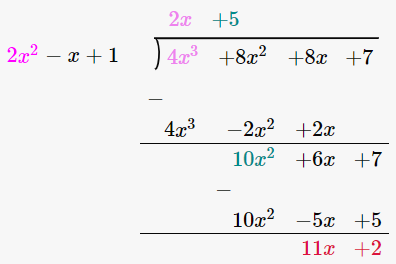
Thus,
q(x) = 2x + 5 and r(x) = 11x + 2
(iv) f(x) = 15x3 – 20x2 + 13x – 12, g(x) = x2 – 2x + 2
Solution:
Given,
f(x) = 15x3 – 20x2 + 13x – 12 and g(x) = x2 – 2x + 2

Thus,
q(x) = 15x + 10 and r(x) = 3x – 32
2. Check whether the first polynomial is a factor of the second polynomial by applying the division algorithm:
(i) g(t) = t2–3; f(t)=2t4 + 3t3 – 2t2 – 9t – 12
Solution:
Given,
g(t) = t2 – 3; f(t) =2t4 + 3t3 – 2t2 – 9t – 12
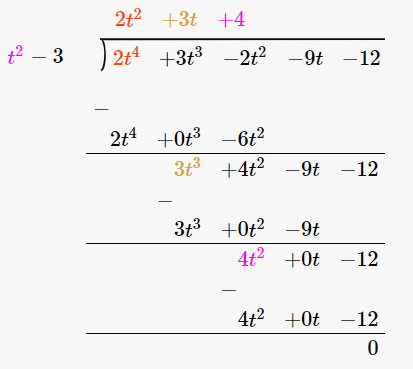
Since, the remainder r(t) = 0 we can say that the first polynomial is a factor of the second polynomial.
(ii) g(x) = x3 – 3x + 1; f(x) = x5 – 4x3 + x2 + 3x + 1
Solution:
Given,
g(x) = x3 – 3x + 1; f(x) = x5 – 4x3 + x2 + 3x + 1

Since, the remainder r(x) = 2 and not equal to zero we can say that the first polynomial is not a factor of the second polynomial.
(iii) g(x) = 2x2– x + 3; f(x) = 6x5 − x4 + 4x3 – 5x2 – x –15
Solution:
Given,
g(x) = 2x2– x + 3; f(x)=6x5 − x4 + 4x3 – 5x2 – x –15
Since, the remainder r(x) = 0 we can say that the first polynomial is not a factor of the second polynomial.
3. Obtain all zeroes of the polynomial f(x)= 2x4 + x3 – 14x2 – 19x–6, if two of its zeroes are -2 and -1.
Solution:
Given,
f(x)= 2x4 + x3 – 14x2 – 19x – 6
If the two zeros of the polynomial are -2 and -1, then its factors are (x + 2) and (x + 1)
⇒ (x+2)(x+1) = x2 + x + 2x + 2 = x2 + 3x +2 …… (i)
This means that (i) is a factor of f(x). So, performing division algorithm we get,

The quotient is 2x2 – 5x – 3.
⇒ f(x)= (2x2 – 5x – 3)( x2 + 3x +2)
For obtaining the other 2 zeros of the polynomial
We put,
2x2 – 5x – 3 = 0
⇒ (2x + 1)(x – 3) = 0
∴ x = -1/2 or 3
Hence, all the zeros of the polynomial are -2, -1, -1/2 and 3.
4. Obtain all zeroes of f(x) = x3 + 13x2 + 32x + 20, if one of its zeros is -2.
Solution:
Given,
f(x)= x3 + 13x2 + 32x + 20
And, -2 is one of the zeros. So, (x + 2) is a factor of f(x),
Performing division algorithm, we get

⇒ f(x)= (x2 + 11x + 10)( x + 2)
So, putting x2 + 11x + 10 = 0 we can get the other 2 zeros.
⇒ (x + 10)(x + 1) = 0
∴ x = -10 or -1
Hence, all the zeros of the polynomial are -10, -2 and -1.
5. Obtain all zeroes of the polynomial f(x) = x4 – 3x3 – x2 + 9x – 6, if the two of its zeroes are −√3 and √3.
Solution:
Given,
f(x) = x4 – 3x3 – x2 + 9x – 6
Since, two of the zeroes of polynomial are −√3 and √3 so, (x + √3) and (x–√3) are factors of f(x).
⇒ x2 – 3 is a factor of f(x). Hence, performing division algorithm, we get

⇒ f(x)= (x2 – 3x + 2)( x2 – 3)
So, putting x2 – 3x + 2 = 0 we can get the other 2 zeros.
⇒ (x – 2)(x – 1) = 0
∴ x = 2 or 1
Hence, all the zeros of the polynomial are −√3, 1, √3 and 2.
6. Obtain all zeroes of the polynomial f(x)= 2x4 – 2x3 – 7x2 + 3x + 6, if the two of its zeroes are −√(3/2) and √(3/2).
Solution:
Given,
f(x)= 2x4 – 2x3 – 7x2 + 3x + 6
Since, two of the zeroes of polynomial are −√(3/2) and √(3/2) so, (x + √(3/2)) and (x –√(3/2)) are factors of f(x).
⇒ x2 – (3/2) is a factor of f(x). Hence, performing division algorithm, we get
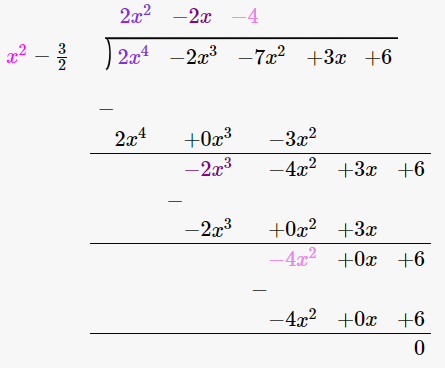
⇒ f(x)= (2x2 – 2x – 4)( x2 – 3/2)= 2(x2 – x – 2)( x2 – 3/2)
So, putting x2 – x – 2 = 0 we can get the other 2 zeros.
⇒ (x – 2)(x + 1) = 0
∴ x = 2 or -1
Hence, all the zeros of the polynomial are −√(3/2), -1, √(3/2) and 2.
7. Find all the zeroes of the polynomial x4 + x3 – 34x2 – 4x + 120, if the two of its zeros are 2 and -2.
Solution:
Let,
f(x) = x4 + x3 – 34x2 – 4x + 120
Since, two of the zeroes of polynomial are −2 and 2 so, (x + 2) and (x – 2) are factors of f(x).
⇒ x2 – 4 is a factor of f(x). Hence, performing division algorithm, we get

⇒ f(x)= (x2 + x – 30)( x2 – 4)
So, putting x2 + x – 30 = 0 we can get the other 2 zeros.
⇒ (x + 6)(x – 5) = 0
∴ x = -6 or 5
Hence, all the zeros of the polynomial are 5, -2, 2 and -6.
RD Sharma Solutions for Class 10 Maths Chapter 2: Download PDF
RD Sharma Solutions for Class 10 Maths Chapter 2–Polynomials
Download PDF: RD Sharma Solutions for Class 10 Maths Chapter 2–Polynomials PDF
Chapterwise RD Sharma Solutions for Class 10 Maths :
- Chapter 1–Real Numbers
- Chapter 2–Polynomials
- Chapter 3–Pair of Linear Equations In Two Variables
- Chapter 4–Triangles
- Chapter 5–Trigonometric Ratios
- Chapter 6–Trigonometric Identities
- Chapter 7–Statistics
- Chapter 8–Quadratic Equations
- Chapter 9–Arithmetic Progressions
- Chapter 10–Circles
- Chapter 11–Constructions
- Chapter 12–Some Applications of Trigonometry
- Chapter 13–Probability
- Chapter 14–Co-ordinate Geometry
- Chapter 15–Areas Related To Circles
- Chapter 16–Surface Areas And Volumes
About RD Sharma
RD Sharma isn't the kind of author you'd bump into at lit fests. But his bestselling books have helped many CBSE students lose their dread of maths. Sunday Times profiles the tutor turned internet star
He dreams of algorithms that would give most people nightmares. And, spends every waking hour thinking of ways to explain concepts like 'series solution of linear differential equations'. Meet Dr Ravi Dutt Sharma — mathematics teacher and author of 25 reference books — whose name evokes as much awe as the subject he teaches. And though students have used his thick tomes for the last 31 years to ace the dreaded maths exam, it's only recently that a spoof video turned the tutor into a YouTube star.
R D Sharma had a good laugh but said he shared little with his on-screen persona except for the love for maths. "I like to spend all my time thinking and writing about maths problems. I find it relaxing," he says. When he is not writing books explaining mathematical concepts for classes 6 to 12 and engineering students, Sharma is busy dispensing his duty as vice-principal and head of department of science and humanities at Delhi government's Guru Nanak Dev Institute of Technology.