
Class 7: Maths Chapter 15 solutions. Complete Class 7 Maths Chapter 15 Notes.
RS Aggarwal Solutions for Class 7 Maths Chapter 15–Properties of Triangles
RS Aggarwal 7th Maths Chapter 15, Class 7 Maths Chapter 15 solutions
Ex 15A
Question 1.
Solution:
In ∆ABC,
∠A = 72°, ∠B = 63°
But ∠A + ∠B + ∠C = 180° (Sum of angles of a triangle)
⇒ 72° + 63° + ∠C = 180°
⇒ 135° + ∠C = 180°
⇒ ∠C= 180°- 135° = 45°
Question 2.
Solution:
In. ∆PQR,
∠E = 105°, and ∠F = 40°
But ∠D + ∠E+ ∠F= 180° (sum of angles of a triangle)
⇒ ∠D + 105°+ 40°= 180°
⇒ ∠ D + 145° = 180°
⇒ ∠D = 180°- 145°
⇒ ∠D = 35°
Question 3.
Solution:
In ∆XYZ,
∠ X = 90°, ∠ Z = 48°
But ∠X + ∠Y + ∠Z = 180° (Sum of angles of a triangle)
⇒ 90° + ∠ Y + 48° = 180°
⇒ 138°+ ∠ Y = 180°
⇒ ∠Y = 180° – 138° = 42°
⇒ ∠Y = 42°
Question 4.
Solution:
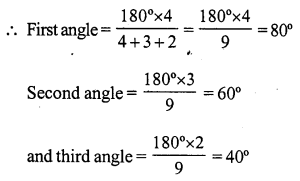
Sum of angles of a triangle = 180°
and ratio in the three angles = 4 : 3 : 2
Question 5.
Solution:
In a right triangle
Sum of the two acute angles = 90°
One angle = 30°
Second angle = 90° – 36° = 54°
Question 6.
Solution:
In a right triangle
Sum of two acute angles = 90°
and ratio of these two angles = 2 : 1
Let first angle = 2x
Then second angle = x
2x + x = 90°
⇒ 3x = 90°
⇒ x = 903 = 30°
First angle = 2x = 2 x 30° = 60°
and second angle = x = 1 x 30° = 30°
Question 7.
Solution:
In a triangle,
Measure of one angle = 100°
Sum of other two angles = 180° – 100° = 80°
(Sum of angles of a triangles)
But, these two angles are equal.
Measure of each angle = 802 = 40°
Question 8.
Solution:
Sum of angles of a triangle = 180°
Let third angle = x
then, each equal angles = 2x
x + 2x + 2x = 180°
⇒ 5x = 180°
⇒ x = 1805 = 36°
Each equal angle = 2x = 2 x 36° = 72°
and third angle = 36°
Question 9.
Solution:
In a triangle ABC,
Let ∠A = ∠B + ∠C
But ∠A + ∠B + ∠C = 180° (Sum of angles of a triangle)
⇒ ∠A + ∠A = 180° (∠B + ∠C = ∠A)
⇒ 2A = 180°
⇒ ∠ A = 1802 = 90°
∠ A = 90°
Hence, ∆ABC is a right triangle.
Question 10.
Solution:
In a ∆ABC,
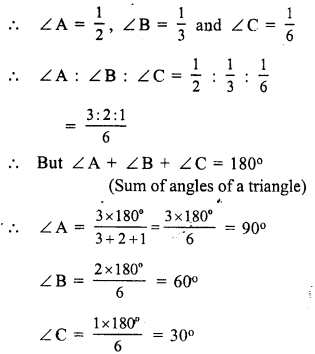
2 ∠A = 3 ∠B = 6 ∠C = 1 (suppose)
Question 11.
Solution:
In an equilateral triangle,
All sides are equal.
All angles are also equal.
Each angle = 1803 = 60°
(Sum of angles of a triangle = 180°)
Question 12.
Solution:
In the given figure,
ABC is a triangle in which DE || BC,
∠A = 65° and ∠B = 55°
DE || BC and ADB is the transversal
⇒ ∠ ADE = ∠ B (corresponding angles) = 55° (∠B = 55°)
In ∆ADE,
∠A + ∠ADE + ∠AED = 180° (sum of angles of a triangle)
⇒ 65° + 55° + ∠AED = 180°
⇒ ∠ 120° + ∠AED = 180°
⇒ ∠AED = 180°- 120° = 60°
∠AED = 60°
D || BC and AEC is the transversal
∠ C = ∠ AED (A corresponding angles)
∠C = 60°
Hence ∠ADE = 55°, ∠AED = 60° and ∠ C = 60°
Question 13.
Solution:
(i) No. In a triangle, only one right angle is possible as if there are two right angles, then The third angle will be ∠ero which is not possible.
(ii) No. In a triangle only one obtuse angle is possible as if there are two obtuse angles, then the sum of these two angles will be greater than 180° which is not possible.
(iii) Yes. two acute can arc possible.
(iv) No. The sum of these three angles will be greater than 180° which is not possible in a triangle.
(v) No. The sum of these angles will be less than 180° which is not possible.
(vi) Yes. The sum of there three angle will be in 180° which is possible.
Question 14.
Solution:
(i) Yes, it can be a right triangle also
(ii) Yes, if right triangle has its sides different then it is possible.
(iii) No, a right triangle cannot be an equilateral triangle as an equilateral triangle has each side 60°.
(iv) Yes, it is possible, if its sides opposite to acute angles are equal.
Question 15.
Solution:
(i) A right triangle cannot have an obtuse angle.
(ii) The acute angles of a right triangle are complementary.
(iii) Each acute angle of an isosceles right triangle measures 45°.
(iv) Each angle of an equilateral triangle measures 60°.
(v) The side opposite the right angle of the right triangle is called the hypotenuse.
(vi) The sum of the lengths of the sides of a triangle is called its perimeter.
Ex 15B Solutions
Question 1.
Solution:
In ∆ABC,
∠A = 75°, ∠B = 45°
side BC is produced to D
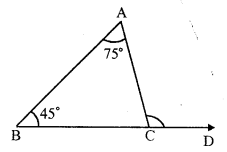
forming exterior ∠ ACD
Exterior ∠ACD = ∠A + ∠B (Exterior angle is equal to sum of its interior opposite angles)
= 75° + 45° = 120°
Question 2.
Solution:
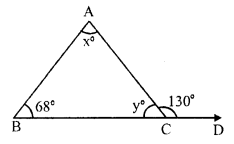
In ∆ABC, BC is produced to D forming an exterior angle ACD
∠ B = 68°, ∠ A = x°, ∠ ACB = y° and ∠ACD = 130°
In triangle,
Exterior angles is equal to sum of its interior opposite angles
∠ACD = ∠A + ∠B
⇒ 130° = x + 68°
⇒ x = 130° – 68° = 62°
But ∠ACB + ∠ACD = 180° (Linear pair)
⇒ y + 130° = 180°
⇒ y = 180° – 130° = 50°
Hence x = 62° and y = 50°
Question 3.
Solution:
In ∆ABC, side BC is produced to D forming exterior angle ACD.
∠ACD = 65°, ∠A = 32°
∠B = x, ∠ACB = y
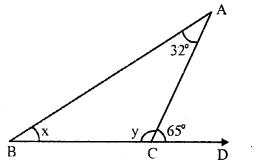
In a triangle, the exterior angles is equal to the sum of its interior opposite angles
∠ACD = ∠A + ∠B
⇒ 65° = 32° + x
⇒ x = 65° – 32° = 33°
But ∠ ACD + ∠ ACB = 180° (Linear pair)
⇒ 65° + y = 180°
⇒ y = 180°- 65° = 115°
x = 33° and y = 115°
Question 4.
Solution:
In ∆ABC, side BC is produced to D forming exterior ∠ ACD
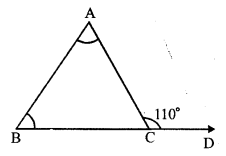
∠ACD = 110°, and ∠A : ∠B = 2 : 3
In a triangle, exterior angles is equal to the sum of its interior opposite angles
⇒ ∠ACD = ∠A + ∠B
⇒ ∠A + ∠B = 110°
But ∠A : ∠B = 2 : 3
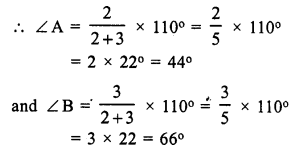
But ∠A + ∠B + ∠C = 180° (sum of angles of a triangle)
⇒ 44° + 66° + ∠C = 180°
⇒ 110° + ∠C = 180°
⇒ ∠C = 180° – 110° = 70°
Hence ∠ A = 44°, ∠ B = 66° and ∠ C = 70°
Question 5.
Solution:
In ∆ABC, side BC is produced to forming exterior angle ACD.
∠ACD = 100° and ∠A = ∠B
Exterior angle of a triangle is equal to the sum of its interior opposite angles.
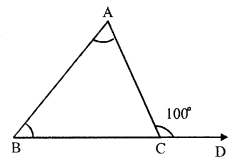
∠ACD = ∠A + ∠B But ∠A = ∠B
∠A + ∠A = ∠ACD = 100°
⇒ 2 ∠A = 100°
⇒ ∠A = 50°
∠B = ∠A = 50°
But ∠A + ∠B + ∠ ACB = 180° (sum of angles of a triangle)
⇒ 50° + 50° + ∠ ACB = 180°
⇒ 100° + ∠ ACB = 180°
⇒ ∠ ACB = 180° – 100° = 80°
Hence ∠ A = 50°, ∠ B = 50° and ∠ C = 80°
Question 6.
Solution:
In ∆ABC, side BC is produced to D From D, draw a line meeting AC at E so that ∠D = 40°
∠A = 25°, ∠B = 45°
In ∆ABC,
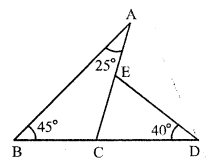
Exterior ∠ACD = ∠A + ∠B = 25° + 45° = 70°
Again, in ∆CDE,
Exterior ∠ AED = ∠ ECD + ∠ D = ∠ACD + ∠D = 70° + 40° = 110°
Hence ∠ACD = 70° and ∠AED = 110°
Question 7.
Solution:
In ∆ABC, sides BC is produced to D and BA to E
∠CAD = 50°, ∠B = 40° and ∠ACB = 100°
∠ ACB + ∠ ACD = 180° (Linear pair)
⇒ 100° + ∠ ACD = 180°
⇒ ∠ ACD = 180° – 100° = 80°
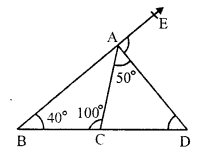
In ∆ACD,
∠ CAD + ∠ ACD + ∠ ADC = 180° (sum of angles of a triangle)
⇒ 50° + 80° + ∠ ADC = 180°
⇒ 130° + ∠ ADC = 180°
⇒ ∠ ADC = 180° – 130° = 50°
Now, in ∆ABD, BA is produced to E
Exterior ∠DAE = ∠ACD + ∠ADC = 80° + 50° = 130°
Hence ∠ ACD = 80°, ∠ ADC = 50° and ∠DAE = 130°
Question 8.
Solution:
In ∆ABC, BC is produced to D forming exterior ∠ ACD
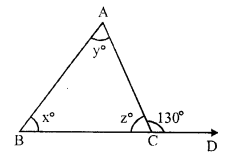
∠ACD = 130°, ∠A = y°, ∠B = x° and ∠ACB = z°.
x : y = 2 : 3
Now, in ∆ABC,
Exterior ∠ACD = ∠A + ∠B
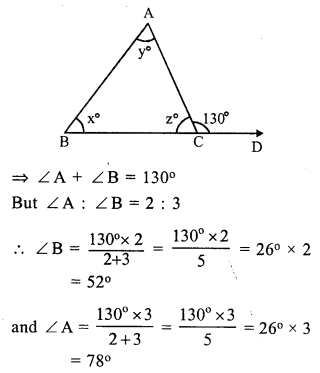
But ∠A + ∠B + ∠ACB = 180° (sum of angles of a triangle)
⇒ 78° + 52° + ∠ACB = 180°
⇒ 130° + ∠ACB = 180°
⇒ ∠ACB = 180° – 130°
⇒ ∠ACB = 50°
⇒ ∠ = 50°
Hence x = 52°, y = 78° and z = 50°
Ex 15C
Question 1.
Solution:
We know that in a triangle, sum of any two sides is greater than the third side. Therefore :
(i) 1cm, 1cm, 1cm
It is possible to draw a triangle
(1 + 1) cm > 1cm (sum of two sides is greater than the third)
(ii) 2cm, 3cm, 4cm
It is also possible to draw the triangle
(2 + 3) cm > 4cm (sum of two sides is greater than third side)
(iii) 7cm, 8cm, 15cm
It is not possible to draw the triangle
(7 + 8)cm not > 15cm
But (7 + 8) cm = 15 cm
(iv) 3.4 cm, 2.1 cm, 5.3 cm
It is possible to draw the triangle
(3.4 + 2.1) cm > 5.3 cm
⇒ 5.5cm > 5.3 cm
(v) 6cm, 7cm, 14cm
It is not possible to draw
(6 + 7) cm not > 14cm
i.e. 13cm not > 14cm (13cm < 14cm)
Question 2.
Solution:
Two sides of a triangle are 5 cm and 9 cm long
Then the third side will be less then (5 + 9) or less than 14 cm
Question 3.
Solution:
(i) In ∆APB,
PA + PB > AB (sum of two sides is greater than its third side)
(ii) In ∆PBC,
PB + PC > BC (sum of two sides is greater than its third side)
(iii) In ∆PAC,
AC < PA + PC (PA + PC > AC)
Question 4.
Solution:
Proof: AM is the median of ∆ABC
M is mid-point of BC
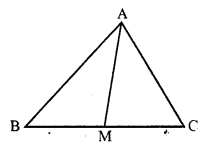
In ∆ABM,
AB + BM > AM ….(i)
(Sum of any two sides of a triangle is greater than its third side)
Similarly in ∆ACM,
AC + MC > AM ….(ii)
Adding (i) and (ii)
AB + BM + AC + MC > 2 AM
⇒ AB + AC + BM + MC > 2AM
⇒ AB + AC + BC > 2AM
Hence proved.
Question 5.
Solution:
Given: In ∆ABC, P is a point on BC.
AP is joined.
To prove :
(AB + BC + AC) > 2AP
Proof : In ∆ABP,
AB + BP > AP …(i) (Sum of two sides is greater than third)
Similarly in ∆ACP,
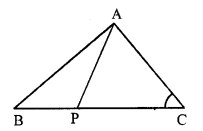
AC + PC > AP …(ii)
Adding (i) and (ii)
AB + BP + AC + PC > AP + AP
⇒ AB + BP + PC + CA > 2AP
⇒ AB + BC + CA > 2AP
Hence proved.
Question 6.
Solution:
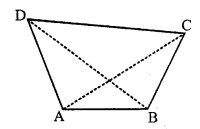
ABCD is a quadrilateral AC and BD are joined.
Proof: Now in ∆ABC
AB + BC > AC ….(i)
(Sum of any two sides of a triangle is greater than its third side)
Similarly in ∆ADC,
AD + CD > AC ….(ii)
In ∆ABD,
AB + AD > BD ….(iii)
and in ∆BCD,
BC + CD > BD ……..(iv)
Adding (i), (ii), (iii) and (iv)
AB + BC + CD + AD + AB + AD + BC + CD > AC + AC + BD + BD
⇒ 2 (AB + BC + CD + AD) > 2(AC + BD)
⇒ AB + BC + CD + AD > AC + BD
Hence proved.
Question 7.
Solution:
Given : O is any point outside of the ∆ABC
To prove : 2(OA + OB + OC) > (AB + BC + CA)
Construction : Join OA, OB and DC.
Proof: In ∆AOB,
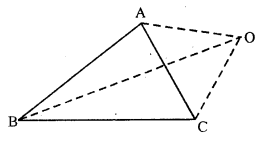
OA + OB > AB ….(i) (Sum of two sides of a triangle is greater than its third side)
Similarly in ∆BOC,
OB + OC > BC …(ii)
and in ∆COA
OC + OA > CA …(iii)
Adding (i), (ii) and (iii), we get:
OA + OB + OB + OC + OC + OA > AB + BC + CA
2 (OA + OB + OC) > (AB + BC + CA)
Hence proved.
Ex 15D
Question 1.
Solution:
In right triangle ABC, ∠B = 90° AB = 9cm, BC = 12cm
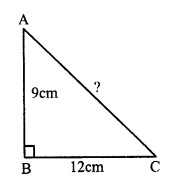
By Pythagoras Theorem,
AC² = AB² + BC² = (9)² + (12)² = 81 + 144 = 225
AC = √225 = 15 cm
Question 2.
Solution:
In right ∆ABC, ∠B = 90°
AC = 26cm, AB = 10cm
By Pythagoras Theorem
AC² = AB² + BC²
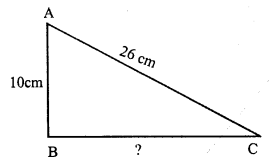
⇒ (26)² = (10)² + BC²
⇒ 676 = 100 + BC²
⇒ BC² = 676 – 100 = 576 = (24)²
⇒ BC = 24 cm
Question 3.
Solution:
In right ∆ABC, ∠C = 90°,
AB = 7.5cm, BC = 4.5cm
By Pythagoras Theorem
AB² = BC² + AC²
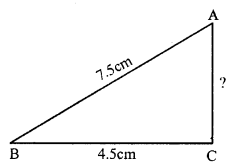
⇒ (7.5)² = (4.5)² + AC²
⇒ 56.25 = 20.25 + AC²
⇒ AC² = 56.25 – 20.25 = 36.00 = (6)²
⇒ AC = 6cm
Question 4.
Solution:
In ∆ABC, ∠B = 90°
Let each leg = x cm
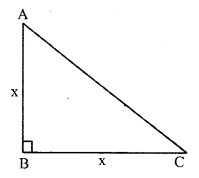
By Pythagoras Theorem,
x² + x² = AC²
⇒ 2x² = 50
⇒ x² = 25 = (5)²
⇒ x = 5
Length of each equal leg = 5cm
Question 5.
Solution:
A triangle is a right-angled,
If (Hypotenuse)² = sum of squares or other two sides
If (39)² = (15)² + (36)² (Hypotenuse is the longest side)
If 1521 = 225 + 1296
If 1521 = 1521 Which is true.
It is a right-angled triangle.
Question 6.
Solution:
In ∆ABC, ∠C = 90°
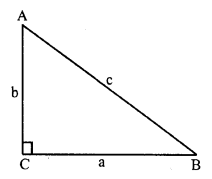
a = 6cm, b = 4.5cm.
By Pythagoras Theorem
c² = a² + b² = (6)² + (4.5)² = 36.00 + 20.25 = 56.25 = (7.5)²
c = 7.5 cm
Question 7.
Solution:
A triangle will be a right angled
if (longest side)² = Sum of squares of other two sides
(i) a = 15cm, b = 20cm, c = 25cm.
Here, longest side = c ,
The triangle will be right angled
if c² = a² + b²
if (25)² = (15)² + (20)²
if 625 = 225 + 400 = 625 Which is true.
It is a right angled triangle.
(ii) a = 9cm, b = 12cm, c = 16cm
∆ABC is a right angled triangle if
c² = a² + b²
if (16)² = (9)² + (12)²
if 256 = 81 + 144 = 225
⇒ 256 = 225
Which is not true
Triangle is not a right angled triangle.
(iii) a = 10cm, b = 24cm, c = 26cm
The triangle ABC is a right angled triangle
if c² = a² + b²
if (26)² = (10)² + (24)²
if 676 = 100 + 576
if 676 = 676 Which is true.
The triangle is a right angled triangle.
Question 8.
Solution:
In ∆ABC,
∠B = 35° and ∠C = 55°
∠A = 180°- (∠B + ∠C) = 180° – (35° + 55°) = 180° – 90° = 90°
∆ABC is a right angled triangle
By Pythagoras Theorem,
BC² = AB² + AC²
(iii) is hue
Question 9.
Solution:
AB is a ladder and it is 15 m long B is window and BC = 12 m
In right ∆ABC
AB² = AC² + BC² (By Pythagoras Theorem)
⇒ (15)² = x² + (12)²
⇒ (15)² = x² + (12)²
⇒ 225 = x² + 144
⇒ x² = 225 – 144
⇒ x² = 81 = (9)²
x = 9 m
Distance of the foot of ladder from the wall = 9 m
Question 10.
Solution:
Let AB be the ladder and AC be the height.
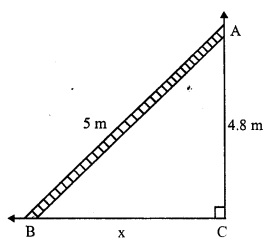
Length of ladder AB = 5m
and height CA = 4.8m
Let distance of the ladder from the wall BC = x
Now in right angled ∆ABC, ∠C = 90°
AB² = AC² + BC² (By Pythagoras Theorem)
⇒ (5)² = (4.8)² + x²
⇒ 25 = 23.04 + x²
⇒ x² = 25.00 – 23.04 = 1.96 = (1.4)²
⇒ x = 1.4
The foot of ladder are 1.4m away from the wall.
Question 11.
Solution:
Let AB be the tree which broke at D and its top A touches the ground at C
their BD = 5m, BC = 12m,
Let AD = x m, then CD = x m
Now, in right ∆ABC,
CD² = BD² + BC²
(By Pythagoras Theorem)
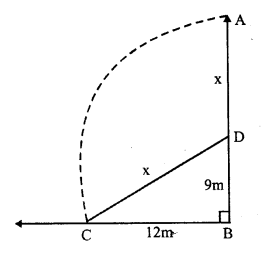
CD² = (9)² + (12)² = 81 + 144 = 225 = (15)²
CD = 15m,
AD = x = 15m
Height of the tree AB = AD + BD = 15 + 9 = 24m
Question 12.
Solution:
AB and CD are two poles and they are 12,m apart
AB = 18 m, CD = 13m and BD = 12 m
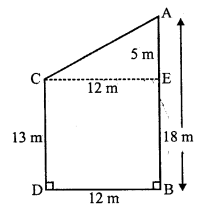
From C, draw CE || BD Then
CE = BD = 12 m
and AE = AB – EB = AB – CD = 18 – 13 = 5 m
Join AC
Now in right ∆ACE
AC² = CE² + AE²
(By Pythagoras Theorem)
AC² = (12)² + (5)² = 144 + 25 = 169 = (13)²
AC = 13 m
Distance between their tops = 13 m
Question 13.
Solution:
A man starts from O and goes 35m due west and then 12m due north, then
In rights ∆OAB,
OA = 35 m
AB = 12 m
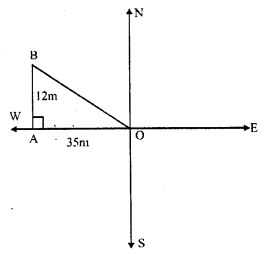
OB² = OA² + AB² (By Pythagoras Theorem)
= (35)² + (12)² = 1225 + 144 = 1369 = (37)²
OB = 37
Hence he is 37m away from the starting point
Question 14.
Solution:
A man goes 3km due north and then 4km east.
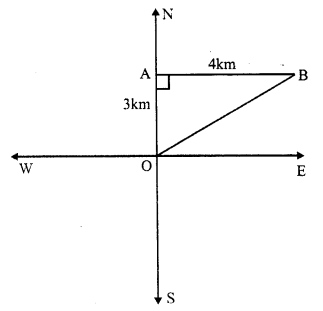
In right angled ∆OAB,
OA = 3km.
AB = 4km.
OB² = OA² + AB² (By Pythagoras Theorem)
= (3)² + (4)² = 9 + 16 = 25 = (5)²
OB = 5km
Hence he is 5km from the initial position.
Question 15.
Solution:
ABCD is a rectangle whose sides
AB = 16cm and BC = 12cm.
AC is its diagonal
In right angled ∆ABC
AC² = AB² + BC²
(By Pythagoras Theorem)
= (16)² + (12)² = 256 + 144 = 400 = (20)²
AC = 20cm
Hence length of diagonal AC = 20 cm
Question 16.
Solution:
ABCD is a rectangle and AC is its diagonal
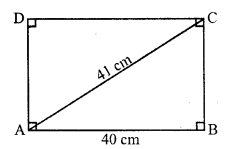
AB = 40 cm and AC = 41 cm
Now in right ∆ABC
AC² = AB² + BC² (By Pythagoras Theorem)
⇒ (41)² = (40)² + BC²
⇒ 1681 = 1600 + BC²
⇒ BC² = 1681 – 1600 = 81 = (9)²
⇒ BC = 9 cm
Now perimeter of rectangle ABCD = 2 (AB + BC)
= 2 (40 + 9) = 2 x 49 = 98 cm
Question 17.
Solution:
Perimeter of rhombus ABCD = 4 x Side
Diagonal AC = 30 cm and BD = 16 cm
The diagonals of rhombus bisect each other at right angles
AO = OC = 302 = 15 cm
and BO = OD = 162 = 8 m
Now in right ∆AOB,
AB² = AO² + BO² = (15)² + (8)² = 225 + 64 = 289 = (17)²
AB = 17 cm
Now perimeter = 4 x side = 4 x 17 = 68 cm
Question 18.
Solution:
(i) In a right triangle, the square of the hypotenuse is equal to the sum of the squares of the other two sides.
(ii) If the square of one side of a triangle is equal to the sum of the squares of the other two sides, then the triangle is a right angled.
(iii) Of all the line segments that can be drawn to a given line from a given point outside it, the perpendicular is the shortest.
RS Aggarwal Solutions for Class 7 Maths Chapter 15: Download PDF
RS Aggarwal Solutions for Class 7 Maths Chapter 15–Properties of Triangles
Download PDF: RS Aggarwal Solutions for Class 7 Maths Chapter 15–Properties of Triangles PDF
Chapterwise RS Aggarwal Solutions for Class 7 Maths :
- Chapter 1–Integers
- Chapter 2–Fractions
- Chapter 3–Decimals
- Chapter 4–Rational Numbers
- Chapter 5–Exponents
- Chapter 6–Algebraic Expressions
- Chapter 7–Linear Equations in One Variable
- Chapter 8–Ratio and Proportion
- Chapter 9–Unitary Method
- Chapter 10–Percentage
- Chapter 11–Profit and Loss
- Chapter 12–Simple Interest
- Chapter 13–Lines and Angles
- Chapter 14–Properties of Parallel Lines
- Chapter 15–Properties of Triangles
- Chapter 16–Congruence
- Chapter 17–Constructions
- Chapter 18–Reflection and Rotational Symmetry
- Chapter 19–Three-Dimensional Shapes
- Chapter 20–Mensuration
- Chapter 21–Collection and Organisation of Data (Mean, Median and Mode)
- Chapter 22–Bar Graphs
- Chapter 23–Probability
About RS Aggarwal Class 7 Book
Investing in an R.S. Aggarwal book will never be of waste since you can use the book to prepare for various competitive exams as well. RS Aggarwal is one of the most prominent books with an endless number of problems. R.S. Aggarwal's book very neatly explains every derivation, formula, and question in a very consolidated manner. It has tonnes of examples, practice questions, and solutions even for the NCERT questions.
He was born on January 2, 1946 in a village of Delhi. He graduated from Kirori Mal College, University of Delhi. After completing his M.Sc. in Mathematics in 1969, he joined N.A.S. College, Meerut, as a lecturer. In 1976, he was awarded a fellowship for 3 years and joined the University of Delhi for his Ph.D. Thereafter, he was promoted as a reader in N.A.S. College, Meerut. In 1999, he joined M.M.H. College, Ghaziabad, as a reader and took voluntary retirement in 2003. He has authored more than 75 titles ranging from Nursery to M. Sc. He has also written books for competitive examinations right from the clerical grade to the I.A.S. level.
FAQs
Why must I refer to the RS Aggarwal textbook?
RS Aggarwal is one of the most important reference books for high school grades and is recommended to every high school student. The book covers every single topic in detail. It goes in-depth and covers every single aspect of all the mathematics topics and covers both theory and problem-solving. The book is true of great help for every high school student. Solving a majority of the questions from the book can help a lot in understanding topics in detail and in a manner that is very simple to understand. Hence, as a high school student, you must definitely dwell your hands on RS Aggarwal!
Why should you refer to RS Aggarwal textbook solutions on Indcareer?
RS Aggarwal is a book that contains a few of the hardest questions of high school mathematics. Solving them and teaching students how to solve questions of such high difficulty is not the job of any neophyte. For solving such difficult questions and more importantly, teaching the problem-solving methodology to students, an expert teacher is mandatory!
Does IndCareer cover RS Aggarwal Textbook solutions for Class 6-12?
RS Aggarwal is available for grades 6 to 12 and hence our expert teachers have formulated detailed solutions for all the questions of each edition of the textbook. On our website, you'll be able to find solutions to the RS Aggarwal textbook right from Class 6 to Class 12. You can head to the website and download these solutions for free. All the solutions are available in PDF format and are free to download!