
Class 8: Maths Chapter 2 solutions. Complete Class 8 Maths Chapter 2 Notes.
Maharashtra Board Solutions Class 8-Maths (Practice Set 2.2): Chapter 2- Parallel Lines and Transversals
Maharashtra Board 8th Maths Chapter 2, Class 8 Maths Chapter 2 solutions
Question 1.
Choose the correct alternative.
i. In the given figure, if line m || line n and line p is a transversal, then find x.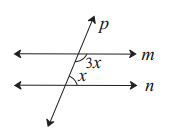
(A) 135°
(B) 90°
(C) 45°
(D) 40°
Solution:
(C) 45°
Hint: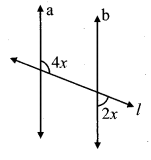
line m || line n and line p is a transversal.
∴ m∠BFG + m∠FGD = 180°
…[Interior angles]
∴ 3x + x = 180°
∴ 4x = 180°
∴ x = 1804
∴ x = 45°
ii. In the given figure, if line a || line b and line l is a transversal, then find x.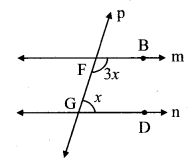
(A) 90°
(B) 60°
(C) 45°
(D) 30°
Solution:
(D) 30°
Hint: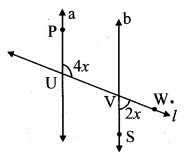
line a || line b and line l is a transversal.
∴ m∠UVS = m∠PUV
…[Alternate angles]
= 4x
m∠UVS + m∠WVS = 180°
… [Angles in a linear pair]
∴ 4x + 2x = 180°
∴ 6x = 180°
∴ x = 1806
∴ x = 30°
Question 2.
In the given figure, line p || line q. Line t and line s are transversals. Find measure of ∠x and ∠y using the measures of angles given in the figure.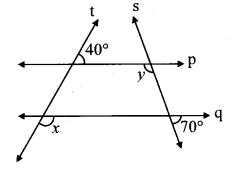
Solution: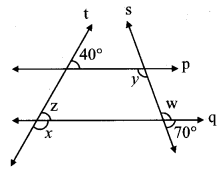
i. Consider ∠z as shown in figure.
line p || line q and line t is a transversal.
∴ m∠z = 40° …(i) [Corresponding angles]
m∠x + m∠z = 180° …[Angles in a linear pair]
∴ m∠x + 40o = 180° …[From(i)]
∴ m∠x= 180° – 40°
∴ m∠x = 140°
ii. Consider ∠w as shown in the figure.
m∠w + 70° = 180° …[Angles in a linear pair]
∴ m∠w = 180° – 70°
∴ m∠w = 110° …(ii)
line p || line q and line s is a transversal.
∴ m∠y = m∠w …[Alternate angles]
∴ m∠y =110° …[From (ii)]
∴ m∠x = 140°, m∠y = 110°
Question 3.
In the given figure, line p || line q, line l || line m. Find measures of ∠a, ∠b and ∠c, using the measures of given angles. Justify your answers.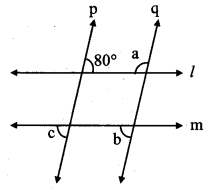
Solution:
i. line p || line q and line l is a transversal.
∴ m∠a + 80° = 180° …[Interior angles]
∴ m∠a= 180° – 80°
∴ m∠a= 100°
ii. line l || line m and line p is a transversal.
∴ m∠c = 80° …(i) [Exterior alternate angles]
iii. line p || line q and line m is a transversal.
∴ m∠b = m∠c … [Corresponding angles]
m∠b = 80° …[From (i)]
∴ m∠a = 100°, m∠b = 80°, m∠c = 80°
Question 4.
In the given figure, line a || line b, line l is a transversal. Find the measures of ∠x, ∠y, ∠z using the given information.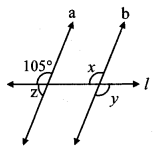
Solution:
line a || line b and line l is a transversal.
∴ m∠x = 105° …(i) [Corresponding angles]
ii. m∠y = m∠x … [Vertically opposite angles]
∴ m∠y = 105° …[From (i)]
iii. m∠z + 105° = 180° …[Angles in a linear pair]
∴ m∠z = 180°- 105°
∴ m∠z = 75°
∴ m∠x = 105°, m∠y = 105°, m∠z = 75°
Question 5.
In the given figure, line p || line l || line q. Find ∠x with the help of the measures given in the figure.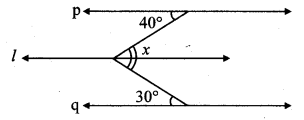
Solution: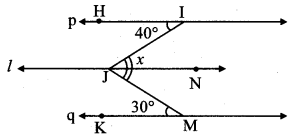
line p || line l and line IJ is a transversal.
m∠IJN = m∠JIH … [Alternate angles]
∴ m∠IJN = 40° …(i)
line l || line q and line MJ is a transversal.
m∠MJN = m∠JMK … [Alternate angles]
∴ m∠MJN = 30° …(ii)
Now, m∠x = m∠IJN + m∠MJN
…[Angle addition property]
= 40° + 30° …[From (i) and (ii)]
∴ m∠x = 70°
Intext Questions and Activities
Question 1.
When two parallel lines are intersected by a transversal eight angles are formed. If the measure of one of these eight angles is given, can we find measures of remaining seven angles? (Textbook pg, no. 9)
Solution:
Yes, we can find the measures of the remaining angles.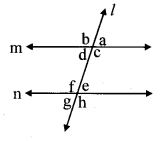
In the given figure, line m || line n and line l is a transversal.
m∠a = 60°(say) …(i)
i. m∠a + m∠b = 180° …[Angles in a linear pair]
∴ 60° + m∠b =180° … [From (i)]
∴ m∠b = 180° – 60°
∴ m∠b = 120° …(ii)
ii. m∠c = m∠b …[Vertically opposite angles]
∴ m∠c = 120° .. .(iii) [From (ii)]
iii. m∠d = m∠a …[Vertically opposite angles]
∴ m∠d = 60° …(iv) [From (i)]
iv. m∠e = m∠d …[Alternate angles]
∴ m∠e = 60° … [From (iv)]
v. m∠f = m∠c …[Alternate angles]
∴ m∠f = 120° …[From (iii)]
vi. m∠g = m∠d …[Corresponding angles]
∴ m∠g = 60° … [From (iv)]
vii. m∠h = m∠c … [Corresponding angles]
∴ m∠h = 120° …[From (iii)]
Question 2.
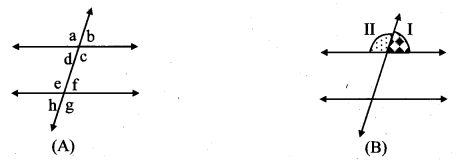
As shown in the figure (A), draw two parallel lines and their transversal on a paper. Draw a copy of the figure on another blank sheet using a trace paper, as shown in the figure (B). Colour part Land part II with different colours. Cut out the two parts with a pair of scissors. Place, part I and part II on each angle in the figure A and answer the following questions. (Textbook pg. no. 9)
- Which angles coincide with part I?
- Which angles coincide with part II?
Solution:
- ∠d, ∠f and ∠h coincide with part I.
- ∠c, ∠e and ∠g coincide with part II.
Download PDF
Maharashtra Board Solutions Class 8-Maths (Practice Set 2.2): Chapter 2- Parallel Lines and Transversals
Chapterwise Maharashtra Board Solutions Class 8 Maths :
- Chapter 1- Rational and Irrational Numbers (Practice Set 1.1)
- Chapter 1- Rational and Irrational Numbers (Practice Set 1.2)
- Chapter 1- Rational and Irrational Numbers (Practice Set 1.3)
- Chapter 1- Rational and Irrational Numbers (Practice Set 1.4)
- Chapter 2- Parallel Lines and Transversals (Practice Set 2.1)
- Chapter 2- Parallel Lines and Transversals (Practice Set 2.2)
- Chapter 2- Parallel Lines and Transversals (Practice Set 2.3)
- Chapter 3- Indices and Cube Root (Practice Set 3.1)
- Chapter 3- Indices and Cube Root (Practice Set 3.2)
- Chapter 3- Indices and Cube Root (Practice Set 3.3)
- Chapter 4- Altitudes and Medians of a Triangle (Practice Set 4.1)
- Chapter 5- Expansion Formulae (Practice Set 5.1)
- Chapter 5- Expansion Formulae (Practice Set 5.2)
- Chapter 5- Expansion Formulae (Practice Set 5.3)
- Chapter 5- Expansion Formulae (Practice Set 5.4)
- Chapter 6- Factorisation of Algebraic Expressions (Practice Set 6.1)
- Chapter 6- Factorisation of Algebraic Expressions (Practice Set 6.2)
- Chapter 6- Factorisation of Algebraic Expressions (Practice Set 6.3)
- Chapter 6- Factorisation of Algebraic Expressions (Practice Set 6.4)
- Chapter 7- Variation (Practice Set 7.1)
- Chapter 7- Variation (Practice Set 7.2)
- Chapter 7- Variation (Practice Set 7.3)
- Chapter 8- Quadrilateral: Constructions and Types (Practice Set 8.1)
- Chapter 8- Quadrilateral: Constructions and Types (Practice Set 8.2)
- Chapter 8- Quadrilateral: Constructions and Types (Practice Set 8.3)
- Chapter 9- Discount and Commission (Practice Set 9.1)
- Chapter 9- Discount and Commission (Practice Set 9.2)
- Chapter 10- Division of Polynomials (Practice Set 10.1)
- Chapter 10- Discount and Commission (Practice Set 10.2)
- Chapter 11- Statistics (Practice Set 11.1)
- Chapter 11- Statistics (Practice Set 11.2)
- Chapter 11- Statistics (Practice Set 11.3)
- Chapter 12- Equations in One Variable (Practice Set 12.1)
- Chapter 12- Equations in One Variable (Practice Set 12.2)
- Chapter 13- Congruence of Triangles (Practice Set 13.1)
- Chapter 13- Congruence of Triangles (Practice Set 13.2)
- Chapter 14- Compound Interest (Practice Set 14.1)
- Chapter 14- Compound Interest (Practice Set 14.2)
- Chapter 15- Area (Practice Set 15.1)
- Chapter 15- Area (Practice Set 15.2)
- Chapter 15- Area (Practice Set 15.3)
- Chapter 15- Area (Practice Set 15.4)
- Chapter 15- Area (Practice Set 15.5)
- Chapter 15- Area (Practice Set 15.6)
- Chapter 16- Surface Area and Volume (Practice Set 16.1)
- Chapter 16- Surface Area and Volume (Practice Set 16.2)
- Chapter 16- Surface Area and Volume (Practice Set 16.3)
- Chapter 17- Factorisation of Algebraic Expressions (Practice Set 17.1)
- Chapter 17- Factorisation of Algebraic Expressions (Practice Set 17.2)