
Class 8: Maths Chapter 8 solutions. Complete Class 8 Maths Chapter 8 Notes.
Maharashtra Board Solutions Class 8-Maths (Practice Set 8.3): Chapter 8- Quadrilateral: Constructions and Types
Maharashtra Board 8th Maths Chapter 8, Class 8 Maths Chapter 8 solutions
Question 1.
Measures of opposite angles of a parallelogram are (3x – 2)° and (50 – x)°. Find the measure of its each angle.
Solution:
Let ₹PQRS be the parallelogram.
m∠Q = (3x – 2)° and m∠S = (50 – x)°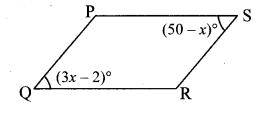
m∠Q = m∠S
…..(i)
[Opposite angles of a parallelogram are congruent]
∴ 3x – 2 = 50 – x
∴ 3x + x = 50 + 2
∴ 4x = 52
∴ x = 524
∴ x = 13
Now, m∠Q = (3x – 2)°
= (3 x 13 – 2)° = (39 – 2)° = 37°
∴ m∠S = m∠Q = 37° …[From(i)]
m∠P + m∠Q = 180°
….[Adjacent angles of a parallelogram are supplementary]
∴ m∠P + 37° = 180°
∴ m∠P = 180° – 37° = 143°
∴ m∠R = m∠P = 143°
…..[Opposite angles of a parallelogram are congruent]
∴ The measures of the angles of the parallelogram are 37°, 143°, 37° and 143°.
Question 2.
Referring the given figure of a parallelogram, write the answers of questions given below.
i. If l(WZ) = 4.5 cm, then l(XY) = ?
ii. If l(YZ) = 8.2 cm, then l(XW) = ?
iii. If l(OX) = 2.5 cm, then l(OZ) = ?
iv. If l(WO) = 3.3 cm, then l(WY) = ?
v. If m∠WZY = 120°, then m∠WXY = ? and m∠XWZ = ?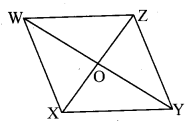
Solution:
i. l(WZ) = 4.5 cm … [Given]
l(X Y) = l(WZ) ….[Opposite sides of a parallelogram are congrument ]
∴ l(X Y) = 4.5cm
ii. l(YZ) = 8.2 cm …[Given]
l(XW) = l(YZ)
…[Opposite sides of a parallelogram are congruent]
∴ l(XW) = 8.2cm … [Given]
iii. l(OX) = 2.5 cm …[Given]
l(OZ) = l(OX)
….[Diagonals of a parallelogram bisect each other]
∴ l(OZ) = 2.5cm
iv. l(WO) = 3.3 cm … [Given]
l(WO) = 12 l(WY)
….[Diagonals of a parallelogram bisect each other]
∴ 3.3 = 12 l(WY)
∴ 3.3 x 2 = l(WY)
∴ l(WY) = 6.6cm
v. m∠WZY =120° … [Given]
m∠WXY = m∠WZY
…..[Opposite angles of a parallelogram are congrument]
∴ m∠WXY = 120° …(i)
m∠XWZ + m∠WXY = 180°
….[Adjacent angles of a parallelogram are supplementary]
∴ m∠XWZ + 120° = 180° … [From (i)]
∴ m∠XWZ = 180°- 120°
∴ m∠XWZ = 60°
Question 3.
Construct a parallelogram ABCD such that l(BC) = 7 cm, m∠ABC = 40°, l(AB) = 3 cm
Solution: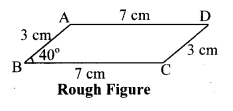
Opposite sides of a parallelogram are congruent.
∴ l(AB) = l(CD) = 3cm
l(BC) = l(AD) = 7 cm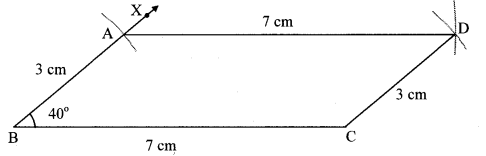
Question 4.
Ratio of consecutive angles of a quadrilateral is 1 : 2 : 3 : 4. Find the measure of its each angle. Write with reason, what type of a quadrilateral it is.
Solution:
Let ₹PQRS be the quadrilateral.
Ratio of consecutive angles of a quadrilateral is 1 : 2 : 3 : 4.
Let the common multiple be x.
∴m∠P = x°, m∠Q = 2x°, m∠R = 3x° and m∠S = 4x°
In ₹PQRS,
m∠P + m∠Q + m∠R + m∠S = 360°
…[Sum of the measures of the angles of a quadrilateral is 360°]
∴x° + 2x° + 3x° + 4x° = 360°
∴10 x° = 360°
∴x° = 36010
∴x° = 36°
∴m∠P = x° = 36°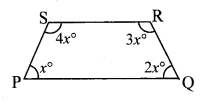
m∠Q = 2x° = 2 × 36° = 72°
m∠R = 3x° = 3 × 36° = 108° and
m∠S = 4x° = 4 × 36° = 144°
∴The measures of the angles of the quadrilateral are 36°, 72°, 108°, 144°.
Here, m∠P + m∠S = 36° + 144° = 180°
Since, interior angles are supplementary,
∴side PQ || side SR
m∠P + m∠Q = 36° + 72° = 108° ≠ 180°
∴side PS is not parallel to side QR.
Since, one pair of opposite sides of the given quadrilateral is parallel.
∴The given quadrilateral is a trapezium.
Question 5.
Construct ₹BARC such that
l(BA) = l(BC) = 4.2 cm, l(AC) = 6.0 cm, l(AR) = l(CR) = 5.6 cm
Solution: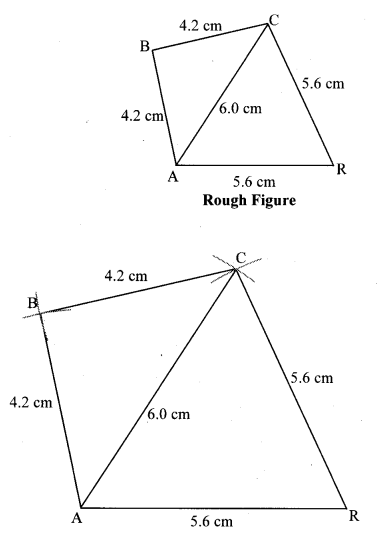
Question 6.
Construct ₹PQRS, such that l(PQ) = 3.5 cm, l(QR) = 5.6 cm, l(RS) = 3.5 cm, m∠Q = 110°, m∠R = 70°. If it is given that ₹PQRS is a parallelogram, which of the given information is unnecessary?
Solution: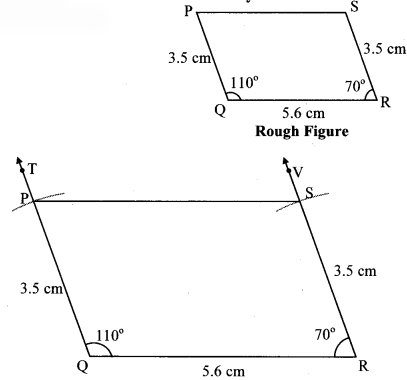
- Since, the opposite sides of a parallelogram are congruent.
∴ Either l(PQ) or l(SR) is required. - To construct a parallelogram lengths of adjacent sides and measure of one angle is required.
∴ Either l(PQ) and m∠Q or l(SR) and m∠R is the unnecessary information given in the question.
Intext Questions and Activities
Question 1.
Draw a parallelogram PQRS. Take two rulers of different widths, place one ruler horizontally and draw lines along its edges. Now place the other ruler in slant position over the lines drawn and draw lines along its edges. We get a parallelogram. Draw the diagonals of it and name the point of intersection as T.
- Measure the opposite angles of the parallelogram.
- Measure the lengths of opposite sides.
- Measure the lengths of diagonals.
- Measure the lengths of parts of the diagonals made by point T. (Textbook pg. no. 47)
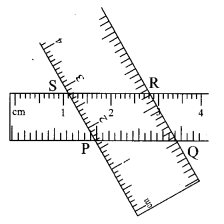
Solution:
[Students should attempt the above activities on their own.]
Question 2.
In the given figure of ₹ABCD, verify with a divider that seg AB ≅ seg CB and seg AD ≅ seg CD. Similarly measure ∠BAD and ∠BCD and verify that they are congruent. (Textbook pg. no. 48)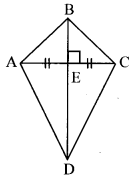
Solution:
[Students should attempt the above activities on their own.]
Download PDF
Maharashtra Board Solutions Class 8-Maths (Practice Set 8.3): Chapter 8- Quadrilateral: Constructions and Types
Chapterwise Maharashtra Board Solutions Class 8 Maths :
- Chapter 1- Rational and Irrational Numbers (Practice Set 1.1)
- Chapter 1- Rational and Irrational Numbers (Practice Set 1.2)
- Chapter 1- Rational and Irrational Numbers (Practice Set 1.3)
- Chapter 1- Rational and Irrational Numbers (Practice Set 1.4)
- Chapter 2- Parallel Lines and Transversals (Practice Set 2.1)
- Chapter 2- Parallel Lines and Transversals (Practice Set 2.2)
- Chapter 2- Parallel Lines and Transversals (Practice Set 2.3)
- Chapter 3- Indices and Cube Root (Practice Set 3.1)
- Chapter 3- Indices and Cube Root (Practice Set 3.2)
- Chapter 3- Indices and Cube Root (Practice Set 3.3)
- Chapter 4- Altitudes and Medians of a Triangle (Practice Set 4.1)
- Chapter 5- Expansion Formulae (Practice Set 5.1)
- Chapter 5- Expansion Formulae (Practice Set 5.2)
- Chapter 5- Expansion Formulae (Practice Set 5.3)
- Chapter 5- Expansion Formulae (Practice Set 5.4)
- Chapter 6- Factorisation of Algebraic Expressions (Practice Set 6.1)
- Chapter 6- Factorisation of Algebraic Expressions (Practice Set 6.2)
- Chapter 6- Factorisation of Algebraic Expressions (Practice Set 6.3)
- Chapter 6- Factorisation of Algebraic Expressions (Practice Set 6.4)
- Chapter 7- Variation (Practice Set 7.1)
- Chapter 7- Variation (Practice Set 7.2)
- Chapter 7- Variation (Practice Set 7.3)
- Chapter 8- Quadrilateral: Constructions and Types (Practice Set 8.1)
- Chapter 8- Quadrilateral: Constructions and Types (Practice Set 8.2)
- Chapter 8- Quadrilateral: Constructions and Types (Practice Set 8.3)
- Chapter 9- Discount and Commission (Practice Set 9.1)
- Chapter 9- Discount and Commission (Practice Set 9.2)
- Chapter 10- Division of Polynomials (Practice Set 10.1)
- Chapter 10- Discount and Commission (Practice Set 10.2)
- Chapter 11- Statistics (Practice Set 11.1)
- Chapter 11- Statistics (Practice Set 11.2)
- Chapter 11- Statistics (Practice Set 11.3)
- Chapter 12- Equations in One Variable (Practice Set 12.1)
- Chapter 12- Equations in One Variable (Practice Set 12.2)
- Chapter 13- Congruence of Triangles (Practice Set 13.1)
- Chapter 13- Congruence of Triangles (Practice Set 13.2)
- Chapter 14- Compound Interest (Practice Set 14.1)
- Chapter 14- Compound Interest (Practice Set 14.2)
- Chapter 15- Area (Practice Set 15.1)
- Chapter 15- Area (Practice Set 15.2)
- Chapter 15- Area (Practice Set 15.3)
- Chapter 15- Area (Practice Set 15.4)
- Chapter 15- Area (Practice Set 15.5)
- Chapter 15- Area (Practice Set 15.6)
- Chapter 16- Surface Area and Volume (Practice Set 16.1)
- Chapter 16- Surface Area and Volume (Practice Set 16.2)
- Chapter 16- Surface Area and Volume (Practice Set 16.3)
- Chapter 17- Factorisation of Algebraic Expressions (Practice Set 17.1)
- Chapter 17- Factorisation of Algebraic Expressions (Practice Set 17.2)