
Class 5: Maths Chapter 5 solutions. Complete Class 5 Maths Chapter 5 Notes.
Maharashtra Board Solutions Class 5-Maths (Problem Set 17) - Part 1: Chapter 5- Fractions
Maharashtra Board 5th Maths Chapter 5, Class 5 Maths Chapter 5 solutions
Important Questions and Answers.
Question 1.
Write the proper number in the box.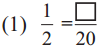
Answer:
Here 20 = 2 x 10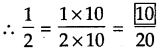
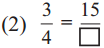
Answer:
Here 15 = 3 x 5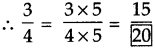
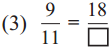
Answer:
Here 18 = 9 x 2
hehce, 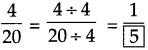
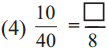
Answer:
Here 40 + 5 = 8,
hence, 
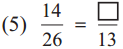
Answer:
Here 26 ÷ 2 = 13,
hence, 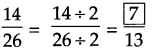

Answer:
Here 6 ÷ 2 = 3,
hence, 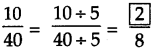
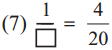
Answer:
Here 4 ÷ 4 = 1,
hence, 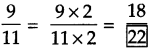
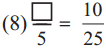
Answer:
Here 25 ÷ 5 = 5,
hence, 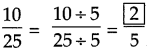
Question 2.
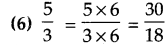
Find an equivalent fraction with denominator 18, for each of the following fractions.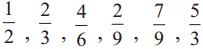
Solution: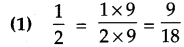
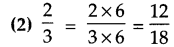
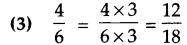
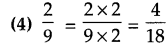
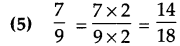
Question 3.
Find an equivalent fraction with denominator 5, for each of the following fractions.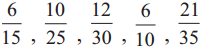
Solution: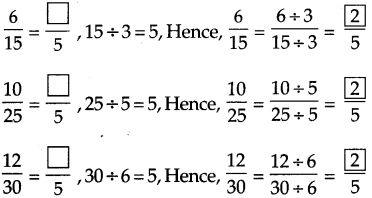
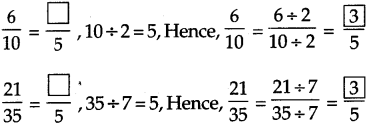
Question 4.
From the fractions given below, pair off the equivalent fractions.
Solution:
Question 5.
Find two equivalent fractions for each of the following fractions.
Solution: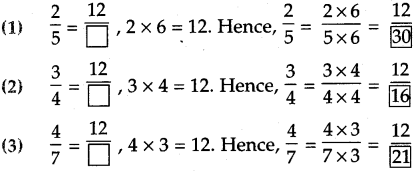

Like fractions and unlike fractions
Fractions such as 17,47,67 whose denominators are equal, are called ‘like fractions’.
Fractions such as 13,48,911 which have different denominators are called unlike fractions’.
Converting unlike fractions into like fractions
Example (1) Convert 5/6 and 7/9 into like fractions.
Here, we must find a common multiple for the numbers 6 and 9.
Multiples of 6 : 6, 12, 18, 24, 30, 36, ……..
Multiples of 9 : 9, 18, 27, 36, 45 ……..
Here, the number 18 is a multiple of both 6 and 9. So, let us make 18 the denominator of both fractions.
Thus, 15/18 and 1418 are like fractions, respectively equivalent to 5/6 and 7/9.
Here, 18 is a multiple of both 6 and 9. We could also choose numbers like 36 and 54 as the common denominators.
Example (2) Convert 4/8 and 5/16 into like fractions.
As 16 is twice 8, it is easy to make 16 the common denominator.
48=4×28×2=816 Thus, 8/16 and 5/16 are the required like fractions.
Example (3) Find a common denominator for 4/7 and 3/4.
The number 28 is a multiple of both 7 and 4. So, make 28 the common denominator.  . Therefore, 16/28 and 21/28 are the required like fractions.
Additional Important Questions and Answers
Question 1.
Find two equivalent fractions for each of the following fraction:
Solution: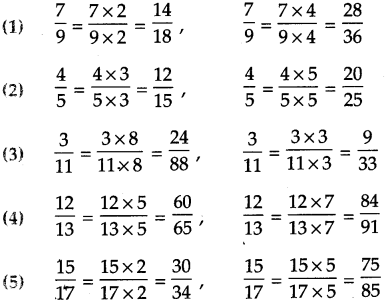
Download PDF
Maharashtra Board Solutions Class 5-Maths (Problem Set 17) - Part 1: Chapter 5- Fractions
Chapterwise Maharashtra Board Solutions Class 5 Maths :
Part 1
- Chapter 1- Roman Numerals (Problem Set 1)
- Chapter 2- Number Work (Problem Set 2)
- Chapter 2- Number Work (Problem Set 3)
- Chapter 2- Number Work (Problem Set 4)
- Chapter 2- Number Work (Problem Set 5)
- Chapter 2- Number Work (Problem Set 6)
- Chapter 3- Addition and Subtraction (Problem Set 7)
- Chapter 3- Addition and Subtraction (Problem Set 8)
- Chapter 3- Addition and Subtraction (Problem Set 9)
- Chapter 3- Addition and Subtraction (Problem Set 10)
- Chapter 3- Addition and Subtraction (Problem Set 11)
- Chapter 3- Addition and Subtraction (Problem Set 12)
- Chapter 3- Addition and Subtraction (Problem Set 13)
- Chapter 4- Multiplication and Division (Problem Set 14)
- Chapter 4- Multiplication and Division (Problem Set 15)
- Chapter 4- Multiplication and Division (Problem Set 16)
- Chapter 5- Fractions (Problem Set 17)
- Chapter 5- Fractions (Problem Set 18)
- Chapter 5- Fractions (Problem Set 19)
- Chapter 5- Fractions (Problem Set 20)
- Chapter 5- Fractions (Problem Set 21)
- Chapter 5- Fractions (Problem Set 22)
- Chapter 5- Fractions (Problem Set 23)
- Chapter 6- Angles (Problem Set 24)
- Chapter 6- Angles (Problem Set 25)
- Chapter 6- Angles (Problem Set 26)
- Chapter 6- Angles (Problem Set 27)
- Chapter 7- Circles (Problem Set 28)
- Chapter 7- Circles (Problem Set 29)
- Chapter 7- Circles (Problem Set 30)
- Chapter 7- Circles (Problem Set 31)
Part 2.
- Chapter 8- Multiples and Factors (Problem Set 32)
- Chapter 8- Multiples and Factors (Problem Set 33)
- Chapter 8- Multiples and Factors (Problem Set 34)
- Chapter 8- Multiples and Factors (Problem Set 35)
- Chapter 9- Decimal Fractions (Problem Set 36)
- Chapter 9- Decimal Fractions (Problem Set 37)
- Chapter 9- Decimal Fractions (Problem Set 38)
- Chapter 9- Decimal Fractions (Problem Set 39)
- Chapter 9- Decimal Fractions (Problem Set 40)
- Chapter 9- Decimal Fractions (Problem Set 41)
- Chapter 9- Decimal Fractions (Problem Set 42)
- Chapter 10- Measuring Time (Problem Set 43)
- Chapter 10- Measuring Time (Problem Set 44)
- Chapter 10- Measuring Time (Problem Set 45)
- Chapter 11- Problems on Measurement (Problem Set 46)
- Chapter 11- Problems on Measurement (Problem Set 47)
- Chapter 12- Perimeter and Area (Problem Set 48)
- Chapter 12- Perimeter and Area (Problem Set 49)
- Chapter 12- Perimeter and Area (Problem Set 50)
- Chapter 13- Three Dimensional Objects and Nets (Problem Set 51)
- Chapter 14- Pictographs (Problem Set 52)
- Chapter 15- Patterns (Problem Set 53)
- Chapter 16- Preparation for Algebra (Problem Set 54)
- Chapter 16- Preparation for Algebra (Problem Set 55)
- Chapter 16- Preparation for Algebra (Problem Set 56)