
Class 5: Maths Chapter 9 solutions. Complete Class 5 Maths Chapter 9 Notes.
Maharashtra Board Solutions Class 5-Maths (Problem Set 40) - Part 2: Chapter 9- Decimal Fractions
Maharashtra Board 5th Maths Chapter 9, Class 5 Maths Chapter 9 solutions
Important Questions and Answers.
Write the following fractions as decimal fractions.
(1) Two and a half
Answer:
2 12 = 2.5 = 2.50
(2) Two and a quarter
Answer:
2 14 = 2.25
(3) Two and three quarters
Answer:
2 34 = 2.75
(4) Ten and a half
Answer:
10 12 = 10.5 = 10.50
(5) Fourteen and three quarters
Answer:
14 34 = 14.75
(6) Sixteen and a quarter
Answer:
16 14 = 16.25
(7) Twenty-eight and a half
Answer:
28 12 = 28.50 = 28.5
Adding decimal fractions
Sir : If the cost of one pencil is two and a half rupees and the cost of a pen is four and half rupees, what is the total cost?
Sumit : Two and a half rupees means two rupees and one half rupee. Similarly, four and a half rupees means four rupees and one-half rupee. 4 rupees and 2 rupees make 6 rupees and two half rupees make one rupee, so both objects together cost 6 + 1 = 7 rupees.
Sir : Correct ! Now, see how this is done using decimals.
The sum of the 0’s in the hundredths place is 0.
0.5 + 0.5 is the same as
510+510=5+510=1010=11=1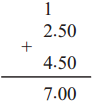
This 1 is carried over to the units place. There is nothing in the tenths place, so we put a zero there. In the units place, 2 + 4 = 6 plus the carried over 1 makes 7.
So 2.50 rupees and 4.50 rupees add up to 7 rupees.
We use the decimal system to write whole numbers. We extend the same method to write fractions; therefore, we can add in the same way as we add whole numbers.
I will now show some more additions. Watch carefully.

Sumit : There is no carried over number in the first sum, but there are carried over numbers in the second and third sums.
Rekha : While adding whole numbers, we add units first. Similarly, here, tenths are added first. In the second example, the sum of the tenths place is 13. 13 tenths are 10 tenths + 3 tenths = 1 unit + 3 tenths.
Sumit : That is why, in the sum, 3 stayed in the tenths place and 1 was carried over to the units place. 6 + 5 plus 1 carried over makes 12.
Sir : Your observations are absolutely correct. We write digits one below the other according to their place values while adding whole numbers. We do the same thing here. Remember that while writing down an addition problem and the total, the decimal points should always be written one below the other.
Study the following additions. (Note that: 10 tenths = 1 unit. 10 hundredths = 1 tenth)
Example (1) Add : 7.09 + 54.93
First, add the digits in the 100ths place. 9 + 3 = 12.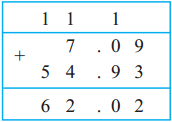
The 1 from the sum 12 in the hundredths place is carried over to the tenths place and 2 is written in the hundredths place. Adding 1 + 9 gives 10 tenths or 1 unit. This 1 is carried over to the units place. 0 is left in the tenths place. Then, the addition is completed in the usual way.
Example (2) Add : 45.83 + 167.4
4 5 . 8 3 We arrange the numbers so that the places and
+
1 6 7. 4 decimal points come one below the other.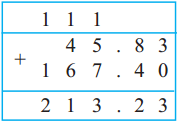
410=4×1010×10=40100 Therefore, to make the denominators of the fractions equal, 167.4 is written as 167.40 and then the fractions are added.
As usual, the digits with the smallest place values are added first and then those with bigger place values are added serially.
Example (3) 10.46 Rupees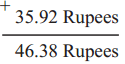
Example (4) 48.80 m
Example (5) 7.5 cm
Additional Important Questions and Answers
(1) Thirty and a quarter
Answer:
30 14 = 30.25
(2) Thirty and a half
Answer:
30 12 = 30.50 = 30.5
(3) Thirty and three quarters
Answer:
30 34 = 30.75
Download PDF
Maharashtra Board Solutions Class 5-Maths (Problem Set 40) - Part 2: Chapter 9- Decimal Fractions
Chapterwise Maharashtra Board Solutions Class 5 Maths :
Part 1
- Chapter 1- Roman Numerals (Problem Set 1)
- Chapter 2- Number Work (Problem Set 2)
- Chapter 2- Number Work (Problem Set 3)
- Chapter 2- Number Work (Problem Set 4)
- Chapter 2- Number Work (Problem Set 5)
- Chapter 2- Number Work (Problem Set 6)
- Chapter 3- Addition and Subtraction (Problem Set 7)
- Chapter 3- Addition and Subtraction (Problem Set 8)
- Chapter 3- Addition and Subtraction (Problem Set 9)
- Chapter 3- Addition and Subtraction (Problem Set 10)
- Chapter 3- Addition and Subtraction (Problem Set 11)
- Chapter 3- Addition and Subtraction (Problem Set 12)
- Chapter 3- Addition and Subtraction (Problem Set 13)
- Chapter 4- Multiplication and Division (Problem Set 14)
- Chapter 4- Multiplication and Division (Problem Set 15)
- Chapter 4- Multiplication and Division (Problem Set 16)
- Chapter 5- Fractions (Problem Set 17)
- Chapter 5- Fractions (Problem Set 18)
- Chapter 5- Fractions (Problem Set 19)
- Chapter 5- Fractions (Problem Set 20)
- Chapter 5- Fractions (Problem Set 21)
- Chapter 5- Fractions (Problem Set 22)
- Chapter 5- Fractions (Problem Set 23)
- Chapter 6- Angles (Problem Set 24)
- Chapter 6- Angles (Problem Set 25)
- Chapter 6- Angles (Problem Set 26)
- Chapter 6- Angles (Problem Set 27)
- Chapter 7- Circles (Problem Set 28)
- Chapter 7- Circles (Problem Set 29)
- Chapter 7- Circles (Problem Set 30)
- Chapter 7- Circles (Problem Set 31)
Part 2.
- Chapter 8- Multiples and Factors (Problem Set 32)
- Chapter 8- Multiples and Factors (Problem Set 33)
- Chapter 8- Multiples and Factors (Problem Set 34)
- Chapter 8- Multiples and Factors (Problem Set 35)
- Chapter 9- Decimal Fractions (Problem Set 36)
- Chapter 9- Decimal Fractions (Problem Set 37)
- Chapter 9- Decimal Fractions (Problem Set 38)
- Chapter 9- Decimal Fractions (Problem Set 39)
- Chapter 9- Decimal Fractions (Problem Set 40)
- Chapter 9- Decimal Fractions (Problem Set 41)
- Chapter 9- Decimal Fractions (Problem Set 42)
- Chapter 10- Measuring Time (Problem Set 43)
- Chapter 10- Measuring Time (Problem Set 44)
- Chapter 10- Measuring Time (Problem Set 45)
- Chapter 11- Problems on Measurement (Problem Set 46)
- Chapter 11- Problems on Measurement (Problem Set 47)
- Chapter 12- Perimeter and Area (Problem Set 48)
- Chapter 12- Perimeter and Area (Problem Set 49)
- Chapter 12- Perimeter and Area (Problem Set 50)
- Chapter 13- Three Dimensional Objects and Nets (Problem Set 51)
- Chapter 14- Pictographs (Problem Set 52)
- Chapter 15- Patterns (Problem Set 53)
- Chapter 16- Preparation for Algebra (Problem Set 54)
- Chapter 16- Preparation for Algebra (Problem Set 55)
- Chapter 16- Preparation for Algebra (Problem Set 56)